
Machine Learning in SEO: Why the Google Algorithm is Evolving in 2026 and Beyond
Table of Contents
- Introduction: The AI Revolution in SEO
- How Machine Learning Influences Google Algorithms
- Why Machine Learning Matters
- Key Google Algorithm Changes Driven by Machine Learning
- The Impact of Machine Learning on SEO
- Adapting Your SEO Strategy for Google’s AI-Driven Future
- The Future of AI and SEO: What’s Next?
- Conclusion: Adapt, Innovate, Lead
Introduction: The AI Revolution in SEO
Search engine optimisation (SEO) is evolving rapidly, driven by advancements in artificial intelligence (AI) and machine learning. AI is transforming how SEO operates on a global scale. Google algorithms have moved beyond traditional methods like keywords and backlinks. Today, their focus is on understanding user behaviour and intent at a deeper level.
With machine learning, Google analyses vast amounts of data. It can adapt to changing search trends and deliver relevant results instantly. AI-based solutions predict user needs even before they finish typing their queries, reshaping how content is discovered and prioritised.
To remain competitive, SEO professionals must shift from outdated strategies. They should embrace data-driven, intent-focused approaches. As Google algorithms continue to evolve, understanding advanced AI tools will be crucial for maintaining effective digital marketing strategies.
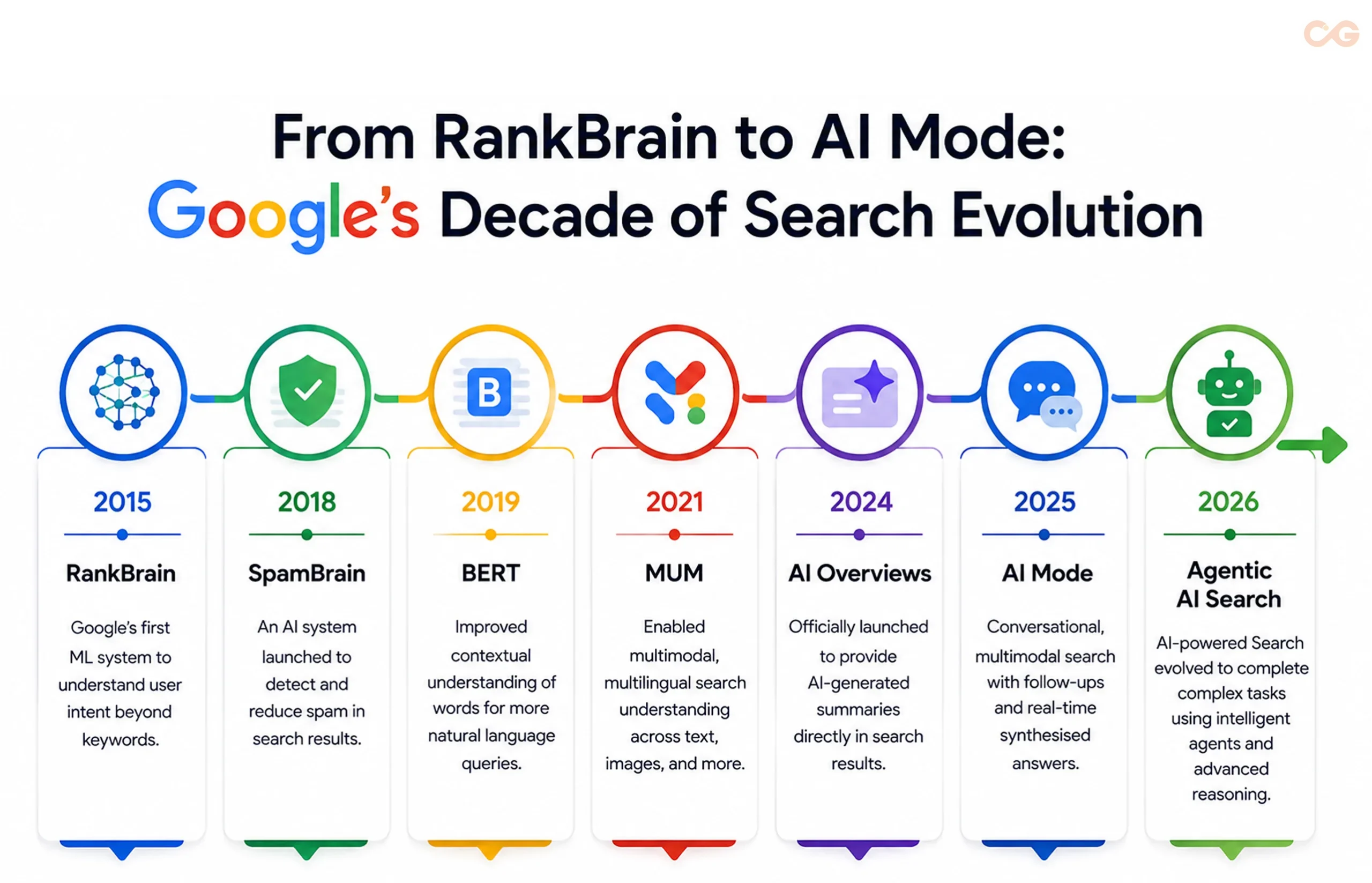
From the introduction of RankBrain in 2015 to the AI-first search landscape we see today in 2026, Google algorithms have evolved significantly. It no longer merely matches keywords; it now incorporates sophisticated machine learning techniques. This means it can understand context, intent, and various input types, providing conversational, AI-generated responses that optimise searches in real time.
By 2026, Google AI Overviews will have become a staple in the search experience. According to research from theStacc, these AI Overviews show up in about 48% of all Google searches, marking a remarkable 58% jump in visibility year-over-year.
How Machine Learning Influences Google Algorithms
What is Machine Learning in SEO?
Machine learning refers to how computers can identify patterns and improve their decision-making without needing explicit programming. In the realm of SEO, it helps Google’s algorithms sift through vast amounts of data — including user experience and search queries — to deliver more relevant and higher-quality results.
Moving from Rule-Based to Learning-Based Search
In the past, Google relied solely on rigid, rule-based algorithms. Ranking factors were set in stone, and any adjustments required manual intervention. Today, however, AI and machine-learning driven systems are far more interactive and adaptive:
- They identify and comprehend new ranking signals based on real-time user behaviour.
- Content rankings are tested and adjusted continuously, depending on engagement metrics.
- They can instantly adapt to shifts in language, trending topics, and evolving search intents.
This shift has dramatically transformed the search landscape from a rigid system to one that continuously optimises itself.
Why Machine Learning Matters
Machine learning allows for genuine personalisation at scale, enabling Google to juggle millions of variables simultaneously. These variables can include device type, location, search history, browsing patterns, and even inferred emotional tone, resulting in highly tailored Search Engine Results Pages (SERPs).
The impact of personalisation is substantial: research indicates that an average of 11.7% of Google’s search results differ from person to person due to factors like user login status and IP address, as noted by Wikipedia. Moreover, a survey by SEOClarity found that 86% of respondents actively incorporate AI into their strategies, with most reporting significant improvements in SEO performance and engagement.
This major shift isn’t just changing the game in SEO — it’s revolutionising how we measure success, moving away from traditional keyword and link-based methods.
Takeaway

Master Google’s 2026 Quality Guidelines
Are you prepared to earn Google’s trust in 2026? Let us make your content unstoppable.
RankBrain: Google’s First Foray into Machine Learning
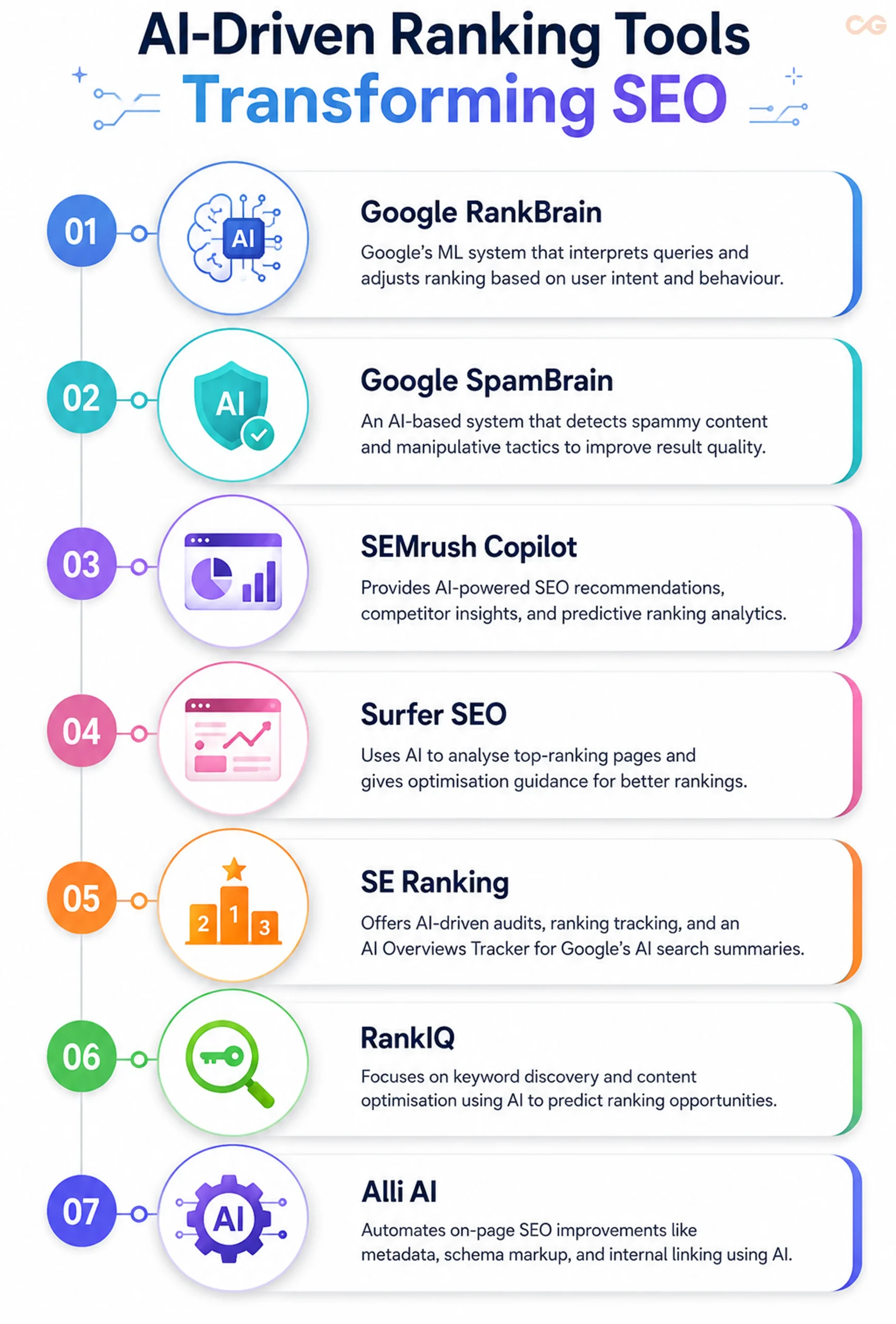
Introduced in 2015, RankBrain was Google’s first AI model for ranking. As highlighted in the Semrush Blog, it uses predictive analytics to interpret unfamiliar or ambiguous queries. This meant a significant change in how Google assesses relevance, prioritising user intent over exact keyword matches.
Key characteristics of Google RankBrain
- RankBrain is a machine learning model designed to grasp the intent behind search queries rather than simply matching keywords.
- It effectively manages unfamiliar searches by predicting user needs.
- It updates search rankings based on user engagement metrics like click-through rates and time spent on pages.
- This enhances Google’s understanding of various concepts and related terms, allowing it to deliver search results that are more relevant and contextually appropriate.
SpamBrain: Safeguarding Search Results from Low Quality
SpamBrain is Google’s advanced spam detection system, now more vigilant than ever. It identifies unnatural link-building, keyword stuffing, and subpar content. With a focus on combating AI-generated content spam, quality remains crucial. Here are SpamBrain’s (AI-based spam detection system) main capabilities:
Key Features of SpamBrain
- Self-Learning Platform: SpamBrain adapts over time, learning to recognise both existing and new spam tactics, including paid links, cloaking, and low-quality content.
- Real-Time Detection: It catches spam during the crawling process, preventing it from entering the indexing phase.
- Effective Link Spam Detection: As per Google’s report, in 2022, SpamBrain detected 50 times more link spam sites than in previous updates, significantly enhancing its ability to identify hacked and manipulative links.
- Increased Spam Coverage: The amount of identified spam sites surged fivefold in 2022 compared to 2021, and 200 times since its inception in 2018, resulting in over 99% of search visits being from legitimate sites, according to SEOZOOM.
BERT: Enhancing Natural Language Processing
BERT, or Bidirectional Encoder Representations from Transformers, was launched in 2019 and significantly improved Google’s Natural Language Processing capabilities, according to IBM. It helps Google interpret subtle language details like prepositions and context. By 2025, BERT will play a crucial role in understanding longer queries and voice searches.
Takeaway
Master Google’s 2026 Quality Guidelines
Are you prepared to earn Google’s trust in 2026? Let us make your content unstoppable.
Key Characteristics of BERT
- Bidirectional Context Understanding: BERT analyses sentences from both directions, ensuring it grasps the full context.
- Enhanced Natural Language Processing: It improves Google’s ability to understand conversational language, such as word order and prepositions.
- Better Long-Tail Query Processing: BERT efficiently handles intricate and specific search queries in natural language.
- Contextual Word Interpretations: It understands words based on their surrounding context, reducing ambiguity.
MUM: Understanding Multimodal Queries
The Multitask Unified Model, or MUM, is reportedly 1,000 times more powerful than BERT, allowing it to comprehensively understand images, text, and multiple languages simultaneously, as per Search Engine Journal. By 2025, MUM will enable Google to synthesise information in various forms, answering questions even if the content is split across different languages and media.
Key Features of MUM
- Multimodal Capability: Unlike previous models that focused solely on text, MUM can integrate text, images, video, and audio in one search, providing more relevant and intuitive results.
- Global and Contextual Intelligence: Trained in over 75 languages, MUM understands complex queries and can retrieve relevant information globally, regardless of language or format, as per Google.
- Indian Use Case: In June 2021, Google India utilised MUM to identify over 800 different names for vaccines in more than 50 languages, enhancing search results related to COVID-19 vaccination information, as reported by Google.
Why This is Powerful:
- Multilingual Expertise: Combines local and national sources, effectively navigating India’s diverse languages.
- Integration of Context: It analyses text, addresses multilingual issues, and creates coherent, reliable outcomes from dispersed information, setting a standard for next-generation intelligent information systems.
AI Overviews
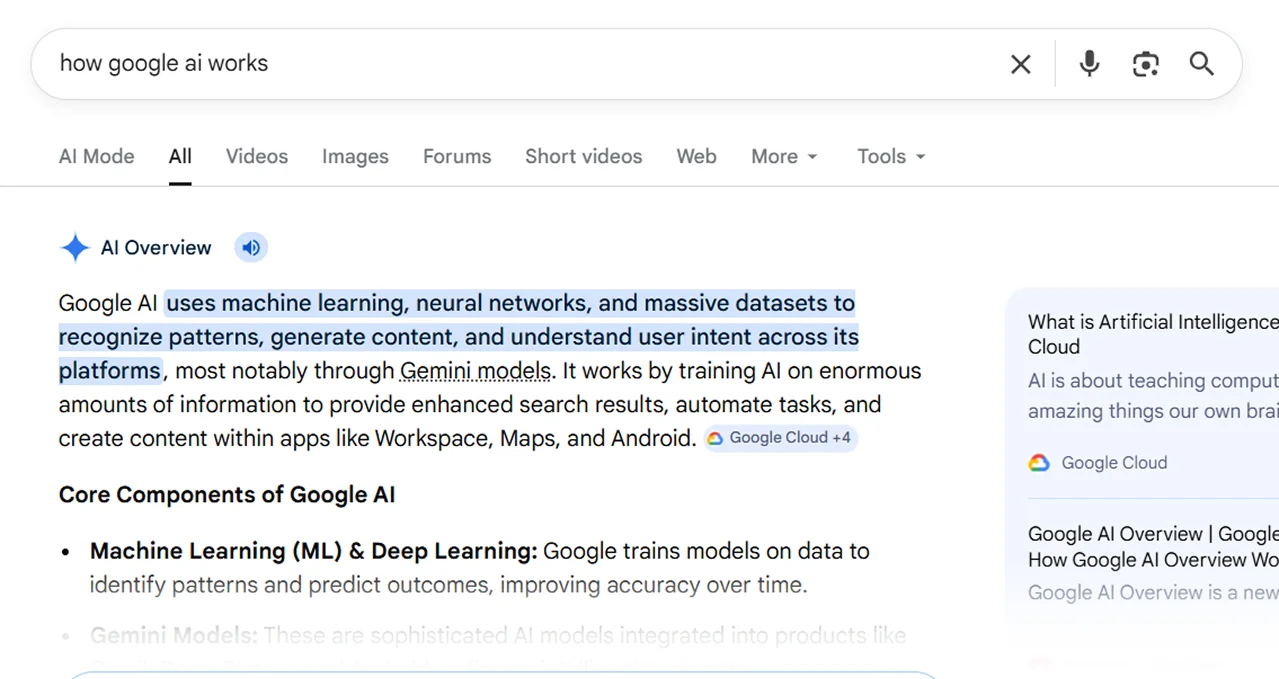
Launched in 2024, AI Overviews provide concise summaries from multiple sources at the beginning of search results, addressing complex questions effectively.
Key Features:
Concise Summaries: Delivers brief, contextual information on topics.
Authority-Based Data Gathering: Sources information exclusively from credible and diverse references.
Multimodal Input Support: Accommodates both images and text.
Minimised Link Clicking: Reduces the need for users to visit multiple links.
Focus on Relevance: Prioritises structured data to enhance visibility.
AI Mode
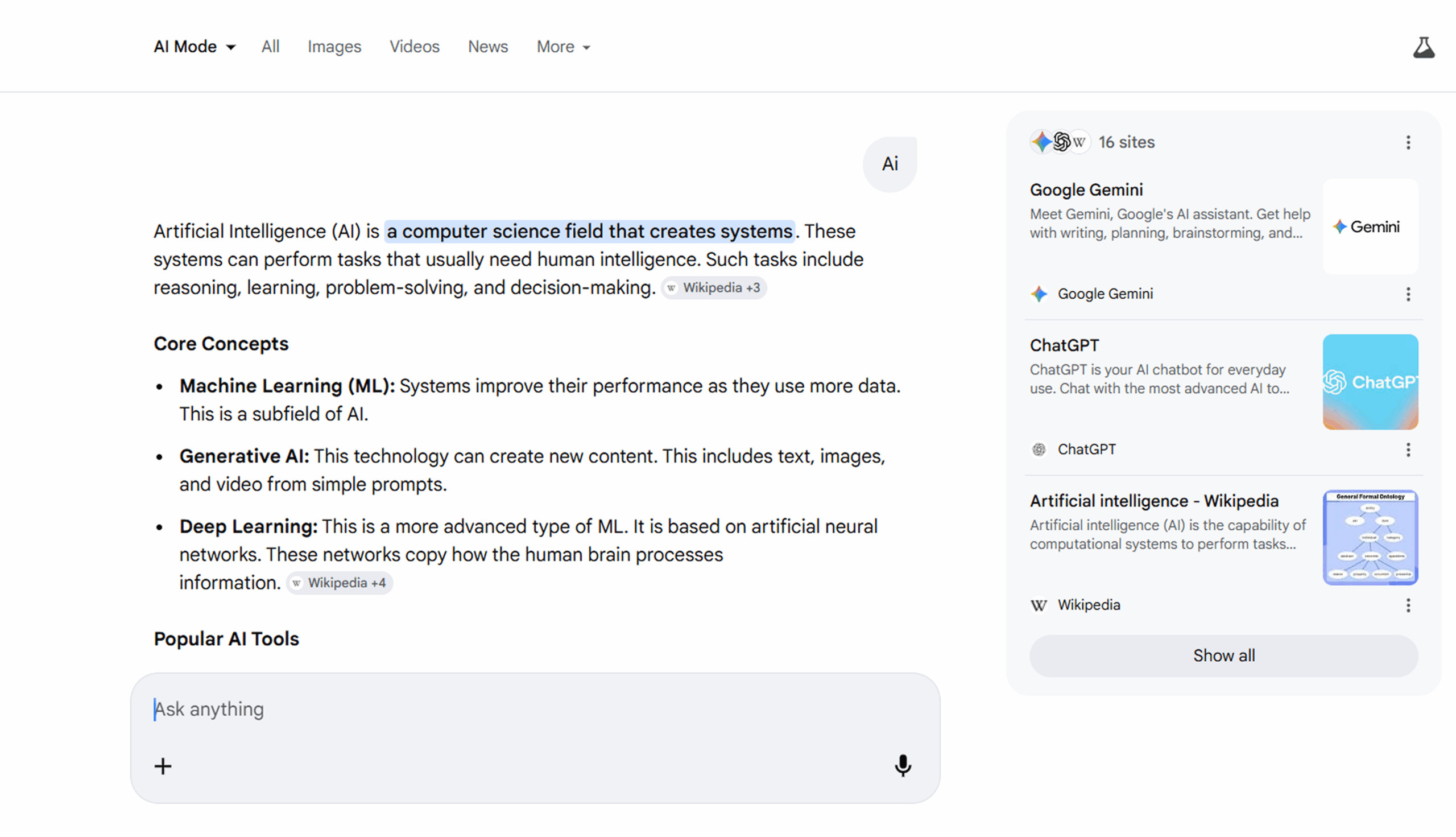
Launched in 2025, AI Mode is an interactive assistant within Google Search powered by Gemini 2.5, offering real-time, AI-generated responses.
Key Features:
Follow-Up Prompts: Engages users with subsequent questions based on their searches.
Real-Time Responses: Provides synthesised, contextual information immediately.
Multimodal Communication: Supports interactions through text, speech, and images.
Enhanced AI Integration: Facilitates task completion through AI agents.
Personalised Engagement: Offers tailored responses, reducing reliance on links.
Agentic AI Search
Google’s search function has evolved to not only provide answers but also assist users in completing tasks. With Agentic AI Search, AI can reason, plan, and undertake complex actions, enhancing user interactivity and personalisation.

Key Features:
Complex Task Completion: Assists users in achieving multi-step tasks with AI capabilities.
Advanced Reasoning: Utilises sophisticated logic for accurate responses.
Multimodal Input Compatibility: Supports diverse input types, including text, voice, and images.
Personalised Experiences: Offers context-aware search results tailored to individual user needs.
Integrated Research and Action: Enables users to conduct research, make comparisons, and take actions directly within the search interface.
The Impact of Machine Learning on SEO
Machine learning has fundamentally changed how search engines evaluate and rank content. Instead of relying solely on keywords, Google’s AI-driven algorithms now assess relevance, user intent, content quality, and overall user experience to deliver more accurate and personalised search results.
Content Optimization
AI-driven algorithms now prioritise content that is high-quality, relevant, and user-focused rather than content written primarily for search engines. Well-structured, comprehensive content is more likely to appear in featured snippets and achieve stronger visibility in organic search results by effectively addressing user intent and demonstrating topical authority.
Understanding Search Intent
Modern SEO revolves around identifying and addressing user needs. AI analyses search intent—whether informational, transactional, navigational, or commercial to deliver the most relevant results. Creating content that aligns with each stage of the user’s journey helps improve visibility, engagement, and overall search performance.
User Experience and Personalisation
User experience plays an increasingly important role in modern SEO. Factors such as mobile-friendliness, page loading speed, intuitive navigation, and Core Web Vitals contribute to better search performance. AI-driven systems also personalise search results based on user context, making relevant and user-centric content more valuable than ever.
Spam Detection and Link Assessment
Google’s AI-powered systems increasingly evaluate backlinks based on their quality, relevance, and context rather than quantity alone. SpamBrain helps identify and reduce link spam and other manipulative practices, making high-quality backlinks and genuine digital authority essential for long-term SEO success.
Adapting Your SEO Strategy for Google’s AI-Driven Future
With machine learning transforming Google’s search algorithms, sticking to old SEO methods won’t cut it. To thrive in 2026 and beyond, focus on content that matches how AI interprets user intent, assesses quality, and produces relevant search results.
1. Emphasise Expertise Over Keywords
Machine learning understands context and relevance much better than simple keyword matching. Instead of cramming keywords, create high-quality, well-researched content that showcases your expertise and authority. Use structured data, like Schema markup, to help search engines understand your content better. This approach increases your chances of achieving rich results.
2. Focus on Search Intent and Relevant Content
Today’s search algorithms prioritise understanding user intent, not just keywords. To create effective content, answer users’ questions thoroughly, address related topics, and write in a natural style. Use AI-driven SEO tools like Clearscope, Surfer SEO, and MarketMuse to pinpoint content gaps and enhance your topic coverage. This approach will help you better meet user needs.
3. Improve User Experience for Better AI Rankings
Google takes user behaviour and page experience seriously to gauge a page’s value. Ensure your website loads quickly, is mobile-friendly, offers easy navigation, and meets Core Web Vitals standards. These factors enhance user experience and can boost your search rankings. Regularly inspect your site using tools like Google Lighthouse to find areas for enhancement.
4. Leverage AI to Boost, Not Replace, Content Creation
AI can make keyword research, content planning, topic organisation, and metadata generation much faster. This efficiency empowers SEO teams to focus on what matters. However, Google prioritises content that offers original insights and value over generic, mass-produced outputs. By integrating AI tools like ChatGPT, Jasper, and Frase with expert human knowledge and editorial guidance, you can produce content that is accurate, engaging, and reputable.
5. Enhance Your Brand’s Authority and Entity Recognition
Google now sees brands as distinct entities rather than mere collections of keywords. Strengthen your online presence by maintaining consistent business information, earning authoritative backlinks, utilising structured data, and gaining mentions on reputable websites. Optimising your Brand SERP, Knowledge Panel, and other key listings helps search engines better recognise your brand, building credibility and trust.
SEO has shifted from a focus on keywords to an emphasis on relevance, expertise, and user experience. Companies that prioritise high-quality content, solid technical foundations, and responsible AI use will be well-positioned for success as Google’s algorithms continue to change.
The Future of AI and SEO: What’s Next?
Voice and Visual Search optimization
By 2026, around 20.5% of internet users are projected to utilise voice search, as mentioned in DemandSage. Brands must optimise for conversational long-tail queries and enhance visual metadata, including structured and alt tags, to capitalise on voice-first and visual search applications.
The Rise of Multimodal Search
Google’s Multitask Unified Model (MUM) can analyse text, images, and other data simultaneously, offering a more integrated search experience. SEO strategies should include video optimisation, image enhancement, and audio readiness to adapt to various query types in Google’s emerging multimodal SERPs.
Evaluating AI-Generated Content
Google’s Search Quality Rater Guidelines indicate that AI-generated content is not penalised solely for being produced by AI. However, content lacking effort, originality, or added value, regardless of its creator, may be rated poorly. Avoid dependence on low-quality AI-generated content.
SEO Requires Human Engagement
Despite the power of predictive analytics, genuine user engagement still relies on human creativity, empathy, and innovation. The 2025 Search Quality Rater Guidelines reinforce the need for human insight in assessing content quality and guiding Google algorithms.
Takeaway
Master Google’s 2026 Quality Guidelines
Are you prepared to earn Google’s trust in 2026? Let us make your content unstoppable.
Conclusion: Adapt, Innovate, Lead
Google algorithms, from RankBrain to MUM, continue to evolve rapidly. Future SEO success will hinge on relevance, intent, and user experience. As of mid-2026, Google holds over 90% of the global search market share, according to Statcounter, with organic search driving about 53% of all website traffic, as per the research of SEOInc. This underscores the continued importance of SEO for online visibility in an AI-powered search landscape.
SEO professionals must merge human creativity with AI insights for success. The focus needs to shift from mere keywords and links to understanding context, intent, and user behaviour. The future of SEO will be intelligent, intuitive, and integrated. Embrace these changes to improve visibility, while those who resist innovation may fall behind.
You May Also Like