
The Role of a Sales Consultant in Modern Organisations: Responsibilities, Functions, and Strategic Value
Table of Contents
- Why Sales Consultants Are More Important Than Ever
- The Changing Role of Sales Consultants in Today’s Business Landscape
- Key Responsibilities of a Sales Consultant
- Key Functions of a Sales Consultant in Sales Execution
- Role in Sales Strategy and Planning
- Contribution to Sales Team Performance
- Tackling Common Sales Challenges
- Strategic Value to the Organisation
- Conclusion
Why Sales Consultants Are More Important Than Ever
Today’s business landscape is more competitive and customer-driven than ever before. Organisations can no longer rely solely on internal sales teams to sustain growth. Modern customers expect personalised interactions, tailored solutions, and meaningful engagement throughout their buying journey.
According to McKinsey & Company, 71% of consumers expect companies to deliver personalised experiences, while 76% become frustrated when interactions feel generic or impersonal.
Meeting these expectations requires more than a capable sales team—it demands a strategic approach to sales planning, customer engagement, and performance optimisation. This is where sales consultants play a crucial role. They help organisations identify growth opportunities, refine sales processes, improve team performance, and develop customer-centric strategies that align with business objectives.
In this guide, we’ll explore the role of a sales consultant in modern organisations, including their key responsibilities, core functions, strategic value, and how they help businesses overcome today’s most common sales challenges.
The Changing Role of Sales Consultants in Today’s Business Landscape
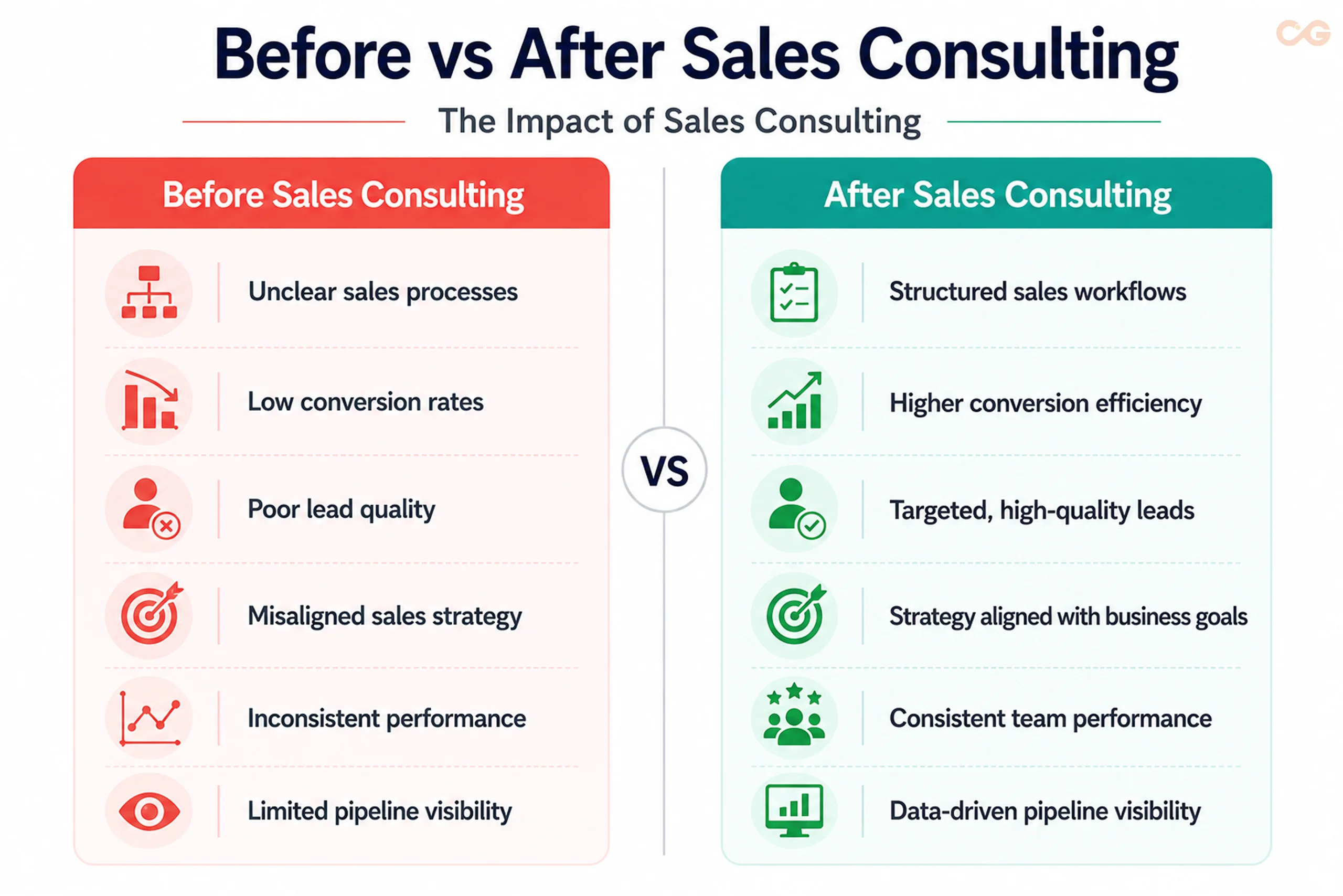
In the past decade, the role of the sales consultant has transformed significantly. Traditionally, sales support focused mainly on training and completing transactions. Now, sales consultants serve as strategic partners. Sales consulting in modern business is essential for:
- Identifying weaknesses in current sales performance.
- Streamlining revenue generation through effective procedures.
- Implementing scalable and repeatable sales models.
Today’s organizations operate in a complex environment where technology, data analytics, and customer-focused strategies drive success. Companies recognize that sales consulting is crucial not just for immediate solutions but also for fostering sustainable business growth. Businesses must embrace this shift to fully realize the potential of sales consulting in the modern landscape.
Key Responsibilities of a Sales Consultant
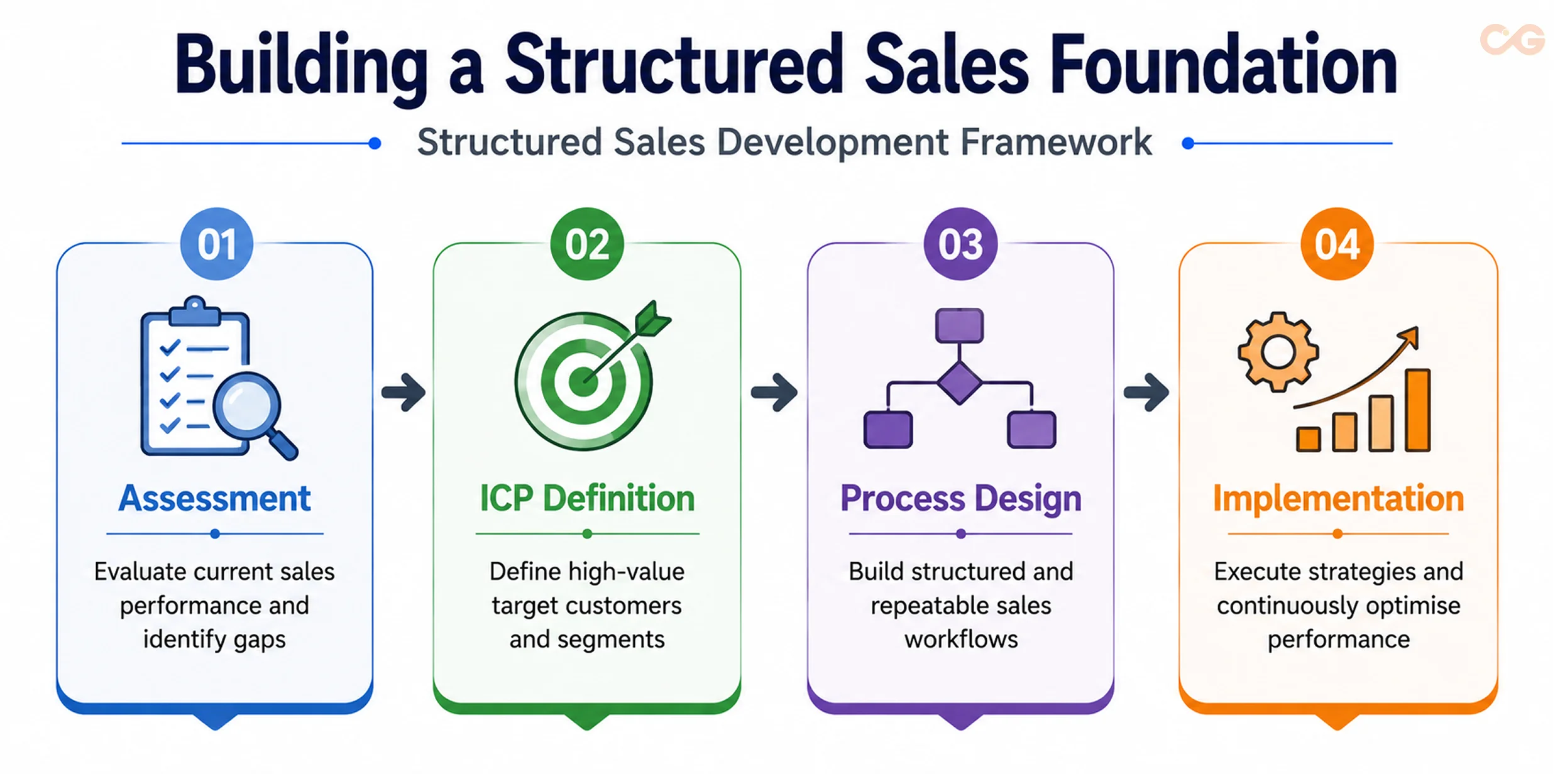
To grasp the role of a sales consultant, it’s essential to identify their primary responsibilities. These responsibilities form the foundation of strategic planning and effective sales execution.
1. Assessing Sales Performance and Identifying Gaps
Sales consultants analyze current performance using a data-driven approach. They conduct audits of sales processes, examine pipeline metrics, and review historical data to pinpoint gaps in areas such as conversion rates, lead quality, and sales cycle efficiency. This ensures that recommendations remain focused and measurable.
2. Defining Target Markets, Ideal Customer Profiles (ICPs), and Sales Goals
Consultants clarify the sales process by identifying target markets and developing precise Ideal Customer Profiles (ICPs). They assist organizations in prioritizing sales objectives in line with broader business goals, enabling a focus on high-value opportunities and more efficient resource allocation.
3. Establishing Structured Sales Processes and Frameworks
A critical task is to cultivate structured and repeatable sales processes. These frameworks ensure consistency, enhance workflow, reduce errors, and lead to shorter sales cycles, improved conversion rates, and increased forecasting accuracy.
People also ask:
Which industries benefit most from sales consulting services?
Sales consulting is particularly advantageous for industries with complex or competitive sales cycles, such as SaaS, IT services, manufacturing, real estate, and financial services, which demand structured processes and strategic selling approaches.
Which industries are best served by sales consulting services?
Sales consulting is most likely to be of benefit to industries whose sales cycles are complex or highly competitive, like SaaS, IT services, manufacturing, real estate, and financial services that require structured processes and strategic selling.
Key Functions of a Sales Consultant in Sales Execution
Once a sales strategy has been established, the next step is effective execution. Sales consultants bridge the gap between planning and results by translating strategic initiatives into measurable revenue growth through structured, data-driven execution. Their role extends beyond developing strategies—they optimise processes, improve team efficiency, and ensure that every stage of the sales cycle contributes to business objectives.
The following are the core functions of sales consultants to drive consistent sales performance and long-term business growth.
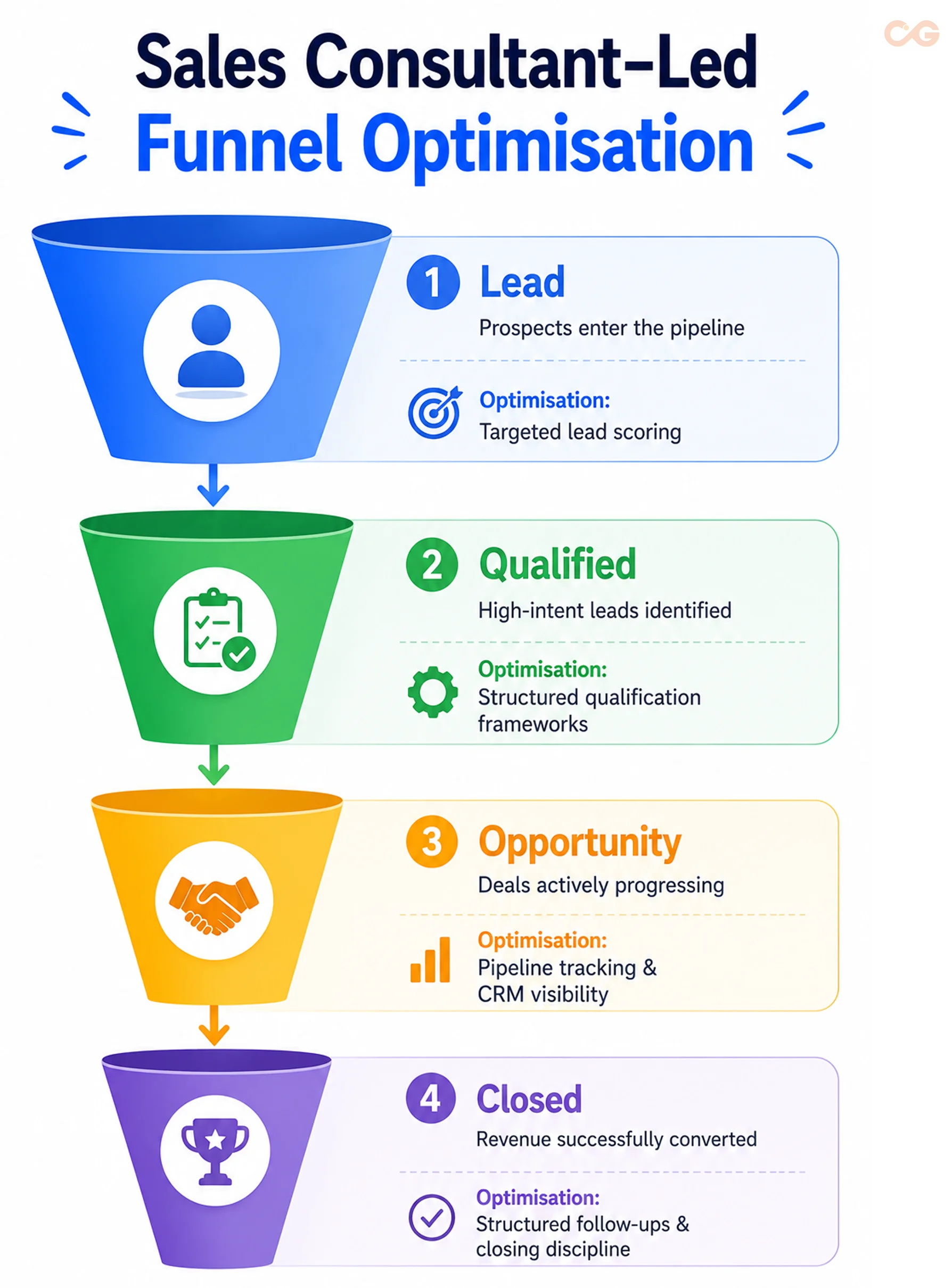
a. Sales Funnel Analysis and Conversion Optimisation
Sales consultants systematically analyse every stage of the sales funnel, from lead generation to final conversion, to identify inefficiencies, bottlenecks, and revenue leakages. By evaluating key performance metrics such as lead-to-opportunity conversion rate, pipeline velocity, and win rate, they uncover areas where potential customers are dropping off and recommend targeted improvements.
According to UserMaven, average B2B conversion rates at the top of the sales funnel typically range between 1% and 3%, depending on the complexity of the sales process. This highlights the significant opportunity businesses have to improve revenue through funnel optimisation.
For example, if a large percentage of qualified leads fail to progress beyond the qualification stage, consultants may refine lead scoring criteria, improve discovery conversations, or better align the definition of a qualified lead between the marketing and sales teams. These targeted improvements increase conversion efficiency without necessarily increasing lead volume.
Takeaway

Use this practical checklist to assess whether your sales process reflects the best practices recommended by sales consultants and identify opportunities for improvement.
b. CRM Implementation and Sales Tool Integration
Technology plays a central role in modern sales execution. Sales consultants recommend and implement CRM platforms and integrated sales tools that centralise customer data, streamline workflows, and improve pipeline visibility.
A well-implemented CRM enables businesses to track customer interactions, automate follow-ups, manage opportunities more effectively, and generate more accurate sales forecasts. It also creates a single source of truth across sales and marketing teams, reducing data silos and improving cross-functional collaboration.
For small and medium-sized businesses, consultants commonly recommend scalable CRM platforms such as:
- HubSpot CRM – Ideal for businesses implementing structured sales tracking for the first time.
- Zoho CRM – A flexible solution for growing teams that require advanced automation and customisation.
- Freshsales – Designed for streamlined sales management with built-in communication and automation features.
For instance, integrating a CRM with marketing automation software enables sales teams to monitor prospect behaviour in real time, prioritise high-intent leads, and deliver personalised outreach at scale. This leads to higher conversion rates, improved sales productivity, and a more efficient customer acquisition process.
c. Sales Playbooks, Scripts, and Outreach Strategy Development
Consistency is essential for scalable sales growth. Sales consultants develop structured sales playbooks, messaging frameworks, and outreach strategies tailored to an organisation’s target audience, sales process, and business goals. These resources provide clear guidance on how sales representatives should engage with prospects throughout each stage of the buyer’s journey.
For example, a structured outreach strategy may include a sequence of personalised emails, follow-up calls, and professional networking interactions, ensuring timely and consistent communication with prospects. Compared to unstructured outreach, this approach improves response rates, shortens sales cycles, and maintains a consistent customer experience across the sales team.
Standardised sales playbooks also accelerate the onboarding of new sales representatives by documenting proven best practices, reducing dependence on individual experience, and ensuring a consistent sales approach across the organisation.
Role in Sales Strategy and Planning
Beyond sales execution, sales consultants play a strategic role in driving long-term business growth. They ensure that sales initiatives align with organisational objectives, market positioning, and expansion plans, enabling businesses to build sustainable and scalable sales strategies.
Aligning Sales Strategy with Overall Business Goals
Sales consultants ensure that sales strategies support broader business objectives, such as revenue growth, market expansion, customer acquisition, and customer retention.
By collaborating closely with leadership teams, they translate organisational goals into actionable sales plans and establish alignment across sales, marketing, and other business functions. This strategic alignment enables organisations to allocate resources effectively, improve decision-making, and pursue growth in a structured and measurable way.
Supporting Go-to-Market Planning and Expansion Initiatives
Whether launching a new product, entering a new market, or targeting a different customer segment, sales consultants provide the strategic guidance needed to execute successful go-to-market initiatives.
They conduct market assessments, evaluate competitive positioning, and define pricing, positioning, and channel strategies. By combining market insights with clear execution plans, they help organisations minimise risks, strengthen market entry strategies, and accelerate sustainable growth.
Building Scalable and Repeatable Sales Models
Sustainable business growth requires sales processes that remain efficient as an organisation expands. Sales consultants design scalable and repeatable sales models by standardising workflows, defining clear sales stages, and establishing consistent performance frameworks.
These structured models improve operational efficiency, simplify onboarding for new sales representatives, and enable organisations to maintain consistent sales performance while adapting to changing market conditions.
Takeaway
Use this practical checklist to assess whether your sales process reflects the best practices recommended by sales consultants and identify opportunities for improvement.
Contribution to Sales Team Performance
A successful sales strategy depends not only on well-defined processes but also on the performance of the people executing them. Sales consultants strengthen sales teams by developing skills, establishing performance standards, and improving operational efficiency. Their focus is on building a high-performing sales culture that delivers consistent, long-term results.
Training, Coaching, and Capability Development
Sales consultants help organisations enhance the capabilities of their sales teams through structured training programmes, personalised coaching, and continuous skill development. Rather than delivering generic training, they tailor learning sessions to real sales scenarios, enabling representatives to apply new techniques directly to their sales pipeline.
Key areas of development include:
- Prospecting and lead qualification
- Discovery and customer needs analysis
- Negotiation and objection handling
- Closing techniques and follow-up strategies
- Relationship building and customer communication
According to SwifTree, organisations that implement structured, consultant-led sales training programmes can increase the percentage of sales representatives achieving or exceeding their quotas by approximately 20%, demonstrating the direct impact of continuous capability development on sales performance.
Setting KPIs, Performance Benchmarks, and Accountability Systems
High-performing sales teams rely on measurable goals and consistent performance tracking. Sales consultants establish clear Key Performance Indicators (KPIs) and benchmarks aligned with organisational objectives, enabling leaders to evaluate progress objectively.
These performance metrics commonly include:
- Lead-to-opportunity conversion rate – Measures the percentage of qualified leads progressing into genuine sales opportunities.
- Pipeline velocity – Measures how quickly deals move through the sales pipeline to closure.
- Average deal size – Calculates the average revenue generated from each successfully closed sales deal.
- Sales cycle length – Tracks the average time required to convert prospects into customers.
- Quota attainment and win rate – Measures sales target achievement and the percentage of deals successfully won.
In addition to defining KPIs, consultants implement accountability frameworks that help sales managers monitor progress, identify performance gaps early, and provide timely coaching. This data-driven approach improves transparency, strengthens decision-making, and creates a culture of continuous improvement.
Enhancing Productivity and Sales Efficiency
Improving productivity is another key contribution of sales consultants. They evaluate existing sales processes to identify inefficiencies that reduce selling time and overall team performance.
Common areas for optimisation include:
- Automating repetitive administrative tasks
- Eliminating duplicate processes and manual work
- Streamlining sales workflows
- Improving collaboration between sales, marketing, and operations
- Optimising CRM usage and reporting
By reducing operational inefficiencies, sales representatives can dedicate more time to high-value activities such as engaging prospects, nurturing customer relationships, and closing deals. The result is higher productivity, improved sales efficiency, and stronger revenue performance across the organisation.
Tackling Common Sales Challenges
Organisations often hire sales strategy consultants to resolve persistent performance issues that their internal teams cannot address. These challenges not only impact revenue but also lead to inefficiencies that hinder growth. Certain aspects of sales are particularly tough to tackle, making it necessary to identify and overcome these challenges to create a consistent, high-performing sales operation.
1. Low Conversion Rates and Poor Lead Quality
Low conversion rates typically stem from poor targeting, ineffective qualification processes, or inadequate lead nurturing. Sales teams often waste time on unsuitable prospects.
Sales consultants effectively tackle this issue by:
- Optimising Ideal Customer Profiles (ICPs) to focus on high-value segments.
- Implementing lead scoring models to identify high-intent prospects.
- Aligning marketing and sales teams on qualification criteria.
These actions ensure that sales activities concentrate on the most promising opportunities without adding to the volume of leads.
2. Ineffective or Undefined Sales Processes
Lack of clarity in sales processes leads to inconsistent execution, making scalability difficult. Teams often adopt varied approaches, resulting in unreliable outcomes and lost opportunities.
Sales strategy consultants enhance structure by:
- Creating standardised end-to-end sales workflows.
- Defining clear steps in the buyer’s journey.
- Establishing regular follow-up and engagement procedures.
This process-driven approach enhances pipeline visibility, improves team coordination, and lays the groundwork for scalable growth.
3. Long Sales Cycles and Inconsistent Performance
Prolonged sales cycles or inconsistent results often reveal underlying inefficiencies, such as unclear value propositions, inadequate qualification, or a lack of accountability. These issues complicate revenue forecasting and limit growth prospects.
Consultants address this by:
- Implementing structured sales playbooks and engagement programs.
- Automating workflows to reduce delays and eliminate redundancy.
- Establishing performance monitoring systems and accountability frameworks.
By improving the accuracy of qualification and ensuring uniform performance, organisations can shorten the sales cycle, balance team output, and achieve more predictable revenue outcomes.
Strategic Value to the Organisation
The true value of a sales consultant extends far beyond improving day-to-day sales performance. By aligning sales strategies with business objectives, strengthening team capabilities, and optimising sales processes, consultants help organisations build a resilient sales function that supports sustainable growth. Their contribution is reflected not only in higher revenue but also in improved operational efficiency, stronger decision-making, and long-term business scalability.
Driving Sustainable Revenue Growth
Sales consultants enable organisations to achieve consistent revenue growth by identifying high-value opportunities, improving conversion efficiency, and aligning sales efforts with strategic business priorities. Rather than relying on short-term sales gains, they develop structured approaches that deliver measurable and repeatable results over time.
SwiftTree reports that companies using data-driven sales models, often with guidance from consultants, can increase their revenue by 5–10% in the first year. Additionally, firms that engage external sales consulting typically achieve an average revenue growth of about 20%, according to McKinsey and Company. These improvements are driven by stronger sales strategies, better execution, and enhanced performance management.
Supporting Data-Driven Business Decisions
Modern sales organisations rely on accurate insights rather than assumptions to guide strategic decisions. Sales consultants help businesses establish a data-driven sales culture by ensuring that leadership has access to reliable performance data and actionable business insights.
This enables organisations to:
- Identify performance gaps and sales opportunities more effectively.
- Improve sales forecasting and resource allocation.
- Make informed decisions on market expansion and growth initiatives.
- Respond quickly to changing customer behaviour and market conditions.
By transforming sales data into actionable insights, consultants help organisations make faster, more confident decisions that support long-term business success.
Building a Scalable and Resilient Sales Organisation
As businesses grow, maintaining consistent sales performance becomes increasingly challenging. Sales consultants help organisations build structured sales frameworks that can scale alongside the business while maintaining operational consistency.
Their strategic contribution includes:
- Establishing standardised sales processes across teams and locations.
- Creating repeatable systems that reduce dependence on individual performers.
- Improving collaboration between sales, marketing, and customer success teams.
- Supporting continuous improvement through structured performance reviews and best practices.
These foundations enable organisations to adapt to market changes, maintain consistent customer experiences, and sustain sales performance as the business expands.
Takeaway
Use this practical checklist to assess whether your sales process reflects the best practices recommended by sales consultants and identify opportunities for improvement.
Conclusion
Sales consultants are more than just outside experts; they play a crucial role in driving strategic growth by bringing organisation, clarity, and measurable results to sales operations. By tackling common sales challenges and utilising data-driven approaches, they can transform an organisation’s uneven performance into a reliable and scalable revenue stream.
To enhance sales capabilities, it’s essential to recognise the key role that sales consulting plays in today’s businesses, as well as the fundamental responsibilities of a sales consultant. As competition intensifies and customer expectations rise, the significance of sales consulting becomes increasingly clear, impacting both efficiency and long-term growth.
Therefore, selecting the right sales consultant should not be seen as an extra step, but rather as a strategic investment that enables organisations to build sustainable, high-performing sales frameworks.
You May Also Like