Building a High-Performance Sales Funnel That Converts
Table of Contents
- Introduction
- Grasping Sales Funnel Structure
- Defining Target Audience and Buyer Journey
- Top-of-Funnel (TOFU): Producing High-Quality Leads
- Middle-of-Funnel (MOFU): Nurturing and Qualification
- Bottom-of-Funnel (BOFU): Conversion and Closing
- Enhancing Funnel Performance
- Using Technology and Data to Improve the Sales Funnel
- Aligning Sales and Marketing for Better Conversions
- Conclusion
1. Introduction
1.1 What is a Sales Funnel and Why It Matters
Before building a scalable growth system, businesses must first understand what a sales funnel is and why it plays such a critical role in driving revenue.
A sales funnel in digital marketing is more than a visual representation of the customer journey. It is a structured framework that guides potential customers from initial awareness to final conversion by delivering the right message at the right time throughout the buying journey.
High-performing businesses do not treat the sales funnel as a passive concept. Instead, they strategically optimise every stage to influence buying decisions, reduce friction, and move prospects towards conversion in a predictable and measurable way.
1.2 Why Most Sales Funnels Fail
Despite widespread adoption, many businesses struggle to understand the stages of a sales funnel in a way that delivers measurable results.
The challenge is rarely about generating leads. More often, it lies in what happens after those leads enter the funnel.
Most sales funnels fail because they:
- Look well-designed but lack a clear strategic purpose.
- Deliver inconsistent messaging across different sales funnel stages, creating confusion for potential customers.
- Fail to nurture leads based on their position in the buying journey and decision-making stage.
According to HubSpot, 79% of marketing leads never convert into sales, largely because of ineffective lead nurturing. This highlights an important reality: most sales funnels do not fail at the awareness stage—they lose prospects during the nurturing and consideration phases.
1.3 The Real Impact of a High-Converting Funnel
A well-planned sales funnel strategy does more than improve conversion rates. It creates a predictable and scalable system for sustainable business growth.
In practice, an effective sales funnel helps businesses:
- Convert demand into revenue more efficiently.
- Shorten the sales cycle through better lead qualification.
- Reduce customer acquisition costs (CAC) by delivering targeted and timely customer engagement.
- Improve customer experience by providing relevant information at every stage of the buying journey.
- Increase long-term revenue through stronger lead nurturing and higher conversion rates.
2. Grasping Sales Funnel Structure
2.1 Stages of the Sales Funnel
To create a successful sales system, businesses must go beyond surface-level definitions. It’s crucial to understand the sales funnel stages through the lens of buyer behaviour.
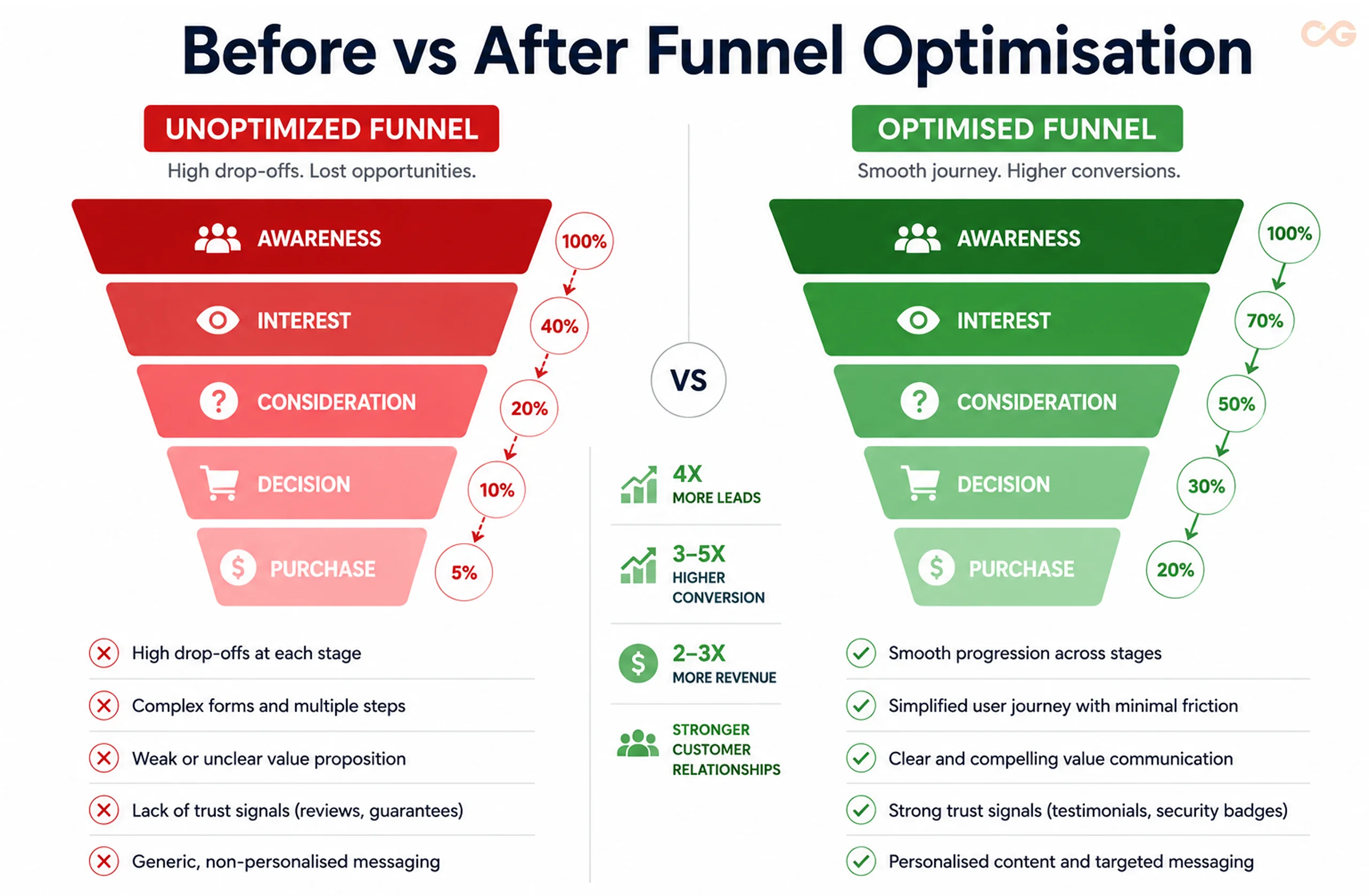
At its core, a funnel reveals the progression of buyer intent. The four primary stages of the sales funnel are:
1. Awareness: The buyer recognises a problem or opportunity, often sparked by external content, advertisements, or experiences.
2. Interest: The buyer begins to research solutions actively and seeks more information.
3. Consideration: The buyer evaluates different options, weighing features, prices, and value.
4. Decision: The buyer selects a solution and takes action, influenced by trust, clarity, and perceived risk.
These stages represent shifts in buyer behaviour, not just simple tasks. As buyers move through the funnel, their expectations change. Each stage requires tailored content, messages, and engagement strategies.
Understanding these transitions is vital. Often, misalignments between buyer intent and messaging lead to funnel failures. Ensure your messaging aligns with each stage to guide buyers effectively.
2.2 The Impact of Funnel Stages on Conversions
Each step in the funnel plays a specific role in driving conversions. When companies treat all stages the same, their messaging often loses effectiveness.
Here’s a closer look at each phase:
- Awareness generates visibility and grabs attention, but buyers are not ready to convert yet.
- Interest sparks curiosity and builds initial trust through relevant information.
- Consideration boosts confidence by addressing objections, showing value, and providing evidence.
- Decision reduces perceived risk and encourages action through clear and compelling calls to action.
This sequence underscores an important truth: conversion isn’t just a single event; it results from the cumulative effects of each stage.
Forrester found that 74% of B2B buyers conduct a significant amount of research before ever contacting sales. Essentially, by the time a buyer reaches out, they are already deep into their decision-making process.
As a result, companies should move away from aggressive sales tactics. Instead, they should focus on facilitating informed choices through relevant and timely interactions.
2.3 Distinguishing Sales and Marketing Funnels
While marketing funnels and sales funnels are often seen as the same, they serve different purposes.
The marketing funnel primarily raises awareness and informs potential customers. It focuses on generating interest and engaging first-time users through content, campaigns, and outreach.
In high-performing companies, these funnels function as a unified structure. Marketing and sales work closely together.
While marketing funnels and sales funnels are often seen as the same, they serve different purposes.
When alignment is lacking, several issues can arise:
- Poor lead quality due to inaccurate targeting.
- Ineffective handoffs between teams.
- Missed opportunities from communication gaps.
People Also Ask
How can you identify a broken sales funnel?
If you’re receiving steady traffic or leads but struggling to convert them, the issue often lies in middle-funnel engagement, qualification, or misaligned messaging, rather than the initial outreach.
Understanding the funnel stages is only one part of the process. To move prospects through those stages effectively, businesses must first identify the right audience and understand how they make purchasing decisions.
Takeaway

Keep your sales funnel performing at its best by following this practical review schedule for continuous optimisation.
3. Defining Target Audience and Buyer Journey
3.1 Finding Your Ideal Customer Profile (ICP)
A sales funnel can only be effective if you know exactly who it is designed for. Before optimising channels, messaging, or campaigns, businesses must first understand what a sales funnel is intended to achieve and who it is meant to serve.
An Ideal Customer Profile (ICP) defines the type of customer who is most likely to convert, remain loyal, and generate long-term value. It goes beyond basic demographics by identifying how buyers think, behave, and make purchasing decisions.
A well-defined ICP typically includes:
- Firmographics such as industry, company size, and revenue.
- Decision-makers and their roles within the organisation.
- Purchase triggers, behavioural patterns, and buying intent signals.
This level of insight helps businesses build a focused sales funnel strategy, ensuring that every stage of the funnel speaks to the right audience instead of trying to appeal to everyone.
According to Salesforce, 73% of customers expect businesses to understand their individual needs and expectations. This makes accurate audience targeting more than a marketing advantage—it is essential for improving conversions across all sales funnel stages.
3.2 Mapping Buyer Intent and Decision Drivers
An effective sales funnel aligns with the changing intent of buyers throughout their decision-making journey. Understanding this shift is a key part of understanding the sales funnel and stages in a practical way.
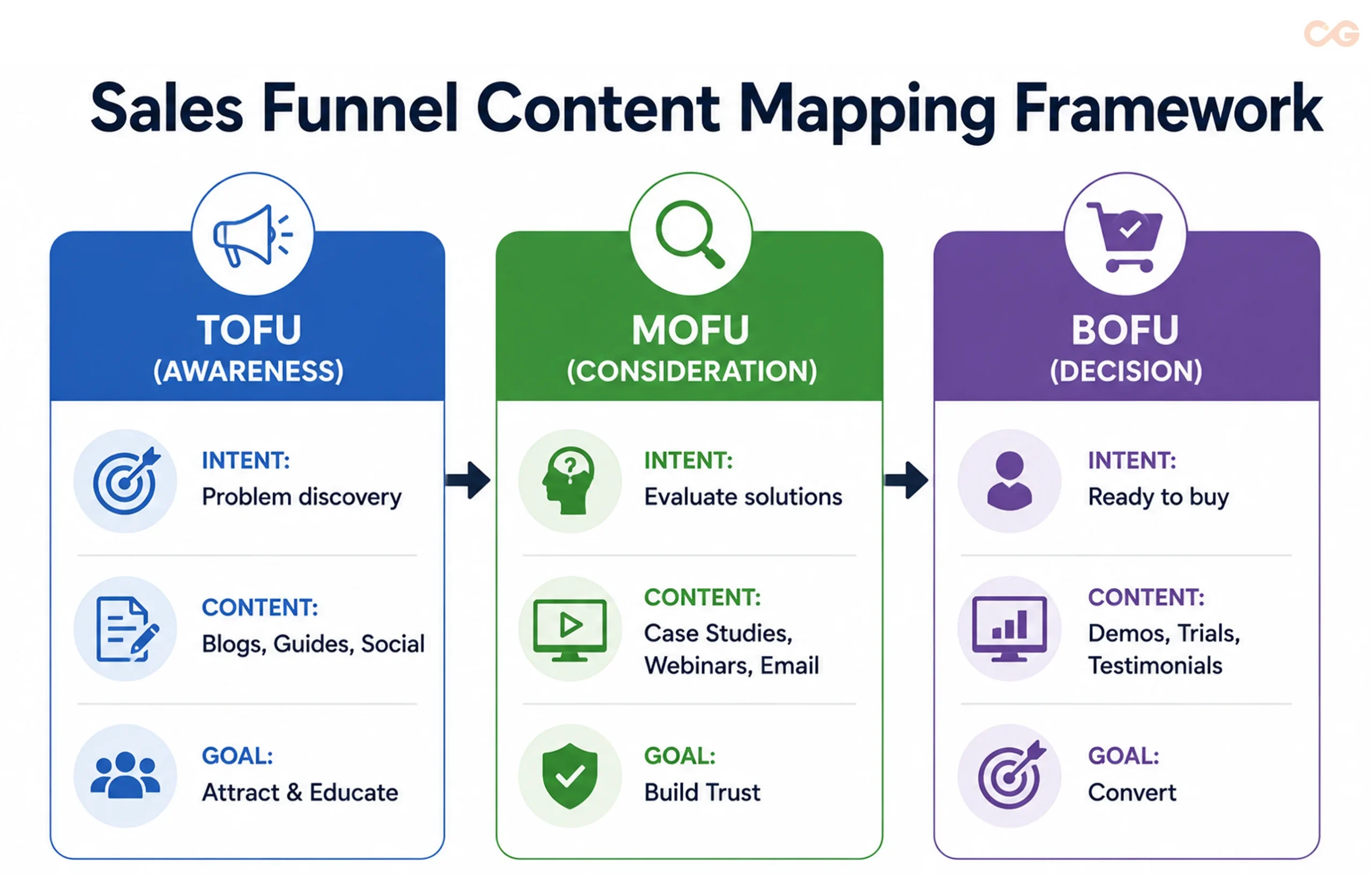
Buyer intent generally falls into three stages:
- Informational: Buyers are identifying a problem and exploring possible solutions.
- Commercial: Buyers compare different products, services, or providers before narrowing their options.
- Transactional: Buyers are ready to make a purchase or take the next step.
Each stage aligns with a different phase of the sales funnel and requires a tailored approach.
At the Top of Funnel (TOFU) stage, the focus is on building awareness and educating potential customers. A successful TOFU funnel attracts the right audience by providing valuable, problem-solving content rather than promoting products too early.
As buyers move into the consideration phase, an effective MOFU sales funnel strategy becomes essential. This stage builds trust through case studies, product comparisons, webinars, and in-depth resources that help buyers evaluate their options.
At the decision stage, the goal is to reduce uncertainty and encourage action. A strong BOFU sales funnel example includes product demonstrations, customer testimonials, transparent pricing, free trials, and other trust-building elements that help prospects make confident purchasing decisions.
When messaging evolves with buyer intent instead of remaining the same throughout the funnel, businesses create a smoother and more effective buying experience.
3.3 Creating a Realistic Buyer Journey Map
One of the biggest mistakes businesses make is assuming that the buyer journey follows a straight path. In reality, buyers move back and forth between stages, influenced by multiple touchpoints, stakeholders, and external factors before making a final decision.
A realistic buyer journey typically includes:
- Trigger events: Problems, challenges, or opportunities that motivate buyers to look for a solution.
- Research behaviour: Comparing options, reading reviews, seeking recommendations, and consuming content across multiple platforms.
- Decision factors: Pricing, ROI, brand credibility, customer reviews, and social proof.
According to Gartner, B2B buyers spend only 17% of their purchasing journey interacting directly with suppliers. Instead, they rely heavily on independent research to evaluate their options before making a decision.
This significantly influences how a sales funnel in digital marketing should be designed. Since buyers gather information from multiple sources before engaging with a business, organisations need to ensure they provide a consistent experience throughout the journey.
This requires:
- Valuable and consistent content at every stage of the funnel.
- A strong multi-channel presence to engage buyers across different touchpoints.
- Clear and consistent messaging that reinforces trust throughout the buying journey.
Ultimately, building an effective sales funnel is not just about understanding its stages. It is about mapping the real behaviour of buyers as they research, compare, pause, revisit, and eventually make purchasing decisions in a non-linear journey.
People Also Ask
What is the most common error when defining a target audience in a sales funnel?
One of the most common mistakes is trying to target everyone. While a broad audience may generate more traffic, it often reduces relevance, resulting in lower engagement and weaker conversions across different sales funnel stages, with examples.
4. Top-of-Funnel (TOFU): Producing High-Quality Leads
Once businesses have identified their target audience and mapped the buyer journey, the next step is attracting the right prospects into the funnel. The Top of Funnel (TOFU) stage focuses on creating awareness, generating interest, and attracting high-intent visitors who are most likely to become customers. Rather than maximising traffic alone, the goal is to build a strong pipeline of qualified leads for the later sales funnel stages.
4.1 Traffic vs Qualified Leads: Why Volume Isn’t Enough
TOFU has been misunderstood in most sales funnel strategies as a pure volume game. Increased traffic is perceived to be an improvement, and in an actual sense, unqualified traffic brings inefficiencies that undermine the whole funnel.
An effective TOFU sales funnel strategy focuses on attracting qualified prospects instead of simply increasing visitor numbers. While high volumes of irrelevant traffic may improve vanity metrics, they often result in lower engagement, weaker lead nurturing, and reduced conversion rates throughout the funnel.
Ultimately, TOFU is not just about increasing visibility. It is about attracting the right audience and building a strong foundation for every stage that follows.
4.2 Shift from Features to Outcomes
Inbound marketing helps businesses connect with people who are already looking for solutions. For most organisations, this is where a sales funnel in digital marketing begins—well before a prospect interacts with a sales representative.
Some of the most effective inbound channels include:
- SEO-driven content that targets informational and commercial search intent.
- Educational resources such as blogs, white papers, webinars, and guides.
- Organic engagement through platforms such as LinkedIn and YouTube.
Real-World Example
Zoho has achieved significant global growth by focusing on content marketing, SEO, webinars, and educational resources. These strategies help potential customers find our products naturally. By offering free trials and hands-on experiences, we draw in high-intent prospects before they reach out to our sales team. This approach clearly demonstrates an effective top-of-funnel sales strategy.
This demonstrates that successful TOFU strategies rely less on promotion and more on discoverability, relevance, and consistently delivering value to the right audience.
4.3 Outbound Channels That Create Demand
While inbound marketing captures existing demand, outbound marketing helps businesses reach potential customers who may not yet be actively searching for a solution. Used together, these approaches create a balanced acquisition strategy that strengthens the top of the funnel.
Common outbound strategies include:
- Paid search and social media advertising targeted at specific audience segments.
- Personalised cold outreach campaigns.
- Account-Based Marketing (ABM) for high-value prospects
Rather than relying on a single acquisition channel, high-performing organisations combine inbound and outbound strategies to maximise reach, generate awareness, and maintain a steady flow of qualified leads.
Together, these channels create a stronger sales funnel strategy, where inbound captures existing demand and outbound expands market opportunities by generating new demand.
4.4 Messaging That Builds Interest and Qualifies Leads
Bringing the right audience into the funnel is only the first step. The messaging they encounter determines whether they continue their journey or leave.
At the Top of Funnel (TOFU) stage, messaging should educate, build interest, and help prospects recognise that your solution is relevant to their needs.
Effective TOFU messaging should:
- Clearly define the problem your solution addresses.
- Speak directly to the intended target audience.
- Communicate your value proposition in a clear, relevant, and easy-to-understand way.
When messaging aligns with buyer intent, it naturally attracts high-intent prospects while filtering out audiences that are unlikely to convert. This creates a smoother customer journey and improves the efficiency of every stage that follows.
It also prepares prospects for the next phase of the funnel, where an effective MOFU sales funnel strategy focuses on nurturing interest and building trust rather than correcting misunderstandings created earlier.
4.5 Common TOFU Mistakes That Reduce Conversions
Even well-designed funnels can underperform if the TOFU stage is poorly executed. Some of the most common mistakes include:
- Prioritising traffic volume over lead quality.
- Using generic messaging that attracts broad, low-intent audiences.
- Ignoring behavioural and intent signals when evaluating visitor engagement.
Although these mistakes may seem minor at the awareness stage, their impact compounds as prospects move through the funnel. Poor-quality leads, unclear messaging, and weak audience targeting make it significantly harder to nurture prospects and achieve conversions later in the buying journey.
A successful TOFU strategy lays the groundwork for everything that follows. When businesses consistently attract the right audience and provide relevant, valuable experiences, prospects move into the next stage with greater intent and stronger engagement.
People Also Ask
Which is more effective for top-of-funnel lead generation: SEO or paid ads?
SEO and paid advertising serve different purposes. SEO builds sustainable, long-term organic traffic, while paid advertising delivers immediate visibility and faster results. High-performing TOFU funnels typically combine both approaches, using SEO to generate consistent long-term growth and paid campaigns to scale awareness and demand when needed.
5. Middle-of-Funnel (MOFU): Nurturing and Qualification
After attracting the right audience at the top of the funnel, the next challenge is maintaining their interest and helping them evaluate your solution. The Middle of Funnel (MOFU) stage focuses on nurturing qualified leads, building trust, and identifying prospects who are genuinely ready to move towards a purchase.
5.1 Why the Middle Funnel Determines Conversion Outcomes
Many businesses invest heavily in lead generation but overlook lead nurturing. As a result, promising prospects lose interest before reaching the decision stage.
MOFU is where trust, credibility, and purchase intent are developed. At this stage, prospects are actively evaluating whether your solution meets their needs, comparing alternatives, and seeking evidence before making a decision.
Without a structured nurturing process, even high-quality leads can lose momentum and exit the funnel before converting.
5.2 Proven Lead Nurturing Approaches
A successful MOFU sales funnel strategy delivers the right information at the right time, based on the buyer’s intent and level of engagement.
Some of the most effective nurturing approaches include:
- Email sequences that deliver personalised follow-ups based on user behaviour.
- Retargeting campaigns that re-engage prospects who have not progressed.
- Case studies and success stories that demonstrate real-world outcomes.
Sify Technologies improved its lead nurturing by using Freshsales CRM. This tool automates email follow-ups, tailors customer interactions, and boosts visibility in the sales pipeline. Freshworks reports that the digital sales team achieved an 80% adoption rate for the CRM and saw a 60% rise in customer engagement.
This case highlights how effective lead nurturing and prompt follow-ups can enhance a mid-funnel (MOFU) sales strategy. Staying in touch with prospects keeps them engaged and guides them towards making a purchase.
A strong MOFU sales funnel gradually shifts the conversation from awareness to validation, giving prospects the confidence they need to move closer to a purchase.
5.3 Lead Qualification Frameworks That Improve Efficiency
Not every lead is ready to move to the next stage. Identifying high-potential prospects allows sales teams to focus their time and resources more effectively.
Common Sales frameworks include:
- BANT (Budget, Authority, Need, Timeline)
- CHAMP (Challenges, Authority, Money, Prioritisation)
These frameworks help businesses prioritise qualified opportunities, ensuring that only relevant, high-intent prospects progress through the sales funnel stages.
Effective qualification improves pipeline quality while enabling sales teams to focus on opportunities with the highest likelihood of conversion.
5.4 Using Behavioural Data to Guide Engagement
Modern lead nurturing relies on behavioural insights rather than fixed communication schedules. By analysing how prospects interact with content, businesses can deliver more relevant and timely engagement.
Key behavioural signals include:
- Page visits and session frequency.
- Content engagement and resource downloads.
- Email open rates and click-through rates.
Businesses that use data-driven insights to personalise engagement typically achieve better conversion outcomes than those relying on generic workflows.
This approach reflects the reality that buyer journeys are dynamic, requiring communication to adapt as prospect behaviour and intent evolve.
5.5 Common MOFU Challenges
Even well-designed funnels can lose momentum during the nurturing stage. Common challenges include:
- Inconsistent or delayed follow-ups.
- Over-communication that causes audience fatigue.
- Poor alignment between marketing and sales on lead readiness.
These issues weaken engagement at a critical stage, making it more difficult for prospects to progress confidently towards a purchasing decision.A well-executed MOFU strategy keeps prospects engaged, builds confidence, and prepares them for the final stage of the funnel, where the focus shifts from nurturing to conversion.
People Also Ask
What is the ideal lead nurturing duration?
There is no fixed timeline for lead nurturing. It depends on the length and complexity of the buying cycle. While B2B buyers may require weeks or even months of consistent engagement, many B2C purchases can be nurtured and converted within a much shorter period.
6. Bottom-of-Funnel (BOFU): Conversion and Closing
After progressing through awareness, consideration, and evaluation, prospects reach the final stage of the funnel. At the Bottom of Funnel (BOFU) stage, the objective is no longer to generate interest but to help prospects make a confident purchasing decision by reducing uncertainty and reinforcing value.
6.1 From Consideration to Commitment
By the time prospects reach BOFU, they have already compared multiple options and narrowed their choices. The focus now shifts from persuasion to reassurance.
Understanding the BOFU meaning is essential, as it represents the final stage in the sales funnel where purchase intent is converted into action. Businesses can improve conversions by providing clear information, addressing remaining concerns, and making the decision-making process as simple as possible.
6.2 Sales Conversations That Influence Buying Decisions
At this stage, successful sales conversations focus on outcomes rather than product features. Prospects want to understand how the solution will solve their specific challenges and deliver measurable value.
High-impact sales conversations typically focus on:
- Understanding the customer’s underlying business or personal challenges.
- Demonstrating the potential impact and return on investment (ROI).
- Aligning the solution with the prospect’s goals and expected outcomes.
This shifts the conversation from explaining product capabilities to demonstrating tangible business value, helping prospects make informed purchasing decisions.
6.3 Reducing Friction at the Decision Stage
Even interested buyers may hesitate if the purchasing process feels complicated. Reducing friction at this stage makes it easier for prospects to complete their purchase.
Indian D2C brand VS Mani & Co. improved its order conversion rate by 27% after implementing Razorpay Magic Checkout, which reduced checkout time through one-click purchasing and pre-filled customer information. This illustrates how removing friction during the final purchase stage can directly improve conversions.
Some of its key optimisation strategies include:
- One-Click purchasing for faster checkout.
- Transparent pricing with no hidden charges.
- Strong trust signals such as customer reviews, ratings, and secure payment options.
These improvements reduce hesitation, improve the customer experience, and increase conversion rates.
6.4 Handling Objections with Data and Proof
Questions and objections are a natural part of the buying process. Addressing them with credible evidence helps prospects move forward with greater confidence.
Common concerns include:
- Pricing and perceived value.
- Implementation complexity.
- Risk and uncertainty.
Effective ways to address these concerns include:
- Presenting ROI-focused case studies and success stories.
- Offering product demonstrations, free trials, or pilot programmes.
- Reinforcing credibility with testimonials, reviews, and third-party validation.
A strong BOFU sales funnel demonstrates how evidence, transparency, and social proof can significantly influence the final purchasing decision.
6.5 Post-Conversion Experience and Retention
Conversion is not the end of the customer journey—it marks the beginning of a long-term relationship.
According to Bain and Company, increasing customer retention by just 5% can boost profits by 25% to 95%, highlighting the long-term value of retaining existing customers.
For this reason, onboarding, customer support, and customer success should be considered essential extensions of an effective sales funnel strategy, rather than activities that begin after the sale.
Businesses that invest in a strong post-conversion experience not only improve customer retention but also encourage referrals, positive reviews, and repeat purchases, creating a continuous cycle of growth that feeds future opportunities back into the funnel.
Takeaway
Keep your sales funnel performing at its best by following this practical review schedule for continuous optimisation.
7. Enhancing Funnel Performance
7.1 Spotting Funnel Bottlenecks
Once we set up a sales funnel, our real challenge begins: ensuring it functions effectively at every stage. Many businesses mistakenly attribute low conversion rates solely to poor customer acquisition, but in reality, issues can arise at any point in the funnel.
To maintain a high-performing system, we must regularly monitor user movement through each stage of the sales funnel, focusing especially on where they drop off.
For instance:
- If we see high traffic but low lead capture, that could signal poor messaging or misalignment with our target audience during the awareness phase.
- A strong flow of leads that doesn’t progress often indicates gaps in our nurturing and engagement strategies.
- If we notice high intent at the final stage but low conversions, this typically points to unresolved objections or a failure to communicate value effectively.
Understanding each stage of the sales funnel is crucial. Every bottleneck is unique, and to optimise performance, we must identify where we’re losing momentum.
According to McKinsey and Company, organisations that enhance the entire customer experience — rather than focusing on individual touchpoints — see significant improvements in conversion rates and reduced acquisition costs.
It’s essential to identify where users are dropping off and why. Once we have that clarity, we can make the necessary adjustments.
7.2 Strategies for Conversion Rate Optimisation (CRO)
Improving your sales funnel involves ongoing adjustments, not just one-time tweaks.
High-performing teams view optimisation as an ongoing part of their sales strategy. They consistently apply structured A/B testing to enhance performance at every stage.
Even small changes can lead to significant improvements:
- Make headlines more relevant to user intent.
- Remove unnecessary form fields to lower friction and boost completion rates.
- Strengthen calls to action to encourage decisive responses.
Research from Invesp indicates that companies with a clear CRO strategy outperform those that rely on guesses or make infrequent updates.
Effective CRO focuses on three main areas:
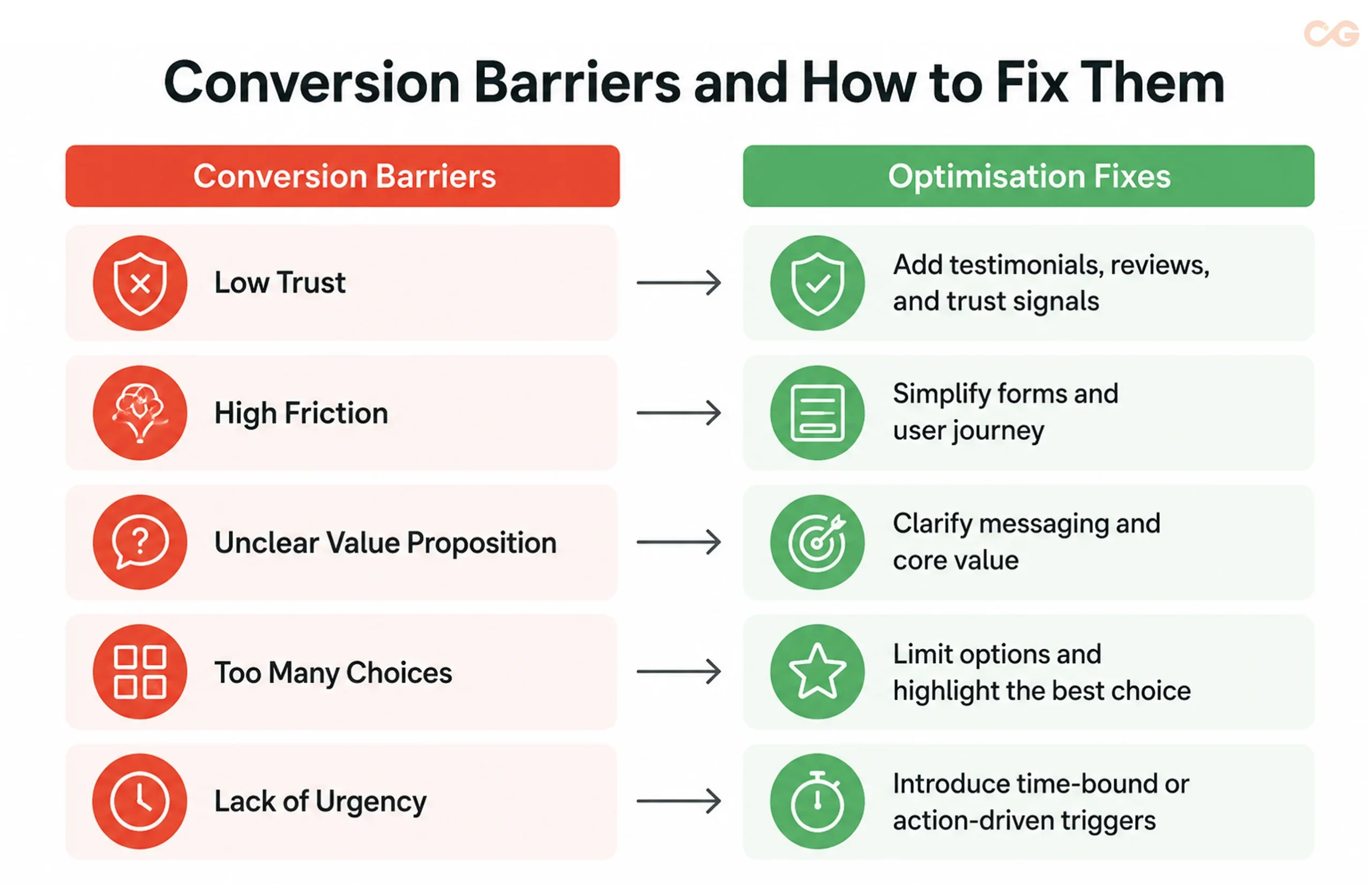
- Reducing friction in the user experience.
- Aligning messages with evolving buyer intent.
- Clarifying value propositions.
These incremental improvements accumulate, resulting in a more powerful and efficient funnel.
7.3 Key Funnel Metrics That Matter
Without the right metrics, funnel optimisation becomes reactive instead of strategic.
To fully understand the sales funnel, companies must measure performance at each stage, not just at the end.
Essential metrics include:
- Conversion rate at each stage, reflecting how well prospects advance through the funnel.
- Customer Acquisition Cost (CAC), which shows how effectively a business turns investments into customers.
- Pipeline velocity, indicating the speed at which prospects move from initial engagement to conversion.
- Lead-to-customer conversion ratio, illustrating how effectively leads turn into revenue.
These metrics serve as performance indicators and highlight areas needing improvement throughout the sales funnel.
Regularly reviewing these metrics reinforces the idea that the sales funnel is a dynamic system. This ongoing observation ensures better decision-making, smarter resource allocation, and continuous optimisation.
8. Using Technology and Data to Improve the Sales Funnel
Creating a strong sales funnel is just the beginning. As we grow, managing leads and customer interactions while enhancing each stage of the funnel gets more challenging. Tools like CRM systems, analytics platforms, and automation software streamline these tasks. They empower us to make informed decisions and provide tailored experiences for our customers.
8.1 Enhancing Sales Funnels with CRM Systems
As our sales funnels get larger, handling customer interactions manually becomes tedious and error-prone. Implementing a Customer Relationship Management (CRM) system helps us manage every stage of the customer journey more effectively.
For instance, platforms like Salesforce allow us to keep track of customer interactions, oversee leads, and automate follow-ups. This ensures we don’t miss opportunities due to delays in communication.
As our sales funnels get larger, handling customer interactions manually becomes tedious and error-prone. Implementing a Customer Relationship Management (CRM) system helps us manage every stage of the customer journey more effectively.
8.2 Enhancing Funnel Performance with Data
Data amplifies the value of technology. By leveraging customer insights, we can eliminate assumptions and pinpoint what works and what needs improvement.
Analyzing user behavior across various channels helps us identify which sources bring in quality leads, how prospects engage with our content, and where they lose interest in the buying process. These insights drive ongoing enhancements in our targeting, messaging, and engagement strategies.
Forrester reports that companies using data-driven strategies align sales and marketing more effectively, which boosts conversion rates.
This method helps us gain a clearer view of the sales funnel, allowing us to improve each stage based on actual customer behavior.
8.3 Customising the Sales Funnel with Customer Data
Leveraging insights from CRM systems and behavioral analytics allows us to tailor the customer journey at every funnel stage.
Today’s customers want relevant and timely interactions, not one-size-fits-all marketing messages. We can use customer data to customize email campaigns, website content, product recommendations, and automated follow-ups to match individual behavior and preferences.
Instead of treating all prospects the same, personalization ensures we deliver relevant content at the right moment. This strategy enhances engagement, builds stronger customer relationships, and boosts conversion rates throughout the sales funnel in digital marketing.
9. Aligning Sales and Marketing for Better Conversions
A high-performing sales funnel depends on more than effective marketing campaigns or skilled sales teams. It requires both functions to work together towards shared goals. When sales and marketing are aligned, prospects experience a consistent journey from initial awareness to final conversion, resulting in stronger engagement and better business outcomes.
9.1 The Impact of Sales and Marketing Misalignment
One of the most common reasons sales funnels underperform is poor alignment between sales and marketing.
Marketing teams often focus on generating leads, while sales teams prioritise lead quality and conversions. When these objectives are not aligned, businesses experience inconsistent messaging, ineffective lead handovers, and missed revenue opportunities.
Misalignment between sales and marketing can result in significant revenue loss, highlighting the importance of a unified approach to funnel management.
9.2 Building a Unified Funnel Strategy
An effective sales funnel requires both teams to work towards shared objectives and use common definitions throughout the customer journey.
This includes:
- Clearly defining Marketing Qualified Leads (MQLs) and Sales Qualified Leads (SQLs).
- Aligning on key performance indicators (KPIs), including conversion rates and pipeline contribution.
- Maintaining consistent messaging across every stage of the funnel.
When sales and marketing operate with shared goals and processes, prospects move more smoothly through the sales funnel stages, improving both conversion rates and overall funnel performance.
This method helps us gain a clearer view of the sales funnel, allowing us to improve each stage based on actual customer behavior.
9.3 Continuous Feedback and Funnel Optimisation
Sales and marketing alignment is an ongoing process rather than a one-time initiative. Regular communication allows both teams to refine the funnel based on real customer insights.
Today’s customers want relevant and timely interactions, not one-size-fits-all marketing messages. We can use customer data to customize email campaigns, website content, product recommendations, and automated follow-ups to match individual behavior and preferences.
This continuous feedback loop enables businesses to optimise the sales funnel over time, ensuring it remains aligned with changing customer behaviour and business objectives.
Takeaway
Keep your sales funnel performing at its best by following this practical review schedule for continuous optimisation.
10. Conclusion
Building a high-performing sales funnel involves much more than understanding what a sales funnel is or mapping its stages. It requires a clear understanding of your target audience, aligning your messaging with buyer intent, and optimising every stage of the customer journey—from attracting qualified leads to nurturing prospects and converting them into loyal customers.
An effective sales funnel strategy is never static. As customer expectations, market dynamics, and buying behaviours evolve, businesses must continuously refine their funnel using data, technology, and close alignment between sales and marketing. Regular optimisation helps improve customer experiences, reduce inefficiencies, and maximise conversion opportunities.
Ultimately, the most successful sales funnels are those that evolve with their customers. By combining a customer-centric approach with continuous improvement, businesses can build a scalable sales funnel that not only drives conversions but also supports sustainable long-term growth.