
When to Outsource Sales and What to Keep In-House: A Practical Guide
Table of Contents
- Designing a Sales System That Really Works
- Sales Outsourcing vs In-House: A Strategic Perspective
- The Sales Ownership Matrix (Practical Decision Framework)
- When to Outsource Sales
- What Should Remain In-House
- When a Fully Outsourced Sales Model Makes Sense
- When to Build or Strengthen In-House Sales Teams
- The Hybrid Model: A Scalable Approach
- How to Evaluate and Choose the Right Sales Partner
- Conclusion
1. Designing a Sales System That Really Works
As businesses grow, building a sales system that is both efficient and scalable becomes increasingly important. One of the biggest decisions organisations face is determining which sales activities should remain in-house and which can be outsourced to improve performance and support long-term growth.
This decision has become more important as today’s business-to-business (B2B) buyers research solutions, compare vendors, and involve multiple stakeholders before engaging with suppliers. According to Gartner, B2B buyers spend only 17% of their purchasing journey interacting with suppliers, making timely and consistent engagement essential. Research by Harvard Business Review also found that companies responding to leads within one hour are seven times more likely to qualify them.
This raises an important strategic question: when should businesses outsource sales, and what should they keep in-house? While outsourced sales teams can improve scalability and execution, in-house sales teams provide greater control over customer relationships and strategic decisions. The key is to align each sales activity—from lead generation to account management—with the approach that delivers the best business outcomes.
2. Sales Outsourcing vs In-House: A Strategic Perspective
After understanding why businesses need a well-structured sales system, the next step is determining how different sales activities should be managed. While sales outsourcing and in-house sales teams serve different purposes, they are most effective when used together to support business growth.
2.1 Sales Outsourcing: Enabling Speed and Scalability
Sales outsourcing involves partnering with an external team to manage specific sales activities, such as lead generation, prospecting, and appointment setting.
Outsourced sales teams offer several advantages:
- Proven sales processes
- Experienced and trained professionals
- Faster execution with minimal onboarding
This makes sales outsourcing an effective option for businesses looking to scale outreach, improve lead generation, and maintain consistent sales execution.
2.2 In-House Sales: Building Long-Term Value
In-house sales teams contribute beyond day-to-day execution. They play a strategic role by:
- Developing deep product and market knowledge
- Building long-term customer relationships
- Supporting sales strategy and business decisions
Over time, these responsibilities strengthen institutional knowledge, improve cross-functional collaboration, and create sustainable business growth.
2.3 Finding the Right Balance
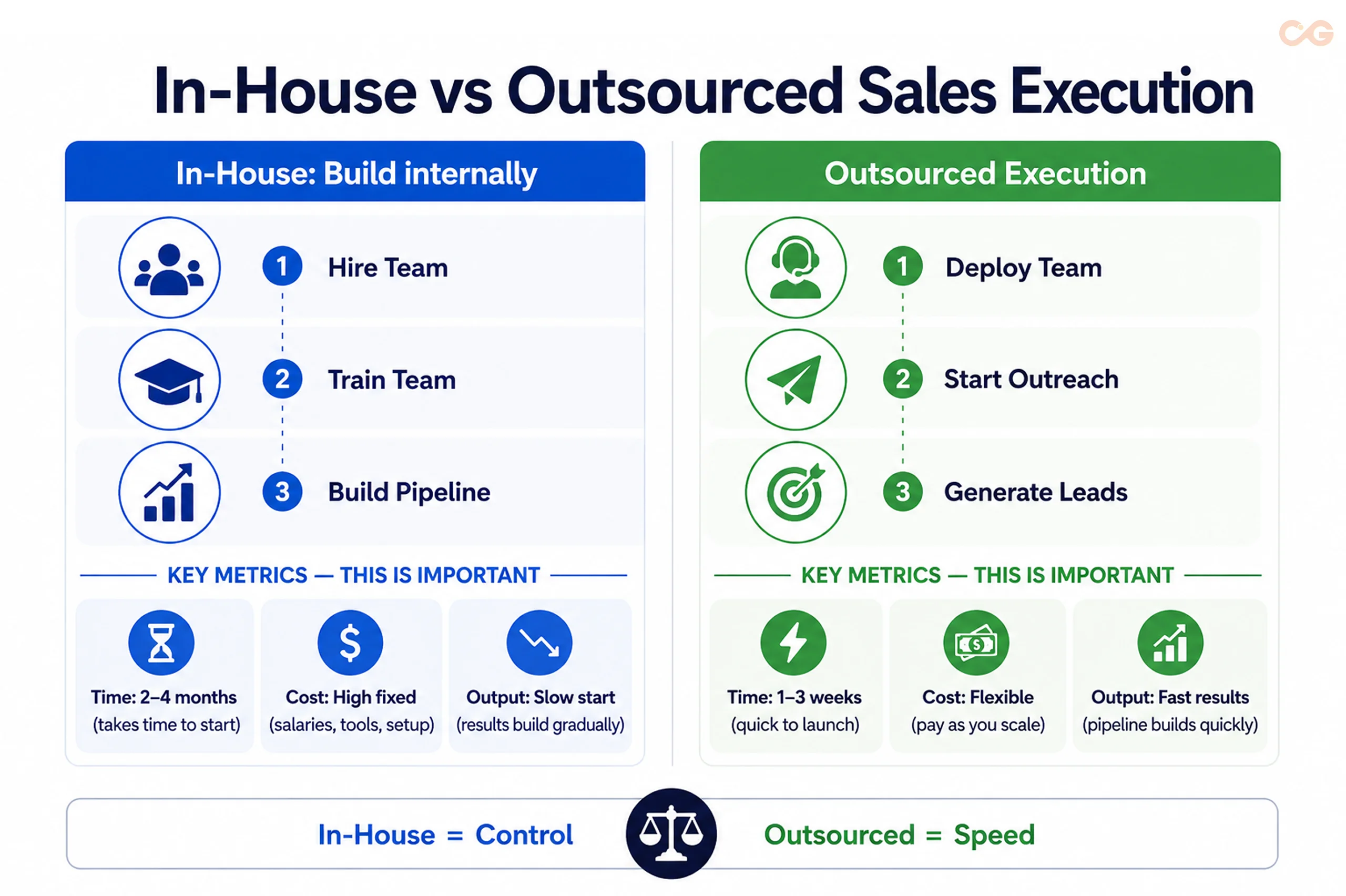
Sales outsourcing and in-house sales should not be viewed as competing approaches but as complementary parts of an effective sales strategy. Activities that require scale, consistency, and repeatable execution are often better suited for outsourced teams, while strategic responsibilities such as deal closing, account management, and customer relationships are best managed internally.
Finding the right balance between the two enables businesses to improve operational efficiency while maintaining control over the activities that have the greatest impact on long-term growth.
Takeaway

Don’t guess whether sales outsourcing is the right fit for your business. Test it with a structured 90-day pilot and use real performance data to make confident decisions.
3. The Sales Ownership Matrix (Practical Decision Framework)
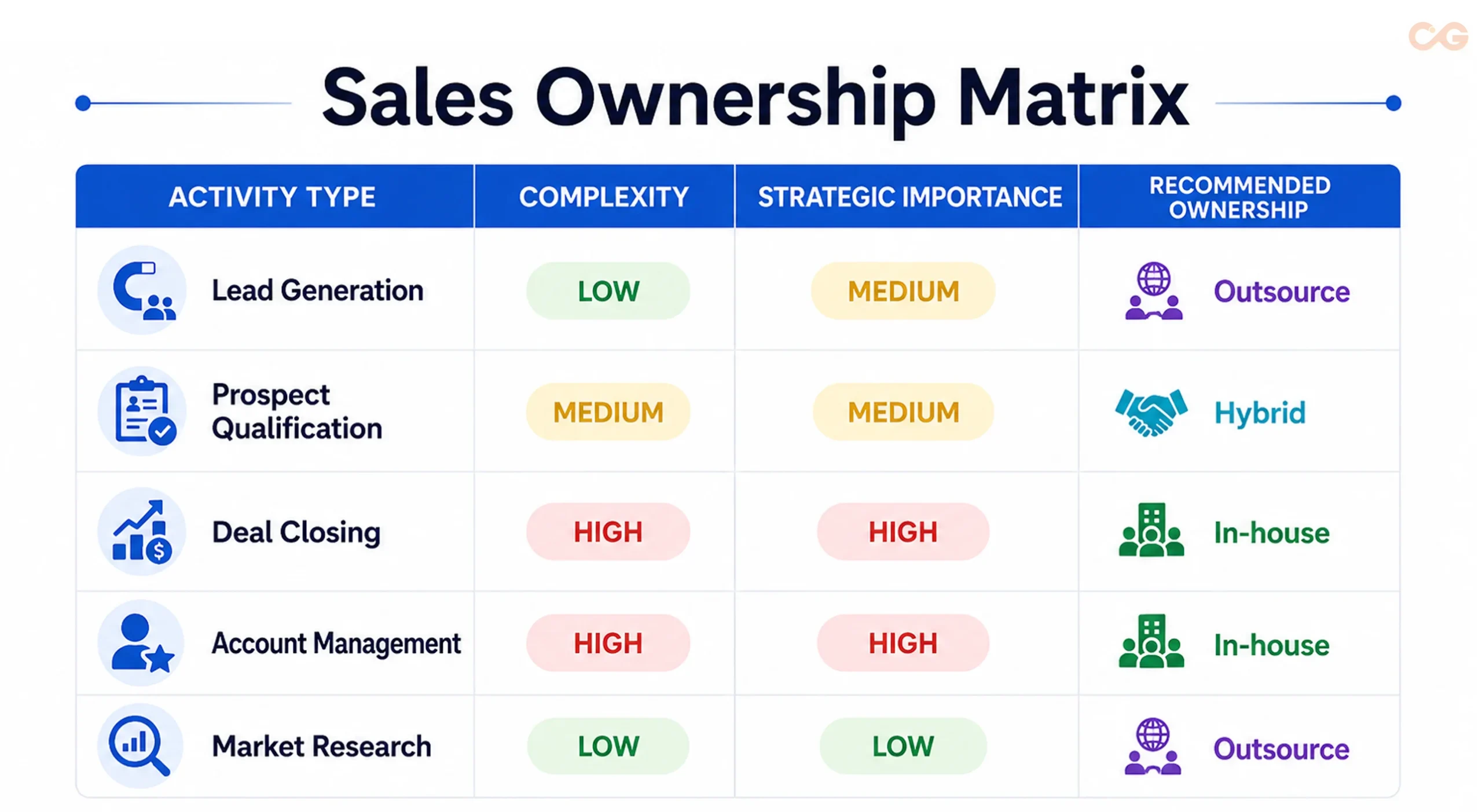
Understanding the difference between outsourced and in-house sales is only the first step. The next challenge is deciding which sales activities belong in each model. The Sales Ownership Matrix provides a simple framework to help businesses evaluate responsibilities based on their complexity, strategic importance, and execution requirements.
Key Insight
The most effective sales models assign ownership based on the nature of the activity rather than applying a single approach across the entire sales process. High-volume, execution-focused activities are generally better suited for outsourcing, while strategic, relationship-driven responsibilities are best managed by in-house teams. Activities that require both operational efficiency and business insight, such as prospect qualification, often benefit from a hybrid approach.
4. When to Outsource Sales
After identifying which sales activities require strategic ownership, the next step is understanding when sales outsourcing can create the greatest value. Outsourcing is most effective when businesses need to improve execution, scale operations, or access specialised expertise without increasing internal complexity.
4.1 Early-Stage or Growth-Stage Businesses
For businesses in the early stages of growth or expansion, sales outsourcing provides a practical way to accelerate execution without significant investment in hiring and infrastructure.
Key benefits include:
- Faster go-to-market execution through ready-to-deploy teams
- Access to experienced professionals and proven outreach strategies
- Reduced time spent on recruitment, onboarding, and training
This enables in-house teams to focus on product positioning, customer insights, and overall business strategy.
4.2 Enhancing Lead Generation Consistency
Lead generation requires structured processes, consistent execution, and ongoing optimisation. According to HubSpot, 61% of marketers identify generating traffic and leads as their biggest challenge, making it one of the most suitable functions for outsourcing.
Outsourced teams support this by:
- Delivering systematic outreach across multiple channels
- Scaling prospecting efforts for target audiences
- Maintaining a consistent flow of qualified leads
As a result, businesses can build a more predictable and sustainable sales pipeline.
4.3 Supporting Market Expansion
Expanding into new markets often requires additional sales capacity and local market insights. Outsourced sales teams can help businesses enter new regions or customer segments more efficiently by providing:
Outsourced teams support this by:
- Market research and customer insights
- Faster prospect identification and qualification
- Scalable outreach campaigns
This allows organisations to validate new opportunities while reducing the risks associated with market expansion.
4.4 Optimising Cost Structure
Sales outsourcing also provides greater financial flexibility by converting certain fixed sales costs into variable expenses.
This enables businesses to:
- Allocate budgets based on business priorities
- Scale sales activities according to demand
- Reduce long-term hiring, training, and infrastructure costs
As a result, organisations can improve cost efficiency while maintaining growth momentum.
4.5 Sales Activities Best Suited for Outsourcing
Not every sales function requires the same level of strategic ownership. Activities that are process-driven, repeatable, and execution-focused are generally better suited for outsourced teams.
These typically include:
- Lead generation and prospecting
- Appointment setting and lead qualification
- Market research and data enrichment
- High-volume inside sales
- Sales operations support, including reporting, pipeline tracking, and administrative tasks
Delegating these responsibilities enables in-house teams to concentrate on strategic priorities such as customer relationships, deal closing, account management, and business planning while maintaining a consistent and scalable sales operation.
Sales outsourcing delivers the greatest value when it supports high-volume, execution-focused activities, allowing businesses to scale efficiently while keeping strategic customer and revenue responsibilities under internal ownership.
5. What Should Remain In-House
Though outsourcing can enhance efficiency and facilitate rapid growth, not all sales tasks should be delegated to external teams. Certain functions necessitate an in-depth grasp of your business, close interdepartmental collaboration, and robust customer interactions. Retaining these operations internally ensures consistency, fosters trust, and bolsters long-term success.
5.1 Closing High-Value Deals
Closing significant deals often requires navigating multiple decision-makers, intricate negotiations, and customised solutions. Achieving success in these transactions involves more than sales expertise; it requires comprehensive knowledge of your products, customers, and business objectives.
In-house sales teams excel at:
- Managing complex negotiations
- Instilling confidence among key stakeholders
- Aligning solutions with customer needs and business goals
This level of understanding is crucial for securing high-value opportunities.
5.2 Managing Customer Relationships
Building strong customer relationships relies on trust, consistency, and impactful interactions. Research from Frederick Reichheld at Bain & Company reveals that a mere 5% increase in customer retention can lead to a profit boost of 25% to 95%. Thus, managing these relationships is most effectively done by in-house sales teamsfamiliar with the customer’s history, challenges, and future objectives.
5.3 Sales Strategy and Planning
Sales strategy defines the business’s path and must stay closely tied to our leadership. We must have a solid grasp of our priorities and long-term goals when setting revenue targets, pricing, and market positioning.
Key responsibilities include:
- Forecasting revenue
- Developing pricing strategies
- Defining market positioning
By keeping these decisions within the organisation, we ensure our sales strategy aligns with our overall business objectives.
5.4 Brand Messaging and Positioning
By keeping these decisions within the organisation, we ensure our sales strategy aligns with our overall business objectives.
Internal teams guarantee:
- Uniform communication at every customer touchpoint
- Alignment between our brand promises and customer expectations
- A stronger, recognisable brand presence
5.5 Customer Feedback Integration
Customer feedback serves as a vital source of insight. Internal teams are well-equipped to interpret this feedback and implement meaningful improvements across the organisation.
These teams are crucial for:
- Collecting customer and market insights
- Enhancing products and services
- Aligning feedback with sales and marketing strategies
By keeping this process in-house, we can respond effectively to changing customer needs and continuously enhance our products, services, and overall customer experience.
Takeaway
Don’t guess whether sales outsourcing is the right fit for your business. Test it with a structured 90-day pilot and use real performance data to make confident decisions.
6. When a Fully Outsourced Sales Model Makes Sense
While many businesses benefit from outsourcing selected sales activities, there are situations where outsourcing the entire sales function can be the more practical choice. This approach works best when speed, flexibility, and specialised expertise are more important than building an internal sales team from the outset.
6.1 Market Validation
When launching a new product or entering an unfamiliar market, businesses often need to test demand before investing in an internal sales team.
A fully outsourced sales team can help by:
- Validating market demand
- Testing sales messaging and outreach strategies
- Identifying target customer segments
This allows businesses to gather valuable market insights while reducing the cost and risk of building an internal team too early.
6.2 Limited Internal Resources
Startups and growing businesses don’t always have the budget, time, or resources to build a dedicated sales function.
In these situations, outsourcing can help organisations:
- Launch sales activities quickly
- Access experienced sales professionals
- Avoid the time and cost of recruitment, onboarding, and training
This enables businesses to maintain momentum while focusing internal resources on product development and business growth.
6.3 Standardised or High-Volume Sales
A fully outsourced model is often effective when the sales process is straightforward and highly repeatable.
This is particularly suitable for businesses with:
- Short sales cycles
- Standardised products or services
- High-volume prospecting and transactional sales
Because these activities follow structured processes, external sales teams can execute them efficiently while maintaining consistent performance.
6.4 Time-Bound Sales Initiatives
Businesses may also benefit from fully outsourced sales support during short-term initiatives, such as:
- Product launches
- Seasonal campaigns
- Market expansion projects
- Temporary increases in sales demand
Outsourcing provides the flexibility to scale sales efforts without placing additional pressure on internal teams or making long-term hiring commitments.
Case study:
IBM successfully used strategic sales outsourcing to support expansion into new markets while retaining control of customer relationships and overall sales strategy. This approach enabled the company to accelerate market entry, improve operational efficiency, and scale its sales efforts without building new internal teams for every region.
Industry Insight
Research by Gartner shows that 73% of B2B buyers prefer personalised engagement over generic sales outreach. This highlights that even when sales activities are fully outsourced, success depends on clear sales processes, strong collaboration, and messaging that aligns with customer needs.
7. When to Build or Strengthen In-House Sales Teams
While sales outsourcing can accelerate growth and improve execution, there comes a stage where building a strong in-house sales team becomes a strategic investment. As businesses mature, greater control over customer relationships, sales strategy, and revenue planning becomes essential for sustainable growth.
According to Gartner, by 2030, 75% of B2B buyers are expected to prefer human interactions when making complex purchasing decisions. This reinforces the importance of developing an in-house team that can build trust, navigate complex sales conversations, and deliver personalised customer experiences.
7.1 Established Product-Market Fit
Once a business has validated its product, identified its ideal customers, and established consistent demand, investing in an in-house sales team becomes a natural next step.
An internal team can:
- Refine sales strategies based on customer insights
- Strengthen customer engagement
- Drive long-term revenue growth
7.2 Complex Sales Environments
Businesses operating in enterprise or consultative sales environments often benefit from keeping sales activities in-house. Complex sales typically involve multiple stakeholders, longer sales cycles, and customised solutions that require close collaboration and a deep understanding of customer needs.
7.3 Relationship-Driven Growth
For businesses that rely on long-term customer relationships, account growth, and repeat business, an in-house sales team provides greater continuity and trust. These teams develop a deeper understanding of customer goals, making it easier to identify new opportunities and deliver ongoing value.
7.4 Revenue Predictability and Strategic Control
A dedicated in-house sales team gives businesses greater visibility into their sales pipeline and supports more accurate forecasting. It also enables stronger alignment between sales, marketing, and leadership, helping organisations respond more effectively to changing market conditions while maintaining control over long-term business strategy.
Key Takeaway
Building an in-house sales team becomes increasingly valuable as a business grows, especially when sales success depends on strategic decision-making, complex customer relationships, and long-term revenue planning. While outsourcing supports execution and scalability, an internal team provides the control and business knowledge needed for sustained growth.
8. The Hybrid Model: A Scalable Approach
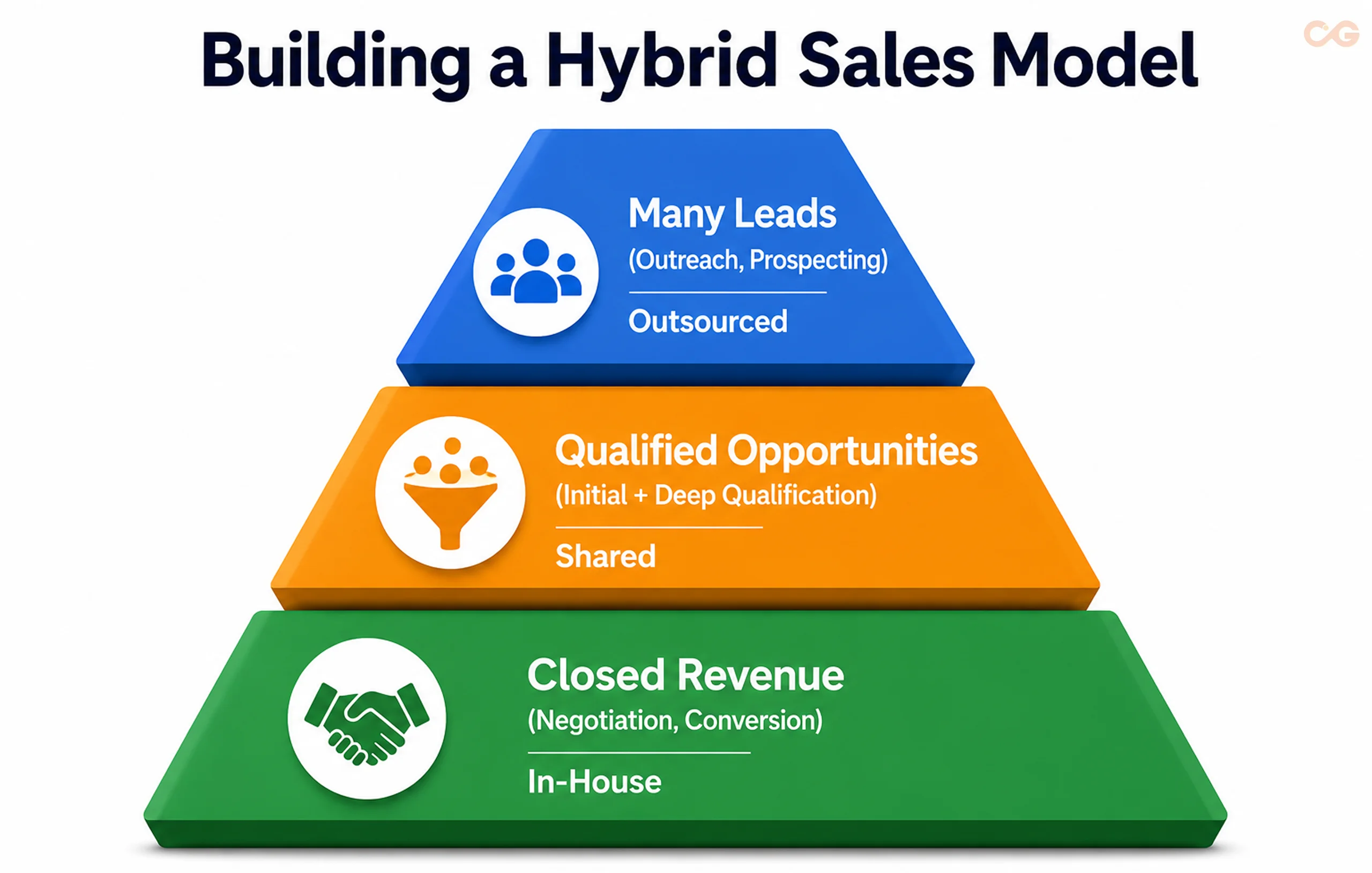
Many companies choose between using an outsourced sales team or an in-house team. Each option has its advantages, but relying solely on one approach can limit adaptability and growth. The hybrid sales model merges the benefits of both, allowing companies to efficiently scale sales efforts while retaining crucial customer relationships and revenue-generating activities.
8.1 How the Hybrid Model Operates
In a hybrid sales model, teams take on roles that align with their strengths:
An internal team can:
- Outsourced Sales Teams handle lead generation, prospecting, and maintaining a robust sales pipeline.
- In-House Sales Teams focus on closing deals, strategic planning, managing accounts, and nurturing long-term customer relationships.
Clearly defining these roles enhances operational efficiency and ensures that each segment of the sales process is managed by the most capable team.
8.2 Benefits of the Hybrid Model
An effective hybrid sales model provides several advantages:
- Ensures a steady pipeline through targeted prospecting efforts.
- Builds strong customer relationships and boosts revenue through in-house expertise.
- Optimizes sales costs by balancing fixed and variable expenses.
- Allows for scaling sales operations without losing strategic oversight.
By combining effective execution with strategic control, the hybrid model supports sustainable growth while maintaining authority over the key activities that drive long-term success.
8.3 Enhancing Sales Performance with a Hybrid Model
Companies with a defined sales structure achieve higher quota success, increased win rates, and better sales forecasts. The hybrid model fosters these results by clarifying roles throughout the sales process, minimising inefficiencies, and enhancing teamwork between internal and external teams.
This model provides a strong framework for businesses to merge the speed and scalability of outsourced sales with the strategic benefits of an in-house team.
Case Study: Microsoft – Scalable Hybrid Sales Model
Microsoft successfully expanded its global sales operations by combining partner-led sales with a strong in-house sales team. While partners and resellers focused on lead generation, distribution, and market reach, Microsoft’s internal sales teams retained ownership of enterprise sales, strategic customer relationships, and overall sales strategy.
This hybrid approach enabled Microsoft to scale efficiently without significantly increasing its internal sales workforce. By balancing outsourced execution with in-house strategic oversight, the company accelerated global expansion while maintaining control over high-value customer relationships and long-term business objectives.
Gartner notes that 67% of B2B buyers prefer a rep-free purchasing experience. This trend underscores the importance of digital engagement and partner-driven interactions alongside traditional sales methods. A hybrid sales model empowers businesses to meet these evolving buyer expectations while reinforcing strong customer relationships where personal interaction proves most beneficial.
8.4 Best Practices for Adopting a Hybrid Sales Model
To optimize a hybrid sales model:
- Define the roles of internal and outsourced teams clearly.
- Set shared objectives and performance measures.
- Foster consistent communication between both teams.
- Ensure alignment in messaging, processes, and customer ownership for a uniform customer experience throughout the sales journey.
Key Takeaway
A hybrid sales model enables businesses to blend the scalability of outsourced sales with the strategic benefits of an in-house team. By assigning roles based on strengths, companies can enhance efficiency, strengthen customer ties, and create a more reliable and sustainable sales process.
Takeaway
Don’t guess whether sales outsourcing is the right fit for your business. Test it with a structured 90-day pilot and use real performance data to make confident decisions.
9. How to Evaluate and Choose the Right Sales Partner
Choosing the right sales partner is just as important as deciding what to outsource. The right partner should complement your business goals, integrate smoothly with your existing sales team, and deliver measurable results. Taking a structured approach to evaluating potential partners can help you build a successful and long-lasting sales partnership.
9.1 What to Look For
When evaluating a sales outsourcing partner, consider whether they:
- Have experience in your industry or target market
- Follow proven sales processes that deliver consistent results
- Use data-driven strategies to measure, optimise, and report performance
These qualities indicate that the partner can support your business with scalable and reliable sales execution.
9.2 Questions to Ask Before You Decide
Before entering into a partnership, ask questions such as:
- How do you measure success across campaigns and sales activities?
- Which KPIs and performance metrics will you report on?
- How will your team collaborate with our in-house sales team?
- How often will you provide performance updates and reviews?
These questions help set clear expectations from the beginning and ensure both teams are aligned on objectives and responsibilities.
9.3 Signs of a Strong Sales Partner
A reliable sales partner should demonstrate:
- Transparent reporting and regular communication
- Well-defined sales processes and workflows
- A clear understanding of your business goals and revenue priorities
- A collaborative approach to working with your internal teams
When a sales partner offers transparency, accountability, and strategic alignment, businesses are better positioned to build a scalable sales function and achieve sustainable growth.
Key Takeaway
The success of sales outsourcing depends not only on what you outsource but also on who you choose as your partner. Selecting an experienced, transparent, and collaborative sales partner helps businesses maximise the value of outsourcing while maintaining alignment with their long-term growth objectives.
10. Conclusion
Building an effective sales organisation is not about choosing between outsourcing and an in-house team—it’s about assigning the right responsibilities to the right people. Businesses that understand which activities to outsource and which to manage internally can improve execution, scale more efficiently, and build a stronger, more predictable sales pipeline.
At the same time, keeping strategic responsibilities such as customer relationships, deal closing, and sales planning in-house helps maintain trust, strengthen collaboration, and support long-term business growth.
For many organisations, the most effective approach is a hybrid sales model that combines the speed and scalability of outsourced sales with the strategic oversight of an in-house sales team. By aligning each sales activity with the model best suited to deliver results, businesses can create a sales system that is efficient, adaptable, and built for sustainable growth.