
The Complete Guide to B2B Lead Generation Strategies
Table of Contents
- Introduction
- Understanding B2B Lead Generation
- Determining the Target Audience and Ideal Customer Profile (ICP)
- Core B2B Lead Generation Strategies
- Lead Qualification and Scoring
- Lead Nurturing and Engagement Strategies
- Aligning Sales and Marketing for Lead Generation
- Measuring and Optimising Lead Generation Performance
- Common Challenges in B2B Lead Generation
- Conclusion
1. Introduction: Scalable Sales Foundation
Traffic alone does not drive growth in B2B markets. Sustainable growth depends on consistently attracting high-quality leads that fit the business, show genuine buying intent, and can ultimately be converted into revenue. This makes a structured approach to B2B lead generation essential for building a predictable sales pipeline.
B2B buying journeys are typically longer and more complex than B2C purchases, involving multiple stakeholders, extensive research, and careful evaluation before a decision is made. Buyers increasingly investigate solutions independently, compare providers, and validate their options before engaging directly with a vendor.
Omniscient reports that B2B buyers conduct an average of 12 or more online searches before contacting a vendor. This highlights the importance of being visible throughout the buyer journey and recognising signals that indicate genuine purchase intent. As a result, businesses need a balanced B2B lead generation strategy that combines inbound, outbound, and referral or partnership channels.
This guide explains how to build, manage, and optimise a scalable B2B lead generation system—from defining your Ideal Customer Profile (ICP) and selecting the right acquisition channels to qualifying, nurturing, and converting leads into valuable sales opportunities.
2. Understanding B2B Lead Generation
What is B2B Lead Generation?
B2B lead generation is the process of identifying, attracting, and engaging businesses that have the potential to become customers. However, effective lead generation is not simply about generating a large number of contacts. The real objective is to attract prospects that match the business’s target profile, demonstrate relevant interest, and have the potential to progress towards a purchase.
A typical B2B lead moves through several stages before becoming a sales opportunity:
- Awareness Stage: Prospects first interact with a business through channels such as search, content, social media, referrals, or other marketing activities.
- Marketing Qualified Lead (MQL): A prospect meets defined marketing criteria based on factors such as profile fit and engagement, indicating that they may be worth further attention.
- Sales Qualified Lead (SQL): The prospect has demonstrated sufficient fit and buying intent to warrant direct engagement from the sales team.
- Opportunity Stage: The prospect is actively evaluating the solution, discussing requirements, comparing options, or moving towards a purchase decision.
These stages create a structured path from initial awareness to potential revenue. At each stage, businesses need to assess whether a prospect has the right fit, intent, and level of engagement to move forward. This helps sales teams focus their time on high-value prospects
Gleanster data reported by SalesHive says that only around 25% of generated leads are considered legitimate and should proceed to sales. While the statistic highlights the importance of qualification, it also illustrates a broader challenge: generating leads without a clear process for evaluating them can result in wasted sales effort and inefficient pipelines.
For this reason, a strong B2B lead generation strategy focuses on the entire journey—not just acquisition. Businesses need to identify the right prospects, capture relevant demand, qualify leads based on fit and intent, and move them through the funnel in a consistent and measurable way.
People Also Ask
How do you measure whether a B2B lead generation strategy is working?
A successful strategy should be measured by the quality and progression of the pipeline, not lead volume alone. Key indicators include lead-to-SQL conversion rate, opportunity creation, sales cycle length, pipeline contribution, and customer acquisition cost.
Takeaway

Keep your sales funnel performing at its best by following this practical review schedule for continuous optimisation.
3. Determining the Target Audience and Ideal Customer Profile (ICP)
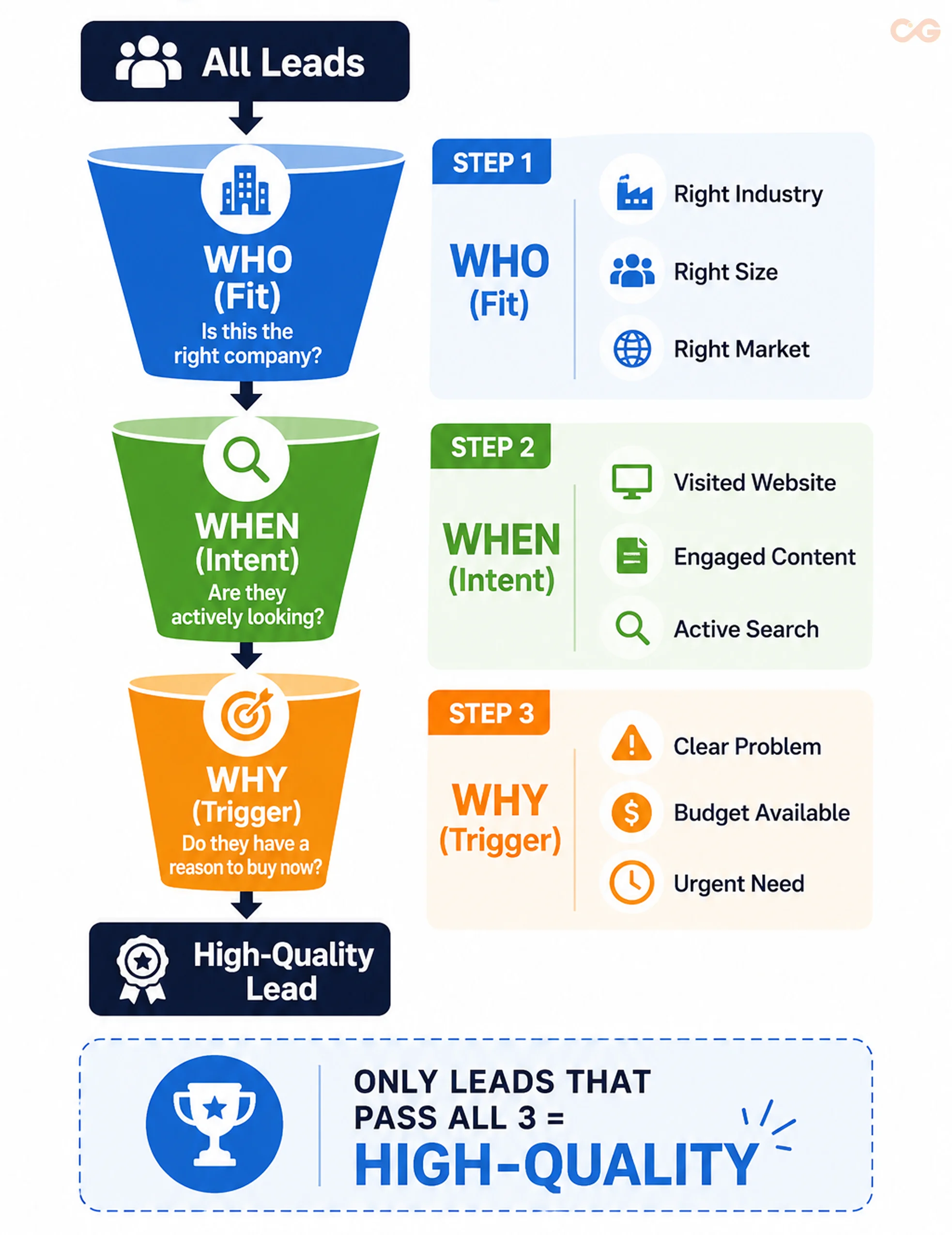
A successful B2B lead generation system starts with a clearly defined Ideal Customer Profile (ICP). Without one, businesses may generate a large number of leads but still struggle to identify which prospects are most likely to become customers. This can lead to wasted sales efforts, lower conversion rates, and longer, less efficient sales cycles.
An ICP is more than just a description of a target audience. It provides a clear picture of the businesses that are most likely to benefit from a company’s offering and become valuable customers. It also helps sales and marketing teams decide which accounts to prioritise and which opportunities are worth pursuing.
At a fundamental level, an ICP includes:
- Firmographic fit: Industry, company size, revenue, location, and business model.
- Buyer roles: Key decision-makers and influencers involved in the purchasing process.
- Business needs: Core challenges, pain points, use cases, and purchase triggers.
However, firmographic fit alone does not tell you whether a prospect is ready to buy. Modern lead generation strategies also consider intent signals to identify businesses that are actively researching a solution or looking for ways to address a specific problem.
Common intent signals include:
- Content engagement: Regularly reading relevant blogs, downloading whitepapers, attending webinars, or engaging with other useful resources.
- Website behaviour: Visiting high-intent pages, returning to the website, or spending time on product and service pages.
- Research activity: Showing relevant research behaviour on third-party platforms or industry resources.
Combining ICP fit with these intent signals makes it easier to distinguish between prospects that simply match your target profile and those that are actively considering a purchase. This is particularly useful for inbound lead generation, where behavioural signals can help identify prospects who are already researching potential solutions.
Ultimately, a well-defined ICP gives your lead generation strategies a clear direction. Instead of trying to reach the largest possible audience, businesses can focus their efforts on prospects that show the strongest combination of fit, intent, and potential value.
How to Identify a
4. Core B2B Lead Generation Strategies
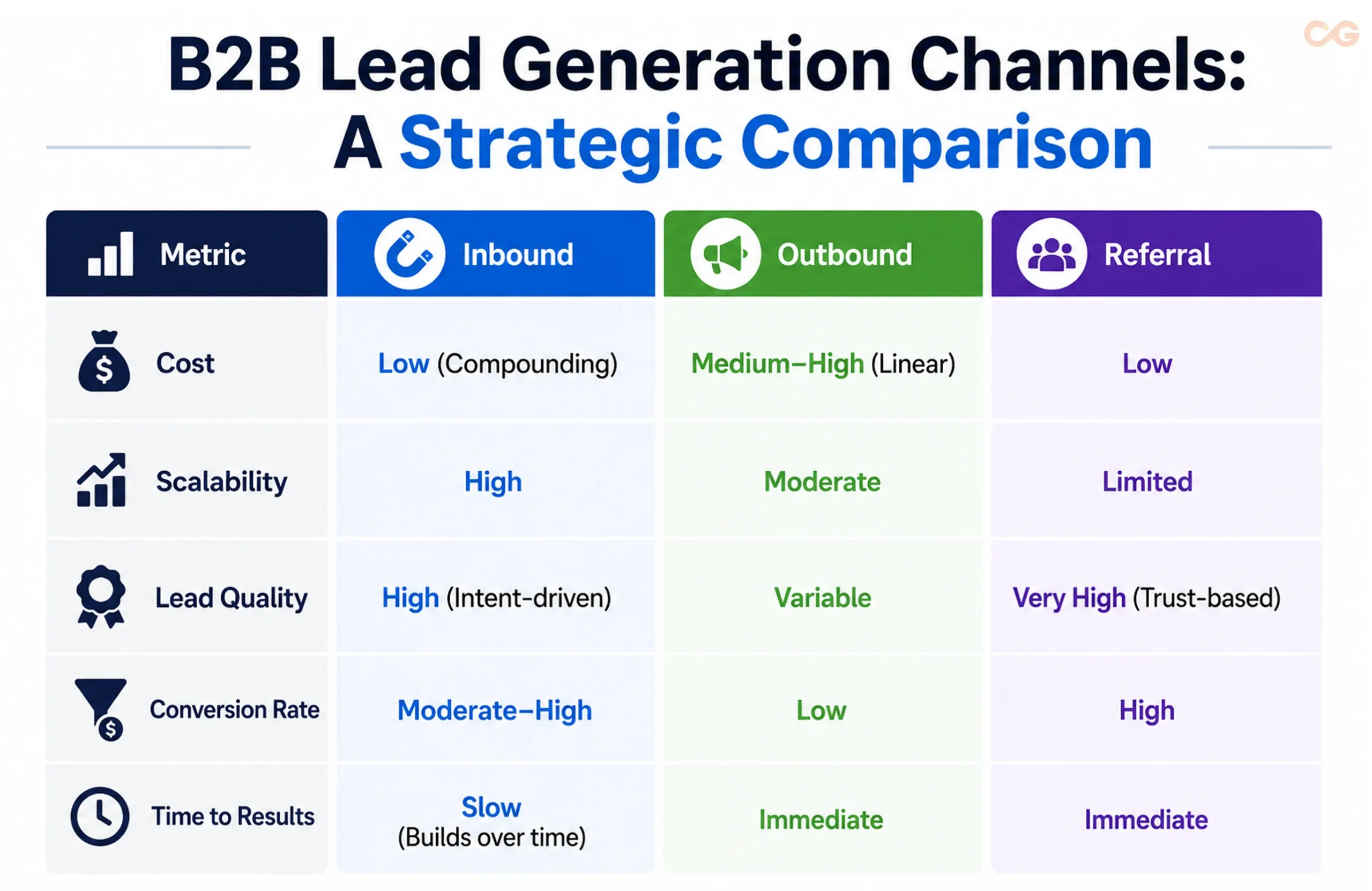
No single channel can meet every B2B acquisition goal. An effective B2B lead generation strategy combines multiple channels to attract prospects, build demand, and create a consistent sales pipeline. The right mix depends on the target audience, buying journey, available resources, and business goals.
4.1 Inbound Lead Generation Strategy
Inbound lead generation focuses on attracting potential customers by creating useful, relevant content that addresses their search intent, questions, and business challenges. Instead of approaching prospects directly, businesses create resources that help buyers discover and evaluate their solutions on their own.
Key inbound channels include:
- SEO-driven blog content targeting relevant, high-intent searches.
- Gated assets such as whitepapers, reports, and guides that capture prospect information.
- Educational resources and webinars that build trust and demonstrate industry expertise.
According to the Content Marketing Institute, B2B marketers that use content marketing report generating three times as many leads as those that do not. This highlights why content can play an important role in building a scalable inbound acquisition engine.
Inbound also aligns with how modern B2B buyers research solutions. Decision-makers often look for information independently before speaking with a vendor. By providing useful content throughout this research process, businesses can attract prospects earlier, build credibility, and capture demand as buying intent develops.
4.2 Outbound Lead Generation Strategy
Outbound lead generation involves proactively reaching potential customers rather than waiting for them to discover the business. It can help companies reach specific accounts, create demand, and accelerate pipeline development.
Common approaches include:
- Cold email outreach to relevant accounts and decision-makers.
- LinkedIn prospecting, connection-building, and social selling.
- Account-based marketing (ABM) focused on high-value target accounts.
Modern outbound strategies are less dependent on generic mass outreach. High-performing teams use account information, buyer research, personalisation, and intent signals to make their messaging more relevant to each prospect.
This makes inbound and outbound less about choosing one over the other and more about using them together:
- Outbound can proactively reach target accounts and accelerate pipeline creation.
- Inbound can attract prospects who are already researching relevant problems and strengthen their engagement with the brand.
When coordinated effectively, the two channels can create a more consistent and scalable lead generation strategy, with outbound expanding reach and inbound supporting demand capture and conversion.
4.3 Referral and Partnership Strategy
Referrals and partnerships can provide another valuable source of lead generation, particularly when trust plays an important role in the buying decision. Instead of relying entirely on paid or organic acquisition, businesses can use existing relationships and networks to reach relevant prospects.
Common approaches include:
- Strategic partnerships and industry alliances.
- Affiliate and co-marketing programmes.
- Customer referral programmes.
- Partner-led introductions and recommendations.
AnnexCloud reports that 92% of customers trust recommendations from people they know, highlighting the role that referrals can play in building credibility. Referral leads often enter the sales process with a higher level of trust because they have been introduced through an existing relationship.
Partnerships can also extend a company’s reach by connecting it with complementary audiences. For B2B businesses, this can be particularly useful when partners serve the same target market but offer non-competing products or services.
People Also Ask
Which lead generation channel is right for your business?
The right channel depends on your target audience, buying journey, sales cycle, budget, and available resources. Inbound is useful for building long-term demand, outbound can help reach specific accounts and accelerate pipeline creation, while referrals and partnerships can strengthen acquisition through existing trust and relationships.
5. Lead Qualification and Scoring
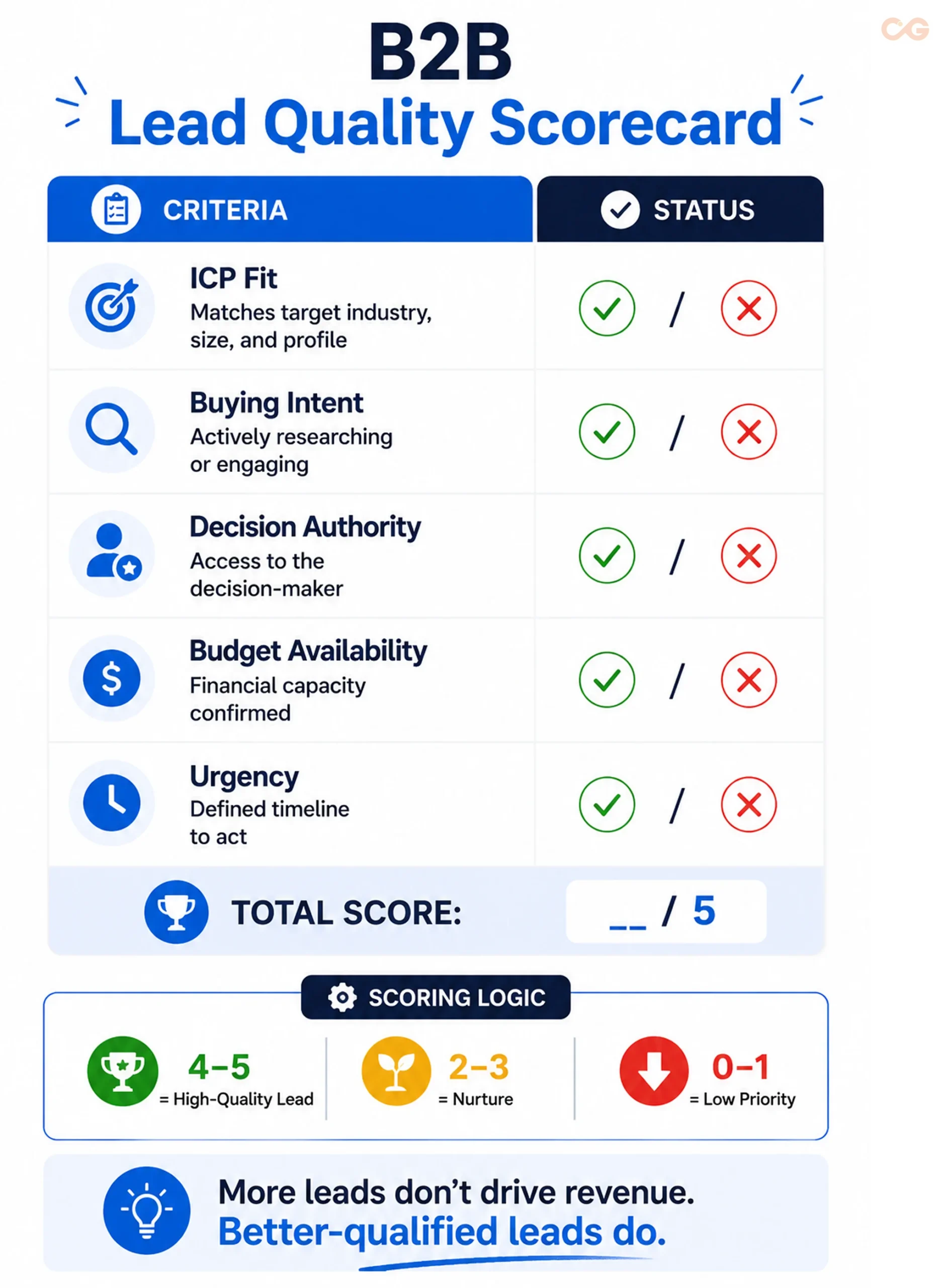
Generating a large number of leads does not guarantee a strong sales pipeline. When leads are not properly qualified, sales teams can spend valuable time on prospects that have little potential, leading to wasted resources and lower conversion rates. This makes lead qualification an essential part of any B2B lead generation strategy.
Effective lead qualification typically looks at two fundamental dimensions:
- Fit: How closely the lead matches the ICP based on factors such as industry, company size, role, and other relevant business characteristics.
- Intent: The signals that indicate a prospect may be considering a purchase, such as content engagement, website activity, or solution-related research.
Lead scoring builds on these factors by assigning values to specific characteristics and behaviours. This gives sales and marketing teams a consistent way to identify high-potential prospects and prioritise those that are more likely to convert.
Pengolin cites that firms using lead scoring can achieve up to 77% better ROI from lead generation because sales teams can focus their efforts on higher-quality opportunities. While the exact impact can vary by business and scoring model, the principle remains the same: prioritising leads based on relevant data can make sales efforts more efficient.
Lead scoring also helps create a clearer handoff between marketing and sales. By setting defined thresholds, businesses can determine when a lead has enough fit and intent to become a Marketing Qualified Lead (MQL) or progress towards a Sales Qualified Lead (SQL).
A simple scoring framework can therefore make the lead generation process more efficient by reducing time spent on low-intent prospects and helping teams focus their attention where it is most likely to create pipeline value.
6. Lead Nurturing and Engagement Strategies
Not every qualified lead is ready to make a purchase immediately. B2B buyers often need more time to research solutions, compare alternatives, involve other stakeholders, and build internal agreement before making a decision. As a result, effective lead nurturing is essential for keeping potential buyers engaged until they are ready for a sales conversation.
The goal of nurturing is not simply to increase the number of interactions. It is to build trust and provide relevant information that helps prospects move through the buying journey at the right pace.
Common lead nurturing strategies include:
- Email sequences: Delivering relevant information based on the prospect’s funnel stage, interests, and previous actions.
- Retargeting campaigns: Re-engaging visitors who have previously interacted with the website or high-intent content.
- Personalised content: Sharing resources that address a prospect’s specific interests, challenges, or stage in the buying process.
The effectiveness of nurturing depends less on communication volume and more on timing, context, and relevance. Sending the same message repeatedly can create unnecessary noise, whereas timely content that addresses a prospect’s current needs can help maintain engagement and build confidence.
Nurturing can also help move prospects from Marketing Qualified Leads (MQLs) towards Sales Qualified Leads (SQLs) by strengthening engagement and identifying when buying intent has increased. Once a prospect demonstrates sufficient interest and readiness, the sales team can step in with a more relevant and timely conversation.
People Also Ask
How can automation be used to nurture leads?
Sales automation can help businesses deliver timely follow-ups, email sequences, and behavioural communications at scale. However, automation is most effective when messages are based on the prospect’s interests, actions, and position in the buying journey rather than being sent as generic follow-ups.
Takeaway
Keep your sales funnel performing at its best by following this practical review schedule for continuous optimisation.
7. Aligning Sales and Marketing for Lead Generation
Generating and nurturing leads is only part of an effective B2B lead generation process. If sales and marketing teams work with different definitions, priorities, or expectations, qualified leads can be delayed, overlooked, or lost during the handoff. Strong alignment helps both teams work towards the same pipeline and revenue goals.
In high-performing organisations, sales and marketing operate as connected parts of the same revenue process rather than as separate functions. Marketing focuses on attracting and qualifying potential buyers, while sales uses those insights to engage the most promising opportunities and move them towards conversion.
Key practices for aligning sales and marketing include:
- Define MQL and SQL criteria: Agree on what makes a lead ready for sales so both teams use the same qualification standards.
- Establish service-level agreements (SLAs): Set clear expectations for when and how sales should follow up with qualified leads and how marketing supports the process.
- Share pipeline visibility: Give both teams access to relevant lead, engagement, and opportunity data so they can track progress and identify gaps.
- Create a feedback loop: Sales should share information about lead quality, objections, and buyer needs so marketing can refine targeting and messaging.
LinkedIn reports that stronger sales and marketing alignment can contribute to more consistent revenue performance and greater pipeline predictability, particularly when both teams work towards shared objectives and use common data.
This alignment is especially important across different lead generation strategies. Marketing can focus on attracting and screening prospects with relevant fit and intent, while sales can prioritise qualified opportunities and turn them into meaningful sales conversations.
Ultimately, sales and marketing alignment is more than simply coordinating activities. It creates a connected process in which leads are qualified, handed over, followed up, and tracked consistently throughout the funnel. This helps businesses reduce gaps between teams and create a more predictable path from lead generation to revenue.
8. Measuring and Optimising Lead Generation Performance
A successful B2B lead generation process requires more than consistent execution. Businesses also need to measure performance across the funnel to understand what is working, where leads are dropping off, and which areas need improvement. Without clear data, teams may focus on surface-level metrics such as lead volume without understanding whether those leads are contributing to meaningful sales opportunities.
Key metrics for measuring lead generation performance include:
- Cost per Lead (CPL): The average cost of acquiring a single lead through a specific channel or campaign.
- Conversion Rate: The percentage of leads that move from one stage of the funnel to the next.
- Pipeline Contribution: The value or proportion of leads that progress into sales opportunities and contribute to the pipeline.
- Customer Acquisition Cost (CAC): The total cost involved in acquiring a new paying customer, including the marketing and sales resources used throughout the acquisition process.
Looking at these metrics together gives businesses a clearer view of both acquisition efficiency and revenue impact. For example, a channel may generate leads at a low CPL but produce few qualified opportunities, while another channel may have a higher CPL but contribute more valuable pipeline.
McKinsey & Company research highlights the value of data-driven marketing in improving business performance and driving stronger revenue and ROI outcomes. For B2B businesses, using performance data consistently can help teams make better decisions about targeting, messaging, channel investment, and resource allocation.
Measurement should therefore lead to action, not simply reporting. Teams should regularly review funnel drop-offs, conversion rates, acquisition costs, and pipeline movement to identify bottlenecks and test improvements. Changes to targeting, content, messaging, channels, or follow-up processes can then be evaluated based on their impact on lead quality and revenue.
In this way, B2B lead generation becomes a continuous cycle of measuring, learning, testing, and optimising rather than a one-time campaign.
People Also Ask
Which is the most important lead generation metric in B2B?
There is no single metric that works for every business. Pipeline contribution and Customer Acquisition Cost (CAC) are particularly important because they connect lead generation activity with revenue and acquisition efficiency. However, businesses should evaluate these alongside metrics such as CPL and conversion rate to understand the performance of the complete funnel.
9. Common Challenges in B2B Lead Generation
Even well-planned B2B lead generation processes can face challenges that affect lead quality, funnel efficiency, and revenue predictability. These issues are often less about generating enough leads and more about reaching the right prospects, keeping them engaged, and moving them through the funnel efficiently.
Impact:
- High drop-off after initial engagement.
- Sales teams spend time on irrelevant prospects.
- Lower conversion rates and inefficient acquisition spend.
Solution:
Refine the ICP using relevant firmographic and intent signals. Apply consistent targeting criteria across inbound lead generation and other acquisition channels, then review lead quality regularly to identify which characteristics are associated with stronger conversion.
2. Long and Complex Sales Cycles
B2B purchases often involve multiple stakeholders, detailed evaluations, and internal approvals. As a result, prospects may take longer to make decisions, creating challenges for businesses trying to maintain engagement and keep opportunities moving through the pipeline.
Impact:
- Delayed revenue realisation.
- Prospects lose momentum during the evaluation process.
- Reduced pipeline velocity.
Solution:
Use structured lead nurturing to maintain relevant engagement throughout the buying journey. Provide prospects with useful content based on their needs and stage, and use engagement signals to identify when Marketing Qualified Leads (MQLs) are becoming ready for sales engagement as Sales Qualified Leads (SQLs).
3. Ineffective Sales and Marketing Handoffs
Even qualified leads can be lost when marketing and sales teams have unclear responsibilities or inconsistent follow-up processes. Delayed handoffs, unclear ownership, or different definitions of lead quality can create gaps between lead generation and sales engagement.
Impact:
- Delayed revenue realisation.
- Prospects lose momentum during the evaluation process.
- Reduced pipeline velocity.
Solution:
Establish clear service-level agreements (SLAs) between marketing and sales, including lead handoff and follow-up expectations. Define shared qualification criteria, assign clear ownership at each stage, and maintain real-time pipeline visibility so both teams can track lead progression.
Key Insight
B2B lead generation strategies should not be judged by lead volume alone. Sustainable results depend on reaching the right audience, qualifying leads effectively, maintaining engagement, and ensuring that sales and marketing work together to move opportunities through the funnel.
Takeaway
Keep your sales funnel performing at its best by following this practical review schedule for continuous optimisation.
10. Conclusion
Building an effective B2B lead generation system requires more than choosing a few lead generation strategies or relying on a single acquisition channel. It requires a connected approach that brings targeting, acquisition, qualification, nurturing, sales alignment, and ongoing optimisation together.
A scalable B2B lead generation system rests on four core pillars:
- A well-defined Ideal Customer Profile (ICP) that identifies the prospects most likely to become valuable customers.
- A balanced mix of inbound and outbound strategies that supports both demand capture and proactive prospecting.
- Effective lead qualification and nurturing systems that help teams prioritise high-potential prospects and develop those who are not yet ready to buy.
- Continuous measurement and optimisation to identify gaps, improve performance, and adapt to changing buyer behaviour.
The most successful organisations treat lead generation as an ongoing revenue process rather than a one-time campaign. They continuously refine their targeting, channels, messaging, and follow-up based on buyer behaviour, market changes, and performance data.
Ultimately, the goal is not to generate the highest possible number of leads. It is to consistently attract, qualify, nurture, and convert the right leads into meaningful sales opportunities and predictable revenue.