
Social Media Marketing on a Shoestring Budget: Ultimate Guide to Indian Small Businesses in 2026

Table of Contents
- Understanding India’s Unique Social Media Landscape
- How to Do Smart Social Media Marketing as a Small Business
- Chapter 1: How to Set Your Social Media Marketing Budget
- Chapter 2: Social Media Marketing Tools for Small Businesses
- Chapter 3: Content Creation Strategies That Appeal to Indian Audiences
- Chapter 4: Platform-Based Approaches to Social Media Marketing at a Low Cost
- Chapter 5: Micro-Influencer Marketing for Indian Small Businesses
- Chapter 6: Paid Advertising on a Shoestring Budget
- Chapter 7: How to Measure Social Media ROI and Grow on a Shoestring Budget
- Common Pitfalls and How to Avoid Them
- Conclusion: Build Your Social Media Success on a Small Budget
Running a small business in India often means managing everything from daily operations to customer acquisition – while competing with brands that have much larger marketing budgets. For many entrepreneurs, the challenge is not whether to invest in social media, but how to make a limited social media marketing budget deliver meaningful results.
The good news is that effective social media marketing does not always require a large budget. With the right platforms, consistent content, organic strategies, and targeted paid campaigns, small businesses can build visibility, engage their audience, and generate leads without overspending.
Whether you run a local restaurant in Mumbai, a handicraft business in Rajasthan, or a tech start-up in Bengaluru, this guide will show you how to plan, execute, and optimise cost-effective social media marketing in India in 2026 – helping you get more value from every rupee you spend.
Understanding India’s Unique Social Media Landscape
India’s social media ecosystem is one of the world’s largest, with over 491 million social media users, according to DataReportal. But its opportunity goes beyond audience size. India’s digital audience is spread across different age groups, languages, regions, and consumer preferences, making platform selection especially important for small businesses working with limited budgets.
Understanding India’s Unique Social Media Landscape
India’s social media ecosystem is one of the world’s largest, with over 491 million social media users, according to DataReportal. But its opportunity goes beyond audience size. India’s digital audience is spread across different age groups, languages, regions, and consumer preferences, making platform selection especially important for small businesses working with limited budgets.
India’s social media ecosystem is one of the world’s largest, with over 491 million social media users, according to DataReportal. But its opportunity goes beyond audience size. India’s digital audience is spread across different age groups, languages, regions, and consumer preferences, making platform selection especially important for small businesses working with limited budgets.
Instead of trying to maintain a presence everywhere, businesses should identify the platforms where their target customers are most active and concentrate their time and budget there.
Platform Dominance in India
A large audience does not automatically make a platform the right choice for your business. The most cost-effective platform is the one where your target customers are active, and your content can consistently generate meaningful engagement, enquiries, or sales.
Start with one or two relevant platforms instead of spreading your limited budget across every channel. Build an organic presence, track which content generates results, and then allocate paid spending to the formats and platforms that demonstrate the strongest performance.
People Also Ask: Which social media platform is the most ROI-effective for Indian small businesses?
For small businesses, ROI depends largely on the target audience, business type, and marketing goals. WhatsApp Business can be highly effective for local businesses focused on enquiries and conversions, while Instagram often works well for product-based businesses that rely on visual engagement. YouTube can be valuable for businesses using educational content to build trust and long-term customer relationships.
How to Do Smart Social Media Marketing as a Small Business
Chapter 1: How to Set Your Social Media Marketing Budget
Once you have identified the social media channels that best fit your target audience, the next step is to determine how much you should invest. A clear budget helps small businesses balance content creation, paid advertising, design, and performance tracking without overspending.
The Reality of Social Media Costs in India
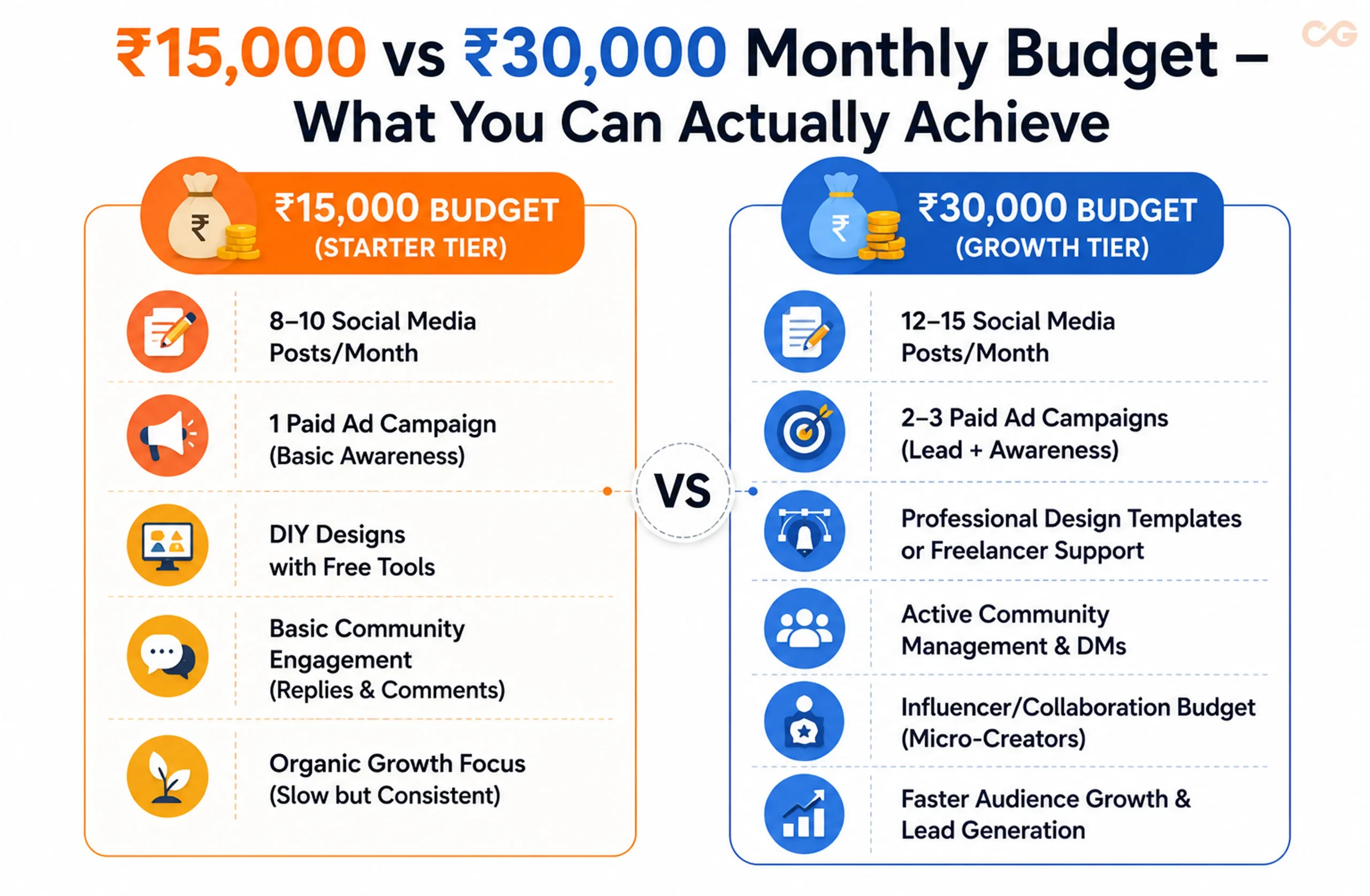
When outsourcing to agencies, small businesses usually spend INR 15,000 to INR 30,000 monthly, as per Kerplunk Media.
This provides a rough estimate of social media marketing costs for small businesses. Actual expenditure can vary depending on business objectives, industry, campaign requirements, target audience, selected platforms, and campaign performance. Use these figures as a general budgeting guideline rather than a fixed cost.
Budget Breakdown Framework
For businesses with a monthly budget of ₹15,000-₹30,000, a practical allocation can include:
- Content Creation Tools: 20% (₹2,000-6,000 per month)
- Paid Advertising: 50% (₹10,000-15,000 per month)
- Design & Graphics: 26% (₹2,500-8,000 per graphic)
- Analytics & Scheduling Tools: 4% (₹500-1,000 per month)
People Also Ask: What is the recommended amount that a small business in India should spend on social media marketing?
At present, an average of 12.1% of companies’ marketing budgets is spent on social media, and estimates show that this may increase to 19% in five years, according to Social Insider. For small businesses, the actual amount should be adjusted based on business goals, available resources, and expected returns.
People Also Ask: What is the recommended amount that a small business in India should spend on social media marketing?
At present, an average of 12.1% of companies’ marketing budgets is spent on social media, and estimates show that this may increase to 19% in five years, according to Social Insider. For small businesses, the actual amount should be adjusted based on business goals, available resources, and expected returns.
For small businesses working with limited budgets, the right free tools can simplify content creation, scheduling, customer communication, and performance tracking without requiring expensive software.
Content Creation Tools
- ChatGPT – The free version helps create social media captions, content ideas, hooks, calendars, and product copy, reducing the time spent on routine content creation.
- Google Gemini – The free version supports brainstorming, caption writing, rewriting, and creating content variations for different platforms and audiences.
- Canva – Its free version includes templates for Indian festivals such as Diwali, Holi, and Dussehra, making it useful for creating locally relevant marketing content.
- Unsplash – Provides high-quality, free-to-use stock photos, including visuals that can support Indian-themed content.
- Remove.bg – Automatically removes backgrounds from product images within seconds, making it useful for creating clean product visuals.
- Google Fonts – Supports Devanagari and other scripts, allowing businesses to create professional-looking content in Hindi and other Indian languages.
Content Creation Tools
- Meta Business Suite – A free tool for managing Facebook and Instagram accounts, scheduling posts, and monitoring insights.
- Later – Its basic plan provides 10 free posts per social profile each month, with one social set for planning.
- Buffer – Its free plan allows businesses to connect up to three social accounts and use basic post-scheduling features.
Analytics That Matter
Use Facebook Insights, Instagram Insights, Google Analytics, and YouTube Studio to track important metrics such as reach, engagement, website traffic, and video performance. These insights help small businesses understand what is working and make better content and marketing decisions.
Indian-Specific Tools
- WhatsApp Business – Helps businesses communicate directly with customers, manage enquiries, showcase products through catalogues, and build stronger customer relationships.
- Google My Business – Helps improve local visibility and makes it easier for customers to discover and contact businesses through Google Search and Maps.
- Hashtag Research Tools – Can help identify relevant and trending hashtags to improve content discoverability on social media platforms.
Pro Tip: The 80/20 Rule for Tools
Avoid using every tool available. Focus on 3-4 free tools that directly support your marketing goals. For many small businesses, a combination of ChatGPT, Canva, Meta Business Suite, WhatsApp Business, and platform-specific analytics can provide a strong foundation without adding unnecessary costs.
Chapter 3: Content Creation Strategies That Appeal to Indian Audiences
Understanding the Psychology of the Indian Consumer
Indian social media audiences are diverse, and content that reflects their cultural context, language, and everyday experiences can create stronger connections.
- Family-Centric Posts – Family-oriented content can create an emotional connection by reflecting values and experiences that are familiar to many Indian audiences.
- Festival Integration – Festival-related campaigns can generate 1.5-3x higher levels of engagement, making seasonal occasions valuable opportunities for relevant social media campaigns, according to Exchange4media.
- Regional Language Content – A KPMG-Google report indicates that 90 percent of users like native language content, highlighting the potential of regional-language communication.
- Value-Based Communication – Educational and informative content can perform better than purely promotional messaging because it provides value while helping businesses build trust and credibility.
Low-Cost Content Creation Strategies
1. Festival-Based Content Calendar
India’s extensive festival calendar provides small businesses with opportunities to create timely and culturally relevant content throughout the year.
Major Festival Strategy
- Diwali – Create gift guides, prosperity-focused content, product offers, and light-themed visuals.
- Holi – Use colourful, cheerful content that reflects celebration and energy.
- Eid – Focus on community, gratitude, togetherness, and thoughtful offers.
- Christmas – Build content around family, celebrations, gifting, and festive experiences.
Regional Festival Strategy
Go beyond the major national festivals by adapting content to regional celebrations and audiences:
- Durga Puja – Explore themes around culture, celebration, empowerment, and community.
- Ganpati – Create content around new beginnings, positivity, and overcoming challenges.
- Onam – Focus on harvest, prosperity, tradition, and togetherness.
- Karva Chauth – Use meaningful themes around relationships, love, and togetherness.
2. Indian Business Stories and Behind-the-Scenes Content
Indian audiences can connect strongly with authentic stories that reveal the people and processes behind a business. Small businesses can explore:
- Founder’s Journey – Share how the founder started the business, overcame challenges, or adapted to digital transformation.
- Artisan Spotlights – Showcase the people, skills, and traditional techniques behind handmade or locally produced products.
- Family Business Heritage – Highlight multi-generational stories to communicate authenticity, experience, and trust.
- Local Sourcing – Showcase locally sourced materials, Indian suppliers, traditional production methods, or initiatives that support local communities.
3. User-Generated Content Strategies
User-generated content can help small businesses build credibility by showing genuine customer experiences. In the “Real Users, Real Stories” campaign by Mamaearth, genuine testimonials from customers were used to share their skincare experiences and product usage. Videos and social media posts featuring real customer experiences helped the brand strengthen trust and credibility.
Through this campaign, Mamaearth was able to reach more than 25 million people and generate over 100K pieces of UGC content, with the majority created by micro and nano influencers in India, as per Zone Media. The approach also supported stronger brand loyalty and reinforced Mamaearth’s customer-focused positioning.
People Also Ask: What kind of content is the most engaged with on Indian social media?
Video content works particularly well, with 72% of consumers saying they prefer learning more about products by watching videos rather than reading text, as per Firework. Other effective formats include image carousels that explain step-by-step processes and user-generated content featuring customers from different regions of India.
Takeaway

Download the 30-Day DIY Social Media Marketing Challenge and start creating, engaging, measuring, and growing – without overspending.
Chapter 4: Platform-Based Approaches to Social Media Marketing at a Low Cost
Once you have selected the right channels and established your budget, the next step is to adapt your strategy to each platform. Small businesses do not need to be active everywhere – they can focus on the platforms that best match their audience and use their free features to maximise results.
WhatsApp Business: The Indian Game-Changer
WhatsApp Business has one of the highest penetration rates among Indian users, making it a powerful and cost-effective channel for customer communication, relationship building, and direct sales.
Free Features That Can Generate Sales:
- Business Catalogue – Showcase products with concise descriptions and prices in local currency, making it easier for customers to browse and make purchase decisions.
- Automated Messages – Set up welcome messages in Hindi or other regional languages to create a familiar and personalised customer experience.
- Quick Replies – Save predefined responses to answer frequently asked customer questions quickly and consistently.
- Broadcast Lists – Send promotions, offers, and updates to a maximum of 256 customers at a time, helping businesses communicate efficiently with their audience, according to Webmaxy.
Budget-Friendly WhatsApp Strategies:
- Share exclusive deals with your WhatsApp subscriber base to encourage purchases and improve retention.
- Provide customer support in customers’ preferred languages to make communication more accessible and personalised.
- Build community groups for loyal customers to encourage interaction, repeat purchases, and long-term relationships.
Cost-Effective Instagram Strategies
Instagram can help small businesses build visibility through consistent organic content without requiring a large advertising budget.
Reels Strategy:
- Use trending Bollywood or regional music where permitted and available within Instagram’s licensed music options to make content more engaging and culturally relevant.
- Create reusable festival-specific templates to save time and maintain visual consistency each year.
- Share behind-the-scenes footage of traditional production processes to highlight authenticity and craftsmanship.
- Showcase customer experiences and celebrations involving your products to build trust and a sense of community.
- Use polls, questions, and other interactive Story features to encourage regular audience participation.
Maximise location tags and regional-language features in Stories, and regularly share user-generated content to improve local discovery and strengthen brand trust.
Create tutorials in native languages, share festival preparation tips, feature customer reviews, and develop local guides for location-based businesses. Focus on practical, culturally relevant information that provides genuine value to your target audience.
Facebook: Community Building Across Demographics
Facebook remains useful for small businesses that want to connect with local communities and reach audiences across different age groups.
Free Facebook Growth Strategies:
- Facebook Groups – Create or participate in communities based on shared interests, such as Mumbai Food Lovers, to connect with relevant audiences.
- Facebook Events – Promote local workshops, sales, launches, or cultural events to increase attendance and awareness.
- Facebook Live – Host product demonstrations, Q&A sessions, or interactive discussions to engage with your audience in real time.
- Local Business Pages – Keep your page updated with accurate location and business information to improve local discoverability and attract nearby customers.
YouTube: Long-Term Brand Building
YouTube can provide long-term value for small businesses because useful videos can continue attracting viewers after publication.
Cost-Effective YouTube Content Ideas:
- Create regional how-to videos in local languages that solve common customer problems and position your brand as useful and trustworthy.
- Share festival-related content connected to your products or services to engage audiences around culturally relevant occasions.
- Feature customer success stories and interviews to build credibility and demonstrate real-world experiences.
- Develop local area guides for location-specific businesses to reach nearby audiences while showcasing your connection to the local community.
Chapter 5: Micro-Influencer Marketing for Indian Small Businesses
The Power of Local Influence
Influencer marketing allows businesses to collaborate with creators who already have an engaged audience. Depending on the arrangement, a business may pay the influencer a fee, provide free products or samples, or use a combination of both.
Indian Micro-Influencer Pricing (2025) as per Influencer Connect:
- Nano-Influencers (1K-10K followers): ₹500-2,000 per post
- Micro-Influencers (10K-100K followers): ₹2,000-10,000 per post
- Macro-Influencers (100K-1M followers): ₹50,000-2,00,000 per post
- Mega-Influencers (1M+ followers): ₹2,00,000-10,00,000 per post
Regional-language influencers are often a cost-effective option for businesses targeting specific local markets.
Identifying the Right Micro-Influencers
Rather than choosing micro-influencers based only on follower count, look for creators whose audience, location, content, and engagement align with your target customers.
- Local Food Bloggers – Suitable for restaurants, cafés, food brands, and local food businesses.
- Regional Fashion Influencers – Useful for clothing, accessories, and regional fashion brands.
- Mom Bloggers – Relevant for family-focused products, parenting brands, and household offerings.
- Fitness Enthusiasts – Suitable for fitness, wellness, and related brands with an active target audience.
- Travel Micro-Influencers – Useful for tourism businesses, hotels, experiences, and local destinations.
Case Study: Vanior Jewels
Vanior Jewels organised an influencer marketing campaign in Mumbai and partnered with 10 high-profile influencers to increase brand awareness. The campaign included personalised store visits and content across multiple social media platforms. The initiative reportedly helped the brand reach more than 1 million new customers in Mumbai, increasing brand awareness and engagement during the festive season, as per Socialveins.
People Also Ask: What is the way to get affordable influencers to promote my small business in India?
Use Instagram’s creator marketplace, search relevant city-based hashtags such as #MumbaiInfluencers and #DelhiBloggers, explore local Facebook communities, and directly approach micro-influencers whose audience matches your target customers. Prioritise audience relevance and engagement over follower count when selecting creators.
Repurpose Content Across Platforms
Small businesses can stretch their content budget further by adapting one strong piece of content for multiple platforms instead of creating everything from scratch.
For example, a Diwali product campaign can be repurposed as:
- Instagram: Reels, carousels, or product posts with relevant regional-language captions.
- Facebook A longer brand story connected to family, traditions, or the festival.
- WhatsApp: Personalised festival messages with product or catalogue links.
- YouTube: Behind-the-scenes videos showing the product, campaign, or festive preparations.
- LinkedIn: A business-focused post highlighting seasonal growth, expansion, or customer success.
Localise Where It Matters
Adapt your language, visuals, and cultural references to the audience you are targeting. For example, a business targeting Maharashtra can use Marathi, while businesses targeting Tamil Nadu, West Bengal, Andhra Pradesh/Telangana, or North India can consider Tamil, Bengali, Telugu, or Hindi content respectively.
The goal is not to create five different campaigns. Create once, adapt thoughtfully, and distribute strategically – saving both time and content production costs.
Takeaway
Download the 30-Day DIY Social Media Marketing Challenge and start creating, engaging, measuring, and growing – without overspending.
Chapter 6: Paid Advertising on a Shoestring Budget
Smart Spending Strategies
Paid social media marketing can help small businesses expand their reach, generate qualified leads, and drive conversions beyond their organic audience. However, a limited social media marketing budget requires careful planning. Instead of running ads across every platform, focus your social media advertising on the channels where your target audience is most active and where your business has the strongest potential for ROI.
Start with a small test budget and experiment with different audiences, creatives, and campaign objectives. Once you identify what generates meaningful results, gradually increase your spending rather than committing a large amount upfront.
Smart Targeting for Indian Audiences
- Geographic Targeting – Target specific cities, neighbourhoods, or regions based on your business location and customer base. This is particularly useful for local businesses with a defined service area.
- Language-Based Targeting – Use relevant regional languages in your ad creatives and messaging to connect more naturally with specific audience segments.
- Interest-Based Targeting – Reach potential customers based on relevant interests, behaviours, products, festivals, or lifestyle preferences.
- Lookalike Audiences – Reach new users who share characteristics with your existing customers, helping you expand your audience while maintaining relevance.
Cost-Effective Campaign Types
- Traffic Campaigns – Direct potential customers to your website, landing page, product page, or other relevant destination.
- Engagement Campaigns – Increase interactions with your social media content and improve brand visibility among relevant audiences.
- Lead Generation Campaigns – Collect customer details such as names, phone numbers, or email addresses through targeted advertising, helping businesses build a database of potential customers.
- Conversion Campaigns – Encourage specific actions such as purchases, bookings, registrations, or enquiries when the business has sufficient data and tracking in place.
Budget-Saving Approach
Do not judge an advertisement only by its reach or number of impressions. Track meaningful metrics such as cost per click, cost per lead, engagement, conversions, and return on ad spend (ROAS) to understand whether your investment is producing results.
Begin with a small test, compare different creatives and audience segments, pause underperforming ads, and gradually allocate more of your social media marketing budget to campaigns that demonstrate stronger results. This approach helps small businesses control costs while building a more predictable and effective paid advertising strategy.
Chapter 7: How to Measure Social Media ROI and Grow on a Shoestring Budget
Free Analytics That Matter
For small businesses, tracking the right metrics is essential to make the most of a limited social media marketing budget. Instead of focusing on vanity metrics alone, measure the activities that contribute to engagement, leads, website traffic, and revenue.
Key Metrics to Track:
- Audience Reach & Engagement – Monitor how many people see your content and how actively they interact with it. A 3-6% engagement range can be used as a reference point for small Indian businesses, as per Social Insider.
- Reach vs. Impressions – Compare unique reach with total impressions to understand whether your content is attracting new audiences or being repeatedly viewed by existing users.
- Website Traffic – Use Google Analytics to identify how much traffic comes from social media and which platforms or campaigns are driving visitors.
- Lead Generation – Track enquiries, form submissions, calls, or other customer actions generated through social media campaigns.
- Customer Acquisition Cost (CAC) – Divide total marketing spending by the number of new customers acquired to understand the cost of gaining each customer.
Free Tools for Tracking
Use Facebook Insights, Instagram Insights, Google Analytics, YouTube Analytics, and WhatsApp Business Analytics to monitor reach, engagement, website traffic, and customer interactions. Reviewing these metrics regularly helps businesses identify successful content and improve their strategy without unnecessarily increasing spending.
Zero-Cost Growth Tactics
You can strengthen your social media presence without increasing your advertising spend by using your existing team, customer relationships, communities, and content more effectively.
1. Employee Advocacy
Encourage employees to share company content, achievements, expertise, and behind-the-scenes moments through their personal networks. Authentic employee participation can humanise the brand and extend its organic reach.
2. Community Participation
Participate genuinely in relevant Facebook Groups, LinkedIn discussions, local business communities, and industry conversations. Focus on answering questions and providing useful insights rather than relying on constant promotion.
3. Content Curation
Share relevant industry news, local developments, customer success stories, and useful third-party content along with your own perspective. Repost customer-generated content with permission and proper credit to build credibility and community engagement.
4. Social Listening
Monitor brand mentions, customer conversations, industry discussions, and emerging topics using free platform features and tools. These insights can reveal customer needs, content ideas, and opportunities to join relevant conversations.
Partnership Strategies
Collaborating with complementary businesses can help small businesses access new audiences without significantly increasing marketing costs.
- Cross-Promotion – Promote each other’s products or services to reach relevant new audiences.
- Joint Campaigns – Combine resources to create shared campaigns, contests, or seasonal promotions.
- Local Networking – Participate in local business associations, events, and community initiatives to build valuable relationships and increase visibility.
- Co-Created Content – Create joint Reels, interviews, guides, or educational content to share production efforts and introduce both brands to new audiences.
Key Takeaway: The most sustainable low-cost social media strategy is not about constantly increasing your budget. It is about measuring what works, strengthening organic growth, and reinvesting your limited resources where they create the greatest impact.
Common Pitfalls and How to Avoid Them
Mistakes That Can Undermine Cost-Effective Social Media Marketing in India
A limited budget makes it even more important to avoid preventable mistakes. Small businesses can protect their time, money, and brand reputation by identifying common problems before they affect performance.
1. Ignoring Regional Preferences
Problem: Publishing only English content in markets such as Tamil Nadu can make communication feel less relevant to local audiences.
Solution: Use appropriate regional languages, cultural references, local traditions, and celebrations when they align with your target audience. Localisation should feel natural rather than forced.
2. Posting Too Much Without a Plan
Problem: Publishing multiple posts every day without a clear purpose can overwhelm followers, dilute your messaging, and make content less effective.
Solution: Prioritise quality and consistency over quantity. Create a content calendar, define the purpose of each post, and use audience insights to identify suitable posting times.
3. Neglecting Customer Service
Problem: Delayed responses to comments, messages, or enquiries can reduce customer confidence and create a poor brand experience.
Solution: Set clear response guidelines, monitor messages regularly, and provide timely, helpful, and personalised responses. For frequent/ly asked questions, use tools such as WhatsApp Business quick replies or automated messages.
4. Copying Strategies Without Localising Them
Problem: Replicating campaigns designed for Western audiences without considering India’s diverse cultural preferences can make a campaign feel irrelevant or insensitive.
Solution: Adapt global trends and campaign ideas to Indian festivals, regional celebrations, cultural values, and local consumer behaviour instead of copying them directly.
5. Ignoring Analytics
Problem: Creating content without reviewing its performance can waste limited time and marketing resources.
Solution: Regularly monitor metrics such as reach, engagement, website traffic, leads, and conversions. Identify high-performing content, test different approaches, and allocate more resources to strategies that deliver better results.
Quick Check: Before publishing, ask: Is this content relevant to my audience, does it serve a clear purpose, and can I measure its impact? If the answer is yes, you are more likely to make every piece of content count.
Takeaway
Download the 30-Day DIY Social Media Marketing Challenge and start creating, engaging, measuring, and growing – without overspending.
Conclusion: Build Your Social Media Success on a Small Budget
Effective social media marketing for small businesses is not about having the biggest budget – it is about having the right strategy. Focus on the platforms where your target audience is active, create culturally relevant content, and use free or low-cost tools to build a strong online presence without overspending.
Start small, stay consistent, and let your results guide your next move. Build genuine communities, collaborate with relevant local creators, and track your social media ROI to understand what is working.
With a well-planned social media marketing budget, consistent execution, and regular optimisation, affordable social media marketing in India can become a practical growth channel. You do not need to do everything – focus on what works for your business and invest more in those strategies over time.