
Programmatic SEO: A Complete Guide to Scalable Search Visibility
Table of Contents
- Introduction
- Understanding Programmatic SEO
- Core Components of Programmatic SEO
- Benefits of Smart Bidding for PPC Campaigns
- Key Advantages of Programmatic SEO
- Technical SEO for Programmatic Pages
- Avoiding Common SEO Traps
- Measuring & Optimising Performance
- Case Studies & Real-World Examples
- Conclusion
Introduction
Getting your website to appear in search results is becoming more challenging as people search for an ever-growing range of topics, products, services, and locations. Traditional SEO is still effective, but creating and optimising every page manually can become time-consuming when a business needs to target thousands of relevant search queries.
This is where programmatic SEO can help. By combining SEO automation, structured data, and reusable page templates, businesses can create and optimise large numbers of pages more efficiently.
With programmatic SEO, businesses can target thousands or even millions of relevant long-tail searches by creating pages around specific keywords, entities, and user intents. Instead of building every page from scratch, they can use a consistent framework and populate it with relevant data.
This makes it easier to expand organic search coverage while keeping the website organised and useful for visitors. Research from SEODiscovery says that a company using programmatic SEO increased its indexed pages by 35% and its organic traffic by 28% within six months.
In this guide, we’ll look at how programmatic SEO works, the key elements involved, the technical factors to consider, common challenges, and ways to measure and improve performance.
Whether you’re an SEO professional or a digital marketer looking to produce content at scale, this guide will help you understand how to use programmatic SEO effectively without losing sight of content quality or user experience.
Understanding Programmatic SEO
Definition and Key Principles
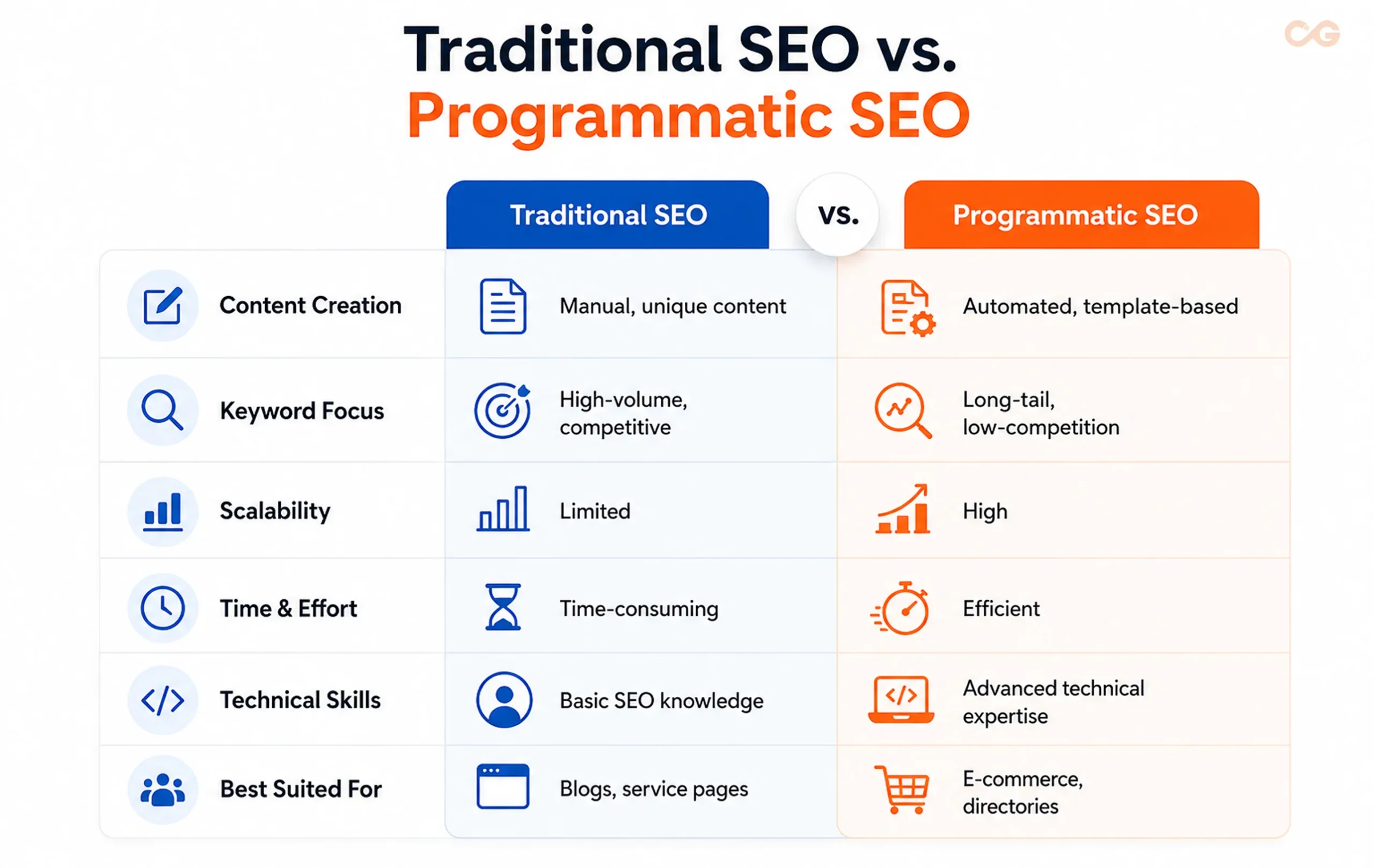
Programmatic SEO uses automation, structured data, and reusable templates to create and optimise a large number of SEO-focused pages. Unlike traditional SEO, where pages are often created manually for individual topics or keywords, programmatic SEO provides a more scalable way to target a broad range of search queries.
The approach is built around four key principles:
Automation: Pages can be generated dynamically using scripts, APIs, or CMS tools, reducing the need to create and update every page manually.
Template-Driven Content: Reusable page templates provide a consistent structure while allowing elements such as locations, product specifications, prices, or other attributes to change based on the available data.
Data-Driven Targeting: Structured datasets provide the information needed to create relevant pages around specific long-tail and entity-based keywords.
User Intent Alignment: Each generated page should address the searcher’s specific intent, whether it is informational, navigational, or transactional.
When these elements work together, programmatic SEO allows businesses to expand their search visibility across a large number of relevant queries while maintaining a consistent site structure.
Takeaway

Need a complete reference for your Programmatic SEO stack? Download our easy-to-use guide to explore the tools that support keyword research, data management, automation, auditing, measurement, and page management.
How Search Engines Evaluate Programmatically Generated Pages
Creating pages at scale does not automatically make them valuable. Search engines evaluate programmatically generated pages based on factors such as relevance, content quality, uniqueness, and technical performance.
Relevance: Does the page directly address the user’s search query and intent?
Uniqueness: Does the page provide meaningful information that distinguishes it from other pages on the site?
Technical Soundness: Is the page accessible, well structured, mobile-friendly, and fast enough to provide a good experience?
When programmatic SEO is supported by useful data, well-designed templates, and strong quality controls, generated pages can attract relevant organic traffic. However, creating large numbers of pages without sufficient value can lead to thin, repetitive, or low-quality content.
Core Components of Programmatic SEO
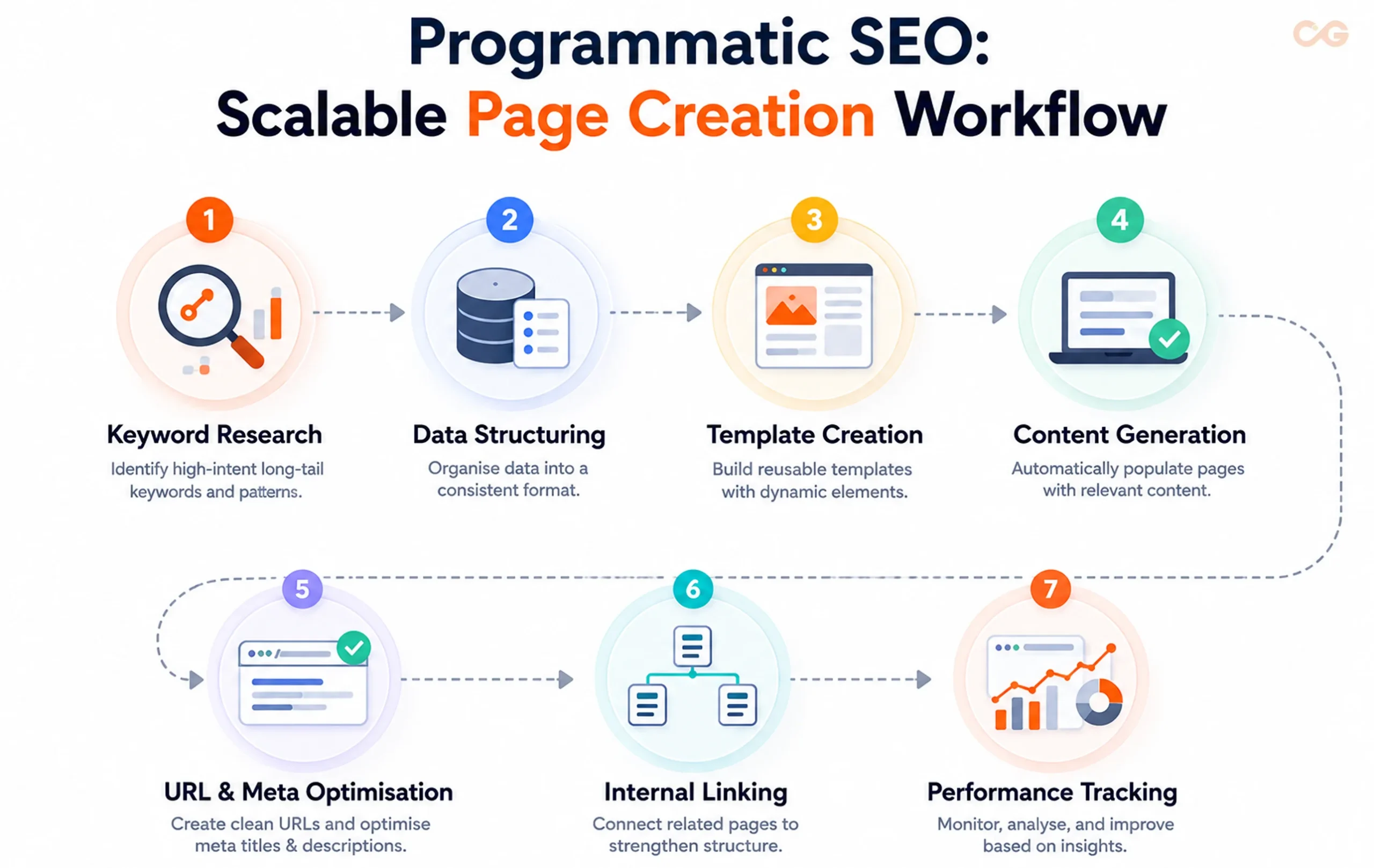
Once the fundamentals of programmatic SEO are clear, the next step is understanding the components that make large-scale page creation possible. From identifying scalable search opportunities to structuring data and connecting pages, each component plays a role in building an effective programmatic SEO system.
Keyword Research at Scale
Keyword research is the starting point for identifying search opportunities that can be targeted through programmatic SEO. Instead of focusing on individual keywords, the goal is to find repeatable search patterns that can support multiple pages.
Long-Tail Keywords: Focus on specific search queries that may have lower individual search volumes but can collectively attract significant traffic. For example, queries such as “pet-friendly 2 BHK apartments in Whitefield Bengaluru near IT parks” can represent specific and highly relevant search demand.
Entity-Based Keywords: Identify search terms connected to entities such as locations, products, services, or categories. These entities can then be used as dynamic variables within page templates.
Keyword Clustering: Group semantically related keywords and queries to identify content patterns and avoid creating multiple pages that compete for the same search intent.
Search Intent Mapping: Classify keywords according to user intent, such as informational, navigational, or transactional. This helps determine the type of content and page structure required for each keyword group.
Tools such as Ahrefs, SEMrush, and Google Keyword Planner can help identify keyword opportunities at scale, while clustering methods can help organise them into meaningful groups.
Content Templates & Automation
Once keyword opportunities have been identified, reusable templates provide the structure needed to create pages efficiently. A well-designed template maintains consistency while allowing relevant information to change from one page to another.
Dynamic Fields: Templates can include variables such as location, product attributes, price, ratings, or service details. These fields are populated automatically using information from relevant data sources.
Intent Alignment: Templates should be designed around the search intent, not just the target keyword. For example, a “best [product] in [location]” page may need product comparisons, reviews, pricing information, and location-specific details.
Rich Content Elements: Where relevant, include elements such as FAQs, reviews, images, videos, comparisons, and other useful information. These elements can make pages more informative and reduce the risk of creating generic, repetitive content.
Automation Tools: CMS plugins, custom scripts, APIs, or platforms such as Webflow and Airtable can automate content population and page creation, reducing manual effort.
The goal is not simply to create more pages, but to create useful and relevant pages at scale through a flexible template system.
Database-Driven Content Generation
Programmatic SEO depends on reliable and well-structured data. The quality of the underlying dataset directly affects the quality and usefulness of the pages generated from it.
Internal Databases: Existing datasets, such as product catalogues, property listings, or service directories, can provide the information needed to populate programmatic templates.
APIs and Third-Party Data: External data sources, such as maps, weather information, or review platforms, can add relevant information to pages where appropriate.
Unique Data Points: Using meaningful differences in the underlying data helps ensure that each page provides information relevant to its specific topic, location, product, or service rather than simply replacing a few words in the same template.
Structured Data Markup: Schema.org markup, such as Product, FAQ, or How-To, can help search engines understand specific types of information on a page when the markup accurately reflects the visible content.
A reliable database therefore forms the foundation of a scalable system, helping businesses create pages that are both consistent and relevant.
Internal Linking Strategy
Creating thousands of programmatic pages is only part of the process. Those pages also need to be connected through a clear internal linking structure so that users and search engines can discover and navigate them effectively.
Automated Linking: Scripts or CMS functionality can create links between related pages based on shared attributes such as category, location, product type, or service.
Descriptive Anchor Text: Use clear and relevant anchor text that helps users understand what they will find on the linked page.
Hierarchical Linking: Organise links according to the site’s structure. For example, a category page can link to relevant subcategories, which can then connect to individual programmatic pages.
Contextual Linking: Add links where they are genuinely useful within the page content rather than adding links simply to increase the number of internal links.
A well-planned internal linking strategy helps users move between related pages while making it easier for search engines to discover and understand the relationships between different sections of a large website.
Key Advantages of Programmatic SEO
Programmatic SEO helps businesses build a broader search presence while making large-scale page creation more manageable. Its key advantages include:
1. Expands Keyword Coverage: Programmatic SEO makes it easier to target large numbers of long-tail and niche keyword variations, helping websites capture a wider range of relevant searches.
2. Addresses Specific Search Intent: Pages can be tailored to specific keywords, locations, products, services, or other entities, allowing businesses to provide information that closely matches what users are looking for.
3. Maintains Consistent Page Structure: Reusable templates and structured data create a consistent framework across large numbers of pages while allowing relevant information to vary based on the target search query.
4. Reduces Manual Content Effort: Automation, databases, and reusable templates reduce the need to build each page from scratch, helping SEO teams manage large volumes of SEO-optimised content more efficiently.
5. Creates a Repeatable SEO Process: Once the underlying system is established, businesses can apply the same process to new keywords, products, locations, or services, making it easier to expand their SEO efforts over time.
Technical SEO for Programmatic Pages
Creating pages at scale is only one part of programmatic SEO. As the number of pages grows, a strong technical foundation becomes essential for helping search engines discover, crawl, understand, and index the right pages.
a. Site Architecture & URL Structure
A clear site structure helps both users and search engines navigate a large website and understand how its pages are related. This becomes especially important when hundreds or thousands of programmatic pages are being created.
Use Descriptive URLs: Keep URLs short, clear, and relevant to the page topic. For example, /seo-services/houston/ or /running-shoes/flat-feet/seattle/ gives users and search engines a better idea of what each page covers.
Keep URL Parameters Under Control: Avoid unnecessary parameters that can create multiple versions of the same page. Where parameters are necessary, use them carefully to prevent duplicate or low-value URLs from being crawled and indexed unnecessarily.
Organise Pages into Logical Groups: Use categories, subcategories, and other meaningful relationships to organise programmatic pages. This creates a clearer site hierarchy and makes related content easier to discover.
Manage Pagination Carefully: For sites with paginated listings, make sure each page has a crawlable URL, relevant content, and clear links to other pages in the sequence. Avoid relying on outdated pagination signals such as rel=”next” and rel=”prev” as a primary indexing mechanism.
b. Schema Markup & Structured Data
Structured data can help search engines better understand the information presented on programmatic pages. When used correctly, it can also make eligible pages suitable for certain enhanced search features.
Use Relevant Schema Types: Choose schema types that accurately represent the page content, such as Product, LocalBusiness, Event, or other applicable types. Only add markup that reflects information visible and relevant on the page.
Automate Schema Generation: When publishing pages at scale, schema markup can be generated from the same structured data used to populate page templates. This helps maintain consistency and reduces repetitive manual work.
Keep Markup Accurate: Automatically generated schema should be reviewed regularly to ensure that it matches the current page content. Incorrect or outdated structured data can reduce its usefulness to search engines.
c. Page Speed & Performance Optimisation
Large programmatic websites can contain thousands of pages and substantial amounts of content and media. Keeping these pages fast and responsive is therefore important for both user experience and overall site performance.
Monitor Core Web Vitals: Pay attention to metrics such as Largest Contentful Paint (LCP), Interaction to Next Paint (INP), and Cumulative Layout Shift (CLS) to identify potential user-experience issues.
Use Caching and CDNs: Server-side caching and content delivery networks (CDNs) can help deliver frequently requested resources more efficiently, particularly for websites serving users across different regions.
Optimise Page Assets: Compress images, use efficient image formats such as WebP where appropriate, and reduce unnecessary JavaScript and other resources that can slow down page loading.
Prioritise Mobile Performance: Since Google uses mobile-first indexing, programmatic pages should work well on mobile devices as well as desktops. Check page speed, navigation, layouts, and interactive elements across different screen sizes.
A strong technical foundation helps programmatic pages remain accessible, crawlable, and useful as a website grows. Combined with valuable content and well-structured templates, these technical practices make it easier to manage SEO at scale.
Takeaway
Need a complete reference for your Programmatic SEO stack? Download our easy-to-use guide to explore the tools that support keyword research, data management, automation, auditing, measurement, and page management.
Technical SEO for Programmatic Pages
Creating pages at scale can make SEO more efficient, but it also comes with a few challenges. If similar pages, low-value content, or unnecessary URLs are left unchecked, they can affect the overall quality of a website. Here are some practical ways to avoid the most common issues.
1. Tackling Duplicate Content Issues
When many pages are built from the same template, it is easy for them to end up looking too similar. The goal is not to make every page completely different, but to make sure each page offers something useful and relevant to its target search.
Use Canonical Tags: When multiple URLs contain substantially similar content, use canonical tags to tell search engines which version should be treated as the preferred one. This can help consolidate signals between similar pages.
Add Meaningful Variation: Simply changing a keyword or location name is not enough. Add relevant information such as product details, local insights, comparisons, or other data that makes each page useful for its specific search query.
Manage Pagination Carefully: If your website has paginated content, make sure each page has a clear purpose and a crawlable URL. Avoid creating unnecessary versions of pages that provide little additional value.
2. Ensuring Quality and Avoiding Thin Content
Creating thousands of pages does not automatically mean creating thousands of valuable pages. If a page contains little useful information beyond automatically inserted keywords or data, it may not give users a good reason to stay or return.
Combine Automation with Human Review: Automation can handle the scale, but human review is still important. Check generated pages for accuracy, relevance, depth, and consistency before publishing them widely.
Use AI for Quality Checks: AI tools can help identify repetitive language, missing information, or potentially low-value pages. Use these tools as an additional quality check rather than relying on them to make the final editorial decision.
Add Unique Value to Each Page: Look for ways to make each page more useful through original insights, comparisons, FAQs, visuals, reviews, or user-generated content. The additions should be relevant to the specific topic and search intent rather than added simply to make the page longer.
3. Smart Indexation Management
Not every page created through a programmatic system needs to appear in search results. Keeping unnecessary or low-value pages out of the index helps search engines focus on the pages that matter most.
Use Robots.txt and Noindex Appropriately: Use robots.txt to control crawling where necessary, while noindex can be used for pages that should not appear in search results. Choose the appropriate method based on what you want search engines to do with each page.
Keep XML Sitemaps Organised: Include the canonical, index-worthy URLs you want search engines to discover. Keep your sitemaps updated as pages are added, removed, or changed.
Conduct Regular SEO Audits: Review your indexed pages regularly to find duplicate, outdated, low-value, or underperforming URLs. Depending on the situation, improve, consolidate, or remove these pages to keep the site healthy.
Ultimately, successful programmatic SEO is not about getting as many pages indexed as possible. It is about creating and maintaining pages that are genuinely useful, relevant, and worth finding in search results.
Measuring & Optimising Performance
Creating programmatic pages is only the first step. Once they are live, you need to monitor their performance to understand what is working, where users are dropping off, and which pages or templates need improvement. Regular measurement helps turn programmatic SEO into an ongoing process rather than a one-time setup.
Important Metrics to Track
The right metrics can show whether your programmatic pages are attracting relevant visitors and contributing to your business goals.
1. Organic Traffic: Track the amount of traffic your programmatic pages receive from search and how it changes over time. Comparing different page groups or templates can also help identify which ones are performing well.
2. Click-Through Rate (CTR): CTR shows how often users click your page after seeing it in search results. A lower CTR may indicate that your title or description could better match the user’s search intent and expectations.
3. Engagement Metrics: Metrics such as engagement time and interactions can help identify pages where users may not be finding the information they expected. These metrics are more useful when considered alongside the page’s purpose and search intent.
4. Conversion Rate: Organic traffic is valuable, but it is not the only measure of success. Conversion rate shows whether visitors from programmatic pages are taking meaningful actions, such as submitting a form, making a purchase, or requesting a service.
A/B Testing and Continuous Optimisation
Programmatic SEO should not be treated as a set-and-forget strategy. Testing and refining different elements over time can help you understand what works best for different page types and audiences.
Test Templates and Page Elements: Where appropriate, test variations in page layouts, headings, calls to action, or other on-page elements to identify what improves engagement and conversions.
Make Data-Driven Decisions: Use performance data to compare page groups, identify underperforming templates, and find areas that need improvement. Rather than changing the entire system at once, focus on the areas where the data shows the greatest opportunity.
Keep Refining the Strategy: Search behaviour, competition, content performance, and website conditions can change over time. Review your templates, content, internal links, and technical setup regularly, and make adjustments based on performance.
A successful programmatic SEO strategy is built on continuous improvement. By tracking the right metrics and using those insights to refine pages and templates, businesses can expand their search presence while keeping the quality and usefulness of their content under control.
Case Studies & Real-World Examples
Real-world examples make it easier to see how programmatic SEO works beyond theory. 99acres shows how property and location data can be used to create pages at scale, while Thomas Cook India demonstrates how travel businesses can use similar techniques to target specific destination and package searches.
99acres: Scaling Real Estate Search with Programmatic SEO
99acres is a good example of programmatic SEO in the real-estate industry. According to an upGrowth case study, the platform uses dynamically generated pages around locations, cities, property types, and other real-estate searches. These pages are built using structured templates and data from its property database.
The case study reports 17.9M+ monthly organic traffic and 46M+ pages indexed on Google. Examples include pages such as “{Locality} Map, Property Rates, Projects, Reviews, Photos & Videos” and “Property in {Location} – Real Estate in {Location}.” This approach allows 99acres to target highly specific searches related to different locations and property needs.
The example ties closely to several principles covered earlier in this guide, including database-driven content generation, dynamic templates, location-based keyword targeting, structured data, and internal linking.
Thomas Cook India: Targeting Travel Searches at Scale
Thomas Cook India offers another practical example, this time from the travel industry. According to an upGrowth case study, the company uses destination-focused pages and structured templates to target searches around cities, destinations, and tour packages.
The case study reports 5.8M+ monthly organic traffic and 85,200+ pages indexed on Google. Some of the examples include pages targeting searches such as “Mumbai Tour Packages,” “Pune Tour Packages,” and “Bangalore Tour Packages.” The templates also include elements such as titles, CTAs, FAQs, and filters to make the pages more useful for visitors.
This approach shows how businesses can combine locations, destinations, travel categories, and other data points to target specific, high-intent searches. It also highlights an important point about programmatic SEO: creating pages at scale is not enough. Each page still needs useful information and a structure that helps users take the next step.
Key Lessons from These Examples
1. Find a repeatable search pattern: Both examples build pages around recurring variables such as locations, property types, destinations, and tour packages. These patterns create opportunities for scalable page creation.
2. Use relevant data to make pages useful: A strong database allows businesses to populate templates with information that is genuinely relevant to each page instead of simply changing a keyword or location name.
3. Match pages to user intent: Programmatic pages work best when they are built around what users are actually searching for, whether they are researching a property in a specific locality or looking for a tour package in a particular city.
4. Scale without sacrificing value: Automation makes it possible to create a large number of pages, but scale should never come at the expense of usefulness. Each page should provide relevant information, have a clear structure, and give users a reason to engage with it.
Takeaway
Need a complete reference for your Programmatic SEO stack? Download our easy-to-use guide to explore the tools that support keyword research, data management, automation, auditing, measurement, and page management.
Conclusion
Programmatic SEO gives businesses a practical way to expand their organic search presence by creating relevant pages at scale. However, successful implementation is about more than simply generating a large number of URLs. A strong strategy combines scalable keyword research focused on long-tail queries, entities, and search intent with flexible content templates that turn structured data into useful, relevant pages.
It also requires a strong technical SEO foundation, including site architecture, URLs, internal linking, structured data, and page performance, along with consistent quality control to prevent duplicate, thin, or low-value pages. When these elements work together, businesses can target broader search opportunities while keeping their pages useful for both users and search engines.
Ultimately, the goal of programmatic SEO is not to create more content simply for the sake of scale. It is to create valuable content efficiently and consistently while continuously monitoring and improving performance. By maintaining this balance, businesses can build a stronger and more sustainable organic search presence as their content needs grow.