
Localising a Global Brand: Think Global, Act Local

Table of Contents
- What Does Brand Localisation Mean?
- Cultural Intelligence in Branding: Driving Beyond Superficial Adaptation
- Building Your Strategic Foundation: A Brand Localisation Framework
- Leveraging Technology for Global Brand Localisation
- Success Metrics and Optimisation: Measuring Localisation Effectiveness
- The Future of Global Brand Localisation
- Conclusion
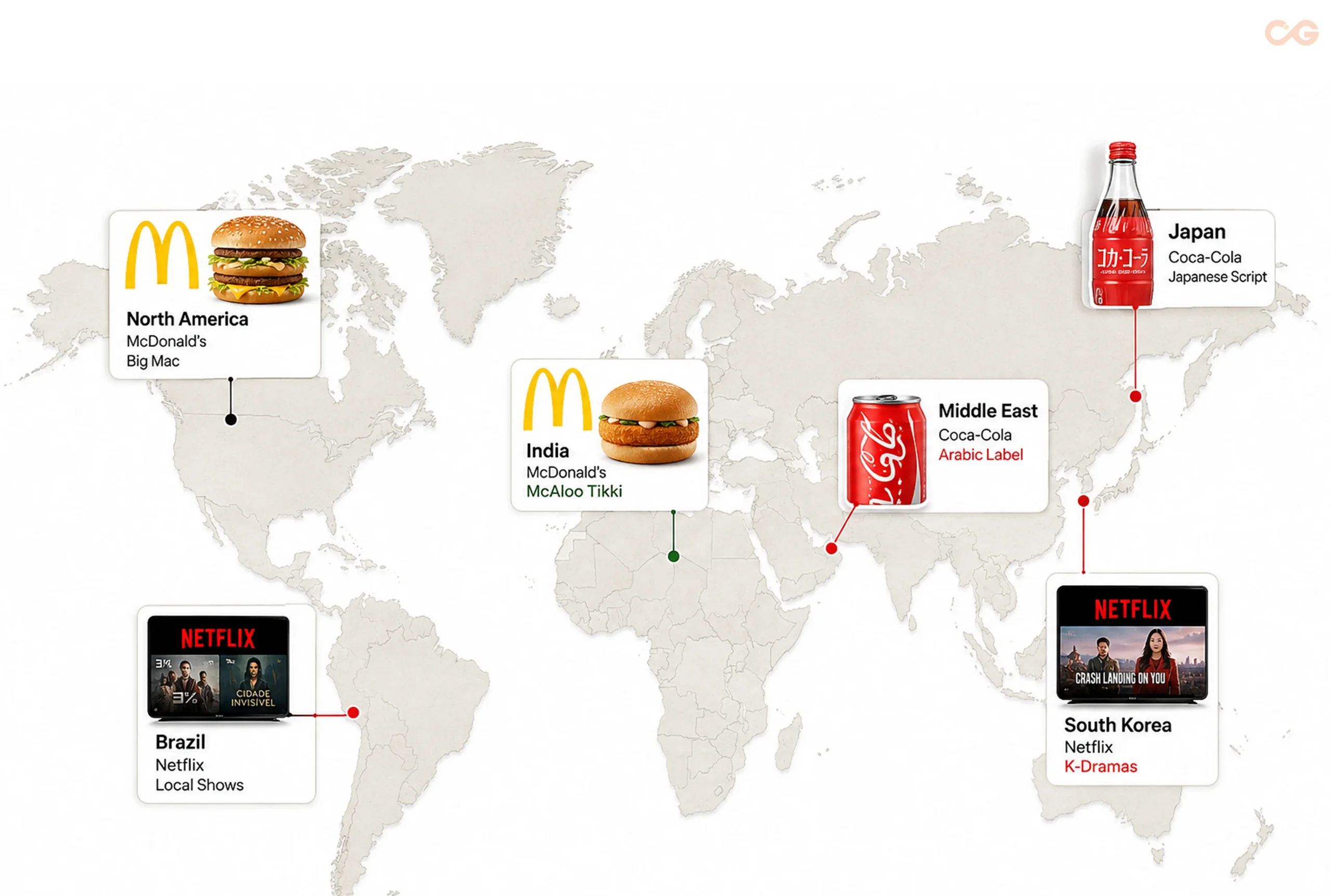
Picture yourself walking through the bustling streets of Mumbai. You see the iconic golden arches of McDonald’s. Instead of ordering a classic Big Mac, you choose the McAloo Tikki, a spiced potato burger tailored for Indian tastes. The brand is instantly recognisable, yet the experience feels uniquely local. This illustrates the strength of brand localisation: keeping a consistent global identity while adapting to local culture, preferences, and expectations.
As brands enter new markets, simply offering the same product and message won’t suffice. Brand localisation requires adjusting products, messaging, visual identity, pricing, and customer experience to connect with local audiences without compromising the core essence of the global brand.
The challenge lies in balancing global consistency with local relevance. When executed effectively, localisation enables brands to remain familiar worldwide while communicating in a manner that resonates culturally and commercially with their target audience.
Global Brands, Local Flavours
What Does Brand Localisation Mean?
Brand localisation is the process of adapting a brand’s products, messaging, marketing strategy, and customer experience to suit the cultural, linguistic, social, and commercial expectations of a specific market or region. The goal is to make a global brand feel relevant and relatable to local audiences while preserving its core identity, values, and brand recognition.
Effective localisation goes beyond translating content. It may involve adapting product offerings, visual communication, tone of voice, pricing, promotional campaigns, packaging, and customer experiences to reflect local preferences and cultural nuances. This allows brands to maintain global consistency while building stronger connections with customers in individual markets.
People Also Ask
Before exploring brand localisation strategies and frameworks, here are answers to some common questions about localising a global brand:
What is the difference between globalisation and localisation in branding?
Globalisation focuses on maintaining a consistent brand identity and standardised approach across multiple markets to improve efficiency and recognition. Localisation, on the other hand, adapts selected brand elements to suit the culture, language, preferences, and expectations of a specific market—without compromising the brand’s core identity.
What is the cost of brand localisation?
The cost of brand localisation varies depending on the industry, number of target markets, and level of adaptation required. On average, spending on translation and localisation tends to account for 1% to 4% of a business’s marketing budget, according to MarketingProfs.
Can small businesses afford to localise their brands?
Yes. Small businesses can start with cost-effective localisation initiatives, such as translating key content, adapting social media communication, and tailoring campaigns to local audiences. Rather than entering multiple markets at once, businesses can prioritise regions with the strongest market potential and expected ROI, then scale their localisation efforts as they grow.
Cultural Intelligence in Branding: Driving Beyond Superficial Adaptation
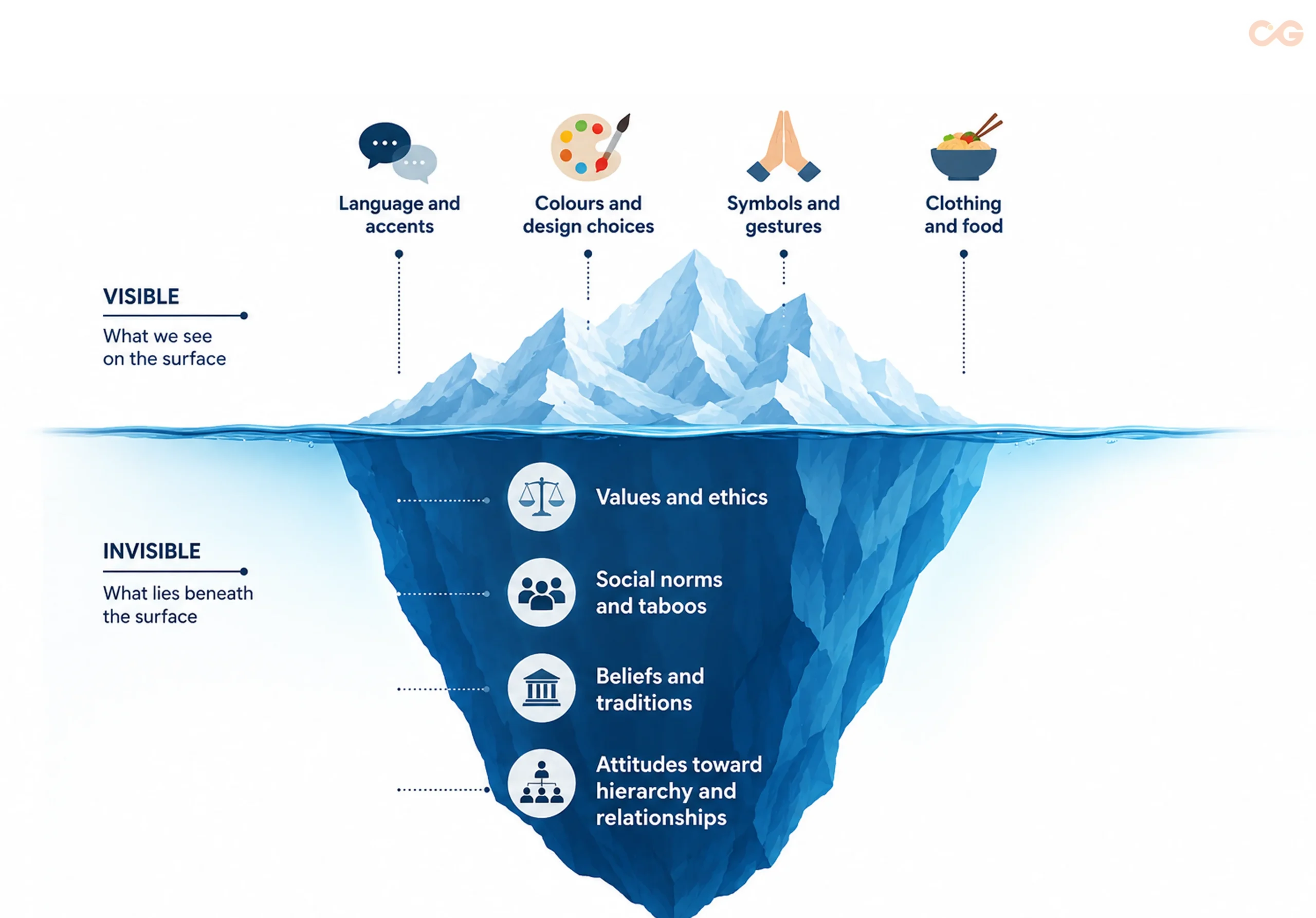
Many brands assume brand localisation simply means translating content or changing colours for different markets. Effective localisation goes much deeper. It requires cultural intelligence—the ability to understand the values, behaviours, traditions, social norms, and cultural forces that influence how consumers perceive and interact with a brand.
For global brands, this means looking beyond what is immediately visible and understanding the cultural context behind consumer decisions. A message, colour, symbol, product, or campaign that works in one market may have a very different meaning somewhere else.
Uncovering the Invisible Side of Culture
Deep Cultural Research Methodologies
An effective international brand expansion strategy begins with cultural research—not just demographics, sales figures, or purchase data. Brands need to understand how people live, make decisions, communicate, and use products within their cultural environment.
Ethnographic Research:
Ethnographic research involves observing consumers in their everyday environments to understand the cultural context surrounding product use. For global consumer brands, this can reveal behaviours and needs that conventional surveys or focus groups may overlook.
Brands can gain deeper cultural insights by collaborating with designers and creators who understand the communities they represent. Nike’s 2026 Air Works programme is a relevant example. The initiative brought emerging designers from eight global cities, including Mumbai, London, Beijing, Paris, Shanghai and Tokyo, to work alongside Nike designers and engineers. Each designer developed a 3D-printed Air Max concept that reflected their individual style while paying homage to their culture and community.
Local Advisory Panels:
Global brands can also work with local cultural experts, community leaders, researchers, and long-term residents to identify cultural nuances that may not be obvious to an external team. Local perspectives can help brands evaluate messaging, imagery, product concepts, and campaigns before they reach the wider market.
Colour Symbolism in Different Cultures: More Than Meets the Eye
Colour psychology is not universal. A colour that communicates celebration, trust, or prosperity in one market can carry completely different associations in another. Understanding these differences is an important part of cultural branding adaptation.
China: Red is strongly associated with prosperity, good fortune, joy, and celebration and is widely used during festivals and weddings.
India: Red can represent auspiciousness, fertility, and purity and has strong associations with weddings, traditions, and religious occasions.
South Africa: Red can carry associations with mourning in some contexts, while also being associated with vitality and life.
Middle East: Red can have varied meanings depending on the country and context, including danger, caution, strength, and bravery.
The takeaway is simple: never assume that a colour has one universal meaning. Global brands should evaluate colour choices within the cultural and contextual environment of each target market.
Case Study: WhatsApp’s Green Evolution
WhatsApp’s 2024 interface redesign provides an interesting example of how colour and visual identity can influence brand perception. According to Dataconomy, WhatsApp introduced a greener interface as part of a broader update intended to create a more modern experience while improving accessibility and usability. The redesign brought iOS closer to WhatsApp’s established green brand aesthetic, while Android users saw a more subtle shade change.
The update went beyond colour. WhatsApp also introduced changes to icons, buttons, spacing, dark mode, navigation, and the prominence of the logo within the Chats interface.
Why it matters for localisation:
The example demonstrates that visual branding cannot be evaluated through colour alone. Brand identity, user expectations, accessibility, interface conventions, and cultural associations all influence how a visual change is perceived. For localisation teams, the lesson is to consider the complete user experience rather than adapting individual design elements in isolation.
Religious and Social Sensitivities: Beyond Translation
Global brands need to understand that cultural localisation extends beyond language and product preferences. Religious beliefs, social norms, gender expectations, festivals, and cultural traditions can influence how consumers interpret advertising, imagery, product messaging, and brand behaviour.
A campaign that appears harmless in one market can potentially be perceived as insensitive or inappropriate in another. This makes cultural research and local review important before launching campaigns internationally.
- Religious references: Are symbols, imagery, or messaging appropriate for the target audience?
- Social norms: Does the campaign align with local expectations around family, gender, relationships, or hierarchy?
- Cultural occasions: Are festivals and national events being represented accurately and respectfully?
- Language and tone: Could a translated phrase have an unintended meaning or offensive interpretation?
- Visual representation: Do people, clothing, gestures, and settings reflect the local cultural context accurately?
Local Competitor Landscape Analysis
Cultural intelligence should extend beyond consumers to the competitive landscape. Global brands are not competing only against other multinational companies; they are also entering markets where local brands may already understand consumer preferences, cultural behaviours, pricing expectations, and distribution patterns better.
In India, for example, international food and beverage brands have had to compete with local and home-grown businesses that understand established consumption habits. Jumbo King, with its focus on vada pav, illustrates how a local format can build relevance around a distinctly Indian food culture. Similarly, Café Coffee Day (CCD), which opened its first café in Bengaluru in 1996, positioned its cafés as spaces for coffee, conversation, and socialising, helping establish the modern café experience for India’s urban consumers.
A Framework for Local Competitor Analysis
When entering a new market, analyse competitors across four dimensions:
1. Global Competitors: How are other international brands adapting their products, messaging, and customer experience?
2. Local Champions: Which local brands dominate the category, and what cultural insights contribute to their success?
3. Cultural Incumbents: Which existing products, behaviours, traditions, or consumption habits could influence how customers respond to your brand?
4. Emerging Disruptors: Which local startups or new businesses are introducing products, experiences, or business models that could reshape the market?
Understanding these four layers allows brands to move beyond superficial localisation and develop a market-specific brand strategy grounded in cultural intelligence, consumer behaviour, and competitive insight.
Takeaway

Download the Playbook: Turn Your Localisation Strategy into a Market-Ready Launch
Building Your Strategic Foundation: A Brand Localisation Framework
Understanding a market is only the first step. The next challenge is turning cultural, audience, and competitor insights into strategic localisation decisions. A strong brand localisation strategy should determine what remains globally consistent, what needs local adaptation, and where bigger market-specific changes are necessary.
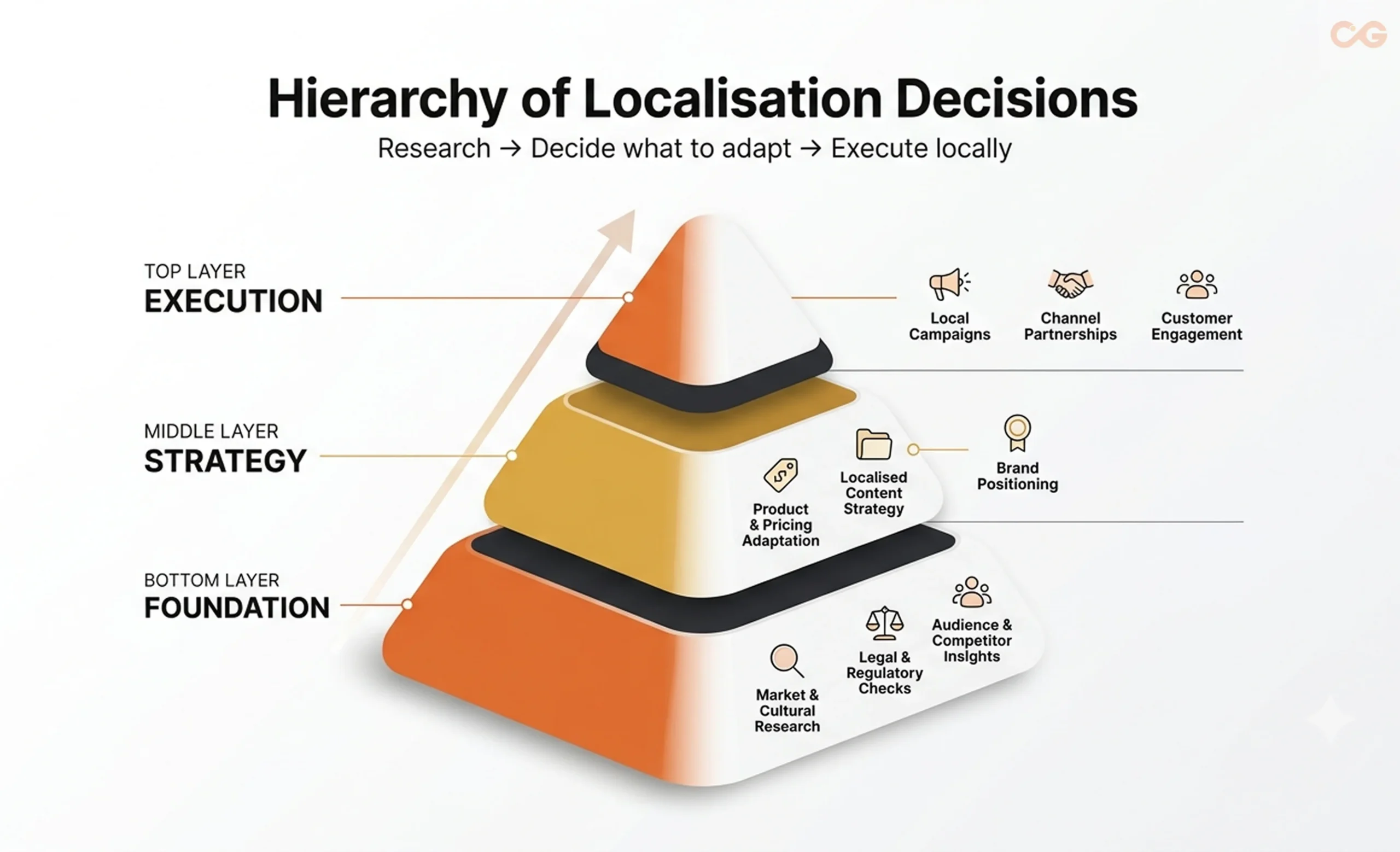
The framework follows a simple progression: research the market, determine what needs to change, and execute those changes without losing the brand’s core identity.
Brand Element Adaptation Matrix
Not every part of a global brand requires the same degree of localisation. The key is to distinguish between elements that should remain consistent and those that should respond to local market conditions.
Keep foundational elements such as the brand mission, core values, primary logo, and fundamental product functionality consistent wherever possible. This protects brand recognition, trust, and global consistency across markets.
Adapt messaging, tone of voice, product naming, positioning, visual communication, and campaign concepts when local language, culture, or consumer expectations require it. This creates relevance without weakening the brand’s core identity.
However, successful global branding requires finding the right balance between standardisation and localisation. While maintaining consistent brand values, visual identity, and overall positioning across markets, businesses must recognise that consumer preferences, cultural values, and market conditions vary from one region to another. The goal is to preserve a unified global identity while allowing enough flexibility to connect meaningfully with local audiences.
Elements closest to the customer often require greater flexibility. These may include pricing, product variants, promotional campaigns, distribution, customer support, and channel strategy. Local purchasing power, regulations, competition, and consumer behaviour can all influence these decisions.
The goal is not to localise everything. It is to localise the elements that affect local relevance while protecting the elements that make the brand recognisable worldwide.
Types of Local Partnerships in Global Brand Localisation
Local partnerships can strengthen the execution of a global brand localisation strategy by providing market knowledge, operational capabilities, distribution access, and cultural expertise.
Joint Ventures and Local Operating Partners:
These partnerships can provide access to established distribution networks, regulatory knowledge, suppliers, and local market expertise while allowing the global brand to retain strategic oversight.
Franchise Partnerships:
Franchising can provide a structured way to maintain global brand standards while allowing appropriate flexibility in products, customer experience, promotions, and operations to meet local market requirements.
Strategic Partnerships:
Brands can also collaborate with local retailers, distributors, creators, technology providers, or cultural organisations to improve market access and strengthen local relevance.
The right partnership model depends on the market, level of localisation required, regulatory environment, and degree of control the brand needs to maintain.
Regional Brand Ambassador and Creator Strategies
Local voices can help global brands translate their positioning into culturally relevant communication. However, choosing a regional ambassador should involve more than selecting a well-known personality.
Cultural Relevance:
Select ambassadors whose values, audience, language, and public image align with the local market and the brand.
Regional Creator Networks:
Work with creators who understand specific languages, communities, lifestyles, and consumer preferences. Micro-influencers can be particularly useful for reaching niche or regional audiences with more authentic communication.
Local Expertise:
Local employees, creators, cultural consultants, and community partners can provide insights into how campaigns and brand messages are likely to be interpreted within the market.
The objective is to make the global brand feel locally meaningful without making it appear disconnected from its wider identity.
Localisation Execution: From Strategy to Market
Once localisation priorities are established, execution should follow a structured process:
1. Prioritise Markets:
Identify markets based on market potential, audience fit, competitive conditions, regulatory requirements, and expected ROI.
2. Define Adaptation Levels:
Determine which brand elements require minimal, moderate, or maximum localisation.
3. Build Local Execution Plans:
Translate the strategy into market-specific plans covering content, campaigns, products, pricing, channels, partnerships, and customer experience.
4. Validate Before Launch:
Test localised messaging, creative assets, product concepts, and customer experiences with local audiences or cultural experts before wider rollout.
5. Launch and Monitor:
Track indicators such as engagement, conversion, customer feedback, brand perception, retention, and market performance.
6. Refine Continuously:
Use market feedback and performance data to improve the localisation strategy rather than treating localisation as a one-time adaptation exercise.
The Localisation Decision Loop
A successful brand localisation framework is not a one-time checklist. It is a continuous cycle:
Research → Prioritise → Adapt → Validate → Launch → Measure → Refine
This approach helps global brands maintain a consistent core identity while continuously adapting their customer-facing experience to changing local needs, preferences, and market conditions.
Takeaway
Download the Playbook: Turn Your Localisation Strategy into a Market-Ready Launch
Leveraging Technology for Global Brand Localisation
As global brands enter multiple markets, technology makes it easier to adapt, manage, and scale localised brand experiences without compromising the consistency of the core brand. From multilingual content and digital assets to international SEO and regional websites, technology can streamline localisation across multiple touchpoints.
The most effective approach is not to automate localisation completely, but to combine technology, data, and local expertise to make informed market-specific decisions.
Translation and Localisation Technology
Language is one of the first elements brands need to adapt when entering a new market. Translation management platforms such as Smartling and Lokalise help teams manage multilingual content, terminology, translation workflows, reviews, and approvals from a centralised environment.
These platforms are particularly useful when brands need to localise websites, apps, marketing campaigns, product content, and other digital experiences across multiple languages.
Digital Asset Management
Localisation can result in multiple versions of the same campaign, image, video, template, or brand asset for different markets. Without proper governance, this can lead to outdated or inconsistent brand materials.
A digital asset management platform such as Bynder helps global teams organise, manage, approve, and distribute brand assets from a centralised library. This gives regional teams the flexibility to use market-specific assets while maintaining global brand guidelines and consistency.
Technology for International SEO
Localising a website requires more than translating its existing content. Brands also need to understand how audiences search in each market, including local terminology, keywords, search intent, and competitor behaviour.
Tools such as Semrush can support international SEO through market-specific keyword research, competitor analysis, content research, and search-performance tracking.
The objective is to create content that reflects how local audiences actually search, rather than simply translating keywords from the original market.
Localised Digital Experiences
For organisations operating multiple regional websites, managing different languages, content, and market requirements can become challenging. Adobe Experience Manager (AEM) supports multilingual content management, regional website structures, and translation workflows, helping brands deliver localised digital experiences while maintaining centralised control.
This is particularly valuable for large organisations that need to balance regional flexibility with global brand governance.
AI and Automation in Localisation
AI is adding another layer of efficiency to localisation. It can assist with translation, content adaptation, asset organisation, quality checks, and content analysis, allowing teams to manage larger volumes of market-specific content.
However, automation should not replace cultural judgement. Local experts should review content where tone, cultural references, sensitivities, or brand perception could affect how the message is received.
A practical approach is:
AI-Assisted Adaptation → Local Review → Brand Approval → Market Launch → Performance Optimisation
Building a Technology-Enabled Localisation ProcessTechnology delivers the most value when it is integrated into a structured localisation workflow:
Research → Adapt → Review → Publish → Measure → Optimise
By combining technology with cultural intelligence, local expertise, and market data, global brands can create experiences that feel relevant to local audiences while preserving the recognition and consistency of their global brand identity.
Success Metrics and Optimisation: Measuring Localisation Effectiveness
A brand localisation strategy should be measured by more than short-term sales or engagement. Brands need to understand whether their local adaptations are improving brand relevance, cultural resonance, market performance, and business returns.
Brand Relevance
The first step is to determine whether the local market recognises, considers, and prefers the brand.
Brand Recall: Measures how well consumers remember the brand, both spontaneously and when prompted.
Brand Consideration: Shows whether local consumers would consider the brand when making a purchase decision.
Brand Preference: Indicates how strongly consumers favour the brand compared with local and international competitors.
Together, these indicators show whether localisation is strengthening the brand’s relevance and position in the local market.
Cultural Resonance
Cultural fit is harder to measure through numbers alone. Brands should combine audience data with qualitative insights to understand how naturally the brand connects with local consumers.
Key indicators include:
Local Sentiment: Tracks how positively or negatively local audiences respond to the brand and its messaging.
User-Generated Content: Shows whether consumers are organically discussing, recommending, reviewing, or interacting with the brand.
Local Engagement: Measures how audiences respond to localised campaigns, content, and cultural moments.
To understand why audiences respond in a particular way, brands can complement these metrics with focus groups, ethnographic research, social listening, and local expert feedback.
Market Performance
Ultimately, effective localisation should contribute to stronger performance in the target market.
Market Share: Indicates how the brand is performing against competitors within the category.
Customer Acquisition and Conversion: Shows whether localised products, content, and campaigns are attracting and converting customers.
Customer Retention and Lifetime Value: Helps determine whether stronger local relevance is contributing to longer-term customer relationships.
These measures connect brand localisation efforts with tangible business outcomes.
Localisation ROI
Localisation requires investment in research, translation, product adaptation, content, technology, local teams, and market-specific campaigns. Measuring ROI helps determine whether those investments are generating sufficient value.
Compare localisation investment against outcomes such as:
- Revenue generated from the target market
- Customer acquisition and conversion
- Customer retention and lifetime value
- Growth in market share or penetration
The objective is not simply to identify the highest-performing market, but to understand which localisation investments generate sustainable growth and customer value.
People Also Ask: Common Brand Localisation Questions
What are the most common mistakes brands make with localisation?
Common mistakes include treating translation as localisation, overlooking local competitors and consumer behaviour, entering markets without sufficient research, ignoring local economic conditions, and failing to involve local expertise.
How long does it take to see the results of brand localisation?
The timeline varies by market, industry, investment, and strategy. Early indicators such as engagement, traffic, and customer feedback may appear within months, while improvements in brand preference, market share, and customer loyalty generally require longer-term measurement.
How long does it take to see the results of brand localisation?
Not always. Product names may need adaptation when language, cultural meaning, pronunciation, legal requirements, or consumer perception make localisation beneficial. Testing with local audiences can help determine whether a global or local naming approach is more effective.
Should brands localise product names?
Keep the core brand identity, values, and strategic positioning consistent while adapting customer-facing elements such as messaging, products, campaigns, and cultural expression to local market needs.
The principle is simple: maintain the same brand identity while expressing it in a way that feels natural and relevant to each market.
The Future of Global Brand Localisation
As brands expand across increasingly diverse markets, localisation is moving beyond basic translation and market adaptation towards more intelligent, personalised, and continuous approaches.
AI-Assisted Cultural Intelligence: AI and machine learning can analyse large volumes of consumer, social, and market data to identify emerging cultural patterns and potential localisation opportunities. Human expertise will remain essential for interpreting cultural nuance and validating these insights.
Hyper-Local Personalisation: Advances in data and digital delivery are enabling brands to tailor experiences beyond national markets to regions, cities, and communities, creating greater relevance for specific audience groups.
Real-Time Cultural Adaptation: Social media and digital platforms allow brands to respond more quickly to local events, emerging trends, and cultural moments, making localisation a continuous rather than one-time process.
Collaborative Localisation: Greater collaboration with local creators, communities, cultural experts, and regional teams can help brands develop more authentic market experiences while reducing the risk of cultural misinterpretation.
Takeaway
Download the Playbook: Turn Your Localisation Strategy into a Market-Ready Launch
Conclusion
Successful global brand localisation is not about choosing between consistency and adaptation. It is about knowing what must remain consistent and what should evolve to reflect the needs, culture, and expectations of each market.
The strongest global brands combine cultural intelligence, strategic localisation, local expertise, technology, and continuous measurement to create experiences that feel relevant without losing their core brand identity. They understand that effective localisation extends beyond translation to influence messaging, products, customer experiences, digital presence, and brand expression.
Most importantly, localisation should not be treated as a one-time market-entry exercise. Consumer expectations, cultural conversations, and digital behaviours continue to change, making continuous learning, testing, and optimisation essential to long-term success.
The goal is simple: build one recognisable global brand that can speak naturally to many different cultures. When brands achieve that balance, localisation becomes more than a market adaptation strategy—it becomes a competitive advantage that strengthens relevance, trust, customer loyalty, and sustainable growth across markets.