
How to Identify and Target High-Value Prospects
Table of Contents
- Introduction
- What Is a High-Value Prospect?
- Creating an Ideal Customer Profile
- Where to Find High-Value Prospects
- How to Qualify and Prioritise High-Value Prospects
- How to Target and Engage High-Value Prospects
- Common Mistakes to Avoid
- Conclusion
1. Introduction
A sales team can start the quarter with a pipeline that looks promising. There are plenty of leads, meetings are being booked, and the team seems to be making good progress.
Then, a few weeks in, things start to change.
Some deals take longer than expected to close. Promising conversations lose momentum, while some prospects stop responding altogether. Despite all the activity, the sales numbers aren’t moving as expected.
When the team takes a closer look at the pipeline, the problem often becomes clear: not every lead is worth pursuing. Some prospects may show interest but don’t really fit the business, while others may not have a strong enough need or the right timing to move forward.
This is where the ability to identify and qualify high-value prospects becomes important. Effective sales prospecting isn’t about chasing as many leads as possible. It’s about knowing which prospects are a good fit, recognising signs of genuine buying intent, and focusing sales efforts where they are most likely to pay off.
MarketingSherpa reports that only 27% of leads are genuinely sales-ready, highlighting the importance of focusing sales time and effort on prospects who are more likely to be ready to buy. The real challenge, then, isn’t simply filling the pipeline with more leads. It’s finding the right prospects, understanding their readiness, and engaging them at the right time.
2. What Is a High-Value Prospect?
Identifying a high-value prospect requires looking beyond basic signs such as interest, engagement, or a completed form. A prospect may interact with your brand several times without having the right need, budget, or timing to become a valuable customer.
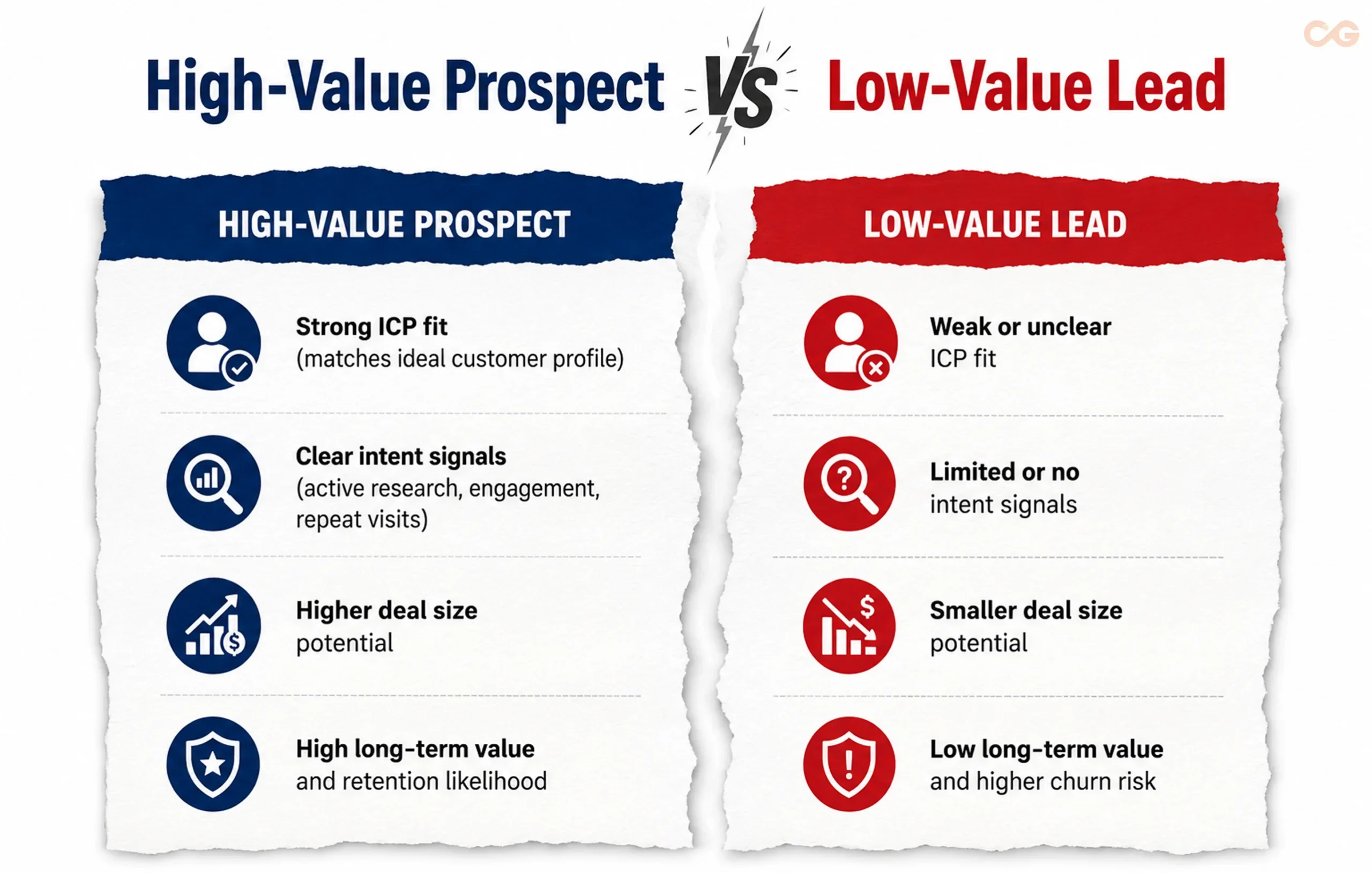
A high-value prospect is someone who combines strong strategic fit, genuine buying intent, revenue potential, and long-term value. These factors help sales teams decide which opportunities deserve greater attention and where to focus their efforts.
Core Characteristics of a High-Value Prospect
2.1 Revenue Potential
A high-value prospect has the potential to generate meaningful revenue through a strong initial deal, future purchases, or expansion opportunities. The value is not limited to the size of the first transaction; the prospect may also have the potential to grow into a larger account over time.
2.2 Fit With Your Ideal Customer Profile
A strong match with your Ideal Customer Profile (ICP) is another important indicator of prospect value. Prospects that closely match your ICP are more likely to have needs your business can address, making it easier to create relevant sales conversations and build lasting customer relationships.
Companies with a clearly defined ICP often see up to 36% higher conversion rates and 68% better ROI from targeted campaigns, according to CXL.
2.3 Buying Intent
Interest alone does not always indicate that a prospect is ready to buy. However, actions such as repeated website visits, content engagement, product enquiries, or conversations with the sales team can provide stronger signals of buying intent.
Recognising these signals early helps sales teams understand where prospects are in their buying journey and focus their efforts on those showing stronger interest and readiness.
2.4 Long-Term Value
A prospect’s value can extend well beyond the initial purchase. Prospects who are a strong fit for the business may have greater potential for retention, repeat purchases, cross-selling, or account expansion.
Bain & Company reports that a 5% increase in customer retention can increase profits by 25% to 95%. This highlights why sales teams should consider not only the immediate opportunity, but also the potential value of the customer relationship over time.
People Also Ask
Can a high-value prospect exist without immediate buying intent?
Yes. A prospect may not be ready to buy today but can still be valuable if they closely match your ICP, have a relevant business need, and show potential for future opportunities. In such cases, the goal is to maintain a relevant relationship and engage them when their needs and buying timing align.
3. Creating an Ideal Customer Profile
If you want to identify and engage high-value prospects, you first need a clear picture of the customers who are most valuable to your business. This is where an Ideal Customer Profile (ICP) comes in.
An ICP is more than a description of your ideal customer. It gives sales teams a practical set of criteria for deciding which prospects to prioritise, where to focus their efforts, and which opportunities are most likely to be a good fit.
The most effective ICPs are built using a combination of firmographic information and actual sales data. Instead of relying on assumptions, teams can use what they have learned from existing customers and sales performance to define and refine their target profile.
3.1 Firmographic and Structural Fit
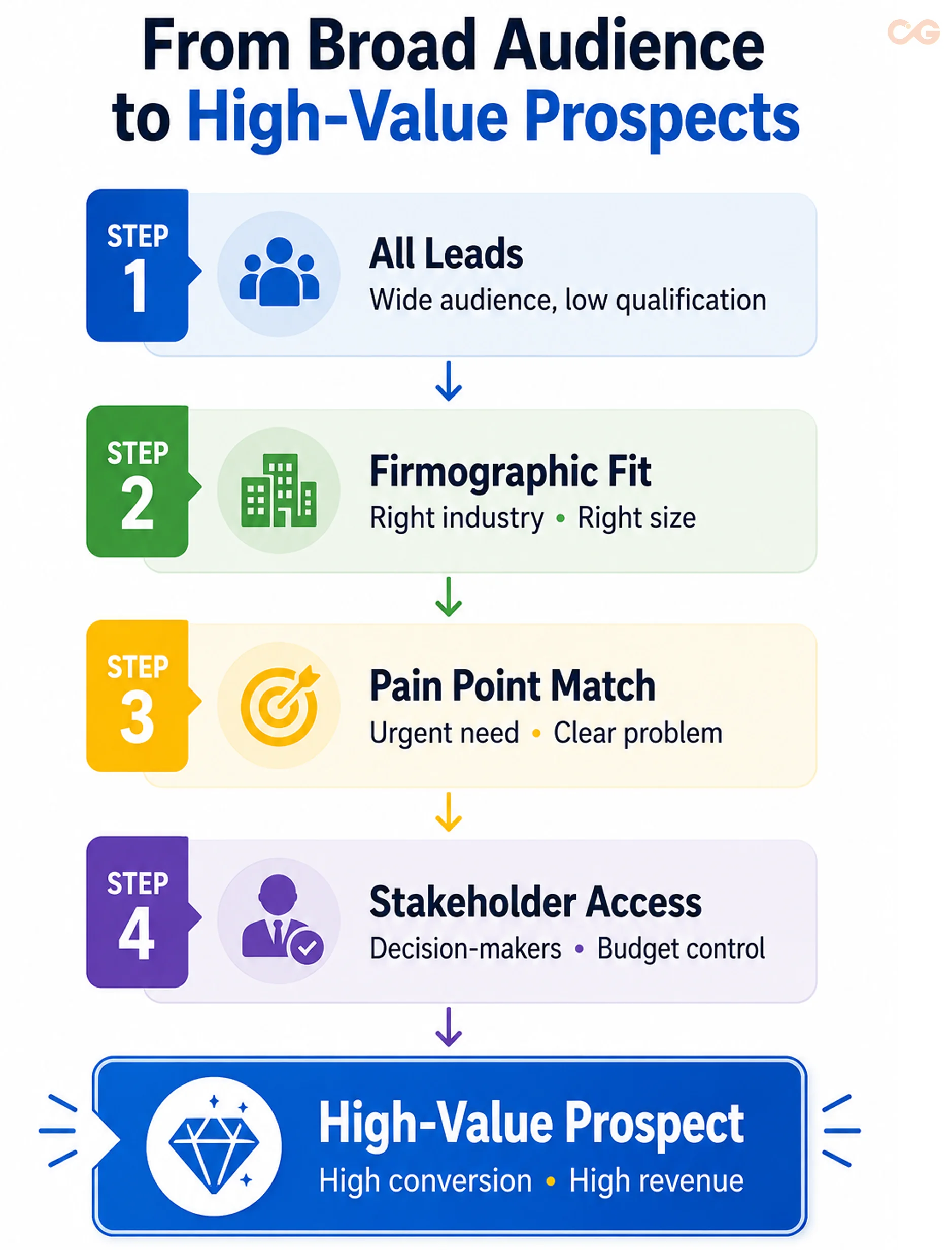
Start with factors such as company size, location, industry, business model, and organisational structure. These characteristics help determine whether a prospect operates in a market where your product or service is relevant.
For example, a solution designed for large B2B organisations may not be the right fit for a small business with a very different set of needs. Defining these criteria early helps sales teams focus on prospects that have a stronger potential fit.
3.2 Decision-Maker Identification
B2B purchases often involve multiple stakeholders, each with different priorities and concerns. Identifying the right decision-makers and influencers helps sales teams tailor their conversations to the people who have a role in the buying process.
According to Gartner, a typical buying group can include 6–10 decision-makers. Mapping these stakeholders can help sales teams understand who influences the purchase and what matters to each person.
3.3 Pain Points and Needs
Firmographic fit alone does not make a prospect valuable. Sales teams also need to understand what the prospect is trying to solve.
High-value prospects are more likely to have a clear business challenge that your solution can address. Understanding these pain points helps sales teams make their outreach more relevant and show how the solution can support a specific business need.
Takeaway

Download the full Sales Prospecting Toolkit (2026) for actionable tools, frameworks, and an execution guide.
3.4 Data-Driven Refinement
An ICP should not remain fixed. As sales teams learn more about which customers convert, stay longer, and generate greater value, they can use that information to refine their profile.
Three useful sources of insight include:
To identify and target high-value prospects, you need to combine your ICP with real-time data sources like need, engagement and timing. A prospect may fit your ICP, but if they don’t have an active need or urgency for a solution, the conversion rate will be low.
- Win/Loss Analysis: Examines why opportunities were won or lost to improve targeting and messaging.
- Customer Lifetime Value (CLV): Shows which customer segments generate greater value over the course of the relationship.
- Conversion Rates: Reveals which types of prospects are more likely to move through the sales funnel successfully.
Using these insights helps sales teams keep their ICP aligned with actual business performance rather than relying on assumptions.
3.5 Putting the ICP Into Practice: Targeting the Right Prospects
Creating an ICP is only the starting point. The next step is to use it to identify prospects that are not only a good fit but also show signs that the timing is right.
To identify and target high-value prospects, combine your ICP criteria with signals such as current needs, engagement, business changes, and buying intent. A prospect may match your ICP perfectly, but if there is no relevant need or urgency, they may not be ready for a sales conversation.
Successful sales teams can put their ICP into practice by:
- Prioritising prospects showing relevant behavioural or buying signals
- Considering the prospect’s current business environment and challenges
- Focusing sales resources on prospects with the strongest overall potential
This turns the ICP from a static customer description into a practical framework for finding and prioritising better sales opportunities.
People Also Ask
What’s the difference between an ICP and a buyer persona?
An Ideal Customer Profile (ICP) describes the type of business that is most likely to benefit from your product or service, using factors such as industry, company size, location, and business model. A buyer persona, on the other hand, describes the people within those businesses who are involved in the buying process, including their roles, motivations, challenges, and behaviour.
4. Where to Find High-Value Prospects
Once your ICP is defined, the next step is finding prospects that match it. The best sources are not limited to one channel. Sales teams can combine existing customer data, professional networks, inbound activity, referrals, and targeted prospecting to find opportunities that are a strong fit.
The key is to look for relevant signals, rather than simply adding more names to the pipeline. The right sales prospecting techniques help sales teams spend more time on opportunities that match their ICP and show potential to move forward.
4.1 Existing Customer Base
Your existing customers can be one of the strongest sources of new opportunities. Sales teams can look for accounts with potential for upselling, cross-selling, renewals, or expansion.
Because these customers already know the business and have an established relationship with the sales team, conversations can often start with greater context and trust. Reviewing existing accounts can also reveal similar companies or customer segments worth targeting.
4.2 Professional Networks and Social Platforms
Professional networks such as LinkedIn can help sales teams identify companies, decision-makers, and potential buying signals that match their ICP.
Social selling can make this process more effective. Instead of immediately sending a sales pitch, salespeople can engage with relevant prospects by commenting on industry discussions, sharing useful insights, or interacting with their content.
This helps create familiarity and context before direct outreach. Social selling does not replace outreach; it can make that outreach more relevant and easier to engage with.
4.3 Inbound Channels
Inbound activity can provide useful signals about a prospect’s interests and needs. Website visits, content downloads, product enquiries, demo requests, and other interactions can indicate that a prospect is actively exploring a solution.
Inbound leads can be valuable because they originate from an action taken by the prospect. Sales teams can combine these engagement signals with ICP criteria to determine which inbound prospects deserve follow-up.
4.4 Referrals and Partnerships
Referrals can introduce sales teams to prospects through an existing relationship, making it easier to establish trust and start a conversation.
Nielsen’s study indicates that 92% of people trust referrals from friends and family, highlighting the value of recommendations when building new customer relationships.
Partnerships can also expand access to relevant audiences by connecting businesses with complementary companies, resellers, or industry networks.
4.5 CRM and Data Sources
A well-organised CRM system can help sales teams turn prospect information into actionable opportunities.
CRMs and prospecting databases can store customer information, track engagement, record previous interactions, and identify prospects that match the ICP. This gives sales teams a clearer view of which prospects to prioritise and helps prevent valuable opportunities from being overlooked.
4.6 Account-Based Prospecting
Sometimes, the goal is not to reach a large audience but to focus closely on a smaller group of high-value accounts. This is where account-based prospecting can be useful.
Instead of using the same outreach approach across a broad list, sales teams select a specific set of high-potential accounts and research their business, priorities, stakeholders, and challenges. Each account is treated as a distinct opportunity, allowing communication to be tailored to its situation.
This approach can improve:
- Relevance of communication
- Stakeholder alignment
- Quality of sales opportunities
Account-based prospecting is particularly useful in complex B2B sales, where deals involve multiple stakeholders and each opportunity can have significant revenue potential.
People Also Ask
Which is better: inbound or outbound for finding high-value prospects?
Both can play an important role. Inbound helps sales teams identify prospects who are already showing interest, while outbound allows them to proactively reach prospects who match the ICP. Combining both approaches can create a more balanced prospecting strategy.
Takeaway
Download the full Sales Prospecting Toolkit (2026) for actionable tools, frameworks, and an execution guide.
5. How to Target and Qualify High Value Prospects
After identifying high-value prospects, prioritise which ones need immediate focus and which can be nurtured over time.
A strong sales pipeline requires more than just a large volume of leads. Sales teams need an effective method to evaluate which prospects align well with our goals, show significant engagement, and have a real chance of moving forward.
Implementing a structured qualification process is essential. By combining elements like Ideal Customer Profile (ICP) fit, engagement levels, buying signals, and timing, sales teams can effectively prioritise the most promising opportunities.
5.1 Lead Scoring
Lead scoring offers a systematic approach to evaluate prospects based on key criteria:
- Alignment with the Ideal Customer Profile
- Engagement level
- Presence of buying signals and timing
A prospect that meets the ICP and regularly engages with relevant content needs more attention than one who merely fills out a form. By assigning values to these factors, sales teams can consistently prioritise prospects and concentrate efforts on those with the greatest potential.
5.2 Qualification Frameworks
Using frameworks like BANT (Budget, Authority, Need, Timeline) helps us evaluate a prospect’s suitability and readiness to make a purchase. These frameworks guide sales teams to ask important questions and ensure uniformity in the qualification process.
However, B2B buying processes are often complex. They typically involve several decision-makers, shifting priorities, and varied buying signals. Instead of seeing a qualification framework as a strict checklist, sales teams should view it as a flexible guide, adapting their strategies to fit the unique aspects of each opportunity.
This approach enhances adaptability while providing a consistent method for assessing prospects.
5.3 Engagement and Intent Signals
Behavioural signals offer valuable insights into a prospect’s interest level beyond basic lead data.
Key indicators include:
- Repeat visits to our website
- Patterns in content consumption
- Engagement with emails
- Participation in meetings
- Inquiries about products or services
Tracking these signals helps your sales teams determine the best times to follow up, which information to share, and the level of attention each opportunity deserves.
5.4 Lead Segmentation
Since prospects are not all in the same stage of their buying journey, you should tailor your communication accordingly. Lead segmentation allows sales teams to customise their approach based on each prospect’s readiness and engagement.
- Cold leads → Focus on awareness and education: Share useful information to familiarize them with your solutions before pushing for a sale.
- Warm leads → Engage contextually: Leverage previous interactions and interests to make your communication more relevant.
- High-intent leads → Prioritise conversion: Target prospects showing strong buying signals with solution-oriented discussions and prompt follow-ups.
This strategy helps your sales teams align communication with each prospect’s stage, making sales prospecting more targeted and effective.
6. How to Target and Engage High-Value Prospects
Once the right prospects have been identified and prioritised, the next step is to approach them in a way that reflects their needs and buying context. The goal is not simply to make contact, but to create relevant conversations that give prospects a reason to engage.
High-value prospects are more likely to respond when outreach is personalised, relevant, and focused on business value. A coordinated approach across multiple channels can also help sales teams maintain engagement throughout the buying journey.
6.1 Personalised Outreach
High-value prospects are more likely to engage when communication reflects their role, industry, business needs, or specific challenges.
Instead of using the same message for every prospect, sales teams can tailor their outreach using information gathered during prospect research. For example, a message to a marketing leader could focus on campaign performance, while an operations leader may be more interested in efficiency, productivity, or cost savings.
Personalised outreach makes the conversation more relevant and gives prospects a clear reason to respond.
6.2 Value-Based Positioning
High-value prospects are unlikely to be persuaded by a list of product features alone. They want to understand how a solution can address a business priority or contribute to a measurable outcome.
Effective value-based messaging focuses on:
- Business outcomes: What can the prospect achieve with the solution?
- Relevant challenges: Which specific business problem does it address?
- Measurable value: What potential impact could it have on revenue, efficiency, costs, or growth?
Moving from product-led messaging to value-led conversations helps sales teams communicate more clearly and gives prospects a stronger reason to continue the discussion.
6.3 Multi-Channel Engagement
High-value prospects may interact with a business through different channels during their buying journey. Using a combination of channels can create more opportunities to connect while allowing sales teams to adapt their approach to the prospect.
Common channels include:
- Email outreach
- Sales calls
- LinkedIn engagement
- Content-driven touchpoints
- Relevant follow-ups based on prospect activity
The goal is not to contact prospects across every available channel simply to increase activity. Each interaction should have a clear purpose and add value to the conversation.
When these channels are coordinated around the prospect’s needs and preferences, sales teams can create a more consistent experience and maintain meaningful engagement throughout the buying process.
7. Common Mistakes to Avoid
Even a well-planned sales prospecting strategy can lose effectiveness when the execution is not consistent. Avoiding a few common mistakes can help sales teams focus their time on the right prospects, improve engagement, and maintain a healthier pipeline.
7.1 Broad Targeting
Trying to reach too broad an audience can make it harder to identify prospects that genuinely fit your ICP. It can also lead to generic messaging and lower engagement.
Instead, sales teams should use their ICP and prospecting data to narrow their focus to accounts and prospects with stronger potential. Precision targeting makes it easier to tailor outreach and invest sales resources where they are most relevant.
7.2 Ignoring Data
Sales teams can miss valuable opportunities when prospecting decisions are based mainly on assumptions rather than actual customer and engagement data.
A CRM system, engagement tracking, and behavioural signals can provide visibility into how prospects are interacting with the business. Using these insights helps teams identify changes in interest, prioritise opportunities, and make more informed sales decisions.
7.3 Choosing Volume Over Quality
A large number of leads does not necessarily mean a strong pipeline. Focusing only on lead volume can take attention away from prospects who have a stronger fit, greater potential, or clearer buying signals.
Sustainable pipeline growth comes from maintaining a balance between prospecting activity and prospect quality, ensuring that sales teams continue to build opportunities that have genuine potential.
7.4 Poor Segmentation
Using the same message for every prospect can make outreach feel generic and disconnected from their needs.
Segmenting prospects based on factors such as ICP fit, engagement, buying intent, and stage in the buying journey allows sales teams to make their communication more relevant. This can improve engagement and help prospects receive the right information at the right time.
Using data to support segmentation also gives high-performing sales teams greater visibility into their sales process and helps them make better decisions.
Takeaway
Download the full Sales Prospecting Toolkit (2026) for actionable tools, frameworks, and an execution guide.
8. Conclusion
The goal of sales prospecting is not simply to create more opportunities, but to identify the ones with the strongest potential. Identifying and qualifying high-value prospects helps sales teams focus their time and resources on opportunities that align with their ICP, show meaningful buying signals, and have the potential to deliver long-term value.
Successful B2B sales organisations take a structured approach to prospecting. They define a clear ICP, use data to refine it, identify prospects through relevant channels, and apply consistent qualification and targeting methods. This allows sales teams to make better decisions about which prospects to prioritise and how to engage them.
Ultimately, a strong pipeline is built on relevance, not just volume. By identifying the right prospects, understanding their needs, and engaging them at the right time, sales teams can create stronger opportunities and turn prospecting efforts into sustainable customer relationships and revenue growth.