
How to Do Email Marketing in the Indian Market: The Ultimate 2026 Guide
Table of Contents
- Understanding the Indian Email Marketing Landscape
- Crafting an Email Marketing Strategy for Indian Audiences
- Email Marketing Automation: Work More Efficiently
- Integrating CRM and Business Tools with Email Marketing
- Email Marketing Compliance in India: Navigating Regulations
- Crafting Emails That Grab Attention in India
- Growing Your Email List in India
- Advanced Email Marketing Strategies for Indian Market
- Utilising WhatsApp and Email Integration
- AI and Predictive Analytics in Email Marketing
- Testing and Optimisation Frameworks
- Email Strategies for Retaining Indian Customers
- The Future of Email Marketing in India
- Conclusion: Your Roadmap to Email Marketing Success in India
With more than 1.09 billion internet users, India has one of the world’s largest and most diverse digital audiences, according to TRAI. But reaching this audience effectively requires more than simply sending emails. Language preferences, regional cultures, mobile-first behaviour, and changing customer expectations all influence how Indian consumers respond to email communication.
Whether you run a chai business in Bengaluru, a D2C brand in Delhi, or an e-commerce store in Mumbai, a well-planned email strategy can help you build relationships, nurture leads, and drive repeat sales. This guide covers practical email marketing strategies for small businesses in India, from building a quality subscriber list and creating relevant content to personalising campaigns and measuring results in 2026.
Understanding the Indian Email Marketing Landscape
The Indian market presents unique opportunities and hurdles that global email marketing strategy frameworks often overlook. With a significant number of mobile internet users and a multilingual populace encompassing 22 official languages, email marketing in India demands a localised strategy. This approach must respect cultural nuances while incorporating cutting-edge technology.
People Also Ask: Why Will Email Marketing Still Be Effective in India in 2026?
Despite the rise of social media and messaging apps, email marketing in India shows remarkable returns on investment — 3,600 for every 100 spent, according to ROI Hunt. This makes it one of the most economical marketing methods available for businesses of any size. Additionally, 93% of the population checks their email daily, with 42% doing so 3-5 times per day, as reported by Zero Bounce.
Crafting an Email Marketing Strategy for Indian Audiences
Effective email marketing in India requires more than translation. It demands a strategy that aligns with cultural norms, optimal timing, and an understanding of Indian purchasing behaviours.
Key Cultural Considerations for Successful Campaigns
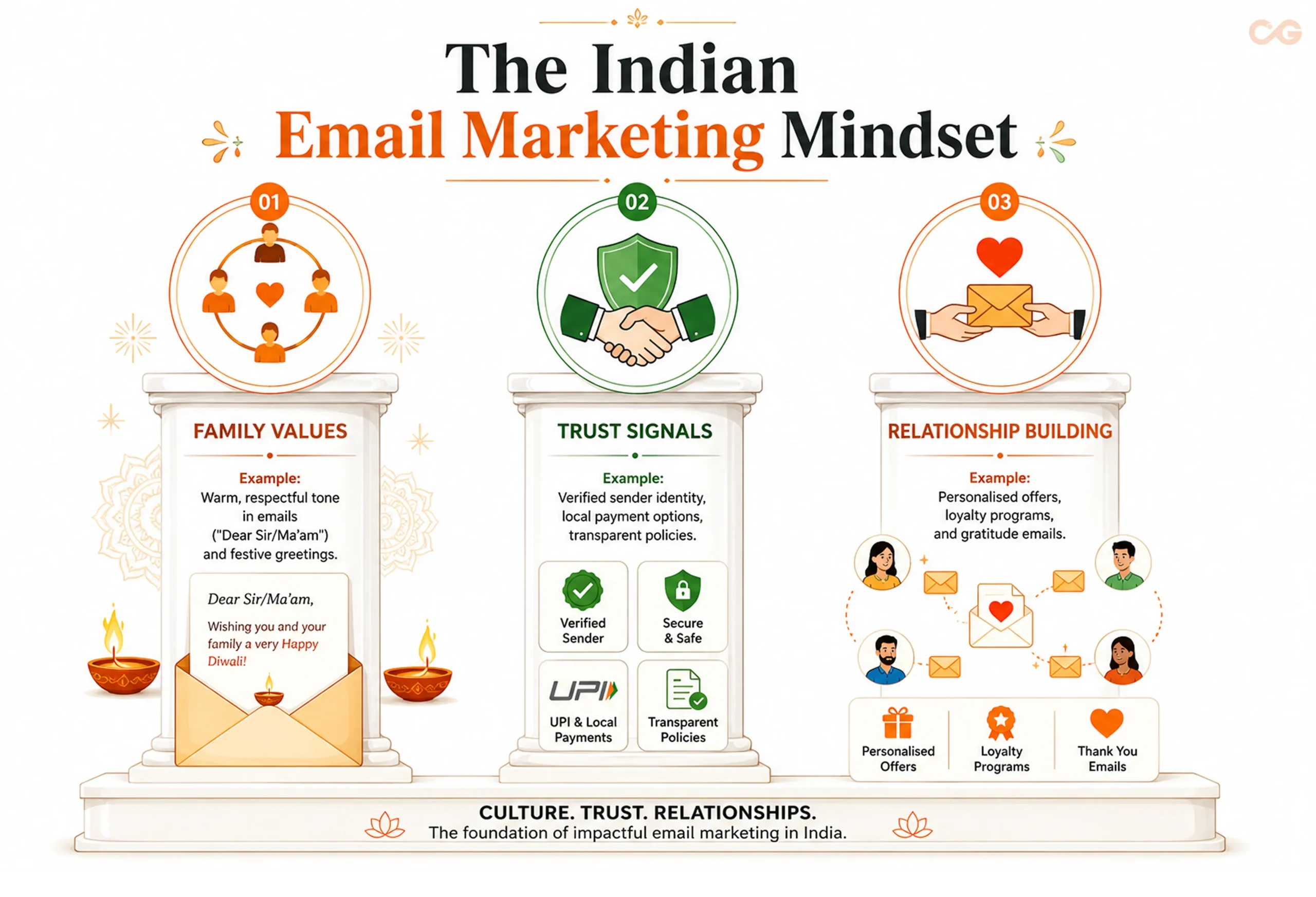
1. Family-Centric Messaging
Indian purchase decisions often involve family consultations. Your emails should acknowledge this collective decision-making. For example, instead of saying, “Upgrade YOUR smartphone today,” say, “Bring home the smartphone your entire family will adore.”
2. Value and Trust Signalling
Build confidence with Indian consumers by emphasising clear pricing. Include local testimonials, highlight certifications, and offer money-back guarantees to establish value and foster loyalty.
3. Focus on Relationship Building
The Indian market prioritises relationships over hard selling. Use educational content, helpful resources, and genuine interactions as your email marketing best practices to drive conversions.
By adopting these strategies, you can effectively harness the potential of email marketing in India, ensuring your messages resonate with the audience and drive business success.
Regional Language Email Strategy: Speak Your Customers’ Language
While English serves as a common language in business, a staggering 98% of Indian internet users prefer content in their native languages, according to an IBEF report. Employing a multi-language email marketing strategy for small businesses can significantly boost engagement.
People Also Ask: Which Language Should You Use in India — Hindi or English?
The answer hinges on your audience’s location. In major urban areas like Mumbai, Bangalore, and Delhi, English is widely accepted for professional communication. Conversely, in smaller towns (tier-2 and tier-3 cities), local languages resonate more with the audience. Segmenting your audience based on location and preferences will allow you to deliver content in the most effective language.
Tips for Multi-Language Campaigns:
Technical Setup:
Ensure your emails support various Indian scripts using Unicode UTF-8 encoding. Run test campaigns across major email clients in India. Segment your lists according to language preferences for tailored communication.
Content Localisation:
Don’t just translate; adapt content to reflect cultural nuances. Localise idioms, humour, and context. Use relatable examples and case studies to establish a connection and build trust.
Best Practices for Subject Lines:
Keep subject lines concise, ideally under 70 characters, to improve readability, especially on mobile devices, as per Mailmodo. Use Hindi or other regional languages when they match your audience’s preferences, and keep the wording natural and relevant. Avoid excessive use of special characters, emojis, ALL CAPS, or misleading language, as these can affect deliverability and engagement.
Choosing an Email Service Provider in India
Unlike the Western markets dominated by a few major platforms, India’s email marketing ecosystem is rich with diverse solutions catering to local business needs and budgets.
Recommended Email Marketing Tools in India
1. Zoho Campaigns
Based in Chennai, Zoho is adept at understanding local business dynamics. With servers in Mumbai and support for INR pricing, it’s a natural fit for Indian companies looking for robust email marketing tools.
2. MailMarketer.in
This Bangalore-based platform specifically serves Indian SMBs, offering affordable bulk email solutions, making it ideal for entering the email marketing arena without high costs.
3. Popular Global Platforms in India
- Mailchimp: Known for its user-friendliness and local customer support, it also accepts popular Indian payment methods.
- Brevo (Sendinblue): Its strong SMS marketing integration has made it a favourite in India.
- GetResponse: Offers competitive pricing tailored to the Indian market.
- Klaviyo: Preferred by e-commerce brands due to its high level of personalisation and segmentation.
Email Marketing Automation: Work More Efficiently
Automating your email marketing can transform how Indian businesses acquire leads and nurture customer relationships, especially vital for small businesses with limited marketing resources.
Essential Automation Sequences for Indian Businesses:
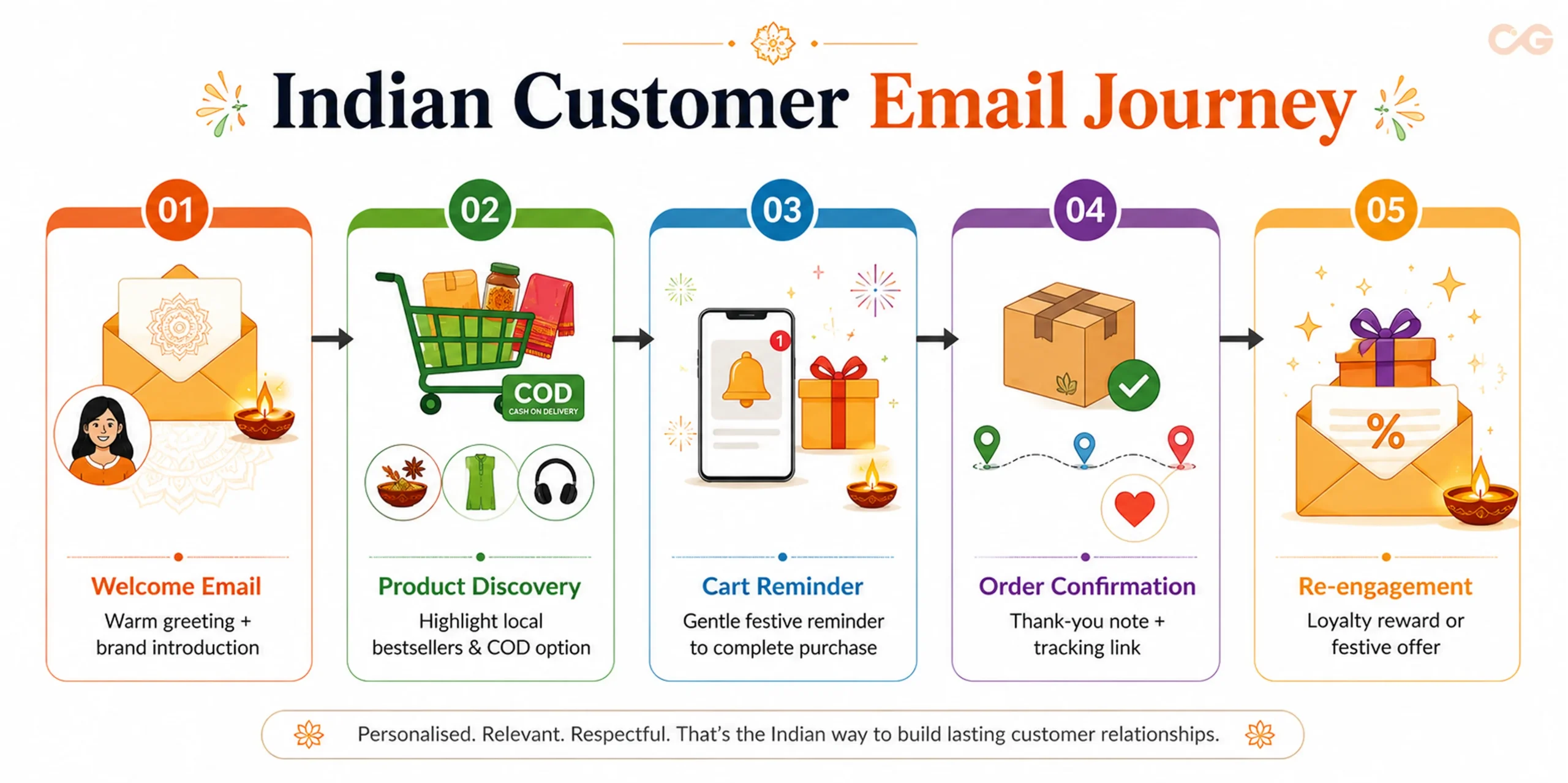
1. Welcome Series Featuring Indian Culture
Make new subscribers feel valued with culturally relevant greetings.
Example Sequence:
- Email 1 (Immediate): Welcoming email with a “Namaste” graphic and your brand story.
- Email 2 (Day 2): Educational content aligned with their interests.
- Email 3 (Day 5): Customer success stories from India.
- Email 4 (Day 7): Exclusive discount or offer.
- Email 5 (Day 10): Invitation to join your WhatsApp community, a highly effective platform in India.
2. Festival-Focused Campaigns
- Set up automated campaigns that activate ahead of key Indian festivals, considering regional variations.
- Brands can tailor their offers and themes around major celebrations like Diwali, Holi, Raksha Bandhan, Onam, Durga Puja, Pongal, and Eid to deepen engagement and cultivate culturally relevant relationships.
3. Cart Abandonment Recovery
India faces a 75% cart abandonment rate in e-commerce, higher than the global average, as per ECDB. Your recovery strategy must address specific local factors.
Recommended Recovery Sequence:
- Email 1 (1 hour): Reminder emphasising saved cart items.
- Email 2 (6 hours): Address common concerns like return policies and payment options.
- Email 3 (24 hours): Offer a small discount (5-10%) along with social proof from satisfied customers.
- Email 4 (48 hours): Create urgency with stock notifications and free delivery offers.
- Email 5 (72 hours): Suggest related products and provide direct customer support contact information.
Highlight customer-friendly features such as Cash on Delivery, easy returns and exchanges, and a variety of payment options (UPI, wallets, net banking) to enhance the shopping experience, particularly for tier-2 and tier-3 cities.
Takeaway

Master Email Deliverability and Performance in India: Optimise Your Lists and Conversion Metrics.
Download our comprehensive guide to discover effective strategies, tools, and benchmarks that will elevate your email marketing efforts in India.
People Also Ask: What is the Cost of Email Marketing Automation in India?
In India, the cost of email marketing automation can range from ₹0 for basic free plans to over ₹15,000 per month, depending on the size of your business. Platforms like Zoho Campaigns, MailerLite, and Mailchimp are great options for small businesses just starting out. Typically, the return on investment (ROI) from automation becomes evident within 3 to 4 months, as it reduces manual work and boosts conversions.
Integrating CRM and Business Tools with Email Marketing
To create a seamless customer experience, Indian enterprises need to align their email marketing strategies with their existing business systems.
Top CRM Integrations in India
1. Zoho CRM + Zoho Campaigns
This integration is popular among Indian small and medium-sized businesses due to its affordability and robust features. It allows automatic syncing of customer data, enables automatic email sends based on CRM updates, and tracks email interactions within customer records.
Use Case: Automate follow-up emails when a lead progresses to a qualified stage in your CRM. Tailor these messages to address their specific industry challenges.
2. Salesforce + Marketing Cloud (Enterprise)
Large Indian corporations and new startups use Salesforce for advanced email marketing, integrating it with their sales pipelines for greater efficiency.
3. Freshsales + Freshmarketer (Freshworks)
Freshworks offers seamless integration of its CRM and email marketing tools, backed by local support and competitive pricing.
4. Custom API Integrations
Many Indian companies create tailored integrations between their email platforms with:
E-commerce platforms (Shopify, WooCommerce, Magento)
Payment gateways (Razorpay, Paytm, PayU)
Inventory management systems
Customer support software (Freshdesk, Zendesk)
Advantages of Integration
Unified Customer View: Combine email activity, purchase history, customer support inquiries, and on-site behaviour into a comprehensive customer profile.
Activated Campaigns: Automatically send emails based on milestones like first orders, repeat purchases, or high-value customers, as well as after support ticket resolutions or product usage patterns.
Personalisation at Scale: Dynamically incorporate customer names, company details, previous purchase suggestions, location-specific deals, and industry-relevant content into emails using CRM data.
By implementing these integrations, businesses can enhance their marketing efforts and better serve their customers.
Email Marketing for Indian Festivals
India has a rich festival calendar packed with events all year round. To maximise email marketing for small businesses, it’s essential to use a thoughtful approach to festival promotions.
Festival Email Marketing Plan
Develop a clear strategy for your festival promotions:
Unlike Western markets, India features multiple festivals throughout the year rather than a single holiday shopping season. It’s important to plan carefully to avoid overwhelming your subscribers.
Best Practices:
Focus on key festivals relevant to your products and audience — don’t promote every event.
Kick off campaigns 2-3 weeks before major festivals.
Create urgency with time-sensitive offers linked to each festival.
Honour cultural sentiments and maintain appropriateness in messaging.
Quarterly Festival Email Strategy
Makar Sankranti / Pongal (January)
These harvest celebrations highlight prosperity and new beginnings. Promote home goods, kitchen items, and traditional wear during this time.
Republic Day (January 26)
Capitalise on this patriotic occasion by featuring Made-in-India products and indigenous brands, incorporating national colours.
Holi (March)
Celebrate this vibrant festival by running youth-centric promotions for fashion, travel, and electronics, using bright and colourful messaging.
Ugadi / Gudi Padwa (April)
This time marks the start of a new year, making it an ideal moment to launch new products or subscriptions.
Ramadan & Eid (April–May)
These spiritual festivals focus on family and sharing. Tailor your emails around gifting, food, and ethnic fashion, planning them post-iftar.
Independence Day (August 15)
Promote national pride with emails featuring Indian brands and universal products during this significant day.
Raksha Bandhan (August)
This festival symbolises sibling love. Showcase gifts, sweets, and personalised accessories in your Rakhi promotions.
Janmashtami, Onam & Ganesh Chaturthi (August-September)
These religious celebrations are perfect for marketing ethnic clothing, sweets, flowers, and decorations.
Durga Puja, Navratri & Dussehra (September-October)
Highlight products in fashion, jewellery, electronics, and vehicles as these festivals celebrate victory and devotion.
Diwali (October–November)
This is the biggest shopping season in India. Run gradual campaigns with teasers, gift suggestions, discounts, and last-minute delivery options. A wide range of products fits this festive mood.
Bhai Dooj (November)
This festival continues the Diwali spirit of gifting, focusing on sibling relationships and promoting accessories and sweets.
Guru Nanak Jayanti (November)
Market religious items, books, and charity contributions during this spiritual celebration.
Christmas (December 25)
Align your promotions with the joy of the season, offering gifts, party wear, and travel options.
New Year (December 31–January 1)
Capitalise on the celebratory nature of the New Year to promote fitness, self-improvement products, and enriching experiences.
Email Marketing Compliance in India: Navigating Regulations
Best email marketing practices in India include staying up to date on data protection laws and building trust with subscribers.
Digital Personal Data Protection Act, 2023 (DPDP Act)
India’s new data protection law, effective in August 2023, changes how companies collect and use email addresses for marketing.
Key Compliance Requirements
1. Explicit Consent
Obtain clear and affirmative consent before sending marketing emails. Implied consent or pre-checked boxes won’t suffice. Make sure your data collection has a clear purpose. Sign-up forms should feature unchecked opt-in boxes.
For example: “Yes, I agree to receive marketing emails from [Company Name] about [specific purposes].”
2. Right to Withdraw Consent
Subscribers should easily withdraw their consent. Include visible, functioning unsubscribe links and process requests within 72 hours. Do not require users to log in or take additional steps to unsubscribe.
3. Data Minimisation Principle
Only collect email information needed for specified purposes. Avoid asking for excessive personal details. Clearly state why each piece of data is necessary.
4. Data Localisation
India’s data protection rules place conditions on transferring certain personal data outside India, with additional requirements for specific sectors. Businesses should check where their email providers store and process customer data and choose providers with Indian data centres or clear India-specific data policies where appropriate.
Additional Compliance Best Practices
Record Keeping: Maintain written records of consent, timestamps, data collection uses, a register of data processing, and updated privacy policies. Regularly notify users about these policies.
Avoid Email List Purchases: Never buy email lists, as this violates DPDP regulations and harms your email deliverability. Honour opt-out requests, limit emails after subscribers unsubscribe, and ensure clear sender identification to maintain reputation and compliance.
Crafting Emails That Grab Attention in India
Success in email marketing hinges on two main areas: strategy and execution. With numerous emails flooding Indian inboxes, it’s crucial to craft messages that stand out.
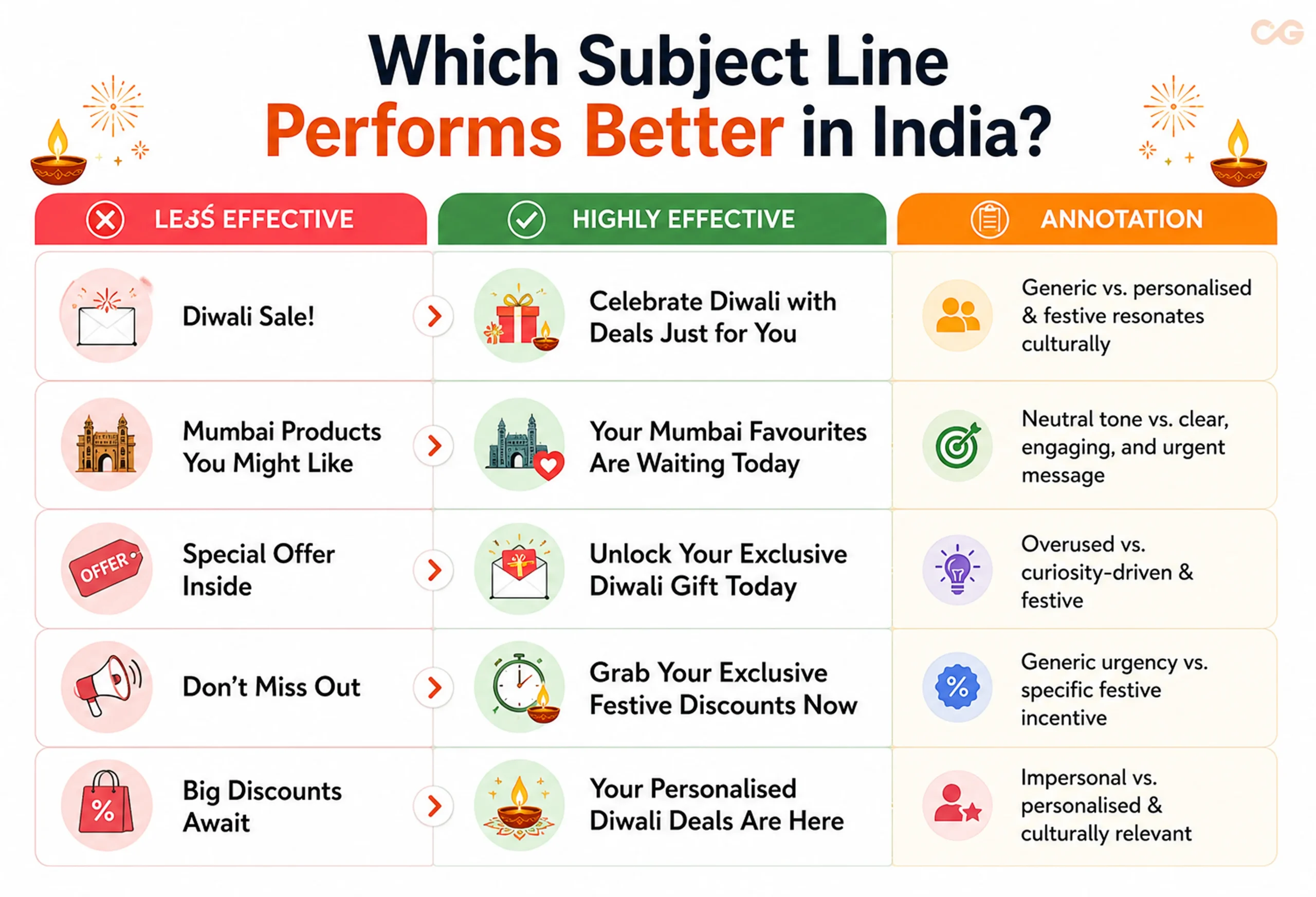
Best Practices for Subject Lines in India:Indian consumers are discerning and not solely motivated by discounts. Focus on crafting subject lines that are relevant and engaging.
What Works:
Specific Value Propositions:
❌ “Sale Now On!”
✅ “₹500 Off + Free Delivery on Orders Above ₹999”
Cultural References:
❌ “Holiday Shopping Guide”
✅ “Complete Diwali Gift Guide: Perfect for Every Family Member”
Urgency with Context:
❌ “Last Chance!”
✅ “Only 2 Days Left for Pre-Diwali Delivery”
Personalization:
❌ “Check Out Our New Collection”
✅ “Priya, New Kurtis in Your Favourite Colour”
Mobile Optimisation
Keep subject lines under 70 characters. Place key information at the start. Use emojis sparingly and only when they enhance clarity for mobile users.
Subject Lines in Regional Languages
Subject lines in Hindi resonate well with Hindi-speaking audiences. Ensure your emails support UTF-8 encoding and function properly across platforms like Gmail, Yahoo, and Outlook. Avoid mixing scripts in a single line.
Testing Recommendations
Conduct A/B tests on the subject lines using 10% of your mailing list. Compare responses for Hindi and English options, focusing on the differences between percentage discounts and rupee values to identify what works best.
Email Design Tailored for Indian Consumers
Priority on Mobile-Optimized Design
Mobile optimisation is essential. According to CloudHQ, a striking 78% of emails in India are accessed via mobile devices.
Key Elements for Mobile-Friendly Design:
Utilise single-column layouts, ensure fonts are legible, implement touch-friendly buttons (44×44 pixels), and prioritise rapid-loading images along with a clear content structure to facilitate easy browsing and interaction.
Culturally Relevant Visuals
Incorporate colours associated with Indian festivals — red and orange for celebration, green for sustainability, blue and white for trust, and gold for luxury — to captivate the audience’s interest.
Best Practices for Imagery:
Use images featuring Indian individuals, family scenes, and local products. Culturally relevant visuals, especially during festivals, enhance relatability and connection.
Typography Guidelines:
Choose web-safe fonts that support Indian scripts, maintain a clear hierarchy, and ensure readability in multiple languages across emails and applications.
Compelling Email Content for Indian Audiences
Appropriate Tone and Style:
Aim for a tone that is warm and respectful yet conversational. Strike a balance; avoid extremes of informality or formality.
Key Copywriting Elements:
Social Validation:
Indians value peer feedback highly. Incorporate:
Reviews with authentic Indian titles and addresses.
Statements like “Join over 50,000 satisfied customers in India.”
Star ratings sourced from Indian review platforms.
“100% genuine products”
“Easy 7-day returns”
“Cash on Delivery available”
“5-star rated on Trustpilot India”
Clear Call-to-Actions:
Make CTAs action-oriented and benefit-focused:
“Claim Your Diwali Discount”
“Yes, Show Me the Collection”
“Book My Slot Now”
“Get Free Shipping”
Address Purchase Barriers:
Proactively address common concerns:
“Free returns in 7 days—no questions asked”
“Delivered to 19,000+ pin codes”
“Pay online and save an extra 5%”
Growing Your Email List in India
A robust subscriber list is essential for effective email marketing in small businesses. Building your list in India should align with local digital habits.
Website Opt-in Forms:
Strategic Placement: Position forms in high-traffic areas like the homepage header, footer, blog posts, exit pop-ups, and dedicated landing pages to maximise conversions.
Attractive Opt-in Incentives for Indian Audiences: Offer discounts of 10-15%, free shipping, early access to deals, local e-books, or entry into festival giveaways to attract subscribers.
Converting Social Media to Email:
Instagram Approach: Use your bio link for a landing page, create story highlights, run contests, and add swipe-up links if you have over 10K followers to build your email list.
Facebook Lead Generation: Implement Lead Ads, share group-exclusive content, and host event sign-ups to collect emails efficiently from the Indian audience.
WhatsApp to Email Migration: Transition WhatsApp users to email for product updates, newsletters, and exclusive offers, keeping communications engaging and valuable.
Physical to Online List Building: Encourage sign-ups in-store, offer incentives on receipts, use event registrations, and loyalty program sign-ups to grow your email list.
Partnership and Co-Marketing: Collaborate on guest blogs, co-host webinars, or create offers that require email registration to reach larger audiences and build your list effectively.
What NOT to Do:
Avoid unchecked email list growth, adding contacts without consent, pre-checked opt-in boxes, hiding unsubscribe links, and emailing users who have opted out. These practices can harm deliverability, compliance, and trust.
People Also Ask: How to Launch Email Marketing in India with Zero Budget?
Start with the free plans offered by platforms such as Mailchimp, MailerLite, or Zoho Campaigns, subject to their current limits. Build a permission-based email list through website forms and social media, use free templates, and send useful newsletters regularly before introducing promotional campaigns.
Takeaway
Master Email Deliverability and Performance in India: Optimise Your Lists and Conversion Metrics.
Download our comprehensive guide to discover effective strategies, tools, and benchmarks that will elevate your email marketing efforts in India.
Advanced Email Marketing Strategies for Indian Market
After you grasp the fundamentals, you can implement advanced techniques to boost your email marketing efforts in India’s competitive landscape.
1. Hyper-Personalization Using Consumer Data
Go beyond demographics to understand real customer behaviours in the Indian market through behavioural segmentation.
Advanced Segmentation Strategies
Purchase History Segmentation: Categorise your audience based on their buying behaviour. Focus on first-time customers, returning buyers, high-value shoppers, lapsed buyers, and inactive users. Tailor campaigns to foster loyalty, encourage repeat purchases, create VIP experiences, and re-engage disengaged customers.
Geographic Micro-targeting: Adjust your marketing strategies based on location, city-specific factors, climate, local festivals, and preferred languages. Offer product recommendations, promotions, and culturally relevant messages to effectively reach diverse audiences across India.
Case Study:
Myntra, India’s leading fashion e-commerce site, has successfully implemented hyper-personalised email marketing. They utilise AI-driven product recommendations based on browsing history, purchase patterns, size preferences, and local fashion trends.
This strategy resulted in a 60% increase in open rates, doubled campaign performance compared to industry benchmarks, and achieved over 94% inbox deliverability for enhanced engagement, according to the report of Netcore.
2. Dynamic Content Personalisation
Use dynamic email content that adapts in real-time based on recipient information. This approach ensures each email feels uniquely tailored to the individual.
Implementation Examples: Product Recommendations
Dear {{FirstName}},
Based on your interest in {{LastViewedCategory}},
we think you’ll love these {{Season}} arrivals:
[Dynamic Product Grid – pulls from similar category items in stock]
Location-Specific Offers:
{{FirstName}}, exclusive for {{City}} customers:
Free same-day delivery on orders above ₹{{MinOrderValue}}
3. Price-Based Segmentation:
Show different product ranges and prices to specific customer groups:
Cost-sensitive customers: Highlight discounts, value bundles, and EMI options.
Premium customers: Showcase new items, limited editions, and high-end materials.
Festival Personalisation:
Automatically identify the next relevant festival for each subscriber based on their region and religion.
Utilising WhatsApp and Email Integration
Linking WhatsApp with email creates a powerful omnichannel marketing strategy that resonates with Indian digital habits.
WhatsApp-Email Integration
Ninety per cent of Indian smartphone users access WhatsApp daily, as reported by Intertoons. Combine WhatsApp and email marketing to create a connected customer journey. Integrating both channels can help businesses engage customers at different stages of the buying journey.
When to Use WhatsApp vs. Email:
WhatsApp:
Ideal for delivering urgent messages like flash sales, order updates, and delivery notifications. It fosters quick customer service and immediate engagement, with typical response times around 90 seconds.
Email:
Best for sharing detailed product descriptions, comprehensive texts, and image-rich catalogues. It suits monthly newsletters, formal receipts, and large segmented campaigns, allowing brands to maintain professionalism.
Integration Strategies
Cross-Channel Nurturing:
Use email for newsletters, educational content, and detailed offers, then use WhatsApp for timely, personalised follow-ups based on customer engagement.
Conversion Optimisation:
Include a WhatsApp CTA in relevant emails to let customers ask questions or get assistance. For abandoned carts, use timely WhatsApp reminders and follow up with email when additional product information or offers are useful.
Segmentation Bridge:
Invite engaged email subscribers to opt in to WhatsApp updates. Offer relevant benefits while using email for detailed content and WhatsApp for timely communication.
Creating a Cross-Channel Email and WhatsApp Funnel
Stage 1 – Awareness (Email Focused):
Educate prospects through blog content, newsletters, and informative emails. Introduce your brand and products to build awareness and trust.
Stage 2 – Consideration (Both Channels):
Use email for detailed product comparisons, reviews, and educational content. Use WhatsApp for personalised recommendations and quick customer queries.
Stage 3 – Decision (WhatsApp Supported):
Use WhatsApp for customer assistance, genuine time-sensitive offers, and purchase-related communication. Make it easy for customers to complete their purchase.
Stage 4 – Retention (Balanced Approach):
Use email for post-purchase education, cross-selling, and loyalty campaigns. Use WhatsApp for relevant check-ins, reorder reminders, and opted-in customer updates.
AI and Predictive Analytics in Email Marketing
The application of AI in email marketing is transforming the way Indian businesses predict customer behaviour and optimise campaigns.
Optimising Send Times
While common advice suggests sending emails at 9 AM or 7 PM, AI analyses each subscriber’s behaviour to determine the optimal time for delivery.
How It Works:
Tracks when each subscriber opens and clicks emails.
Identifies patterns (some prefer lunchtime, others the late evening).
Automatically sends emails at the predicted best time.
Continuously learns and adjusts based on current behaviour.
Platforms Offering This Capability:
- Mailchimp: Send Time Optimisation
- Klaviyo: Smart Send Time
- Omnisend: AI-powered Personalised Sending Time
- Zoho Campaigns: AI-powered Send-Time Optimisation
Predictive Product Recommendations
Machine learning algorithms analyse purchasing behaviour to suggest items customers may want next, often before they realise it themselves.
Effective Use in Indian Markets:
- Fashion E-commerce: Suggests seasonal wardrobe items like dupattas and provides size recommendations based on past purchases.
- Grocery & Household Supplies: Predicts when staples will need reordering, offers bulk pricing, and recommends new items aligned with dietary preferences.
- Electronics: Promotes accessories alongside core products, forecasts upgrade patterns, and suggests complementary items like earbuds when a smartwatch is purchased.
Reducing Customer Churn
AI can identify subscribers at risk of disengaging or unsubscribing before it happens.
Warning Signs AI Detects:
- Declining open rates indicate reduced interest.
- Opens without clicks suggest weak calls to action.
- Shortened reading times may imply unengaging content.
- Incomplete shopping carts reveal hesitation or lack of interest in purchasing.
- An extended period since the last purchase indicates a decline in customer loyalty.
Learning the Indian Consumer Psychology
Week 1 – Value Reminder:
- Subject: “Priya, we miss you! Here’s what’s new…”
- Content: Showcase recent popular items and share customer success stories.
Week 2 – Preference Update:
- Subject: “Help us send you more tailored emails.”
- Content: Direct them to a preference centre for topic and frequency selection.
Week 3 – Special Offer:
- Subject: “Exclusive welcome-back offer for you.”
- Content: Provide a customised discount or free shipping.
Week 4 – Final Outreach:
- Subject: “Should we say goodbye?”
- Content: Offer a chance to update preferences or unsubscribe respectfully.
This structured approach helps engage subscribers, elevate open rates, and reinforce loyalty effectively.
Testing and Optimisation Frameworks
To enhance email marketing, it’s essential to conduct systematic tests that resonate with the Indian audience.
A/B Testing Strategy
What to Test (In Order of Importance):
1. Subject Lines: Experiment with different formats, such as discounts, questions, statements, the use of emojis, varying lengths, personalisation, and language to increase open rates.
2. Send Times: Test different timings, including mornings, evenings, weekdays, weekends, and festive periods, to find when subscribers engage most.
3. Call-to-Action (CTA): Vary the text, colour, placement, and number of CTAs to improve click-through rates and conversions.
4. Email Design: Try different layouts, from single-column to multi-column designs, and alternate between image-heavy and text-heavy formats, including GIFs and video thumbnails to maximise engagement.
5. Content Length: Test shorter promotions against richer storytelling and benefit-focused content while incorporating social proof to boost interaction.
Testing Best Practices:
- Ensure that each variant reaches at least 1,000 subscribers. Wait for 24 hours before drawing conclusions and aim for a confidence level of 95% or higher to ensure reliability.
- Focus on testing one variable at a time. Maintain a log of observations and use past performance data to inform future adjustments.
Indian Market-Specific Tests to Implement:
Cultural Reference Testing:
Compare Western references against culturally relevant themes in India:
Test A: “Black Friday Sale”
Test B: “Diwali Dhamaka Sale”
(Typically, Test B performs better in India)
Payment Method Highlighting:
Test A: Standard CTA
Test B: CTA including a “COD Available” badge
(Test B usually boosts click-through rates)
Multivariate Advanced Optimisation Testing
Once comfortable with A/B testing, consider multivariate testing to evaluate multiple variables simultaneously.
Example of a Multivariate Test:
Variables: Experiment with combinations of different elements. For instance:
Subject lines: 2 options
CTA button colour: 2 options
Image style: 2 options
Total combinations: 2 x 2 x 2 = 8 unique email variants.
When to Use:
This approach is best suited for larger email lists with 10,000 or more subscribers to ensure statistically significant results. Utilise it after baseline A/B tests have identified winning components. It’s ideal for major campaigns like Diwali sales or product launches, where optimal engagement is crucial.
Email Testing Maturity Model for Indian Brands
Email Strategies for Retaining Indian Customers
Investing in customer retention email marketing can be more cost-effective than acquiring new customers, with retention efforts often costing 5–7 times less than customer acquisition. For small businesses in India, a well-planned retention strategy can strengthen customer relationships, encourage repeat purchases, and support long-term growth.
Customer Lifecycle Email Program in India
Phase 1 – Onboarding (First 30 Days):
Send a welcome email when a customer signs up or makes a purchase, followed by helpful messages throughout the first few weeks. Share how-to guides, product usage tips, FAQs, and other resources that make it easier for customers to get started.
Phase 2 – Activation (First 3 Months):
Encourage customers to engage more deeply with your products or services. Share customer success stories, highlight useful or underused features, invite customers to webinars, and request feedback. Case studies can also demonstrate how other Indian customers have achieved results.
Phase 3 – Retention (3–12 Months):
Strengthen loyalty with personalised usage insights, exclusive content, early access to new features, and relevant loyalty rewards. Celebrate meaningful customer milestones with personalised emails and offers.
Phase 4 – Advocacy (12+ Months):
Turn loyal customers into brand advocates through referral programmes, exclusive previews, loyalty benefits, and personalised experiences. Where appropriate, offer incentives for successful referrals and invite long-term customers to provide feedback on new products or services.
Re-Engaging Inactive Customers
Win-Back Email Campaigns:
Identify subscribers who have stopped engaging or purchasing and use targeted win-back email campaigns to encourage them to return. Some businesses report 10–30% reactivation rates through effective win-back strategies, according to 50Folds.
The 4-Step Win-Back Framework
1. Initial Win-Back Email:
Remind inactive customers of the value they previously received, highlight relevant updates, and use a simple CTA to encourage them to return.
2. Follow-Up Email:
If there is no response, address potential concerns and consider offering a relevant incentive. Social proof can also help rebuild confidence
3. Feedback Email:
Ask inactive customers why they stopped engaging through a short survey. An optional incentive can encourage responses and provide useful insights.
4. Final Win-Back Email:
Make one final reactivation attempt with a relevant offer or reminder. Include a clear and easy unsubscribe option for customers who no longer wish to receive emails.
Addressing Objections and Timing Win-Back Campaigns
Use reassurance and relevant offers to address common purchase concerns:
- Delivery Guarantees: Assure customers that you serve over 25,000 pin codes nationwide.
- Reduce Purchase Hesitation: Where applicable, offer free cash on delivery without additional fees.
- Build Product Confidence: Highlight 100% original, certified products when this claim can be substantiated.
Timing also matters. Avoid launching win-back campaigns during the early days of major festivals, when customers may be distracted by competing offers. Test campaigns before and after major festive periods to identify when your audience responds best.
Similarly, avoid presenting Monday mornings as universally ideal for win-back emails. Test different days and times and use your own engagement data to determine the most effective schedule.
The Future of Email Marketing in India
Email marketing in India is becoming more data-driven, personalised, and privacy-conscious. As businesses compete for attention across crowded inboxes, future success will depend on using AI, first-party data, automation, and localised content while maintaining strong deliverability and customer trust.
AI-Powered Personalisation and Automation:
Generative AI is making it easier for marketers to create personalised email content at scale. AI can analyse customer behaviour, preferences, and purchase history to support personalised subject lines, product recommendations, content variations, audience segmentation, and send-time optimisation.
For Indian businesses, AI can also support multilingual email campaigns, helping brands adapt messages for different languages, regions, and customer segments. However, businesses should use customer data responsibly and follow applicable requirements under India’s Digital Personal Data Protection Act (DPDP Act).
Interactive and Dynamic Emails:
Interactive email technologies allow supported email clients to provide actions directly within the inbox, reducing the need for customers to visit another webpage. Examples include dynamic product displays, forms, surveys, appointment confirmations, and other interactive elements.
While interactive email adoption is still developing, it can help Indian e-commerce, SaaS, travel, and service businesses create more convenient customer experiences when supported by the email client and platform.
First-Party Data and Hyper-Personalisation:
As privacy expectations increase and businesses rely less on third-party data, first-party customer data will become increasingly valuable. Purchase history, website interactions, email engagement, preferences, and loyalty activity can help businesses create more relevant campaigns.
Indian brands can use this data to tailor recommendations, offers, language, and content to different customer segments while ensuring that data is collected and used appropriately.
Multilingual and Localised Email Experiences:
India’s linguistic and cultural diversity creates significant opportunities for localisation. Businesses can adapt email content based on customers’ preferred languages, locations, regional festivals, and local shopping behaviour.
AI-powered translation and content tools can make multilingual campaigns easier to create, but human review remains important to ensure that translations and cultural references feel natural and appropriate.
Advanced Email Authentication and Deliverability:
Email security and deliverability will remain critical as inbox providers strengthen their requirements. Businesses should prioritise SPF, DKIM, and DMARC authentication, maintain clean subscriber lists, monitor engagement, and follow responsible sending practices.
For Indian businesses, these measures can help protect their domain reputation, reduce spoofing and phishing risks, and improve the likelihood that legitimate emails reach subscribers’ inboxes.
Sustainable Email Marketing:
Sustainability is also emerging as a consideration in digital marketing. Businesses can reduce unnecessary data consumption by compressing images, optimising email designs, limiting excessive content, and regularly cleaning inactive contacts.
Rather than making broad environmental claims, brands should communicate sustainability initiatives only when they can substantiate them. This approach supports responsible digital marketing while maintaining customer trust.
Takeaway
Master Email Deliverability and Performance in India: Optimise Your Lists and Conversion Metrics.
Download our comprehensive guide to discover effective strategies, tools, and benchmarks that will elevate your email marketing efforts in India.
Conclusion: Your Roadmap to Email Marketing Success in India
Email marketing remains a powerful, cost-effective tool for businesses in India’s dynamic digital environment. To succeed, understand the unique cultural aspects of Indian audiences and incorporate the latest automation and AI techniques. A strategic approach paired with tactical execution is essential.
Steps for Success
1. Establish a Solid Foundation: Choose an email provider that meets the needs of Indian businesses. Build your subscriber base responsibly, adhering to data protection regulations, and set up SPF, DKIM, and DMARC protocols to boost deliverability.
2. Cultural Intelligence: Tailor your messaging to regional preferences, languages, and festivals. Multi-language campaigns are particularly effective in tier-2 and tier-3 cities. Align communications with major festivals like Diwali to maximise outreach.
3. Mobile Optimisation: Ensure emails are mobile-friendly, as 73% of Indian businesses rely on mobile access, according to Keywords Everywhere. Use clear fonts, large buttons, and quick-loading images.
4. Automation Excellence: Implement automated processes, such as welcome emails and cart abandonment reminders. Create behaviour-driven triggers that reflect consumer preferences, integrating with platforms like WhatsApp for seamless communication.
5. Personalisation at Scale: Go beyond basic personalisation. Use dynamic content based on location and shopping behaviour. Leverage AI and predictive analytics to optimise send times and reduce churn.
6. Focus on Measurement: Prioritise metrics like open rates, click-through rates, and conversions, including region-specific data. Assess your ROI in rupees and continuously refine campaigns based on performance.
7. Maintain Compliance and Ethics: Adhere to the DPDP Act for responsible data usage. Build trust by transparently presenting your privacy policies and committing to ethical marketing practices.
Moving Forward
In India, email marketing delivers high returns on investment and effective customer engagement. Embrace market diversity and behaviours, capitalise on mobile access, and encourage purchases during festivals. Start with basic newsletters, test your strategies, and gradually expand with automation, segmentation, and targeted approaches.
Success hinges on building subscriber trust through relevant and valuable content. Focus on creating consistent, authentic relationships. Follow systematic steps for platform selection, audience building, campaign planning, measurement, and iteration. You can master scalable email marketing through gradual progress.
Get Started Today
Ready to launch your email marketing efforts? Here’s how to begin:
This Week: Select an email marketing service, either free or trial-based, to familiarise yourself with its features.
This Month: Grow your email list to over 100 subscribers using opt-in forms on your website, social media channels, and offline methods.
Month 2: Automatically send a series of welcome emails to connect with new subscribers.
Month 3: Segment your audience and conduct your first A/B test to refine content and design.
Month 4: Develop and execute your inaugural festival-themed campaign for significant Indian events.
Month 6: Review campaign performance, evaluate ROI, and scale successful tactics.
Your successful email marketing platform is just six months away. Start today.