
How AI is Revolutionising E-commerce Marketing and Personalisation

Table of Contents
- Introduction
- What Is AI in the E-commerce Landscape?
- How AI Is Personalising the E-commerce Customer Journey
- How Is AI Transforming E-commerce Marketing?
- Benefits of AI in E-commerce
- Challenges & Ethical Considerations
- Future Trends in AI & E-commerce Personalisation
- Conclusion
Introduction
Artificial Intelligence is transforming e-commerce marketing by enabling personalised experiences that strengthen brand interactions and improve the online shopping experience. With AI-powered product recommendations, chatbots, and marketing automation, retailers can analyse vast amounts of customer data in real time and tailor content to individual preferences.
This AI-powered personalisation can improve customer satisfaction while driving sales and conversions. According to a study by Epsilon, 80 per cent of buyers are more inclined to purchase from brands that provide personalised experiences, highlighting the growing importance of personalisation in e-commerce marketing.
Why Is Personalisation Crucial for Online Retail Success?
Generic marketing is becoming less effective in today’s competitive e-commerce landscape. Personalisation uses AI-driven machine learning and predictive analytics to create dynamic and relevant shopping experiences based on individual customer behaviour and preferences. Hyper-personalisation helps brands build stronger customer relationships, increase engagement, anticipate customer needs, and deliver more relevant product recommendations.
The use of AI for dynamic content creation and personalised email marketing also enables retailers to deliver timely, relevant messages that can help reduce abandoned shopping carts and increase sales. By using AI for marketing personalisation, e-commerce businesses can move beyond transactional interactions and create customer-centric experiences that encourage long-term brand loyalty and growth.
What Is AI in the E-commerce Landscape?
Artificial Intelligence (AI) in e-commerce refers to the use of intelligent technologies to analyse data, automate processes, and improve different aspects of online retail. It enables businesses to process large volumes of customer and operational data, identify patterns, and deliver more customised shopping experiences.
AI is changing how retailers understand and engage with customers, manage inventory, and optimise marketing activities. Unlike basic automation, AI can analyse data, learn from patterns, and support data-driven decisions across different stages of the e-commerce journey.
Which Leading AI Technologies Are Fueling Innovation in E-commerce?
Several foundational AI technologies are driving innovation in e-commerce marketing and personalisation:
- Machine Learning: Machine learning models analyse browsing behaviour, purchase history, product preferences, and other customer data to recommend relevant products and predict future buying behaviour.
- Natural Language Processing: NLP enables systems to understand and respond to user queries in natural language. It supports AI chatbots and improves e-commerce search and conversational experiences.
- Computer Vision: Computer vision enables applications such as visual search, allowing customers to discover products using images. It also supports augmented reality (AR) experiences that let shoppers virtually explore or try products before making a purchase.
- Predictive Analytics: Predictive analytics uses historical and real-time data to identify patterns and forecast demand, customer behaviour, pricing trends, and inventory requirements. These insights help retailers make more informed decisions and respond proactively to changing market conditions.
According to UBS estimates reported by The Economic Times, global AI spending is projected to reach $360 billion in 2025 and $480 billion in 2026, reflecting the rapid growth of AI investment across industries. This increasing investment highlights the growing role of AI in helping businesses improve efficiency, understand customers, and develop more data-driven strategies.
Together, these technologies enable e-commerce businesses to build more relevant, responsive, and data-driven shopping experiences while supporting marketing personalisation and long-term customer engagement.
How AI Is Personalising the E-commerce Customer Journey
AI is enabling e-commerce businesses to personalise interactions at different stages of the customer journey, from product discovery and marketing communication to pricing and customer support. By analysing behavioural and transactional data, AI can help retailers deliver more relevant experiences while reducing friction throughout the buying process.
How Do AI-Powered Product Recommendations Help Online Businesses?
AI-powered product recommendations are one of the most widely used applications of personalisation in e-commerce. Recommendation systems use algorithms such as collaborative filtering and deep learning to analyse browsing behaviour, purchase history, product searches, preferences, and other customer interactions.
Based on these patterns, AI can recommend products that are more relevant to each shopper in real time. This helps customers discover products more easily while giving retailers opportunities to increase engagement, conversions, and repeat purchases.
Amazon’s AI recommendation engine has raised sales by 35%, according to DigitalDefynd, demonstrating the potential impact of personalised product recommendations on e-commerce sales.
Takeaway

Want to see how leading brands are using AI to tackle real e-commerce challenges? Download the full takeaway to see how these brands are using AI to improve performance, customer experience, and growth.
Essential AI Techniques Behind Product Recommendations
Two important techniques used to power personalised recommendations include:
- Collaborative Filtering: Recommends products by identifying similarities between customers’ behaviours, preferences, and purchasing patterns.
- Deep Learning Models: Use neural networks to identify complex patterns across large datasets, helping improve the relevance and accuracy of product recommendations.
According to RapidInnovation, retailers using advanced AI recommendation algorithms have witnessed a 22% increase in customer lifetime value, highlighting how relevant product suggestions can encourage stronger engagement and repeat purchases.
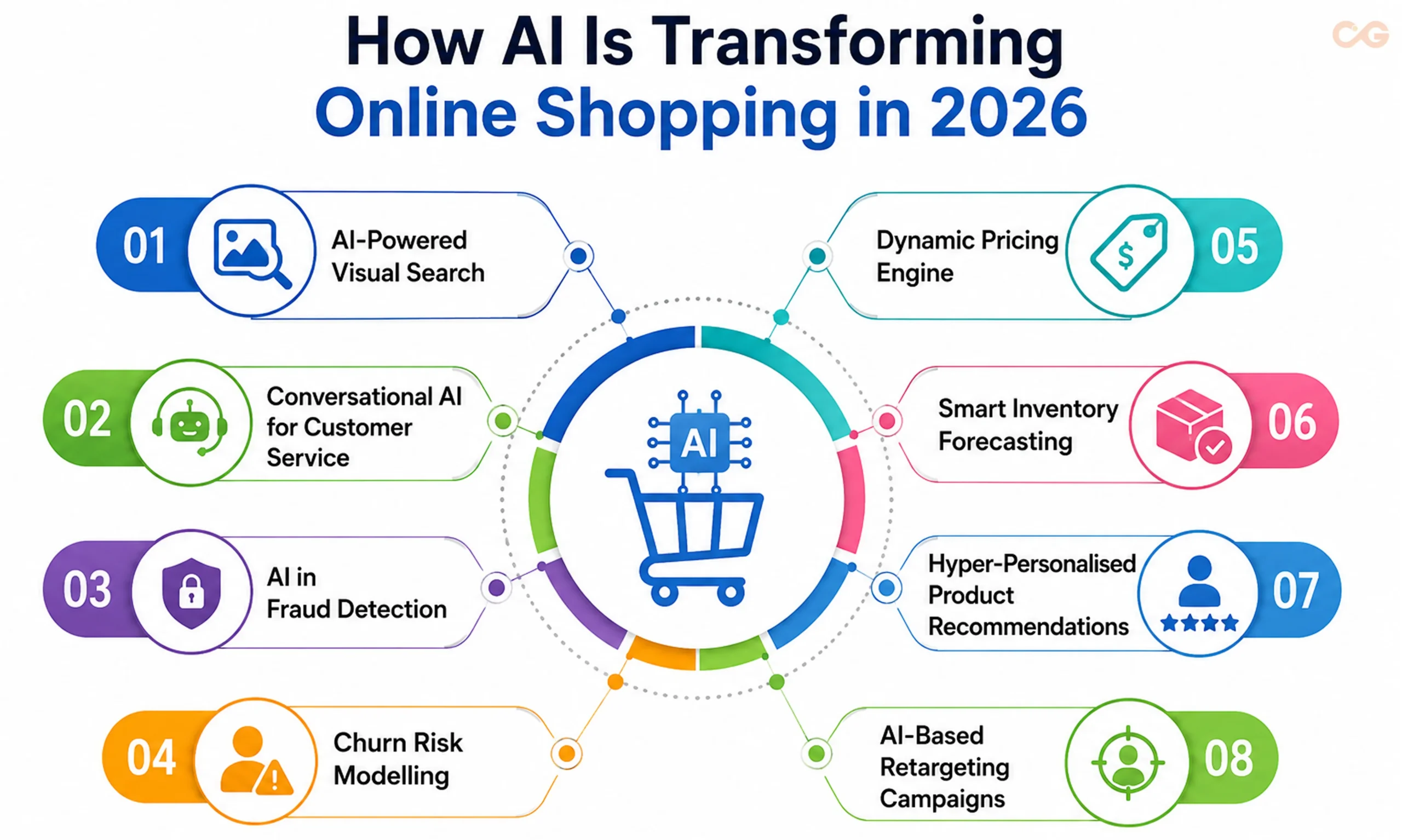
How Does AI Improve Personalised Marketing and Pricing?
AI enables retailers to create more relevant marketing campaigns by analysing customer behaviour and segmenting audiences according to their interests, preferences, and purchase intent. Through email segmentation and customised promotions, businesses can deliver messages that are more relevant to individual customers.
For example, AI can personalise email marketing based on browsing activity, previous purchases, or abandoned carts. This allows retailers to send timely product suggestions, reminders, and offers that can encourage customers to complete their purchases.
AI also supports dynamic pricing, where algorithms analyse factors such as demand, competitor prices, inventory levels, and customer behaviour to determine appropriate prices in real time. This enables retailers to respond quickly to market changes while balancing competitiveness and profitability.
How Do AI Chatbots and Virtual Assistants Improve Customer Support?
AI-driven chatbots and virtual assistants provide conversational, 24/7 support throughout the e-commerce journey. They can answer common questions, help customers find products, provide personalised recommendations, assist with order-related queries, and guide shoppers through purchasing decisions.
By providing immediate and customised assistance, AI can reduce response times and minimise friction during the buying process. At the same time, chatbots can handle routine queries, allowing human customer service teams to focus on more complex issues that require judgement or empathy.
How Is AI Transforming E-commerce Marketing?
AI is helping e-commerce businesses make marketing decisions based on customer behaviour, market trends, and real-time data. From predicting what customers are likely to buy to optimising advertising and creating personalised content, AI enables marketers to make campaigns more relevant and responsive.
Predictive Analytics: Unlocking Consumer Insights and Forecasting Trends
Predictive analytics for e-commerce uses historical and real-time data to identify patterns and forecast customer behaviour, purchasing trends, and market demand. By analysing browsing activity, purchase history, seasonal patterns, and external factors, AI models can help retailers anticipate what customers may want next.
These systems can continuously learn from new data and adapt their predictions as customer behaviour and market conditions change. For example, retailers can use predictive analytics to identify emerging product trends and launch targeted promotions before demand reaches its peak.
According to Deloitte, businesses using predictive analytics can make decisions five times faster than their competitors, highlighting its potential to support faster and more informed marketing decisions.
AI-Generated Content: Automating Personalisation at Scale
Creating personalised content for different customer segments can be time-consuming for e-commerce marketing teams. AI-generated content helps automate this process by producing and adapting product descriptions, landing-page copy, email messages, and other marketing assets at scale.
AI can use natural language generation (NLG) to:
- Create AI-generated product descriptions tailored to different customer segments.
- Adapt landing-page content based on browsing and purchase behaviour.
- Generate personalised email messages based on customer interactions and preferences.
- Create multiple content variations for different audiences and campaigns.
By automating repetitive content tasks, AI allows marketing teams to produce relevant content more efficiently while maintaining a consistent brand experience across customer touchpoints.
AI-Powered Ad Targeting: Smarter and More Relevant Campaigns
AI-powered advertising enables e-commerce brands to target customers based on behavioural signals such as browsing activity, purchase intent, engagement, and previous interactions. Instead of relying only on broad demographic segments, machine learning can identify audiences that are more likely to respond to specific products or offers.
AI can continuously optimise advertising campaigns by:
- Adjusting bids based on the likelihood of conversion.
- Personalising ad content according to customer interests and behaviour.
- Analysing campaign performance across channels to improve targeting.
- Identifying high-intent audiences for retargeting campaigns.
This approach helps marketers make better use of their advertising budgets while delivering more relevant messages to potential customers.
Sentiment Analysis: Understanding Customer Perceptions
AI-powered sentiment analysis uses natural language processing (NLP) to analyse customer reviews, social media conversations, surveys, and other forms of feedback. It helps e-commerce brands understand whether customers feel positively, negatively, or neutrally about their products, services, or overall brand experience.
These insights can reveal common complaints, emerging customer preferences, and areas that require improvement. Marketers can use this information to refine messaging, respond to negative feedback, and create campaigns that better reflect customer expectations.
By monitoring sentiment over time, businesses can identify shifts in customer perception and take action before negative experiences affect brand trust and loyalty.
Takeaway
Want to see how leading brands are using AI to tackle real e-commerce challenges? Download the full takeaway to see how these brands are using AI to improve performance, customer experience, and growth.
Benefits of AI in E-commerce
AI can create value across the e-commerce customer journey by improving personalisation, increasing conversions, streamlining operations, and strengthening security. Beyond automating individual tasks, it enables businesses to make faster, data-driven decisions while delivering more relevant experiences to customers.
Enhancing Customer Engagement and Retention
AI helps e-commerce brands build stronger customer relationships by analysing preferences, browsing behaviour, purchase history, and interactions. These insights allow businesses to deliver more relevant recommendations, offers, and communications that encourage customers to return.
AI-driven chatbots and virtual assistants further support engagement by providing instant, personalised assistance throughout the shopping journey. By reducing friction and resolving routine queries quickly, they can improve the overall customer experience and support long-term retention.
Increasing Conversions Through Tailored Experiences
AI can help turn more browsers into buyers by dynamically adapting product recommendations, offers, and content according to customer behaviour and purchase intent. By presenting shoppers with products and messages that are more relevant to their needs, businesses can create smoother paths to purchase.
According to Accenture, 91% of consumers are more likely to shop with brands that recognise, remember, and provide relevant offers and recommendations. This highlights the value of personalisation in creating experiences that encourage engagement and conversions.
Improving Efficiency and Reducing Costs
AI can automate time-consuming e-commerce processes such as inventory forecasting, demand prediction, customer support, and campaign optimisation. This reduces manual effort, helps minimise errors, and allows teams to focus on higher-value activities.
For example, AI-driven forecasting can help retailers anticipate demand and maintain appropriate inventory levels, reducing the risk of overstocking or stockouts. At the same time, AI chatbots can handle routine customer queries, allowing human agents to focus on more complex customer needs.
Strengthening Fraud Detection and Security
AI also plays an important role in protecting e-commerce businesses and their customers from fraudulent activity. By analysing transaction patterns, account activity, and unusual behavioural signals in real time, AI systems can identify potentially suspicious transactions and flag them for further investigation.
According to Shopify’s research, global e-commerce losses from online payment fraud are estimated at $56.1 billion in 2025 and are forecast to exceed $131 billion by 2030, highlighting the growing need for advanced fraud prevention technologies. AI can help retailers respond to this challenge by detecting suspicious patterns more quickly and strengthening transaction security.
Challenges & Ethical Considerations
While AI can improve personalisation, marketing, and operational efficiency in e-commerce, its adoption also creates challenges around data privacy, fairness, transparency, and human oversight. Addressing these concerns is essential for businesses to use AI responsibly while maintaining customer trust.
Concerns Regarding Data Privacy and Ethical AI Use
AI in e-commerce often relies on large amounts of customer data, including browsing activity, purchase history, preferences, and interactions, to create personalised experiences and targeted marketing campaigns. This raises important questions about how customer data is collected, stored, processed, and shared.
Businesses must comply with applicable data protection regulations, such as the General Data Protection Regulation (GDPR) and the California Consumer Privacy Act (CCPA), while maintaining transparency about how customer information is used. Providing clear privacy policies and appropriate consent and opt-out mechanisms can give customers greater control over their data.
Responsible data practices not only reduce privacy risks but also help businesses build trust as AI becomes more deeply integrated into the shopping experience.
Addressing Algorithmic Bias in Personalisation and Recommendations
Algorithmic bias can occur when AI models are trained on incomplete, unbalanced, or historically biased data. In e-commerce, this can affect product recommendations, promotions, search results, pricing, or the visibility of certain products and customer groups.
For example, an AI system could consistently favour particular customer segments or produce less relevant recommendations for groups that are underrepresented in its training data. Such outcomes can create unfair experiences and undermine customer confidence.
Businesses should use diverse and representative datasets, regularly test AI systems for bias, and monitor their outputs over time. Bias detection and fairness checks can help identify unintended patterns and support more inclusive personalisation.
Balancing AI Automation With Human Intervention
AI can automate many e-commerce processes, but relying on it without human oversight can create additional risks. AI systems may produce inaccurate outputs, misunderstand customer context, or struggle with situations that require empathy, judgement, or ethical decision-making.
Human intervention is therefore essential for handling complex cases and reviewing high-impact AI decisions. Businesses should build human oversight into AI workflows and give employees the ability to review, correct, or override AI-generated outputs when necessary.
Maintaining the right balance between automation and human judgement allows e-commerce businesses to benefit from AI’s efficiency while ensuring accountability, accuracy, and responsible decision-making.
Future Trends in AI & E-commerce Personalisation
As AI adoption continues to evolve, e-commerce personalisation is moving beyond recommendations and targeted campaigns toward more immersive, conversational, and data-driven experiences. Three areas are likely to shape this evolution: AI-powered AR and VR, voice commerce, and AI-enhanced influencer marketing.
Hyper-Personalisation with AI-Powered AR and VR
The combination of Artificial Intelligence (AI), Augmented Reality (AR), and Virtual Reality (VR) is creating more immersive and personalised shopping experiences. AI can use customer preferences and behavioural data to tailor virtual environments, product displays, and recommendations to individual shoppers.
For example, AI-powered virtual try-ons can help customers visualise how products such as clothing, accessories, or beauty items may look before purchasing. As these technologies become more sophisticated, they could make online shopping more interactive while helping customers make more confident purchase decisions.
The Growing Influence of AI in Voice Commerce
AI is also making voice commerce more conversational and intuitive. AI-powered assistants such as Alexa and Google Assistant can understand natural-language queries, interpret customer intent, and provide relevant product information or recommendations.
This enables customers to search for products, compare options, and complete certain shopping tasks through voice commands. According to the Voice Commerce Market Report 2026, the global voice commerce market is expected to grow from $150.34 billion in 2025 to $194.03 billion in 2026, highlighting the growing role of voice-enabled shopping experiences.
The Rise of AI-Powered Influencer Marketing
AI is also changing how e-commerce brands approach influencer marketing. Brands can analyse influencer audiences, engagement patterns, content performance, and audience interests to identify creators who are more closely aligned with their target customers.
AI can also help marketers personalise campaign messaging, generate content variations, and analyse campaign performance. This data-driven approach can help brands make more informed creator-selection decisions and develop influencer campaigns that are more relevant to specific audience segments.
Together, these developments are moving e-commerce personalisation toward more immersive, conversational, and context-aware experiences. As AI becomes more integrated with emerging technologies and marketing channels, retailers will have new opportunities to engage customers throughout the shopping journey while delivering experiences tailored to individual needs and preferences.
Takeaway
Want to see how leading brands are using AI to tackle real e-commerce challenges? Download the full takeaway to see how these brands are using AI to improve performance, customer experience, and growth.
Conclusion
AI is transforming e-commerce through personalised marketing, efficient operations, and connected customer experiences. Technologies such as predictive analytics, dynamic pricing, AI-driven chatbots, and immersive Augmented Reality (AR) and Virtual Reality (VR) experiences help businesses understand customer needs and deliver relevant interactions. McKinsey research shows that companies adopting an AI-driven marketing and personalisation approach can generate incremental revenue of 10–15%, highlighting AI’s competitive potential.
To maximise these benefits, businesses should identify high-value AI applications such as product recommendations, targeted marketing campaigns, and customer service automation. Investing in scalable AI systems and data-driven decision-making can help businesses respond to changing customer behaviour while maintaining transparency, data privacy, algorithmic fairness, and human oversight.
Ultimately, AI adoption is about more than automation. It enables businesses to turn customer data into meaningful insights, deliver relevant experiences, and make better decisions. Combining AI-driven marketing and personalisation with responsible practices can strengthen customer loyalty, improve conversions and efficiency, and support sustainable e-commerce growth.