
How 5G Is Transforming Mobile Marketing and User Experience
Table of Contents
- Introduction
- Defining 4G and 5G: The Foundation of Modern Mobile Networks
- The Evolution of Mobile Marketing with 5G
- Enhancing User Experience with 5G
- Challenges & Considerations
- The Future of Mobile Marketing in a 5G World
- Conclusion
Introduction
The innovation behind 5G technology goes beyond a simple speed upgrade; it is becoming a transformative force across the digital ecosystem. By delivering ultra-high-speed connectivity and immediate data transfer, the fifth generation of mobile networks is creating new opportunities for 5G mobile marketing and 5G user experience. But what does this mean for brands and consumers in an increasingly mobile-centric world?
From a marketing perspective, 5G mobile marketing enables brands to create highly interactive and personalised campaigns using advanced analytics and authentic data to reach consumers more effectively. Faster mobile content delivery allows videos, immersive ads, and interactive mobile campaigns to load with minimal delay, helping brands capture attention and create smoother experiences. The impacts of 5G also extend to the customer journey, as brands can use responsive mobile design and advanced mobile analytics to deliver experiences that better align with user preferences and behaviour.
As 5G and user experience continue to evolve together, the technology is reshaping how users interact with brands across mobile channels. Faster response times, smoother navigation, easier access to information, and more dynamic content can create a more seamless and user-centric experience. Ultimately, 5G is not just about speed; it is about making mobile interactions more responsive, reliable, and engaging.
Defining 4G and 5G: The Foundation of Modern Mobile Networks
4G, or the fourth generation of wireless technology, marked a major milestone in mobile connectivity. According to TechTarget, it offers broadband speeds of up to 100 Mbps, supporting smooth video streaming, faster downloads, and the widespread adoption of mobile apps. However, as user expectations grew and digital experiences became more demanding, 4G networks began to face limitations related to congestion, latency, and scalability.
5G, or the fifth generation of wireless technology, is designed to address these limitations while creating new possibilities for 5G mobile marketing and user experience. According to AsianetFIBER, 5G can deliver speeds of up to 10 Gbps with latency as low as 1 millisecond. It also supports greater bandwidth and can connect up to one million devices per square kilometre. Unlike 4G, which primarily relies on traditional cell towers, 5G uses a denser network of small cells and a wider range of spectrum to support more connected devices and data-intensive experiences.
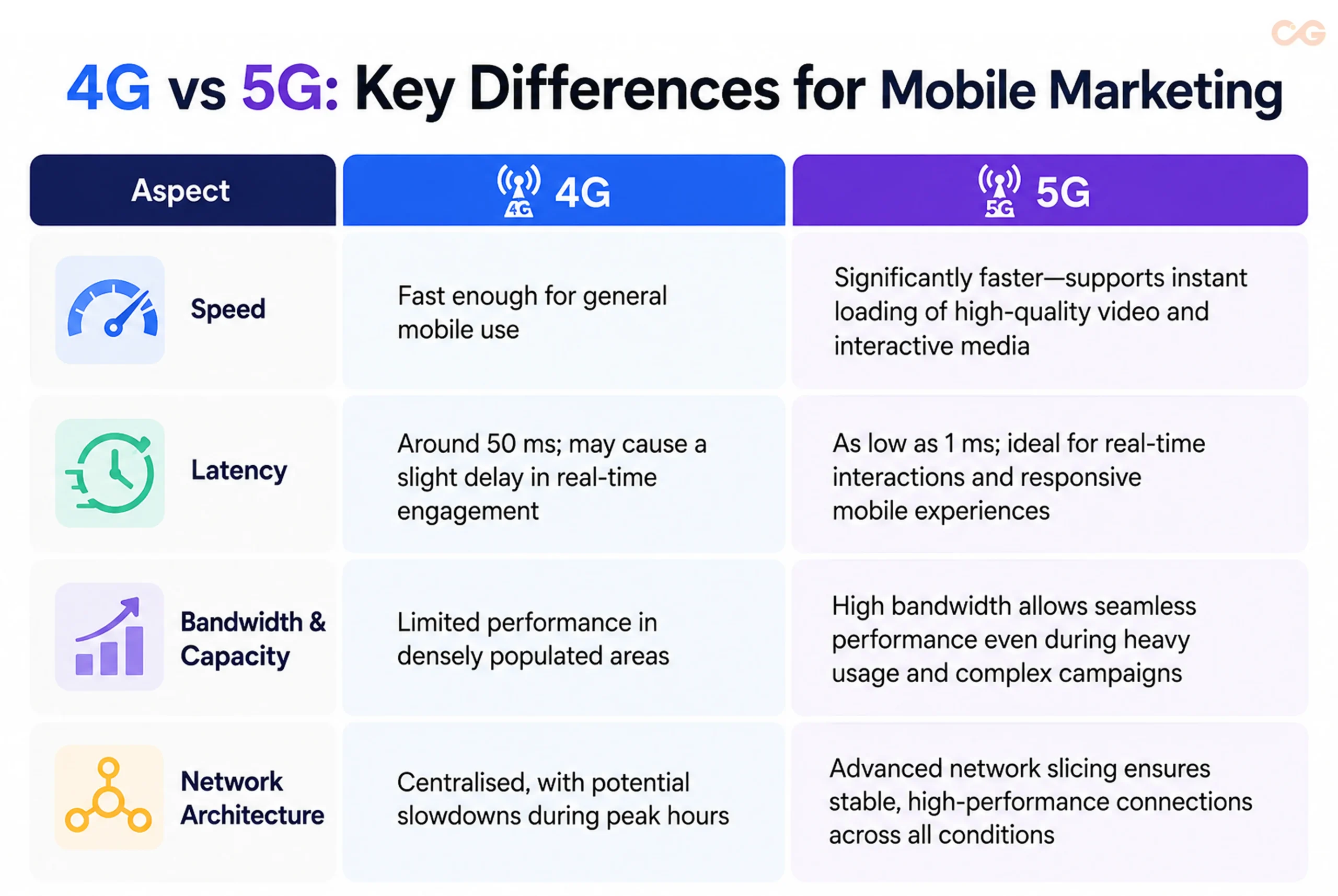
Key Features of 5G Impacting Mobile Experiences
- Faster Mobile Content Delivery: 5G enables high-quality videos, rich media, and AR/VR content to be delivered with less buffering and delay, helping brands create smoother mobile experiences.
- Real-Time Engagement: Its ultra-low latency supports interactive mobile campaigns, live interactions, and responsive interfaces, creating a more engaging 5G user experience.
- Massive Device Connectivity: 5G can support a much larger number of connected devices, enabling advanced mobile analytics and personalised marketing experiences at scale.
- Network Slicing: Network slicing allows operators to create dedicated virtual networks for specific requirements, helping improve reliability and optimise 5G-driven mobile app engagement.
Takeaway

See how leading Indian healthcare organisations are using 5G to improve real-time connectivity, responsiveness, and digitally enabled patient experiences.
The Evolution of Mobile Marketing with 5G
Faster Load Times and Seamless Content Consumption
One of the most immediate benefits of 5G is faster mobile content delivery, allowing users to access high-quality digital content with minimal delays. This creates smoother browsing experiences and gives marketers more flexibility to deliver richer content.
- Users can access high-resolution images, articles, videos, and interactive mobile campaigns with less buffering and waiting time.
- Faster content delivery can support higher engagement by creating a smoother 5G user experience and reducing friction across the mobile customer journey.
- Brands can also use richer content formats without compromising the responsiveness of their mobile experiences.
Premium Video Marketing: 4K Streaming and Interactive Content
The capabilities of 5G mobile marketing are also changing how brands use video to engage mobile audiences. Higher bandwidth allows marketers to deliver richer video experiences while reducing interruptions during playback.
- 4K streaming: Brands can deliver high-definition videos, product demonstrations, and video ads with smoother playback and fewer interruptions.
- Interactive content: Marketers can make video experiences more engaging through clickable elements, polls, product links, and shoppable features.
These capabilities allow video campaigns to move beyond passive viewing and encourage users to interact directly with the content.
Real-Time Interaction with AR/VR Experiences
The ultra-low latency of 5G creates new possibilities for real-time AR and VR experiences. By reducing delays between user actions and digital responses, 5G can make immersive mobile experiences more responsive.
Brands can use virtual try-ons, 360-degree product views, and augmented reality experiences that respond quickly to user interactions. These applications can make 5G mobile app engagement more dynamic by turning mobile devices into interactive experiences rather than simply channels for consuming content.
Personalised Marketing with AI Insights
5G’s greater bandwidth and device connectivity can also strengthen advanced mobile analytics and AI-based personalisation. With more connected devices and faster data transmission, marketers can respond to user behaviour and contextual signals more efficiently.
- Real-time user data can support hyper-personalised marketing messages, offers, and recommendations based on preferences and behaviour.
- Campaigns can be adjusted according to factors such as user interests, location, and interactions, helping brands optimise different stages of the customer journey.
- Combined with AI, these capabilities can help marketers deliver more relevant experiences while improving the efficiency of campaign optimisation.
In India, the adoption of 5G is creating a growing foundation for these experiences. According to the Ministry of Communications, 5G mobile subscriptions reached 25 crore as of March 2025, with Ericsson projecting 980 million subscriptions by 2030.
Enhancing User Experience with 5G
While 5G creates new opportunities for mobile marketing, its impact is ultimately reflected in how users experience digital products and services. Faster data transfer, lower latency, and greater network capacity can make mobile interactions more responsive, immersive, and seamless across different touchpoints.
Improved Mobile Application Performance and Responsiveness
5G can enhance mobile application performance by enabling faster data transfer and extremely low latency. Instead of focusing only on speed, the key benefit for users is a more responsive experience, with apps able to update content and respond to interactions with minimal delay.
- Mobile applications can load and update content more quickly, reducing waiting times and interruptions.
- Real-time features such as instant messaging, live collaboration, and video calls can provide smoother and more responsive interactions.
- HD video streaming within mobile applications can become more seamless, with fewer interruptions during periods of heavy network usage.
An Ericsson study reported that 5G users experienced 20% higher satisfaction with app experiences than 4G users at major events, highlighting the potential of improved connectivity to enhance user satisfaction.
Seamless Omnichannel Experiences
5G can help brands create smoother connections between digital and physical touchpoints, supporting more consistent omnichannel experiences.
- Customers can begin their journey on a mobile device, continue on a website, and complete a purchase in a physical store while their information and preferences remain synchronised.
- Users can access product information, personalised offers, and services while browsing mobile interfaces or interacting with kiosks and smart displays.
- AI-led chatbots and mobile applications can provide faster, context-aware assistance, helping brands deliver more responsive customer support.
This combination of connected touchpoints can reduce friction throughout the customer journey while creating a more consistent experience across channels.
More Immersive Shopping Experiences with AR/VR
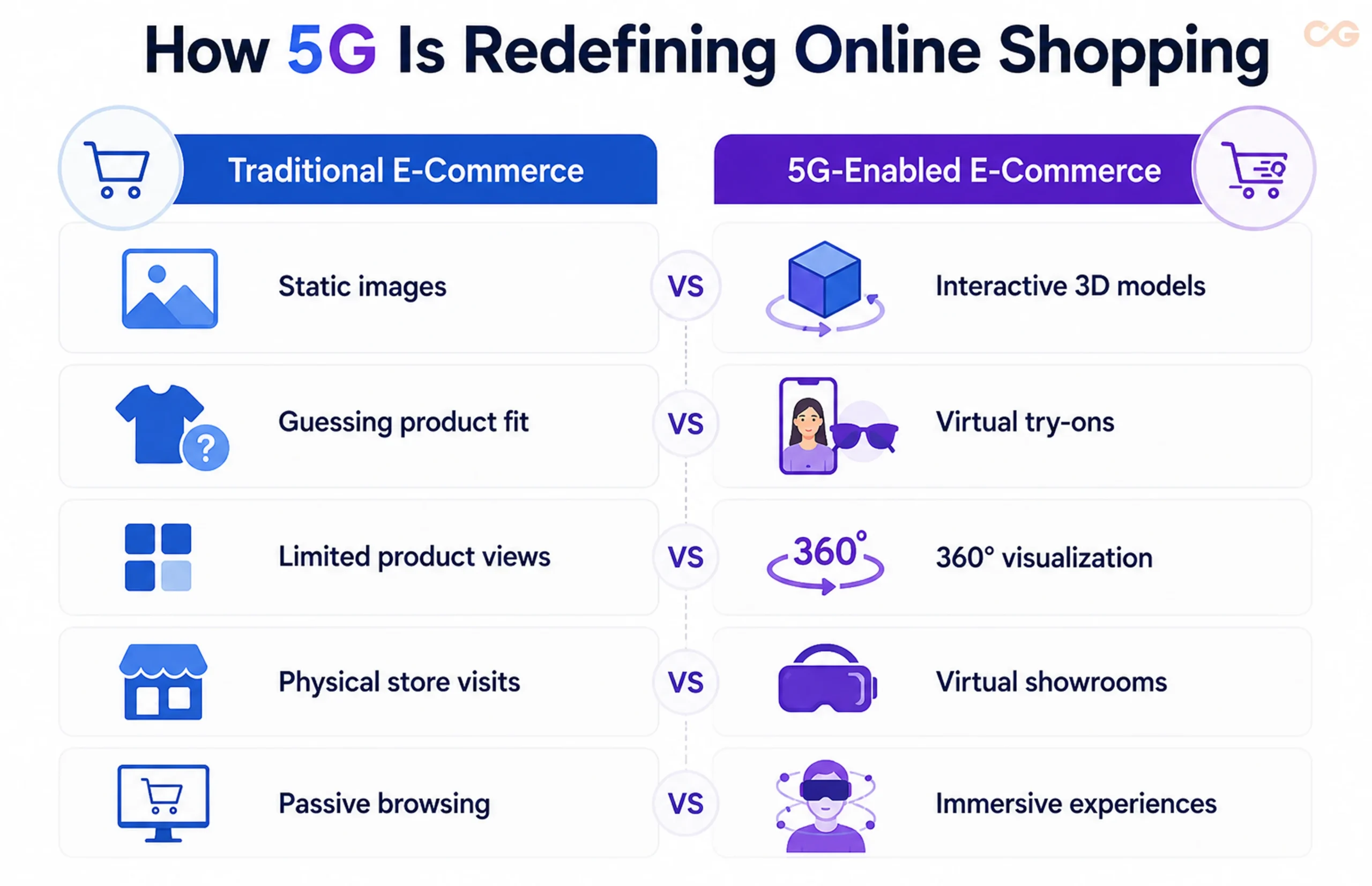
5G’s high bandwidth and low latency can support more responsive AR and VR experiences in e-commerce, allowing shoppers to interact with products in more immersive ways.
- AR applications can allow shoppers to virtually try on clothes and accessories or preview products such as makeup before making a purchase.
- Virtual showrooms and 3D product visualisations can give customers more detailed views of products and help them explore features before buying.
- Retailers can combine digital and physical experiences by allowing customers to interact with products through their mobile devices while shopping in-store.
These experiences can make mobile shopping more interactive while helping customers make more informed purchasing decisions.
Enhanced Mobile Gaming and Entertainment
5G is also changing mobile gaming and entertainment by supporting faster downloads, responsive gameplay, and richer digital experiences.
- Faster downloads of game updates and new content can reduce waiting times for gamers.
- Low latency can make gameplay and controls more responsive, which is particularly important for competitive multiplayer games.
- Higher-quality graphics and immersive experiences can help mobile games deliver experiences that were previously associated mainly with consoles and PCs.
- 5G can also support cloud gaming by allowing users to stream high-quality games to mobile devices without relying entirely on powerful local hardware or large storage capacity.
Together, these capabilities can make mobile entertainment more responsive, interactive, and immersive.
Takeaway
See how leading Indian healthcare organisations are using 5G to improve real-time connectivity, responsiveness, and digitally enabled patient experiences.
Challenges & Considerations
While 5G creates faster, richer, and more connected mobile experiences, its adoption also comes with challenges. Higher data consumption, security and privacy concerns, and unequal access can affect how easily consumers and businesses can take advantage of 5G technology.
Improved Mobile Application Performance and Responsiveness
The ultra-fast speeds and high bandwidth of 5G technology can encourage users to consume more mobile data, particularly through high-resolution video, cloud gaming, and other data-intensive services. According to the OPENSIGNAL report 2021, in mature 5G markets such as Thailand, South Korea, and Saudi Arabia, monthly average data usage per user regularly exceeds 30GB, compared with almost 20GB in 4G scenarios.
This increase in consumption is largely associated with activities such as high-resolution video streaming, cloud gaming, and the growing use of IoT devices.
- 4K video streaming, cloud gaming, and real-time cloud backup can quickly increase data usage, potentially leading to higher bills or greater demand for unlimited data plans.
- Consumers and businesses may also need to account for the cost of upgrading devices and infrastructure to take full advantage of 5G capabilities, which can remain a significant financial barrier, particularly in rural or less developed areas.
Security and Privacy Concerns with Faster Data Processing
Although 5G enables real-time data processing and supports the connection of billions of devices, the increased connectivity also introduces new security and privacy considerations.
- The dense network of small 5G networks can enable more precise location tracking, raising concerns about user privacy and the potential misuse of personal data. The greater amount of location and behavioural information available through 5G technology makes responsible data handling increasingly important.
- A larger number of connected devices can also expand the attack surface for cyber threats. Businesses therefore need to invest in appropriate cybersecurity measures to protect sensitive information and comply with evolving data protection and privacy requirements.
For marketers, this makes transparency, responsible data collection, and strong security practices essential for maintaining user trust while delivering personalised experiences.
Accessibility and Global Adoption Challenges
5G adoption is not uniform across the globe, and differences in infrastructure, device availability, and affordability can influence how quickly consumers and businesses can adopt the technology.
- The cost of infrastructure development remains a major hurdle, particularly in rural and remote areas where returns on investment may be lower. As a result, some regions continue to have limited access to 5G.
- The ecosystem of 5G-enabled devices and applications is still developing. Many users and businesses continue to rely on 4G or LTE devices until 5G-compatible options become more widely available and affordable.
- Training and awareness are also important, as consumers and businesses need to understand how to manage higher data consumption, secure connected devices, and adapt to new ways of working and interacting online.
Ultimately, the success of 5G will depend not only on network performance but also on making its benefits accessible, affordable, secure, and useful for a wider range of users.
The Future of Mobile Marketing in a 5G World
As 5G adoption expands, mobile marketing is likely to become more connected, responsive, and context-aware. Faster connectivity, real-time data processing, and greater device connectivity will give brands new opportunities to understand consumer behaviour and create more relevant experiences across the customer journey.
Emerging Trends: IoT-Driven Marketing and Hyper-Personalisation
5G is creating new opportunities for IoT-driven marketing and hyper-personalisation by enabling more connected devices and faster data exchange. Marketers can gather behavioural and contextual data from smartphones, wearables, smart home devices, and vehicles to better understand how consumers interact with brands across different touchpoints.
- 5G connectivity can enable brands to deliver hyper-personalised ads and offers based on factors such as location, preferences, and ongoing activity.
- For example, a coffee shop could send a relevant offer to a user’s phone when they are nearby, while a retailer could provide a time-sensitive promotion when a customer enters a particular section of a store.
- As more devices become connected, marketers can create context-aware experiences that respond to consumer needs throughout the customer journey.
How Should Businesses Adapt to Leverage 5G?
To remain competitive in 5G and real-time mobile marketing, businesses need to adapt their digital strategies to take advantage of faster connectivity and increasingly connected customer experiences.
- Marketers should invest in AI-powered platforms that can process real-time data and support faster campaign optimisation, helping brands deliver more relevant engagements.
- Brands should optimise their mobile content and experiences for fast loading, high-quality video, interactive formats, and real-time engagement across devices.
- Companies can explore interactive campaigns, smart product recommendations, dynamic pricing, and connected experiences that combine online and offline touchpoints with geo-data and IoT integration.
- As the volume and sensitivity of consumer data increase, businesses must prioritise security, privacy, transparency, and ethical data practices.
Future Trends in 5G-Driven Marketing
The next phase of digital marketing will focus less on simply delivering content faster and more on creating intelligent, real-time, and immersive customer experiences.
- Real-time personalisation is expected to become more sophisticated as brands combine AI, data, and 5G connectivity to deliver content and offers that respond to changing user behaviour and context.
- IoT-driven marketing experiences are likely to expand as connected devices create additional touchpoints across the customer journey.
- Augmented Reality (AR), Virtual Reality (VR), and interactive video can become increasingly important marketing formats, giving users more immersive ways to explore products and interact with brands.
- Mobile experiences are also likely to become more context-aware, with faster connectivity enabling interfaces, recommendations, and support services to respond more effectively to users’ actions and preferences.
Ultimately, the future of 5G-driven marketing will not be defined by speed alone. Its greater value will come from how businesses use connectivity, data, AI, and immersive technologies to create experiences that are faster, more personalised, responsive, and useful for users.
Takeaway
See how leading Indian healthcare organisations are using 5G to improve real-time connectivity, responsiveness, and digitally enabled patient experiences.
Conclusion
Is Your Brand Ready to Flourish in the 5G-Driven Mobile Future?
5G technology is transforming mobile marketing and user experience by making digital interactions faster, more responsive, personalised, and immersive. Its impact extends beyond connectivity, giving brands new opportunities to deliver real-time engagement, interactive AR/VR experiences, and hyper-personalised campaigns supported by AI and IoT.
For businesses, making the most of 5G requires more than simply adopting the technology. Brands need to optimise their mobile experiences, use data responsibly, create content that takes advantage of faster connectivity, and maintain strong security and privacy practices. At the same time, they must ensure that these experiences provide genuine value to users rather than adding complexity.
The opportunities are significant, but challenges such as higher data consumption, privacy concerns, and unequal access remain. As 5G adoption continues to expand, businesses that balance innovation with accessibility, security, and user needs will be better positioned to compete in an increasingly mobile-first digital landscape.
As connectivity continues to evolve, the question for marketers and business leaders is no longer whether mobile experiences will change, but how effectively their brands can adapt to what comes next.