
Digital Brand Asset Management: The Ultimate Guide to 2026

Table of Contents
- Hidden Cost of Brand Inconsistency
- The Key to Success: Building Your Brand Asset Ecosystem
- Global Brand Asset Management: Scaling Across Markets and Cultures
- Digital Asset Management Implementation Roadmap: A 16-Week Action Plan
- Brand Asset Management KPIs: Measuring DAM Performance
- The Future of Digital Brand Asset Management
- Conclusion: The Future of Your Brand Starts Now
The key to safeguarding the integrity of your brand, maximising savings, and increasing efficiency through strategic asset management
In today’s hyper-connected digital environment, your brand is almost omnipresent—across your website, social media, email messages, presentations, and billions of touchpoints your audience encounters every day. However, managing all these assets effectively can be challenging. Brand asset management chaos can cost companies significantly more than they realise, while poor visibility and fragmented systems can make it difficult to manage their most valuable digital assets effectively.
Whether you are a new company growing at an exponential rate or an established business expanding overseas, taking a holistic approach to digital asset management can change the way you manage your brand. It can help you maintain brand consistency, improve efficiency, reduce unnecessary costs, and protect your digital assets across every touchpoint.
This guide explores practical strategies for building a robust brand asset management system that safeguards your brand, maximises savings, and increases efficiency in 2026.
Hidden Cost of Brand Inconsistency
What Is Brand Asset Management?
Brand asset management is the systematic process of organising, regulating, and utilising all digital content that represents your brand identity. This includes logos, fonts, colour schemes, images, videos, templates, designs, and other creative elements used to communicate your brand message.
However, brand asset management goes much deeper than simply storing files. It also involves versioning, access control, approval processes, usage tracking, and compliance monitoring. Together, these functions create an ecosystem that helps businesses maintain brand consistency across multiple teams, channels, and customer touchpoints.
The Cost of Failure: The Real Cost of Getting It Wrong
Poor branding can cost companies dearly through lost trust, reduced sales and revenues, and negative word-of-mouth. Inconsistent branding can create confusion, weaken customer trust, and cause businesses to miss revenue opportunities. The figures highlight the scale of the problem:
Financial Impact:
According to Vonage, bad customer experience costs companies a whopping 62 billion dollars annually.
According to research conducted by Proxima, 60 per cent of the money companies spend on marketing is wasted due to how they implement and manage it.
CORSEARCH reveals that legal wrangles related to unauthorised brand use cost enterprises between $120,000 and $750, 000.
Operational Inefficiencies:
Almost 70 per cent of marketing teams do not have a coherent content strategy, as per Optimizely. This disunity can be expensive in a world where multichannel marketing is more crucial than ever.
Slow approval systems can cause teams to miss deadlines, while working with outdated resources can lead to brand inconsistency. Employees may also spend valuable time searching through scattered files to find the right assets, reducing productivity and potentially affecting the company’s reputation.
Another challenge is quality control. When different departments rely on outdated brand guidelines, maintaining a consistent brand experience becomes increasingly difficult.
Damage to Brand Reputation:
An inconsistent visual identity can weaken brand recognition and affect how customers perceive the business.
According to Women Conquer Business, customer trust is dropped by 47 per cent when customers experience inconsistent brand messages.
When visual assets are not aligned with brand standards, social media involvement can also be impacted, making it harder for businesses to create a consistent experience across channels.
Brand Management Pitfalls
Brand inconsistency can occur at multiple stages of the asset lifecycle. Common pitfalls include using outdated assets, unclear approval processes, limited access controls, scattered files, and a lack of consistent brand guidelines.
These issues can make it difficult for employees to find and use the right assets, increasing the risk of off-brand content and unnecessary duplication.
Case Study: How Dunkin Maintained Brand Consistency During Its Rebrand
In 2019, Dunkin’ updated its brand identity by shortening its name from Dunkin’ Donuts to Dunkin’. Rather than completely changing its visual identity, the brand retained its familiar pink and orange colour scheme and iconic font, helping preserve elements that customers already associated with the brand.
The updated branding was rolled out across multiple brand touchpoints, including packaging, advertising, the website, social channels, and signage at new and remodelled restaurants. This required the brand to maintain a consistent identity across a large number of physical and digital assets.
Results: According to research cited by PR Newswire:
- 34% of consumers noticed the abbreviated name immediately.
- 32% of respondents found the new logo appealing.
- Only 10% of individuals noticed the slight change in the brand colours.
Key Takeaway: Dunkin’s rebrand demonstrates how businesses can modernise their identity without losing recognisable brand elements. By retaining its established colours and font while updating its name and logo across multiple touchpoints, Dunkin showed the importance of maintaining brand consistency when managing a large collection of brand assets.
The Key to Success: Building Your Brand Asset Ecosystem
A strong brand asset management system starts with a clear structure for organising, controlling, and distributing your digital brand assets. From categorisation and version control to approvals, access permissions, and automation, each component helps create a reliable brand asset ecosystem.
Core Asset Categorisation System
The first step in developing an effective brand asset management system is knowing what you manage. Your digital brand ecosystem should include:
Core Brand Assets:
- Logo variations – Horizontal, vertical, monogram, and reverse versions that can be adapted to different platforms and mediums.
- Colour palettes – Approved colour codes and specifications for consistent use across brand materials.
- Typography families – Approved font families, font files, and hierarchy rules to maintain consistent text presentation.
- Brand voice and tone guidelines – Examples and rules that help maintain consistency in messaging across channels.
Visual Content Resources:
- Photography libraries – Images organised by themes, styles, and licensed usage rights to support a consistent visual experience.
- Graphic and illustration libraries – Icons, templates, and custom artwork for consistent design.
- Video content – Brand films, product demos, and short-form social media videos.
- Presentation, social media, and marketing templates – Ready-to-use resources that speed up content creation while maintaining visual consistency.
Communication Materials:
- Brand guidelines – Clearly documented rules that define how brand elements should be used across different touchpoints.
- Messaging structures and copy patterns – Frameworks that maintain consistency in tone, voice, and format.
- Legal disclaimers and compliance text – Approved content to meet regulatory requirements.
- Translation resources – Glossaries and authorised localisation resources for multinational and global markets.
Version Control of Evolving Brand Elements
Version control is one of the most important aspects of brand asset management. Without it, teams may use outdated resources, create inconsistencies, and confuse customers.
Implement a Clear Naming Convention:
BrandName_AssetType_Version_Date_Usage
Example: TechCorp_Logo_v3.2_20250115_Digital
Set Up a Version Hierarchy:
- Master Files: Editable design files such as .ai, .psd, and .fig that contain the complete source work.
- Working Files: Approved final versions such as .png, .jpg, and .pdf that are ready for campaigns, social media, or print.
- Archive Files: Older versions retained for reference or future requirements.
Create Approval Workflows
Each creative asset should follow a defined approval workflow to maintain consistency and brand integrity.
- Creation/Modification: The designer creates or modifies the asset according to project requirements.
- Internal Review: The brand team checks whether the asset meets brand specifications.
- Stakeholder Approval: Relevant department heads or project leads review the asset.
- Final Approval: The CMO or brand manager provides the final sign-off.
- Distribution: The approved asset is tagged, catalogued, and distributed through authorised channels.
This workflow reduces inconsistencies, prevents expensive rework, and ensures that every public-facing asset is on-brand and fit for purpose.
Access Permissions and Approvals Workflow
Without a single source of truth, usage rights, approvals, and regulatory requirements can become unclear, increasing compliance risks. Permission management helps prevent unauthorised usage while keeping workflows efficient.
Enable Role-Based Access Control (RBAC)
Role-Based Access Control assigns permissions according to each user’s responsibilities. This helps prevent unauthorised modifications, protect sensitive brand assets, and improve accountability.
- Level 1: Read Only – External partners, vendors, and contractors can view and download pre-approved assets but cannot modify or upload files.
- Level 2: Standard User – Internal marketing, sales, and regional teams can download assets, add comments, and request new materials but cannot edit or approve final versions.
- Level 3: Product Creator – Designers, content managers, and creative agencies can add and edit content and prepare assets for approval but cannot provide final sign-off.
- Level 4: Brand Manager – Brand managers, CMOs, and creative directors can approve final versions, manage permissions, archive obsolete resources, and modify workflows.
Using RBAC helps organisations protect their brand assets, streamline collaboration, and maintain accountability.
Brand Asset Management Capabilities in Workflow Automation
Modern brand asset management (BAM) software is more than a storage system. It can automate routine activities, reduce manual work, and improve consistency across teams and campaigns.
1. Automated Approval Routing
Assets can be automatically routed to the appropriate stakeholders based on asset type, department, or campaign. Parallel approvals can speed up projects, while escalation procedures can help address approval delays.
2. Smart Tagging and Metadata
AI tagging can identify visual elements and file attributes and automatically assign relevant tags. Bulk metadata updates can also keep assets aligned with changing brand guidelines, while custom taxonomies make assets easier to search and retrieve.
3. Usage Rights Management
Assets can be assigned automatic expiry dates for time-bound campaigns. Rights clearance tracking helps ensure that licensed materials are used only under permitted conditions and within approved geographic regions.
4. Distribution Automation
Once approved, assets can be automatically distributed or syndicated to pre-approved websites, social media platforms, or partner portals. Notifications can also alert stakeholders when new materials become available.
Together, these automation features save time, minimise errors, and help maintain brand consistency across markets and campaigns.
AI-based Asset Tagging and Search
Newer digital asset management (DAM) systems powered by AI are changing how creative resources are organised, found, and used.
Visual Recognition Technology:
AI can automatically recognise objects, people, colours, and scenes in images and identify elements such as logos, product packaging, and design motifs. For videos, AI can extract key frames and generate searchable metadata, making relevant clips easier to find.
Intelligent Search:
Using Natural Language Processing (NLP), teams can search for assets using everyday language, such as “summer sale banner for Facebook.” Visual similarity search can also find assets with similar creative elements, while AI can recommend relevant assets based on the campaign or project.
Content Intelligence:
AI can analyse visual sentiment, identify duplicate assets, and use historical performance data to support better creative decisions.
Automated and context-aware AI-driven tagging and search can improve productivity, brand consistency, and creative collaboration.
Takeaway

Transform Brand Asset Management With Seamless Integrations, Automated Workflows, and the Right Technology Platform for Long-Term Business Growth
Return on Investment Metrics from DAM Implementation
When assessing the return on investment (ROI) of a digital asset management (DAM) system, businesses should consider both direct financial benefits and operational improvements.
Financial ROI Indicators
Operational Efficiency Measures
- Approval Cycle Time: Automated approval routing can reduce approval time and speed up content deployment.
- Asset Utilisation: Tracking asset performance across channels can help inform future content production.
- User Adoption Rate: A successful implementation should see employees actively using the platform as part of their daily workflows.
Digital Transformation Case Study: Denver Zoo
The Denver Zoo managed digital assets across multiple servers and platforms, making it difficult for 400+ employees across 10 teams to find, share, and distribute creative content efficiently. To address this, the zoo implemented Brandfolder, a centralised digital asset management system that simplified asset retrieval, collaboration, and distribution while supporting brand consistency.
Results:
- Managed 5,000+ digital assets on one platform.
- Supported 400+ employees across 10 teams.
- Recorded nearly 15,000 asset engagements in just under six months.
- Improved the distribution of hundreds of assets to internal and external partners.
- Streamlined the creation of 50 yearly major donor reports.
Key Takeaway: The Denver Zoo case shows how digital asset management can improve asset discovery, collaboration, distribution, and brand consistency as an organisation’s digital asset library grows.
Global Brand Asset Management: Scaling Across Markets and Cultures
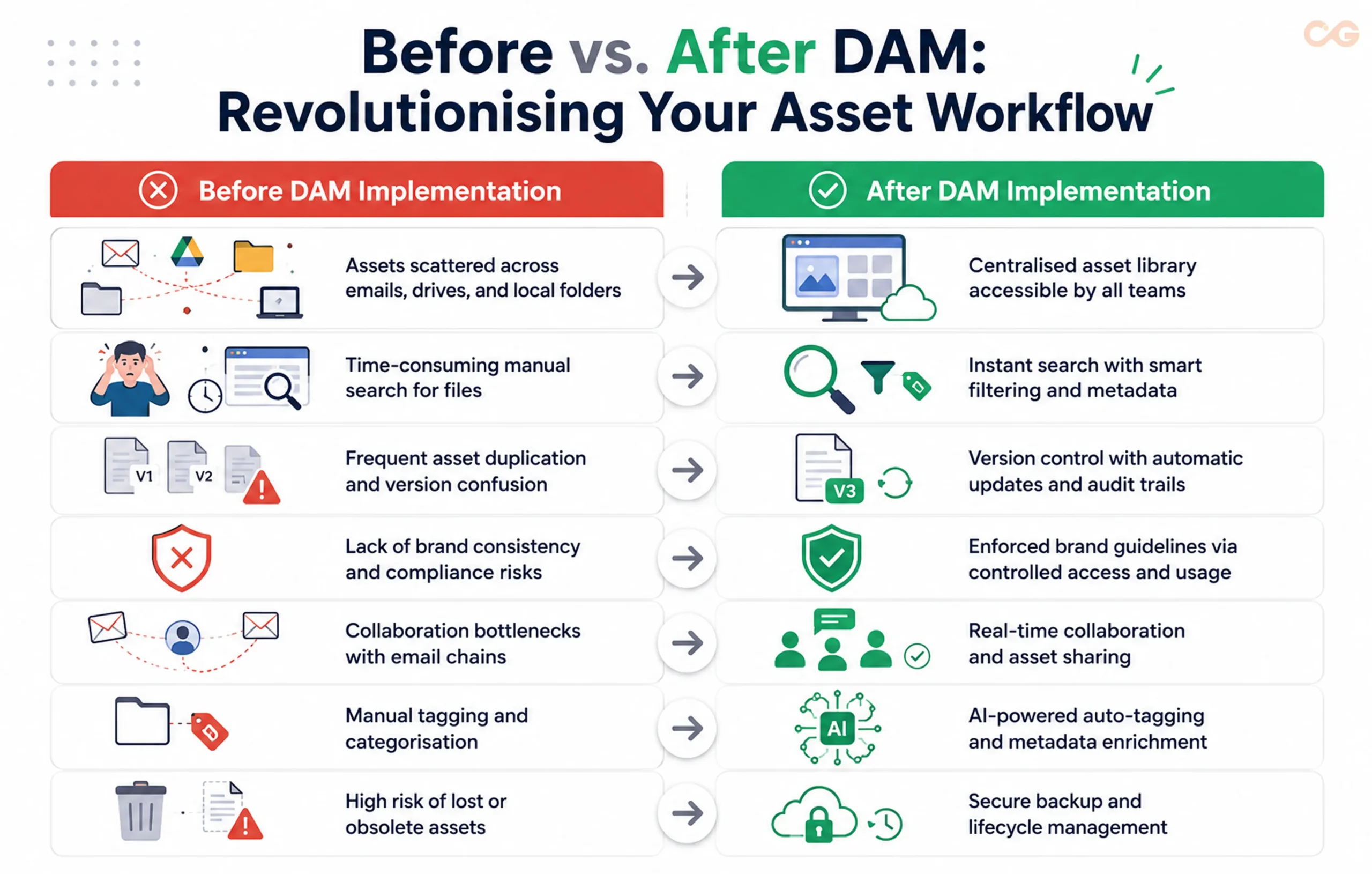
Managing digital brand assets across multiple countries, languages, and teams requires more than a central file repository. A modern Digital Asset Management (DAM) system helps global brands maintain consistency while giving regional teams the flexibility to create locally relevant content.
Multi-Language Asset Management
Global brands often manage logos, product visuals, campaign creatives, videos, documents, and marketing templates in multiple languages and formats. A DAM platform keeps these assets organised while making it easier for teams to find and use the correct version.
A structured digital asset library can include:
- Master Assets: Core logos, fonts, colour palettes, templates, and other assets shared across markets.
- Localised Assets: Translated graphics, videos, copy, and campaign materials adapted for specific languages and audiences.
- Market-Specific Assets: Regional campaigns, product content, seasonal promotions, and culturally relevant creative assets.
- Flexible Templates: Brand-approved templates that allow local teams to customise content without changing core brand elements.
Balancing Global Brand Consistency With Localisation
The biggest challenge for international brands is maintaining a consistent identity without making every market use identical content. DAM helps establish clear boundaries between non-negotiable brand standards and areas where local teams can adapt content.
Global brand standards can include:
- Logo usage and placement
- Primary colour palette
- Core typography
- Brand voice and messaging principles
- Image and video quality standards
Regional adaptation can include:
- Local imagery and cultural references
- Secondary colours
- Translated messaging
- Regional campaigns and promotions
- Market-specific seasonal content
This centralised brand governance model allows organisations to protect brand consistency while giving local teams enough flexibility to respond to regional audiences.
Managing Partners, Agencies, and Franchisees
Global brands often work with agencies, distributors, franchisees, and other external partners. Giving every partner unrestricted access to the entire asset library can create compliance and security risks.
A DAM system can provide:
- Role-based access: Give users access only to the assets relevant to their market or role.
- Approved asset libraries: Make the latest logos, templates, product images, and campaign materials easy to find.
- Co-branding templates: Provide pre-approved layouts for partner campaigns and communications.
- Usage permissions: Control how, where, and for how long specific assets can be used.
- Asset tracking: Monitor downloads and usage to identify outdated or unauthorised assets.
This creates a more controlled brand asset management workflow while reducing the risk of partners using outdated or unapproved materials.
Automated Brand Compliance
As brands scale across markets, manually checking every asset for brand compliance becomes difficult. Modern DAM platforms increasingly use automation and AI to help teams identify potential issues before content reaches customers.
Key capabilities can include:
- AI-powered asset review: Identify potential inconsistencies in visual and written brand elements.
- Image recognition: Detect incorrect or unauthorised use of logos and brand visuals.
- Content checks: Flag content that may not follow approved messaging or brand guidelines.
- Metadata and rights management: Track ownership, licensing, expiration dates, and usage restrictions.
- Automated alerts: Notify relevant teams when an asset requires review or is approaching expiration.
These capabilities turn brand compliance from a manual process into a more proactive and scalable workflow.
Why Global Brands Need DAM in 2026
For global organisations, DAM is becoming an important part of brand governance and digital content operations. It connects central brand teams with regional marketers, agencies, and partners through a controlled source of truth.
The goal is not to make every market look identical. It is to ensure that every local adaptation remains connected to the core brand identity while giving teams the right assets, permissions, templates, and guidelines to work efficiently.
Digital Asset Management Implementation Roadmap: A 16-Week Action Plan
Implementing a Digital Asset Management (DAM) system requires more than selecting a platform and uploading files. A successful DAM implementation starts with auditing existing assets, establishing a clear organisational structure, configuring workflows and permissions, training users, and continuously improving the system.
This 16-week DAM implementation roadmap provides a practical framework for moving from scattered digital assets to a structured, searchable, and scalable digital asset library.
Phase 1: Audit and Organise Your Digital Assets (Weeks 1–4)
Week 1: Audit Existing Assets and Workflows
Start by identifying where digital assets are currently stored across departments, agencies, cloud platforms, and local systems. Identify key stakeholders involved in creating, approving, managing, and using assets.
Document existing workflows and approval processes to identify duplication, bottlenecks, outdated storage practices, and access issues.
Week 2: Categorise and Clean Up Assets
Create an inventory of existing assets and assess their quality, relevance, ownership, licensing status, and usage rights. Identify duplicate, outdated, off-brand, or expired assets and prioritise business-critical content.
Conduct a gap analysis to identify missing assets, such as updated templates, regional versions, or campaign-specific content.
Week 3: Build Your Taxonomy and Metadata Framework
Create a DAM taxonomy that reflects how your teams search for and use content. Establish consistent naming conventions, categories, tags, and metadata fields.
Your metadata framework can capture information such as:
- Asset type and description
- Campaign or project
- Product or service
- Market or region
- Usage rights and licensing
- Creation and expiry dates
- Content owner
- Approval status
Define role-based permissions to ensure users can access the assets they need without compromising brand or content governance.
Week 4: Prepare Assets for Migration
Standardise file formats, names, sizes, and metadata before migrating assets into the DAM platform. Remove unnecessary duplicates and archive outdated content according to defined retention policies.
Prioritise high-value assets for the initial migration so teams can start using the DAM system quickly.
Phase 1 outcome: A clean, structured, and migration-ready digital asset library.
Phase 2: Select and Configure Your DAM Platform (Weeks 5–8)
Week 5: Define Requirements and Shortlist DAM Platforms
Use the findings from your asset audit to define your technical and business requirements. Evaluate DAM platforms based on capabilities such as:
- Asset storage and search
- Metadata and taxonomy management
- Version control
- Approval workflows
- Role-based permissions
- Rights and expiry management
- Integrations with creative and marketing tools
- Scalability and total cost of ownership
Request platform demonstrations using real workflows and representative assets wherever possible.
Week 6: Configure the DAM System
Once the platform is selected, configure the asset structure, metadata, user roles, permissions, and required integrations.
Create a migration plan that defines which assets will be moved first, who will manage the migration, and how asset quality and metadata will be validated.
Week 7: Set Up Workflows and Permissions
Configure automated DAM workflows for asset submission, review, approval, publishing, and updates.
Set permissions according to user roles, departments, regions, or external partners. Automated notifications can help users stay informed without creating unnecessary manual follow-ups.
Week 8: Migrate Priority Assets and Test
Migrate high-priority assets with the required metadata and permissions. Test integrations, search functionality, workflows, and access controls.
Conduct user acceptance testing with key stakeholders to identify and resolve issues before organisation-wide deployment.
Phase 2 outcome: A configured and tested DAM system with priority assets migrated and core workflows ready for use.
Phase 3: Train Teams and Drive DAM Adoption (Weeks 9–12)
Week 9: Develop Role-Based Training
Create training resources tailored to different user groups, including administrators, brand managers, marketers, designers, and general users.
Provide quick-reference guides, demonstrations, and practical examples showing how each team should use the DAM system.
Week 10: Train Teams and Administrators
Conduct role-specific training focused on everyday asset management, search, downloads, approvals, metadata, and permissions.
Train administrators and brand managers on system configuration, governance, troubleshooting, and workflow management.
Week 11: Run a Soft Launch
Begin with selected teams, campaigns, or asset categories before moving to a full rollout. Collect user feedback and identify issues with search, navigation, permissions, workflows, or content organisation.
Use this feedback to improve the user experience before the wider launch.
Week 12: Launch Organisation-Wide
Complete the migration of approved assets and transition teams to the new DAM system. Retire or restrict access to legacy repositories where appropriate to prevent teams from continuing to use outdated content.
Monitor early adoption and provide ongoing support to help users build new asset management habits.
Phase 3 outcome: Teams are trained, legacy processes are reduced, and the DAM platform becomes the central source of truth for digital assets.
Phase 4: Measure, Optimise, and Scale (Weeks 13–16+)
Week 13: Measure DAM Performance and ROI
Review usage and workflow data to understand how teams are using the platform. Track metrics such as:
- User adoption
- Asset downloads and usage
- Search success
- Asset retrieval time
- Approval turnaround time
- Workflow efficiency
- Content duplication
- Time and cost savings
These metrics help demonstrate the business value of your DAM implementation.
Week 14: Optimise Metadata and Workflows
Use search behaviour and user feedback to improve metadata, tags, taxonomy, and navigation. Identify workflow bottlenecks and simplify approval processes where possible.
Review integrations and improve them as your organisation’s requirements evolve.
Week 15: Introduce AI and Advanced Analytics
Once the core DAM foundation is established, introduce advanced capabilities such as:
- AI-powered asset search
- Automated tagging and metadata generation
- Content recommendations
- Duplicate detection
- Asset usage analytics
- Brand compliance monitoring
These capabilities can make a DAM platform more intelligent and reduce manual asset management work.
Week 16+: Continuously Improve and Scale
DAM implementation does not end at launch. Conduct regular asset audits, review permissions and usage rights, remove obsolete content, and update workflows as business needs change.
As adoption grows, expand the DAM ecosystem to additional teams, regions, agencies, and content types while maintaining consistent governance and brand standards.
Phase 4 outcome: A scalable and continuously optimised DAM ecosystem that improves asset accessibility, governance, collaboration, and operational efficiency.
DAM Implementation Checklist
Before considering your implementation complete, make sure you have:
- Audited existing digital assets and storage locations
- Identified key stakeholders and asset workflows
- Defined your DAM taxonomy and metadata structure
- Removed duplicates and outdated content
- Established permissions and usage-rights controls
- Selected and configured the DAM platform
- Migrated priority assets
- Set up approval and publishing workflows
- Integrated relevant creative and marketing tools
- Trained users by role
- Measured adoption and operational performance
- Established an ongoing optimisation process
A successful Digital Asset Management implementation is not simply about moving files into a new platform. It creates a structured system in which teams can find the right assets, use approved content, collaborate efficiently, and maintain control over the brand at scale.
Takeaway
Transform Brand Asset Management With Seamless Integrations, Automated Workflows, and the Right Technology Platform for Long-Term Business Growth
Brand Asset Management KPIs: Measuring DAM Performance
Implementing a Digital Asset Management (DAM) system is only the first step. Organisations should continuously measure how effectively the platform improves asset discovery, brand consistency, collaboration, and business performance.
The right DAM KPIs help brand and marketing teams identify inefficiencies, demonstrate ROI, and determine whether the system is delivering measurable value.
Operational Efficiency Metrics
These metrics show whether the DAM system is helping teams find, manage, and use digital assets more efficiently.
Asset Search Time: Measure the average time users need to find and access the right asset. A shorter search time indicates better organisation, metadata, and search functionality.
Asset Reuse Rate: Track how often existing approved assets are reused instead of creating new versions. Higher reuse can reduce duplication and unnecessary production costs.
Asset Approval Time: Measure the time taken from asset submission to final approval. Faster approval cycles indicate more efficient workflows and fewer bottlenecks.
DAM Adoption Rate: Track the percentage of target users who actively use the DAM platform. High adoption indicates that teams have integrated the system into their everyday workflows.
Asset Download and Usage Rate: Monitor which assets are being accessed and used most frequently. This helps identify valuable content as well as underused or redundant assets.
Brand Consistency and Compliance Metrics
These KPIs measure whether teams and external partners are using approved assets and following established brand guidelines.
Brand Compliance Score: Measure the percentage of reviewed assets that meet approved brand guidelines for elements such as logos, colours, typography, imagery, and messaging.
Approved Asset Usage Rate: Track how frequently teams use current, approved assets instead of outdated or unapproved versions.
Off-Brand Asset Rate: Monitor the number or percentage of assets that fail to meet brand standards. A declining rate indicates stronger brand governance.
Version Control Accuracy: Measure how effectively teams access and use the latest approved version of an asset, reducing the risk of outdated content being published.
Partner Compliance Rate: Track the percentage of assets created or distributed by agencies, franchisees, and other partners that comply with brand guidelines and usage requirements.
Business and Financial Impact
DAM should ultimately contribute to measurable improvements in marketing efficiency, productivity, and risk management.
Asset Production Cost Savings: Compare the cost of reusing existing assets with the cost of producing new content. This helps quantify savings generated through asset reuse.
Time and Productivity Savings: Measure the time saved through faster asset discovery, automated workflows, centralised storage, and reduced manual processes.
Campaign Delivery Efficiency: Track reductions in campaign delays caused by asset searches, approvals, revisions, or missing content.
Risk and Compliance Savings: Monitor the reduction in costs or incidents associated with unauthorised asset use, expired licences, copyright issues, or brand violations.
DAM ROI: Compare the measurable benefits generated by the DAM system—including time savings, cost reductions, productivity gains, and risk reduction—with the total cost of implementation and operation.
A strong DAM measurement framework should combine operational, brand, and financial KPIs rather than relying on a single success metric. Reviewing these measures regularly helps organisations optimise their DAM strategy, improve user adoption, strengthen brand governance, and demonstrate the platform’s long-term business value.
The Future of Digital Brand Asset Management
Digital Asset Management is evolving from a centralised repository into an intelligent system that can help organisations create, organise, distribute, govern, and optimise digital content. As brands manage larger volumes of content across more channels and markets, the next generation of DAM platforms will rely increasingly on AI, automation, intelligent search, and connected workflows.
AI-Powered Asset Management
AI will become increasingly embedded across the DAM lifecycle, reducing manual work and helping teams manage growing content libraries more efficiently.
Intelligent Asset Search: AI-powered search will allow users to find assets using natural-language queries rather than relying only on folder structures, filenames, or exact keywords.
Automated Metadata and Tagging: AI can analyse images, videos, documents, and other files to suggest or generate relevant metadata, tags, descriptions, and categories, reducing manual cataloguing.
Predictive Asset Recommendations: DAM platforms can use user behaviour, campaign context, asset history, and content attributes to recommend relevant assets for specific projects or channels.
Automated Brand Compliance: AI-based checks can identify potential issues such as incorrect logos, outdated assets, missing information, or deviations from approved brand guidelines before content is published.
From Asset Storage to Intelligent Content Operations
Future DAM platforms will increasingly connect asset management with the broader content lifecycle.
Instead of simply storing finished files, DAM systems will become connected with creative, marketing, content management, e-commerce, and collaboration platforms. This will allow teams to move assets more efficiently from creation and approval to distribution and publication.
Automated workflows can also reduce repetitive tasks such as:
- Asset approvals and reviews
- Version management
- Rights and expiry notifications
- Content distribution
- Format and rendition creation
- Archive and retention management
This shift will make DAM an active part of an organisation’s digital content operations, rather than a standalone storage platform.
Personalised and Channel-Ready Content
As brands communicate with increasingly specific audiences across multiple channels, DAM platforms will need to support more content variations.
Future DAM systems will help teams manage and distribute assets based on factors such as:
- Audience
- Region and language
- Campaign
- Product
- Marketing channel
- Content format
- Customer journey stage
This will make it easier for organisations to deliver personalised and channel-specific content while maintaining control over core brand assets and guidelines.
Smarter Rights and Brand Governance
Managing usage rights will become increasingly important as organisations work with larger volumes of images, videos, music, fonts, user-generated content, and third-party materials.
Future DAM platforms will provide stronger automation for:
- Copyright and licensing information
- Asset expiration dates
- Geographic usage restrictions
- Talent and model releases
- Approval status
- Usage permissions
Automated alerts and governance workflows can help teams identify assets that are approaching expiration or have restricted usage, reducing legal and compliance risks.
Predictive Analytics and Content Performance
DAM analytics will move beyond measuring downloads and asset usage. Future systems will increasingly connect asset data with campaign and channel performance to help teams understand which content delivers the greatest.
Brands will be able to identify:
- High-performing assets
- Underused content
- Frequently requested asset types
- Content gaps
- Reuse opportunities
- Asset performance across markets and channels
These insights can inform future content production and help organisations invest in assets that are more likely to deliver business value.
Connected DAM Ecosystems
The future of DAM will be increasingly ecosystem-driven. DAM platforms will work alongside tools used for creative production, marketing automation, content management, product information, e-commerce, and collaboration.
This connected approach can create a more unified content supply chain, allowing approved assets and metadata to move efficiently between systems while maintaining governance and version control.
What This Means for Brands
The future of DAM is not simply about storing more files. It is about making digital content easier to find, safer to use, faster to distribute, and more valuable to the business.
Organisations that build a strong DAM foundation today will be better positioned to adopt AI, automate content workflows, support personalised experiences, and manage increasingly complex digital ecosystems in the years ahead.
Takeaway
Transform Brand Asset Management With Seamless Integrations, Automated Workflows, and the Right Technology Platform for Long-Term Business Growth
Conclusion: The Future of Your Brand Starts Now
In a digital-first environment, managing brand assets effectively is no longer just about keeping files organised. Digital Asset Management (DAM) gives organisations a centralised way to store, organise, govern, distribute, and measure their digital content while maintaining brand consistency across teams, channels, and markets
A well-implemented brand asset management strategy can help teams find content faster, reduce duplication, streamline approvals, protect brand integrity, and scale content operations more efficiently. As AI, automation, personalisation, and connected content ecosystems continue to shape the future of DAM, organisations with a strong digital asset foundation will be better prepared to adapt.
Start Building a Smarter DAM Strategy
The path forward is practical:
Audit your assets to identify duplication, outdated content, access issues, and gaps.
Organise and govern your content with a clear taxonomy, metadata structure, permissions, workflows, and usage-rights framework.
Centralise and scale your assets through a DAM platform that connects teams, markets, agencies, and marketing channels.
Measure and optimise performance using adoption, efficiency, compliance, asset usage, and ROI metrics.
Most importantly, treat your DAM as an evolving business system rather than a one-time technology implementation. Regularly review your content, workflows, user needs, and technology to ensure the system continues to support your organisation as it grows.
Your brand assets are more than files in a digital library. They represent your brand identity, intellectual property, and the experiences you create for your customers. The right DAM strategy ensures those assets remain accessible, consistent, secure, and valuable—today and as your brand evolves.