
Crisis-Proof Branding: Reputation Management in a Digital World
Table of Contents
- What Is Brand Crisis Management and Why Does It Matter?
- Pre-Crisis Brand Preparation: Building a Crisis-Ready Defence
- Real-Time Crisis Response: Acting Under Pressure
- Post-Crisis Brand Recovery: Rebuilding Trust
- Case Studies and Lessons: Learning from Real-World Brand Crises
- Conclusion: Thriving in the Crisis Era
In today’s hyperconnected digital landscape, brand reputation can change in minutes. A customer complaint can go viral, a product issue can trigger widespread backlash, or a poorly judged executive statement can quickly become a public relations crisis. With social media accelerating the spread of both information and misinformation, brands can no longer treat reputation management as something to address only after a crisis occurs.
In 2026, crisis-proof branding requires proactive monitoring, clear communication, and a well-defined response strategy that helps businesses protect trust, respond with confidence, and recover when their reputation is at risk
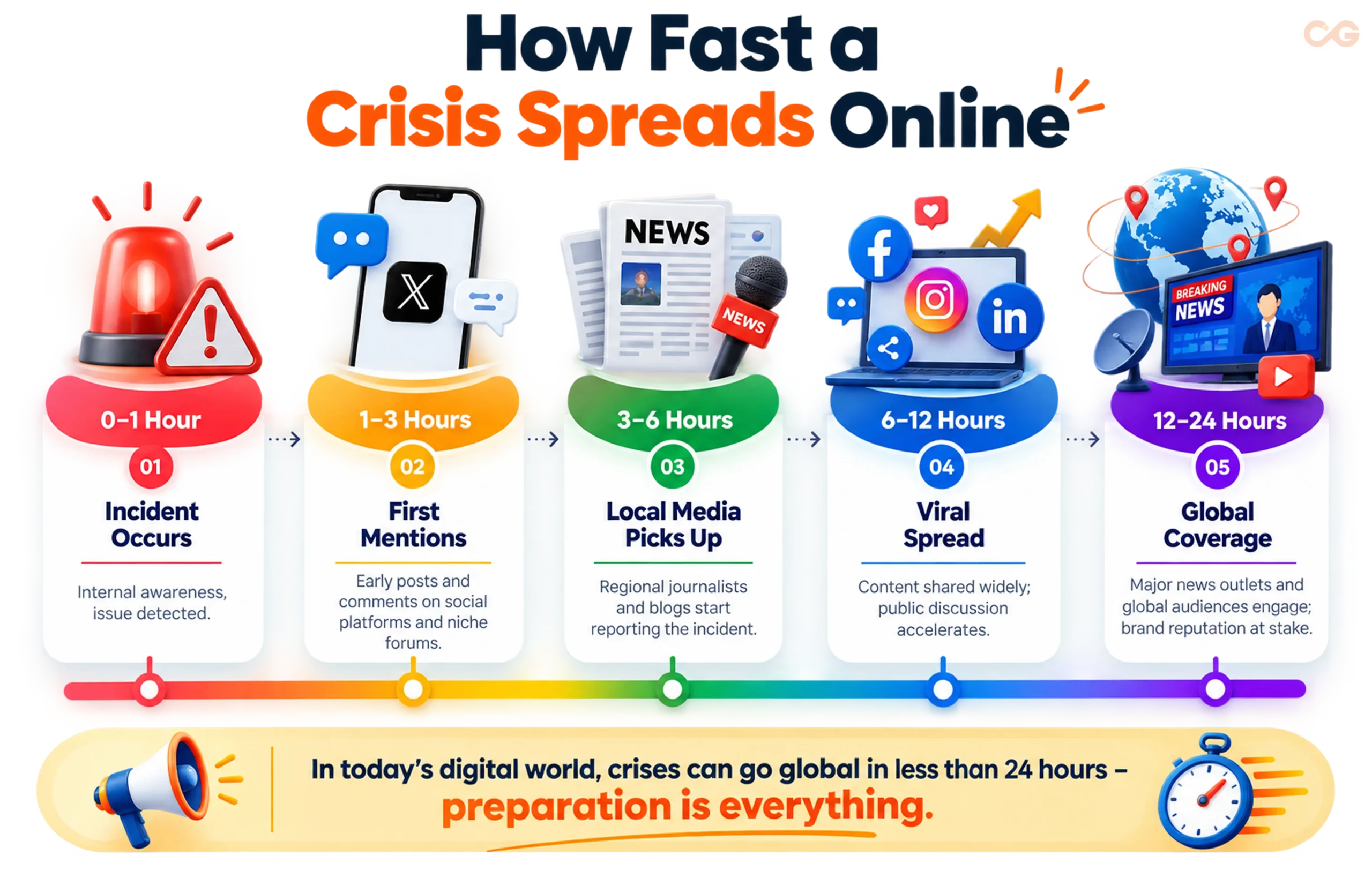
The stakes are higher than ever. A poorly managed crisis can erode brand equity, customer trust, loyalty, and financial performance long after the initial incident has passed. However, brands that anticipate potential risks, establish clear response protocols, and communicate transparently can contain the damage and, in some cases, emerge with stronger credibility and customer relationships.
The growing role of social media makes preparedness even more critical. Sprout Social’s 2026 State of Social Media report found that 50% of consumers are most likely to hear about a brand crisis first on social media, more than twice the next most common source, news articles. This makes proactive crisis communication and reputation management essential. Brands need the right monitoring systems, response frameworks, and communication protocols in place before a crisis unfolds—not after it has already gone viral.
What Is Brand Crisis Management and Why Does It Matter?
Brand crisis management is the strategic process of preparing for, responding to, and recovering from events that threaten a company’s reputation, customer trust, operations, or stakeholder relationships. It goes beyond managing the immediate incident. An effective approach includes risk identification, crisis preparedness, real-time response, reputation management, and post-crisis recovery.
While traditional crisis management may focus on protecting business continuity and limiting operational damage, brand crisis management places greater emphasis on how the crisis affects public perception and stakeholder confidence.
This distinction is particularly important in the digital age, where customer reactions, news coverage, and online conversations can rapidly shape how a brand is perceived.
Why the Digital Landscape Makes Brand Crises Harder to Manage
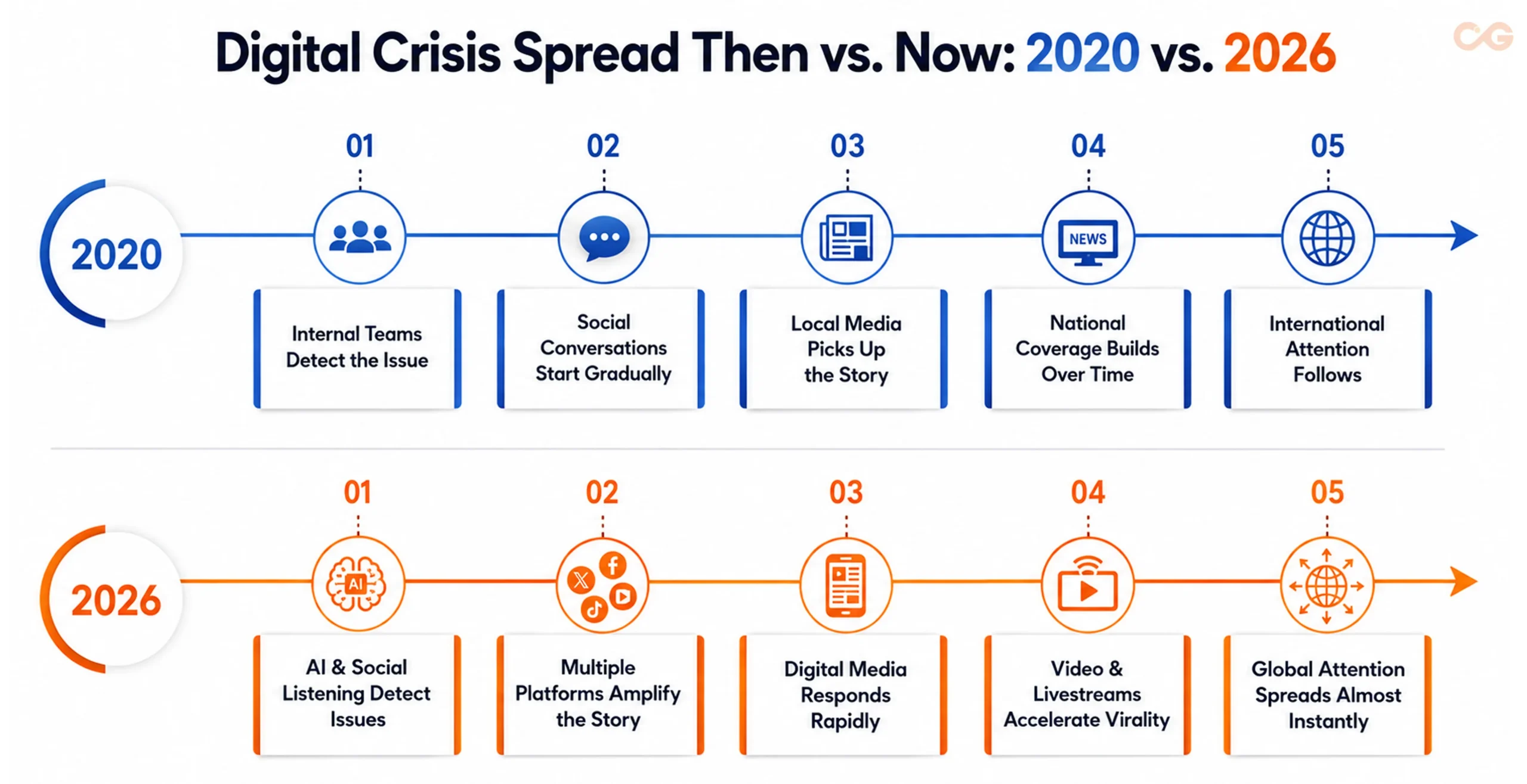
Social media has fundamentally changed the speed, scale, and visibility of brand crises. A customer complaint, product failure, controversial statement, or service issue can quickly move beyond the original audience as users share, comment on, and amplify the incident.
Several factors make digital brand crises particularly challenging:
- Rapid amplification: A single customer complaint can attract widespread attention when it is reshared across social platforms.
- Visual virality: Videos and images documenting product failures, poor service, or controversial incidents can generate stronger public reactions and remain searchable long after the original event.
- Online mobilisation: Digital communities can quickly organise around an issue, leading to calls for boycotts, negative reviews, or coordinated criticism.
- Media amplification: Stories that gain traction on social media can be picked up by news organisations, expanding the crisis beyond digital platforms.
- Always-on exposure: Global brands operate across markets and time zones, making reputation monitoring and timely response a continuous requirement.
As a result, brand crisis management is no longer simply about containing an incident. It is about understanding how information travels, responding appropriately across channels, and protecting stakeholder trust throughout the crisis lifecycle.
Pre-Crisis Brand Preparation: Building a Crisis-Ready Defence
Effective brand crisis management begins before a crisis occurs. Instead of waiting for an incident to expose weaknesses, brands should identify potential risks, establish clear responsibilities, prepare communication resources, and define how different stakeholders will be informed. This preparation creates a structured response system that helps minimise confusion and protect trust when a crisis emerges.
Conduct a Brand Vulnerability Audit
Every brand has potential points of failure. A brand vulnerability audit helps identify these risks before they develop into reputation-threatening incidents.
Key areas to assess include:
- Product Quality & Safety: Identify quality issues, safety gaps, and potential recall risks.
- Employee Behaviour & Training: Review misconduct risks, training gaps, and internal communication weaknesses.
- Supply Chain: Assess supplier reliability, delays, disruptions, and product availability risks.
- Cybersecurity & Data Protection: Evaluate data security, privacy controls, and potential breach scenarios.
- Leadership & Compliance: Examine leadership communication, regulatory compliance, and governance risks.
The audit should involve marketing, communications, legal, operations, HR, IT, and senior leadership so that risks are assessed from multiple perspectives. External specialists can also provide an independent view where specialised expertise is required.
Build a Crisis Communication Team
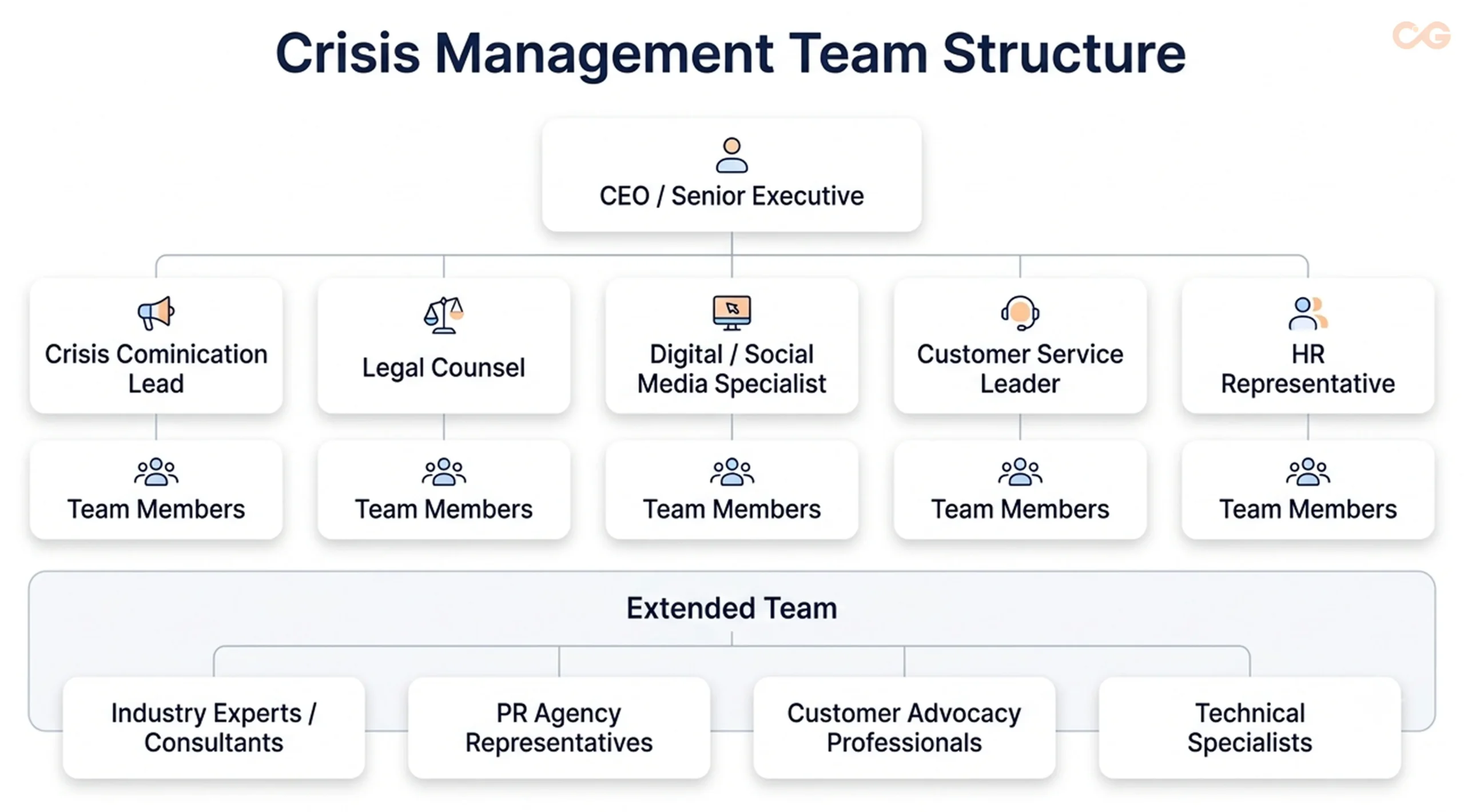
A crisis should never become a situation where employees are unsure who makes decisions, who communicates with the public, or who approves a response. Establish the crisis communication team in advance and clearly define each member’s responsibilities.
Core Team
- CEO / Senior Executive – Provides strategic direction, approves major responses, and represents the organisation when required.
- Crisis Communication Lead – Leads the communication response, coordinates teams, and ensures consistent messaging across channels.
- Legal Counsel – Reviews legal, regulatory, contractual, liability, and compliance risks before communications are released.
- Digital / Social Media Specialist – Monitors online sentiment, tracks emerging issues, and manages social media responses.
- Customer Service Leader – Coordinates customer support, addresses grievances, and ensures frontline teams have accurate information.
- HR Representative – Keeps employees informed, coordinates internal updates, and addresses workforce-related concerns during the crisis.
Extended Team
The extended team provides specialised expertise and additional support when a crisis requires capabilities beyond the core communication team.
- Industry Experts / Consultants: Provide specialised knowledge, independent assessment, and guidance for complex or industry-specific crises.
- PR Agency Representatives: Support media relations, public messaging, press coordination, and reputation recovery.
- Customer Advocacy Professionals: Represent customer concerns, help address grievances, and support trust-building efforts.
- Technical Specialists: Investigate technical issues, explain complex problems, and provide expertise for product, service, IT, or cybersecurity-related crises.
Prepare Pre-Approved Messaging Templates
During a crisis, teams often lose valuable time deciding what to say, who should approve it, and how quickly it can be published. Pre-approved templates provide a starting point while allowing the response to be adapted to the specific situation.
A crisis communication library should include:
- Initial Acknowledgement: Confirm awareness without speculation.
- Investigation Update: Share verified information as the situation develops.
- Apology Statement: Acknowledge responsibility where appropriate.
- Corrective Action: Explain what the brand is doing to address the issue.
- Media Responses: Prepare concise answers to likely questions.
- Social Media Responses: Create short, adaptable responses for digital platforms.
- Stakeholder-Specific Messages: Adapt key information for customers, employees, investors, partners, and regulators.
Every template should follow defined key messages, tone guidelines, legal review checkpoints, personalisation rules, and approval workflows. Templates should support speed—not replace human judgement.
Establish Stakeholder Communication Protocols
Different stakeholders have different concerns during a crisis. A strong crisis communication strategy therefore defines what each audience needs to know, who communicates with them, and which channel should be used.
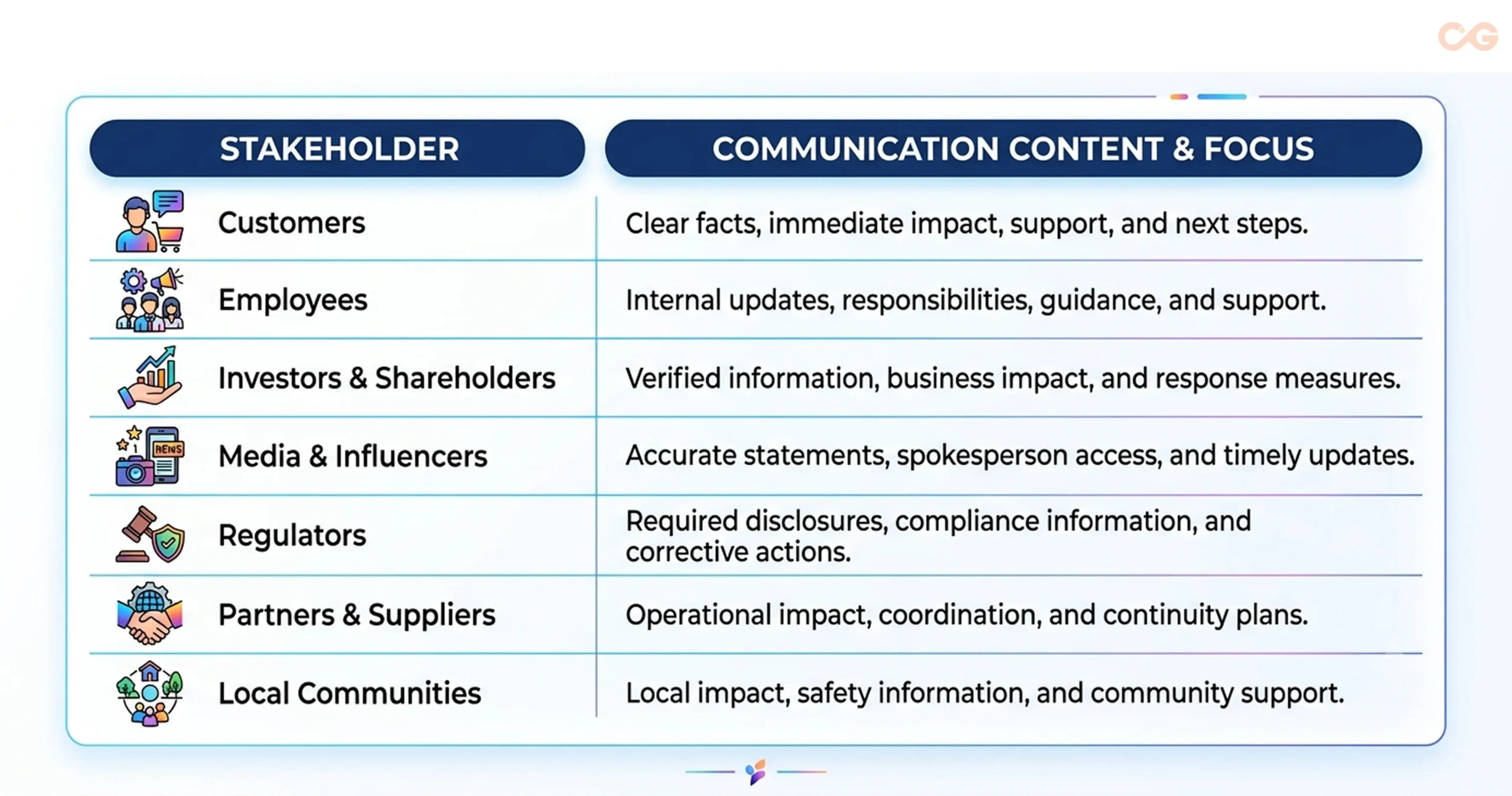
The protocol should also define response-time expectations, escalation triggers, approval authority, communication channels, and feedback mechanisms. This ensures that important audiences receive consistent and relevant information instead of fragmented messages from different parts of the organisation
Use a stakeholder-specific communication plan rather than sending the same message to everyone. Share verified information through the appropriate channels, explain what the crisis means for each audience, provide clear next steps, and update stakeholders as new facts become available. A defined response timeline and escalation process can help ensure communication remains timely, consistent, and credible.
Takeaway

How to Build Crisis Preparedness: A Step-by-Step Roadmap
Get our complete crisis management checklist and make sure your team is prepared to respond confidently when a crisis occurs.
Real-Time Crisis Response: Acting Under Pressure
When a crisis emerges, the initial response can significantly influence how the situation develops. Brands need to monitor conversations, verify information, respond quickly, and adapt their communication as new developments emerge. Real-time response should be fast, but it should also remain accurate, coordinated, and aligned with the brand’s crisis plan.
Speed matters because audiences expect brands to acknowledge serious issues quickly. Sprout Social reports that 70% of users want a brand to respond to a crisis within the first 24 hours, while 41% say they are most likely to regain trust when a brand offers a sincere apology and admits its faults, as reported by NYWICI.
Social Media Tracking and Response
During a social media brand crisis, brands need to know what people are saying, where conversations are spreading, and how sentiment is changing. Real-time social listening helps teams identify emerging issues and respond before they escalate further.
- Social Listening: Tools such as Hootsuite, Sprout Social, and Brand24 help track brand mentions, conversations, and sentiment across platforms.
- Automated Alerts: Trigger notifications when negative mentions or unusual activity suddenly increase.
- Trending Topics & Hashtags: Track emerging conversations to understand how quickly an issue is gaining attention.
- Influencer Monitoring: Identify mentions from influencers and public figures so teams can respond appropriately.
- Cross-Platform Sentiment Analysis: Monitor conversations across multiple channels for a broader view of public sentiment.
- Geographic Monitoring: Identify region-specific issues and tailor responses to local audiences.
Response Strategies:
- Acknowledge the issue quickly: Confirm that the brand is aware of the situation without making unverified claims.
- Verify the facts: Investigate the issue thoroughly and confirm key information before providing detailed updates.
- Respond where the conversation began: Address concerns on the platform where the issue is gaining traction.
- Move sensitive conversations offline: Take individual complaints or sensitive matters to private channels while continuing to provide appropriate public updates.
- Maintain message consistency: Ensure that customers receive the same verified information across social media, websites, media statements, and other channels.
- Monitor and adapt: Track audience response and adjust communication as the situation develops.
Effective Communication Strategies
A crisis does not follow business hours. Brands operating across multiple markets and time zones need 24/7 crisis communication capabilities to identify issues and respond when they emerge.
Key Components:
- 24/7 On-Call Teams: Rotate communication staff to maintain continuous crisis coverage.
- Pre-Authorised Responses: Define approved responses for different levels and types of crises.
- Mobile-First Communication: Use accessible tools to keep crisis teams connected, even when working remotely.
- Automated First-Line Responses: Use automation for immediate acknowledgements, with human teams handling sensitive or complex issues.
- Local Response Teams: Enable region-specific teams to address local issues with appropriate cultural and market context.
- After-Hours Media Support: Ensure media relations professionals are available for urgent requests outside regular working hours.
Legal Issues in Crisis Communication
Crisis communication requires a careful balance between transparency, empathy, and legal protection. A rushed or poorly worded statement can create additional regulatory, contractual, privacy, or liability risks.
Critical Legal Considerations:
Crisis teams should communicate verified information without making premature admissions of liability. They must also meet applicable disclosure requirements, protect employee and customer privacy, safeguard intellectual property, and comply with relevant regulations.
For brands operating internationally, different laws and disclosure requirements can further complicate crisis communication. Maintaining accurate documentation of decisions, approvals, and communications can support compliance and provide an important record if legal proceedings follow.
Best Practices:
- Ensure public statements undergo appropriate legal review before release.
- Give employees clear guidance on what they can and cannot share during a crisis.
- Document key decisions, approvals, and actions throughout the response.
- Regularly train crisis management teams on relevant legal and compliance requirements.
- Understand applicable safe harbour provisions and regulatory protections where relevant.
Influencer and Partner Management During a Crisis
A crisis can quickly extend beyond a brand’s own channels through influencers, partners, distributors, and other third-party advocates. Managing these relationships carefully helps maintain message consistency and prevent further misinformation.
Influencer Communication:
Identify key influencers and brand ambassadors early and provide them with verified information and approved communication guidance. Monitor influencer conversations to identify emerging concerns and respond where appropriate. If a partner or ambassador becomes involved in the controversy, reassess the relationship and determine whether additional communication, support, or contractual action is required.
Maintain two-way communication with important partners throughout the crisis. Review contracts for crisis-related obligations, assess reputational risks on both sides, and agree on coordinated responses where necessary. Regular updates help keep partner messaging aligned and reduce confusion among customers and other stakeholders.
People Also Ask: How do you manage partnerships during a brand crisis?
Maintain open communication with partners, share verified information, review crisis-related contractual obligations, and coordinate public responses when necessary. Regular updates and clearly defined responsibilities help prevent conflicting messages, misinformation, and additional reputational damage.
Post-Crisis Brand Recovery: Rebuilding Trust
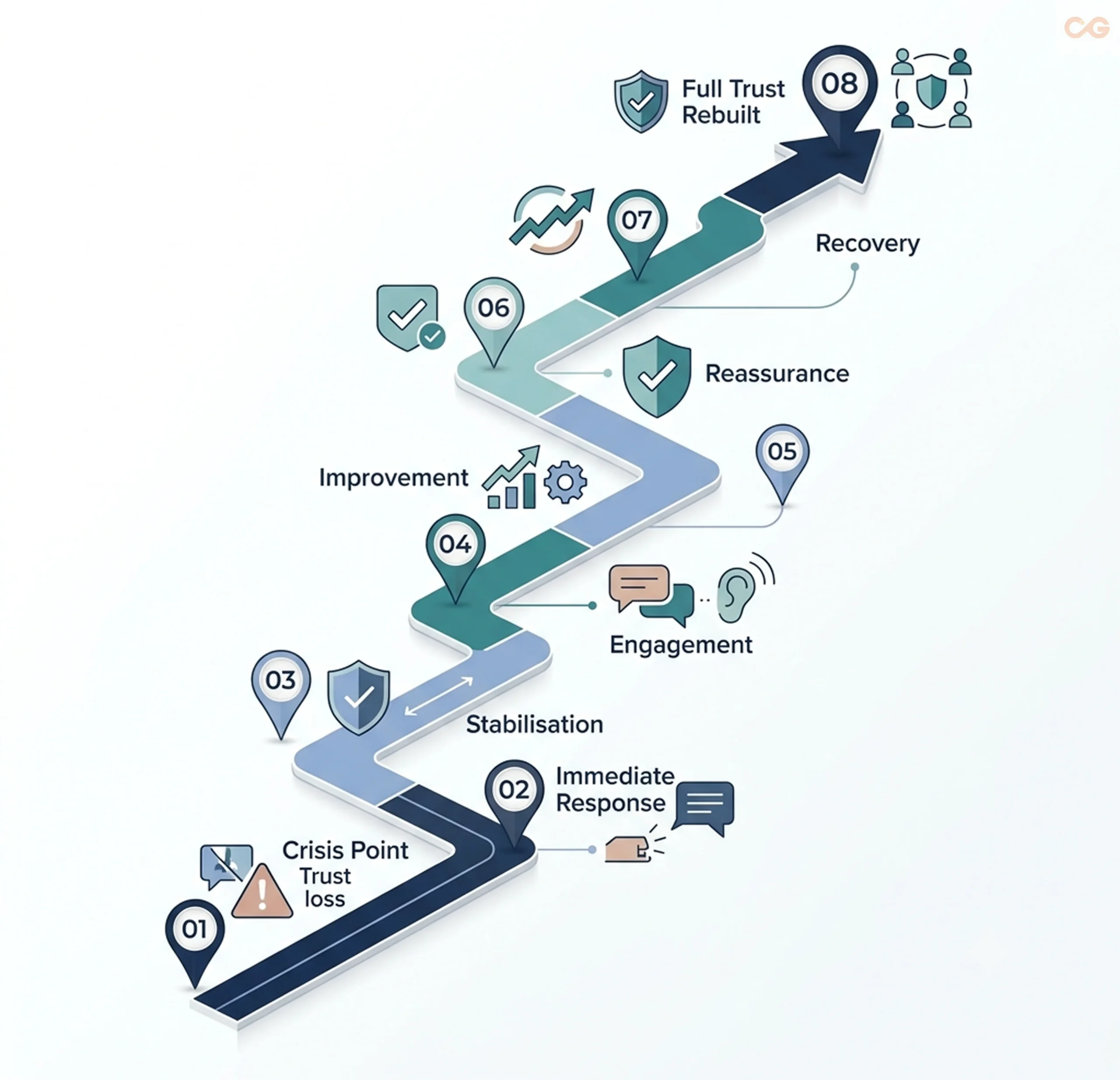
The end of a crisis does not mean the end of its impact. Brand crisis recovery strategies focus on rebuilding trust, restoring reputation, and addressing the weaknesses that contributed to the crisis. Recovery takes time and requires consistent action across customer experience, communication, employee engagement, operations, and other brand touchpoints.
The goal should not simply be to return to the brand’s pre-crisis position. A stronger approach is to use the experience to demonstrate meaningful change, greater accountability, and improved customer value.
Reputation Rebuilding Strategies
Reputation is rebuilt through consistent behaviour rather than one-time statements or campaigns. Brands can demonstrate change by reporting measurable improvements, strengthening customer-focused policies, improving employee training, addressing cultural weaknesses, investing in quality and innovation, and contributing meaningfully to their communities.
These efforts should be visible and sustained. When stakeholders repeatedly see evidence that the organisation has addressed the underlying problem, confidence can gradually return.
Recovery Timeline:
- Urgent (0–3 months): Stabilise operations and maintain clear, consistent communication.
- Short-Term (3–12 months): Implement visible improvements and demonstrate meaningful change.
- Long-Term (12+ months): Sustain progress and build stronger positive associations with the brand.
Trust Restoration Campaigns
Trust cannot be rebuilt through words alone. Trust restoration campaigns should demonstrate what has changed and provide credible evidence that the brand is taking corrective action.
Brands can use behind-the-scenes storytelling, customer testimonials, success stories, employee advocacy programs, third-party endorsements, and community initiatives to demonstrate progress. Regular transparency reports and stakeholder updates can further show that improvements are ongoing rather than temporary.
Messaging should acknowledge previous failures without repeatedly drawing attention to them. Instead, communication should focus on accountability, corrective action, customer value, and long-term commitment. The objective is to earn trust through consistent behaviour and measurable progress.
Long-Term Monitoring of Brand Perception
Recovery needs to be measured over time. Long-term perception monitoring helps brands determine whether trust is returning, identify continuing concerns, and understand how their reputation compares with competitors.
Rather than relying on a single metric, brands should track a combination of customer, employee, media, search, and social signals.
Key Monitoring Metrics:
Tools and Techniques:
Brands can combine surveys, social listening, media monitoring, customer feedback, and employee research to build a broader picture of reputation recovery.
- Brand Perception Surveys: SurveyMonkey, Qualtrics, and Typeform can help collect customer and stakeholder feedback.
- Social Listening: Brandwatch, Sprout Social, and Hootsuite Insights can monitor conversations and emerging trends.
- Media Monitoring: Meltwater, Cision, and Mention can track media coverage and sentiment.
- Customer Feedback: Zendesk, Medallia, and HubSpot can consolidate feedback across customer touchpoints.
- Employee Pulse Surveys: Culture Amp, Officevibe, and TinyPulse can track employee engagement and morale.
- Third-Party Reputation Monitoring: Reputation.com, Trustpilot, and Yotpo can provide additional reputation and review insights.
The tools should support decision-making rather than become an end in themselves. The most useful approach is to establish a baseline, track changes over time, and connect reputation signals to specific recovery initiatives.
Takeaway
How to Build Crisis Preparedness: A Step-by-Step Roadmap
Get our complete crisis management checklist and make sure your team is prepared to respond confidently when a crisis occurs.
Learn, Adapt, and Improve
Every crisis should become a source of organisational learning. A structured post-crisis review helps identify what worked, where the response fell short, and what needs to change before the next incident.
Learning Framework:
- Post-Crisis Analysis: Review the response, outcomes, successes, and gaps.
- Team Performance: Assess how effectively each team carried out its responsibilities.
- Process Improvements: Identify weaknesses in workflows, escalation procedures, and communication protocols.
- Training Updates: Strengthen employee training based on identified gaps.
- Crisis Plan Improvements: Update crisis communication and operational plans using lessons learned.
- Stakeholder Feedback: Incorporate feedback from customers, employees, partners, and other stakeholders.
Continuous Improvement
Crisis readiness should be treated as an ongoing process rather than a one-time exercise. Brands can conduct mock crisis scenarios, test response procedures, train teams, update technology, and review communication protocols at regular intervals.
Strengthening stakeholder relationships, adopting relevant industry practices, and learning from how other organisations handle crises can further improve resilience. Over time, these efforts help brands move beyond simply recovering from a crisis to becoming better prepared, more responsive, and more trusted when the next challenge emerges.
Case Studies and Lessons: Learning from Real-World Brand Crises
Global Brand Crisis Management Examples
1. Zoom’s Security Crisis and Recovery
In 2020, Zoom faced major criticism over security and privacy concerns, including meeting security and encryption issues, putting pressure on the platform during the COVID-19 pandemic. The FTC later required Zoom to strengthen its information-security practices, as per SASH & Company.
Zoom responded with a 90-day security plan, paused non-security feature development, strengthened encryption and meeting controls, brought in cybersecurity expertise, and provided regular security updates.
Key lessons:
- Prioritise the core crisis issue and address its root causes.
- Communicate progress consistently rather than relying on one statement.
- Support public commitments with visible improvements.
2. Coca-Cola’s Response to the Ronaldo Euro 2020 Incident
In 2021, Cristiano Ronaldo moved Coca-Cola bottles away during a Euro 2020 press conference and encouraged people to drink water. The incident generated widespread attention, while Coca-Cola’s market value fell by about $4 billion and its share price declined 1.6%, according to SASH & Company.
Coca-Cola responded with a brief, non-confrontational statement recognising that consumers have different preferences rather than escalating the controversy.
Key lessons:
Match the response to the severity of the incident and avoid unnecessarily turning a short-lived controversy into a larger crisis.
Indian Brand Crisis Management Examples
1. Snapdeal: Aamir Khan Brand-Ambassador Backlash
In 2015, Snapdeal faced significant backlash after comments by its brand ambassador Aamir Khan about intolerance were associated with the brand. The controversy led to social-media criticism, one-star app ratings, and the #AppWapsi campaign.
Snapdeal clarified that Khan’s comments represented his personal views and not the company’s position, as recorded by India PR Distribution.
Key lessons:
2. Flipkart: Big Billion Day Technical Crisis
In 2014, Flipkart’s first Big Billion Day sale experienced technical failures, stock shortages, order cancellations, and pricing complaints, creating significant customer frustration and social-media criticism.
The company’s founders publicly apologised, acknowledged that demand had been underestimated, explained the problems, and committed to improving its systems. With 1.5 million people shopping during the sale, Flipkart faced significant pressure on its platform and infrastructure, according to CrestTech.
Industry-Specific Crisis Scenarios
Different industries face different reputation risks, so crisis preparation should reflect the nature of the business.
Banks, fintech companies, and financial institutions face heightened risks around data breaches, fraud, privacy, and regulatory compliance. Their response must balance rapid customer communication with accurate disclosures and regulatory requirements.
Technology – Product Safety and Privacy
Technology companies may face crises involving product failures, cybersecurity, data privacy, or platform misuse. Their response needs to address both the technical problem and the resulting concerns about customer safety and trust.
Food brands can face recalls, contamination concerns, or product-safety incidents. Consumer safety, transparent communication, and regulatory coordination should take priority.
Retail – Supply Chain and Labour Issues
Retail brands can face disruptions involving product availability, suppliers, labour practices, or sustainability claims. Effective responses require immediate operational action alongside longer-term corrective measures.
ROI of Crisis Preparation Investments
Crisis preparedness is not simply a reputation practice. A well-developed crisis-management system can help organisations respond faster, reduce disruption, limit reputational damage, and protect customer and stakeholder relationships.
The value of crisis preparation can be assessed through several areas:
Prepared organisations can potentially reduce response costs, shorten recovery periods, limit operational disruption, and reduce exposure to legal or regulatory consequences. Faster, more coordinated responses can also help protect customer retention and employee confidence.
Indirect Value Creation:
Crisis readiness can strengthen organisational resilience, stakeholder relationships, risk management, and investor confidence. It can also help brands respond more consistently and protect competitive positioning when unexpected events occur.
Research Finding:
According to PR Lab, organisations with defined crisis-response strategies can mitigate losses by as much as 45%. This figure should be treated as an industry-reported estimate rather than a universal benchmark, as the source does not provide a clearly identifiable underlying primary study.
The broader lesson is clear: crisis preparation should be viewed as an investment in resilience, not merely an expense incurred when something goes wrong.
Takeaway
How to Build Crisis Preparedness: A Step-by-Step Roadmap
Get our complete crisis management checklist and make sure your team is prepared to respond confidently when a crisis occurs.
Conclusion: Thriving in the Crisis Era
In today’s digital-first market, a brand’s reputation can shape customer decisions long after a crisis has passed. That is why reputation should be treated as an ongoing business asset, built through consistent actions, strong stakeholder relationships, and a willingness to learn from difficult situations. A resilient brand is not one that never faces challenges, but one that can navigate them without losing its credibility or identity.
The real value of brand crisis management lies in what happens after the immediate pressure is over. By learning from past incidents, improving internal processes, and staying responsive to changing stakeholder expectations, businesses can turn challenging experiences into lasting resilience. Start building a crisis-proof brand today – because the reputation you protect tomorrow begins with the choices you make now.