
AI-Driven Branding: The Future Is Here
Table of Contents
- Introduction: The AI Revolution in Branding Has Arrived
- What Technology Powers AI Branding?
- Use of AI in Brand Development
- Brand Decisions Supported by Data
- Guide to Practical Implementation
- Measuring AI Branding Success
- Future of AI in Branding
- Conclusion: AI Branding Revolution
Update your brand identity with the latest artificial intelligence technologies
Introduction: The AI Revolution in Branding Has Arrived
Imagine launching a new brand and generating multiple logo concepts in minutes, analysing millions of customer conversations to understand brand sentiment, and testing different messages to identify what resonates with your target audience. What once required multiple teams, extensive research, and weeks of work can now be accelerated with AI branding tools.
AI is reshaping how brands approach identity, research, design, content, personalisation, and customer engagement. Rather than replacing human creativity, artificial intelligence is helping branding teams move faster, uncover deeper insights, and make more informed creative decisions.
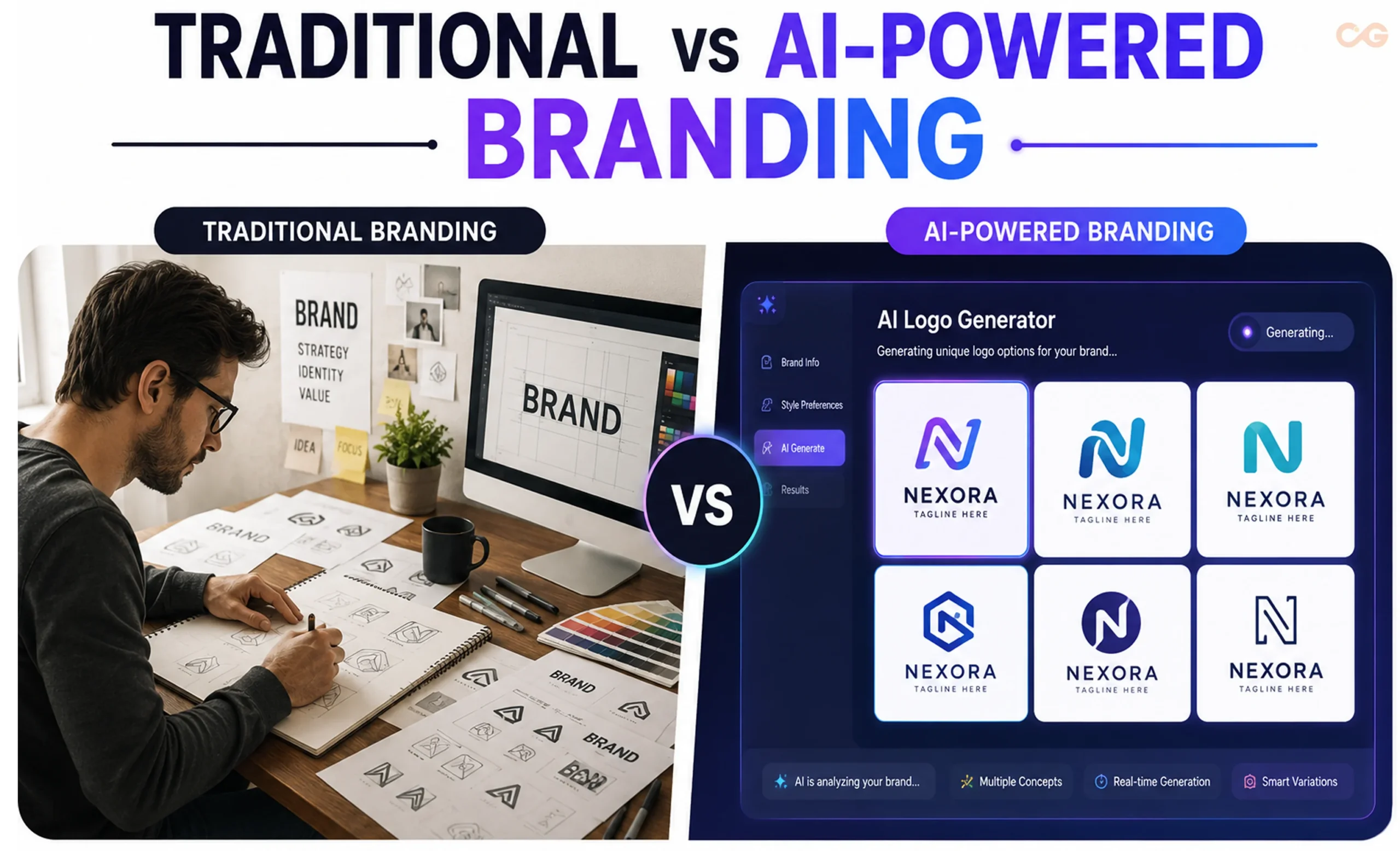
The shift is particularly significant in 2026. Brands are expected to deliver personalised experiences, consistent messaging, and engaging content across an expanding number of digital touchpoints—often at a speed that traditional branding workflows struggle to match. AI can help teams analyse market trends, identify audience preferences, generate creative variations, and optimise brand communication at scale.
Why AI Branding Matters More Than Ever
Modern branding is no longer limited to creating a logo, choosing colours, and defining a visual identity. It involves continuously understanding audiences, adapting to market changes, maintaining consistency across channels, and creating experiences that feel relevant to individual customers.
This is where AI-powered branding becomes valuable. By combining automation, data analysis, generative AI, and predictive insights, businesses can make branding more agile, data-informed, and scalable while keeping human creativity and strategic direction at the centre.
In this guide, we’ll explore how AI is transforming branding in 2026—from AI-powered logo and brand identity creation to audience insights, personalisation, predictive analytics, sentiment analysis, and competitive intelligence. We’ll also look at the technologies, real-world applications, tools, implementation strategies, ethical considerations, and future trends shaping the next generation of AI-driven branding.
What Technology Powers AI Branding?
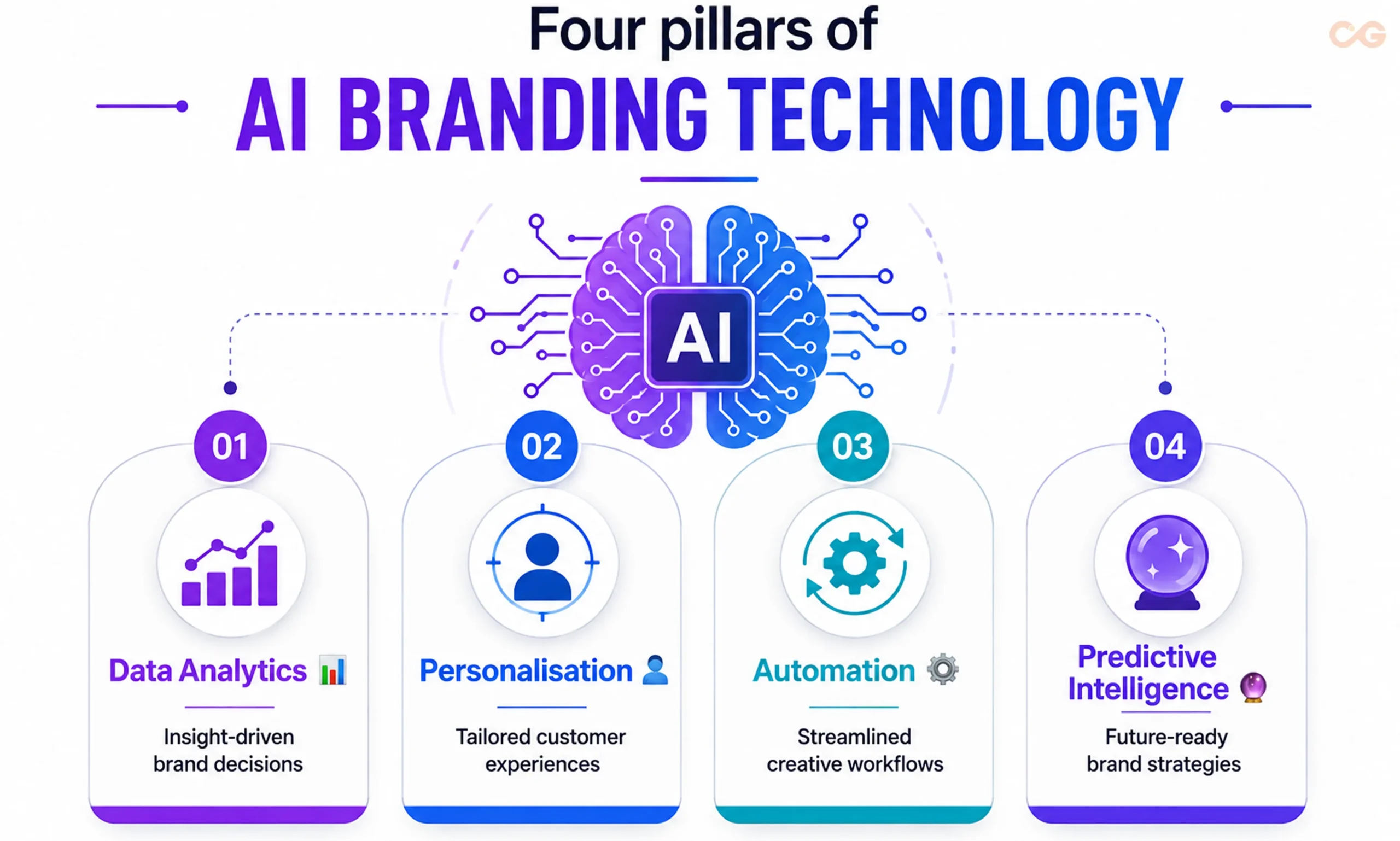
AI-driven branding is powered by a combination of technologies that help brands analyse information, understand audiences, interpret visual assets, predict outcomes, and generate creative content. Each technology plays a different role in turning large volumes of data and brand requirements into actionable insights and creative possibilities.
- Machine Learning: Machine learning identifies patterns across consumer behaviour, brand interactions, campaign performance, and market data. By learning from historical and real-time data, it can help brands identify trends, segment audiences, and make more informed branding decisions.
- Natural Language Processing (NLP): NLP enables AI systems to understand and analyse text, language, tone, and sentiment. Brands can use it to evaluate customer feedback, social media conversations, reviews, and marketing messages, helping them understand how audiences respond to their communication.
- Computer Vision: Computer vision allows AI systems to interpret logos, colours, typography, imagery, and layouts. In branding, it can support visual analysis, asset classification, and consistency checks across different brand materials.
- Predictive Analytics: Predictive analytics examines historical and current data to identify potential patterns in brand performance, customer behaviour, and market trends. These insights can help businesses anticipate changes, evaluate possible outcomes, and make proactive decisions.
- Generative AI: Generative AI creates new text, images, design concepts, and creative variations based on prompts, data, and brand requirements. It can support activities such as logo ideation, brand naming, messaging, campaign concepts, and content development, allowing teams to explore and refine ideas more quickly.
Together, these technologies give AI branding platforms the ability to move beyond simple automation. They support a broader workflow in which brands can understand their audiences, develop creative concepts, test possibilities, and make data-informed decisions while retaining human oversight over strategy and creativity.
Market Adoption and Growth Trends
AI adoption is moving beyond experimentation as businesses increasingly use it to create content, analyse audiences, optimise marketing activities, and improve employee productivity. In branding, this shift is enabling companies to respond faster to changing consumer expectations while scaling personalised experiences across multiple channels.
Recent research highlights the broader business impact of AI adoption:
- 20–80% productivity growth has been associated with AI applications, according to ACXIOM.
- AI-assisted marketing has been reported to achieve 85% accuracy in predicting customer behaviour and 92% accuracy in campaign performance forecasting, according to an IAEME Publication.
- 41% of respondents in a Data Labs study reported cost reductions of 10–19% after adopting AI in supply chain management.
These figures demonstrate the broader business value of AI, but the impact on branding is particularly relevant in areas such as personalisation, content creation, audience analysis, predictive insights, and campaign optimisation.
Use of AI in Brand Development
Automated Logo Creation and Personalisation
There is no longer a time when we had to spend weeks back and forth with designers to make a professional-looking logo. Contemporary AI brand design software will produce thousands of variations of logos in a few minutes, according to various industry needs and brand personalities.
People Also Ask: Can AI render better logos than a human designer?
AI may not be used to make better logos than humans, but it is very good at quickly making logos and optimising them based on data. By using AI, it is possible to analyse thousands of already successful logos to get an idea about what makes them work, create numerous concepts in a short time, and test variations on potential target audiences. Nevertheless, human creativity is still essential when it comes to conceptual thinking, emotional appeal, and brand stories.
The Mechanism Behind AI Logo Generation
There are multiple factors that AI branding tools analyse:
- Industry-Specific Design Standards: Adhere to the industry norms and standards of the brand visuals to establish credibility.
- Colour Psychology and Brand Personality Fit: Apply colours that elicit the required feelings and align with the personality of your brand.
- Typography Trends & Readability Metrics: The selected fonts should be a balance between contemporary trends and readability.
- Cultural Considerations & Market Preferences: Design according to local value system and expectations.
- Media Format Scalability: Designs should be flexible enough to work across print and digital formats as well as social media.
AI-Assisted Brand Name Generation
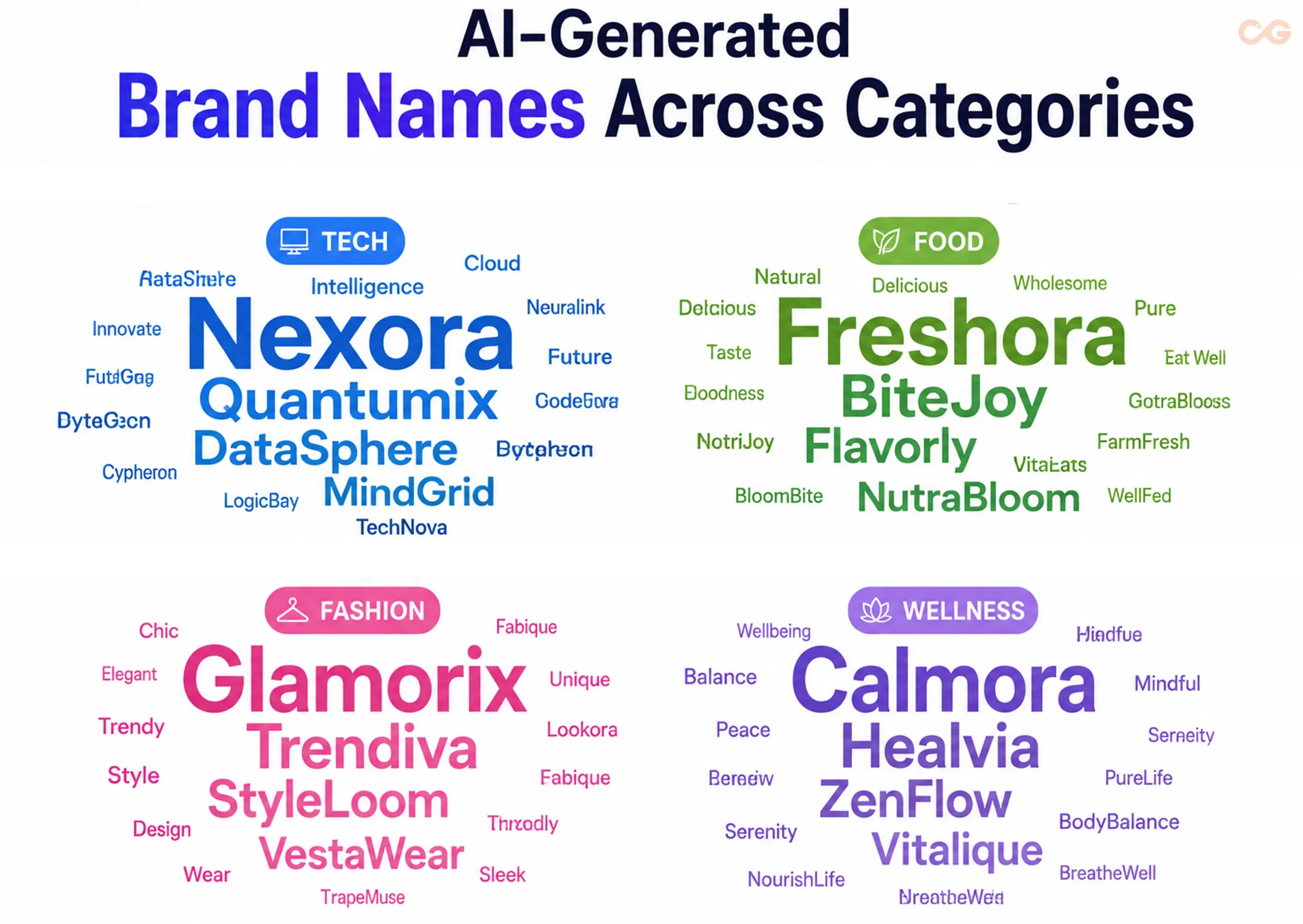
The process of developing the ideal brand name involves a combination of linguistics, a study of the market, and intuitive creativity. The tools of AI brand strategy development have become the best at producing names, which are:
- Linguistically Attractive in Multiple Languages: The brand name or message must be simple to pronounce, culturally sensitive, and without negative meaning in any language worldwide.
- Trademark Registration: Legally verify availability of space in order to secure brand identity and avoid conflict.
- Search Engine/Social Media Optimised: Create unique names that can be searched, which are keyword-friendly and can be changed or adapted to hashtags.
- In Correlation to Brand Personality & Values: Be aligned with the core identity, passion, and the emotional tone of the brand.
AI-Assisted Brand Messaging & Voice Development
AI helps brands establish a consistent messaging strategy and brand voice by analysing brand values, target audiences, competitors, and existing communications. It can assist with:
- Brand Voice: Define whether the brand should sound professional, conversational, authoritative, playful, or empathetic.
- Messaging Frameworks: Develop value propositions, key messages, taglines, and communication pillars aligned with brand positioning.
- Audience Adaptation: Tailor core messages to different customer segments and buyer personas without losing brand consistency.
- Tone Consistency: Review content across websites, social media, emails, and advertisements to ensure a consistent brand tone and personality.
- Multichannel Messaging: Adapt brand messaging for different platforms while preserving its core meaning and identity.
AI can therefore make brand communication more consistent, relevant, and scalable, while human input remains essential for emotional nuance, originality, and strategic direction.
Predictive Brand Performance Modelling
Artificial intelligence marketing branding can perhaps be best used in the ability to anticipate brand element performance prior to launching the brand. AI systems are able to examine:
- Past Results of Similar Companies: Study the results of historical companies to have forecasts of success and risks.
- Consumer Sentiment Trends: Measurements of attitude and emotion to understand brand perception.
- Landscape Dynamics in Competition: The evaluation of competitors’ strategies in order to detect gaps and opportunities.
- Market Trend Trajectories: Analyse changing trends to position branding to meet the demands in the future.
This predictive ability has elevated brand development to a science increasingly based on data rather than a largely intuitive process.
Creation of Personalised Brand Experience
Personalisation with AI branding tools allows accomplishing:
- By comparing individual customer journey patterns, it is possible to trace the behaviours across touchpoints to understand preferences better.
- Creating brand messaging that is tailored to the target audience groups by making it relevant to the respective groups.
- Appeal is maximised by optimising visual elements to target audiences.
- Crafting dynamic brand experiences can enable interactions to change in real-time.
Takeaway

Compare leading AI branding, design, analytics, and content creation tools and explore real-world applications in this guide.
Brand Decisions Supported by Data
AI is helping brands move beyond intuition-led decisions by turning large volumes of consumer, competitor, and market data into actionable branding insights.
Sentiment Analysis of Consumers at Scale
AI-powered brand analytics can analyse customer conversations, reviews, social media interactions, and support feedback to understand:
- Brand Perception: Identify how different audience segments perceive the brand.
- Consumer Sentiment: Track emotional responses to brand messaging, visuals, and campaigns.
- Competitive Positioning: Compare brand perception with competitors to identify differentiation opportunities.
- Emerging Preferences: Detect changing consumer interests and expectations to keep brand positioning relevant.
Automation of Competitive Intelligence
AI can continuously monitor competitors to identify changes in:
- Brand Messaging: Detect new narratives, value propositions, and communication strategies.
- Visual Identity: Track changes in logos, campaigns, creative styles, and other visual elements.
- Market Positioning: Identify gaps and opportunities for differentiation.
- Campaign Response: Analyse consumer reactions to competitor campaigns to uncover potential strengths and weaknesses.
Trend Prediction and Early Opportunity Detection
AI can analyse social conversations, search behaviour, influencer content, and market signals to identify emerging trends before they become mainstream. This helps brands anticipate changing consumer expectations, discover new opportunities, and adapt their positioning more proactively.
Machine Learning for Brand ROI Optimisation
AI can also connect branding activities with performance data to improve marketing ROI. It can support real-time campaign optimisation, smarter budget allocation, predictive customer lifetime value analysis, and large-scale A/B testing, helping marketers identify what works and adjust strategies faster.
Guide to Practical Implementation
How to Begin with AI Branding
A structured implementation approach helps organisations adopt AI branding tools without disrupting existing brand processes. Instead of deploying multiple solutions at once, businesses should start with defined use cases, measurable objectives, and controlled testing.
Phase 1: Assess and Plan (Weeks 1–2)
Evaluate existing branding and marketing workflows to identify pain points, repetitive tasks, and opportunities for AI adoption. Define clear objectives, select priority use cases, establish a budget, and determine KPIs for measuring success.
Phase 2: Select and Implement (Weeks 3–4)
Evaluate suitable AI brand design and branding platforms based on functionality, scalability, integration requirements, security, and ease of use. Configure selected tools according to existing brand guidelines and workflows, and train relevant teams before wider adoption.
Phase 3: Test and Optimise (Weeks 5–8)
Run controlled tests comparing AI-assisted and existing approaches where appropriate. Use A/B testing, performance data, and user feedback to evaluate results, refine workflows, document successful practices, and determine which AI applications are ready to scale.
How to Begin with AI Branding
The Solution: Choose the data visualisation based on the insight you want to communicate. Keep charts simple, use clear labels, maintain appropriate scales, and remove visual elements that don’t add meaning.
Best Practices for Successful AI Branding
Do’s
- Start with focused use cases: Begin with specific, measurable applications rather than attempting an organisation-wide rollout immediately.
- Maintain human oversight: Keep strategic brand decisions and final creative approvals under appropriate human control.
- Protect brand consistency: Configure AI workflows around established brand guidelines, messaging, tone, and visual standards.
- Train relevant teams: Ensure employees understand how to use AI tools effectively and evaluate their outputs critically.
- Test before scaling: Validate performance, quality, and business impact before expanding successful AI applications.
Don’ts
- Don’t automate strategic decisions completely: AI should support brand decisions rather than replace strategic judgement.
- Don’t adopt multiple tools without evaluation: Test platforms for functionality, integration, security, scalability, and actual business value.
- Don’t overlook ethical considerations: Address data privacy, bias, transparency, intellectual property, and responsible AI use.
- Don’t expect immediate ROI: Allow sufficient time for testing, optimisation, team adoption, and performance measurement.
Measuring AI Branding Success
Measuring the impact of AI-driven branding requires a combination of traditional brand KPIs and AI-enhanced metrics. While established metrics help evaluate brand health, customer response, and business performance, AI enables brands to analyse these indicators at greater scale, identify patterns in real time, and generate more predictive insights.
Traditional and AI-Enhanced Brand Metrics
Brand Health Metrics
These metrics help determine how the brand is perceived, recognised, and positioned within its market.
- Brand Awareness: Measures how familiar the target audience is with the brand and whether it comes to mind within its category.
- Brand Recognition and Recall: Evaluates whether customers can identify the brand and remember it without direct prompts.
- Brand Sentiment: Tracks whether consumer conversations and interactions reflect positive, neutral, or negative perceptions of the brand.
- Share of Voice: Measures the brand’s visibility across media, search, social conversations, or other relevant channels compared with competitors.
- Market Positioning: Assesses how customers perceive the brand relative to competitors based on factors such as value, quality, differentiation, and relevance.
Customer Experience Metrics
These metrics evaluate how customers interact with the brand and respond to its experiences across different touchpoints.
- Engagement: Measures how actively audiences interact with brand content, campaigns, products, or digital experiences.
- Customer Satisfaction: Indicates how effectively the brand’s products, services, and interactions meet customer expectations.
- Retention: Measures the brand’s ability to maintain customer relationships and encourage repeat engagement or purchases.
- Personalisation Effectiveness: Evaluates whether AI-driven recommendations, messaging, and experiences improve engagement, satisfaction, or conversion.
- Conversion Rate: Measures the percentage of users who complete a desired action, such as making a purchase, signing up, or submitting an enquiry.
Business Performance Metrics
These metrics connect branding and marketing activities with measurable financial and commercial outcomes.
- Customer Acquisition Cost (CAC): Measures the average cost required to acquire a new customer through marketing and branding activities.
- Customer Lifetime Value (CLV): Estimates the total value a customer is expected to generate throughout their relationship with the brand.
- Revenue Contribution: Measures the extent to which branding and marketing activities contribute to overall revenue generation.
- Marketing ROI: Evaluates the financial return generated from marketing investments relative to the cost of those activities.
AI-Enhanced Metrics
AI adds a real-time and predictive layer to brand measurement, helping organisations identify changes, forecast outcomes, and make faster decisions.
- Real-Time Sentiment Trends: Uses AI to continuously monitor changes in consumer sentiment and identify emerging shifts in brand perception.
- Predictive CLV Accuracy: Measures how accurately AI models forecast future customer value compared with actual customer behaviour.
- Attribution Insights: Uses AI to analyse multiple customer touchpoints and identify which channels or interactions contribute most to conversions and revenue.
- Forecasting Accuracy: Evaluates how reliably AI predicts future trends, campaign performance, customer behaviour, or market changes.
AI Branding Analytics Dashboard
An effective AI brand strategy development dashboard should bring these insights together to provide a clear view of brand performance and emerging opportunities.
- Performance Monitoring: Tracks brand, campaign, customer, and financial KPIs against defined objectives.
- Predictive Indicators: Identifies emerging changes in brand health, customer behaviour, and market conditions before they significantly affect performance.
- Competitive Intelligence: Monitors competitor activity, market positioning, campaigns, and emerging opportunities or threats.
- Customer Journey Analytics: Analyses interactions across customer touchpoints to identify engagement gaps, conversion opportunities, and retention drivers.
Takeaway
Compare leading AI branding, design, analytics, and content creation tools and explore real-world applications in this guide.
Future of AI in Branding
AI is moving from an experimental branding tool to an increasingly integrated part of brand strategy, creative development, customer experience, and decision-making. Its future impact will extend beyond automation, influencing how brands build, manage, measure, and evolve their identities.
Human-AI Collaboration
AI can accelerate data analysis, ideation, testing, personalisation, and optimisation, while human professionals provide strategic judgement, creative direction, emotional understanding, and cultural context. The most effective approach will be to use AI to augment human capabilities rather than treat it as a standalone replacement for brand expertise.
People Also Ask: Will AI Replace Brand Designers and Marketers?
AI is more likely to transform branding roles than replace them entirely. As routine and data-intensive tasks become increasingly automated, professionals will need to focus more on strategy, creative direction, interpretation, and relationship building, while developing the skills required to work effectively with AI.
Ethical and Responsible AI Branding
As AI becomes more deeply integrated into brand development, organisations need safeguards to ensure that automation does not compromise consumer trust, fairness, privacy, or brand authenticity.
- Data Privacy: Collect, process, and store customer data responsibly, with appropriate consent and security measures.
- Algorithmic Bias: Regularly evaluate AI models and datasets to identify biases that could lead to unfair targeting or audience exclusion.
- Transparency: Establish clear guidelines around the use of AI in content creation, personalisation, and brand decision-making.
- Brand Authenticity: Maintain human oversight to ensure AI-generated content remains aligned with the brand’s values, personality, and communication standards.
- Intellectual Property: Review AI-generated content, visuals, and other creative assets for potential copyright, licensing, and ownership concerns.
- Human Oversight: Keep strategic and high-impact brand decisions under appropriate human supervision rather than relying entirely on automated recommendations.
The Evolving Role of Brand Professionals
As AI becomes a standard part of brand development, professionals will need to combine technology expertise with strategic and creative capabilities.
- AI Literacy: Understand AI tools, their capabilities, limitations, and appropriate applications within branding.
- Data Interpretation: Evaluate AI-generated insights and distinguish meaningful patterns from unreliable or misleading outputs.
- Strategic Thinking: Convert AI-driven insights into actionable brand positioning, messaging, and growth strategies.
- Creative Problem-Solving: Use AI as a creative aid while developing distinctive concepts that strengthen brand differentiation.
- Critical Evaluation: Review AI-generated content and recommendations for accuracy, relevance, originality, and brand alignment.
- AI Governance: Develop practical guidelines for responsible AI use, including privacy, transparency, bias monitoring, and human approval processes.
Emerging AI Capabilities
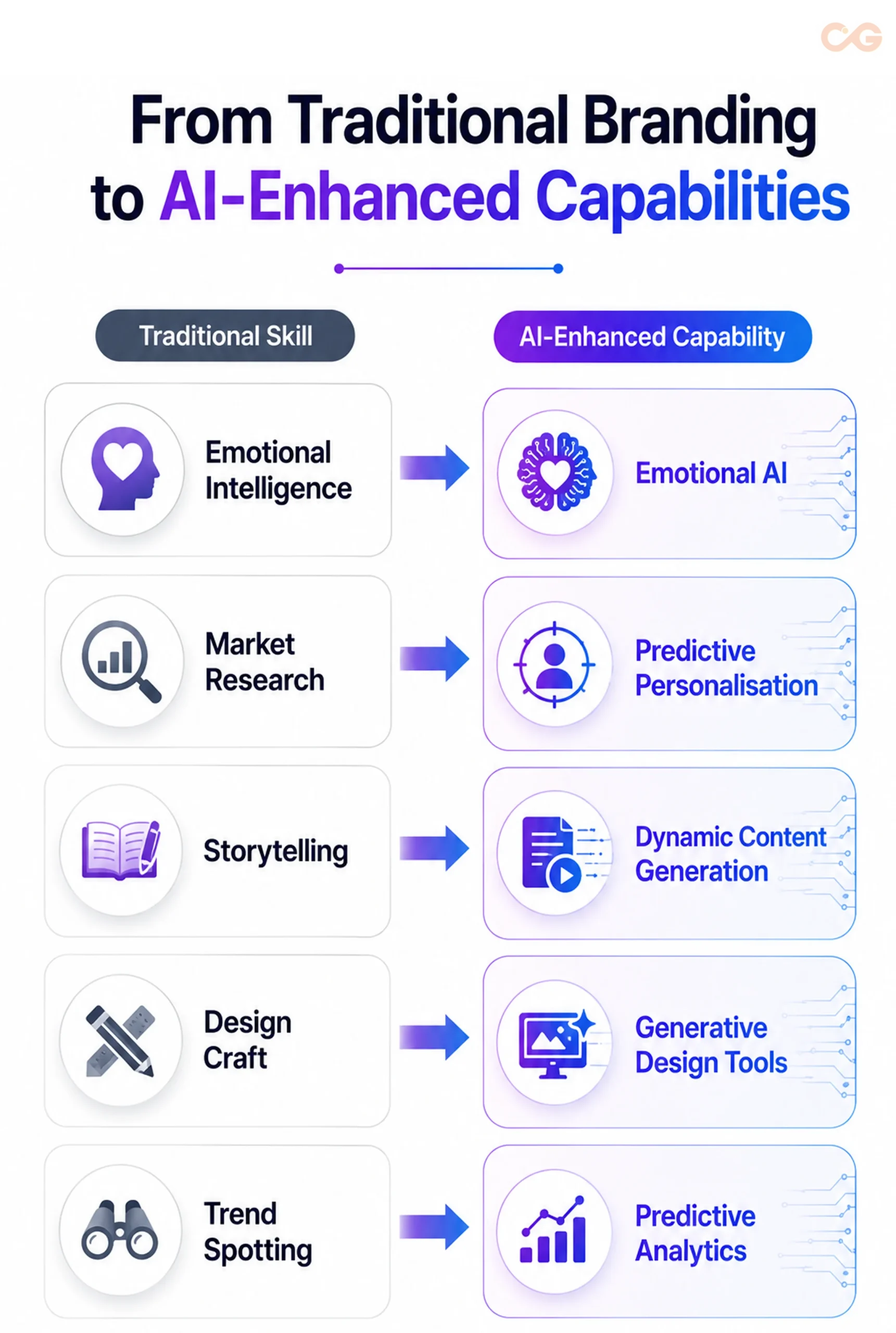
As AI technology advances, emerging capabilities will expand how brands create and deliver experiences:
- Voice and Audio Branding: AI can help develop and optimise sonic identities, voice experiences, and audio content to strengthen brand recognition.
- Immersive Brand Experiences: AI combined with AR and other interactive technologies can help brands create and test more engaging digital experiences.
- Advanced Predictive Analytics: More sophisticated AI models will improve the ability to anticipate consumer behaviour, market trends, and brand performance, supporting faster strategic decisions.
Preparing Your Organisation for AI-Driven Branding
Organisations can prepare for the next stage of AI branding by building the right skills, infrastructure, and governance frameworks:
- Build AI Literacy: Ensure brand and marketing teams understand the capabilities, limitations, and appropriate applications of AI.
- Strengthen Data Infrastructure: Establish reliable systems for collecting, managing, and protecting the data required for AI-driven insights.
- Encourage Experimentation: Create a controlled environment where teams can test, measure, learn, and refine AI applications.
- Establish Ethical Guidelines: Define clear standards for privacy, transparency, bias management, intellectual property, and human oversight.
Takeaway
Compare leading AI branding, design, analytics, and content creation tools and explore real-world applications in this guide.
Conclusion: AI Branding Revolution
AI is no longer a future possibility in branding; it is already transforming how brands are created, managed, measured, and experienced. From AI-assisted logo and name generation to brand messaging, personalisation, predictive analytics, competitive intelligence, and performance optimisation, AI branding tools are helping organisations make faster, more informed, and more scalable decisions.
The competitive advantage lies not simply in adopting AI, but in using it strategically. Brands can reduce repetitive work, accelerate creative experimentation, maintain greater consistency across touchpoints, understand consumer sentiment at scale, and deliver more relevant experiences. At the same time, human expertise remains essential for strategic direction, creativity, cultural understanding, emotional connection, and ethical decision-making.
The best time to explore AI-driven branding is now. Learn their impact, build AI literacy within your team, establish appropriate governance, and scale successful applications gradually. The goal is not to automate branding completely, but to create a more intelligent, agile, measurable, and customer-focused brand operation.
People Also Ask
What are the top AI branding tools to use in a small company?
Small companies can begin with relatively low-cost AI branding tools, such as Looka ($96/year) for logo design, as per Tekpon, Jasper ($59/month) for content creation, as per Jasper, and Brandwatch for social listening. These tools can provide business-quality capabilities without the complexity of enterprise-level platforms.
What is the accuracy of AI in forecasting brand performance?
Modern machine learning brand analytics are able to predict performance accuracy at 70-85 percent, as per Academy Xi, as compared to classical forecasting methods. As AI models are trained with more relevant data and performance outcomes, their forecasting capabilities can improve.
Is it possible for AI to understand the cultural implications of branding?
AI-based brand strategy tools are becoming more capable of analysing cultural patterns, particularly when trained on diverse and region-specific data. However, cultural sensitivity, local market knowledge, and contextual judgement still require human oversight to ensure that brand communication remains appropriate and authentic.
Is there any risk of using AI in branding?
Key risks include algorithmic bias, over-reliance on automation, data privacy concerns, intellectual property issues, and potential loss of brand authenticity. These risks can be addressed through diverse and reliable data, human supervision, appropriate governance, regular AI evaluation, and responsible implementation practices.
Ready to Build a Smarter Brand with AI?
AI is reshaping branding—but successful adoption depends on the right combination of technology, strategy, creativity, and human expertise. Start with a focused application, measure the results, learn from the process, and scale what works.
The AI-powered future of branding is already here. The opportunity now is to use it strategically.