
How AI-Generated Content Is Reshaping Social Media Marketing in 2026
Table of Contents
- Introduction: The Influence of AI on Social Media Marketing
- The Rise of AI in Social Media Marketing
- Key Ways AI Is Transforming Social Media Content
- Advantages of AI-Generated Content on Social Media
- Challenges & Ethical Considerations
- Future of AI in Social Media Marketing
- Conclusion
Introduction: The Influence of AI on Social Media Marketing
Artificial intelligence (AI) is revolutionising social media marketing, particularly in how businesses generate, customise, share, and enhance their content. A report by Sociality.io indicates that 89.7% of social media marketers engage with AI on a daily basis or multiple times a week, highlighting its rapid integration into standard social media practices.
The emergence of generative AI has expedited and broadened the content creation process. Marketers can now leverage AI-driven tools for brainstorming post concepts, crafting captions, repurposing existing materials, designing visual content, and tailoring messages for various platforms. Additionally, AI is capable of analysing audience behaviour and content effectiveness, enabling marketers to provide more targeted content and make well-informed choices.
However, AI’s significance extends beyond mere content production. Its expanding influence is reshaping how social media teams rethink creativity, personalisation, engagement, and optimisation. By streamlining repetitive tasks and offering data-driven insights, AI frees marketers to focus on strategy, storytelling, and forging genuine connections with their audience.
As the capabilities of AI continue to progress, brands face the challenge of striking the right balance between automation and human creativity. The most successful social media approaches will not depend purely on AI; rather, they will integrate its efficiency and analytical power with human insight, authenticity, and cultural awareness.
The Rise of AI in Social Media Marketing
The rapid development of generative AI has accelerated the adoption of artificial intelligence across social media marketing. What was once largely experimental is becoming part of everyday marketing workflows, helping teams create content faster, explore new ideas, and manage increasingly complex social media demands. From generating copy and visual concepts to supporting content planning and optimisation, AI is making social media processes more efficient and scalable.
The growing market for AI-powered social media solutions reflects this shift. AI in social media is projected to grow into a $15.8 billion market by 2032, according to Adobe, highlighting the increasing investment in technologies that support content creation, audience analysis, campaign optimisation, and other social media activities.
As AI-powered platforms such as ChatGPT, Canva AI, and Jasper become more accessible, businesses can incorporate AI into their social media workflows without requiring advanced technical expertise. AI is also moving beyond basic content generation to support different stages of the social media marketing process, from understanding audience behaviour to improving content performance and identifying emerging trends.
This growing adoption is changing the role of AI from a standalone content-generation tool into a broader marketing capability. The following sections explore the key ways AI is reshaping social media content and changing how brands approach their social media strategies.
Key Ways AI Is Transforming Social Media Content
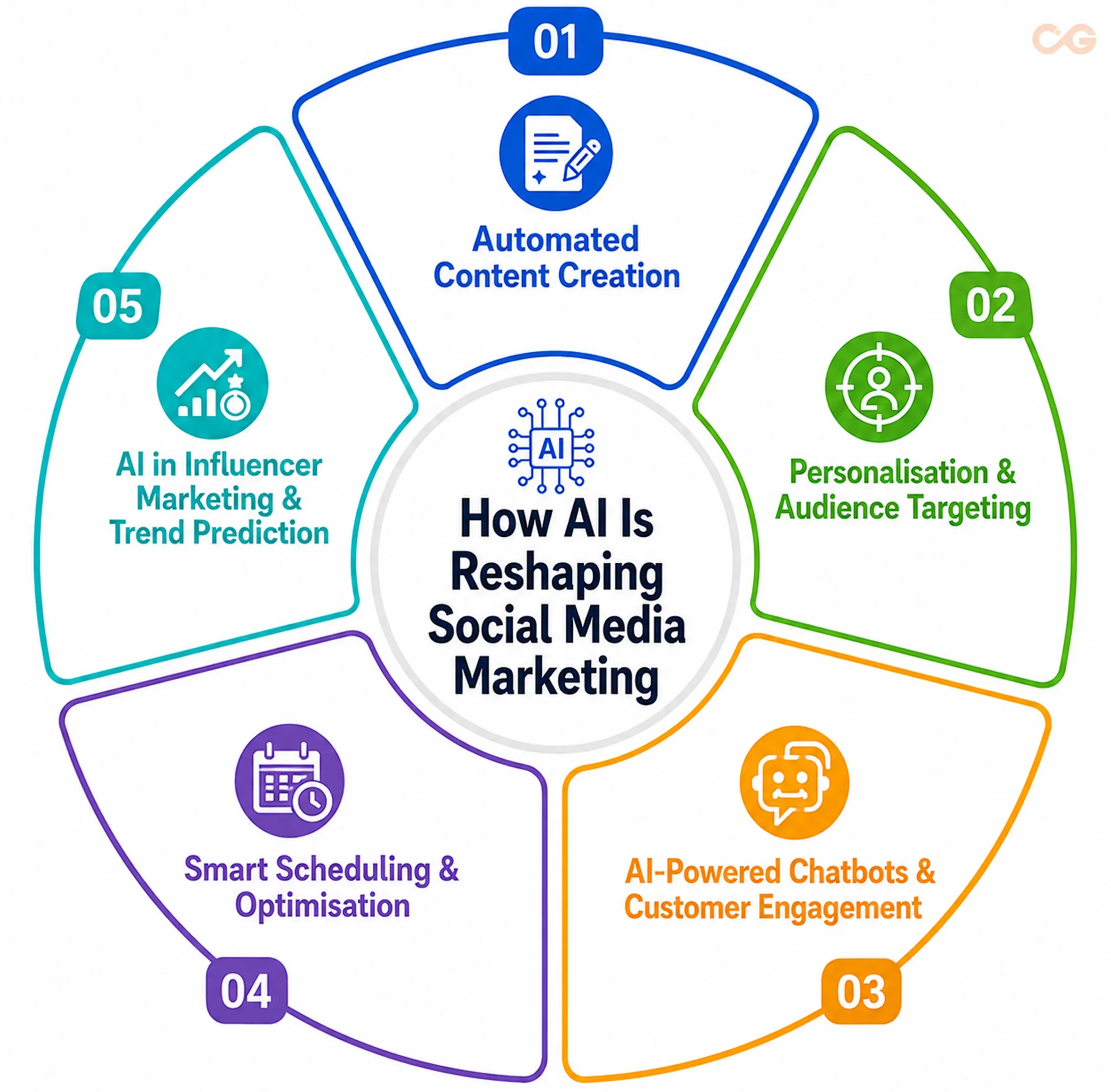
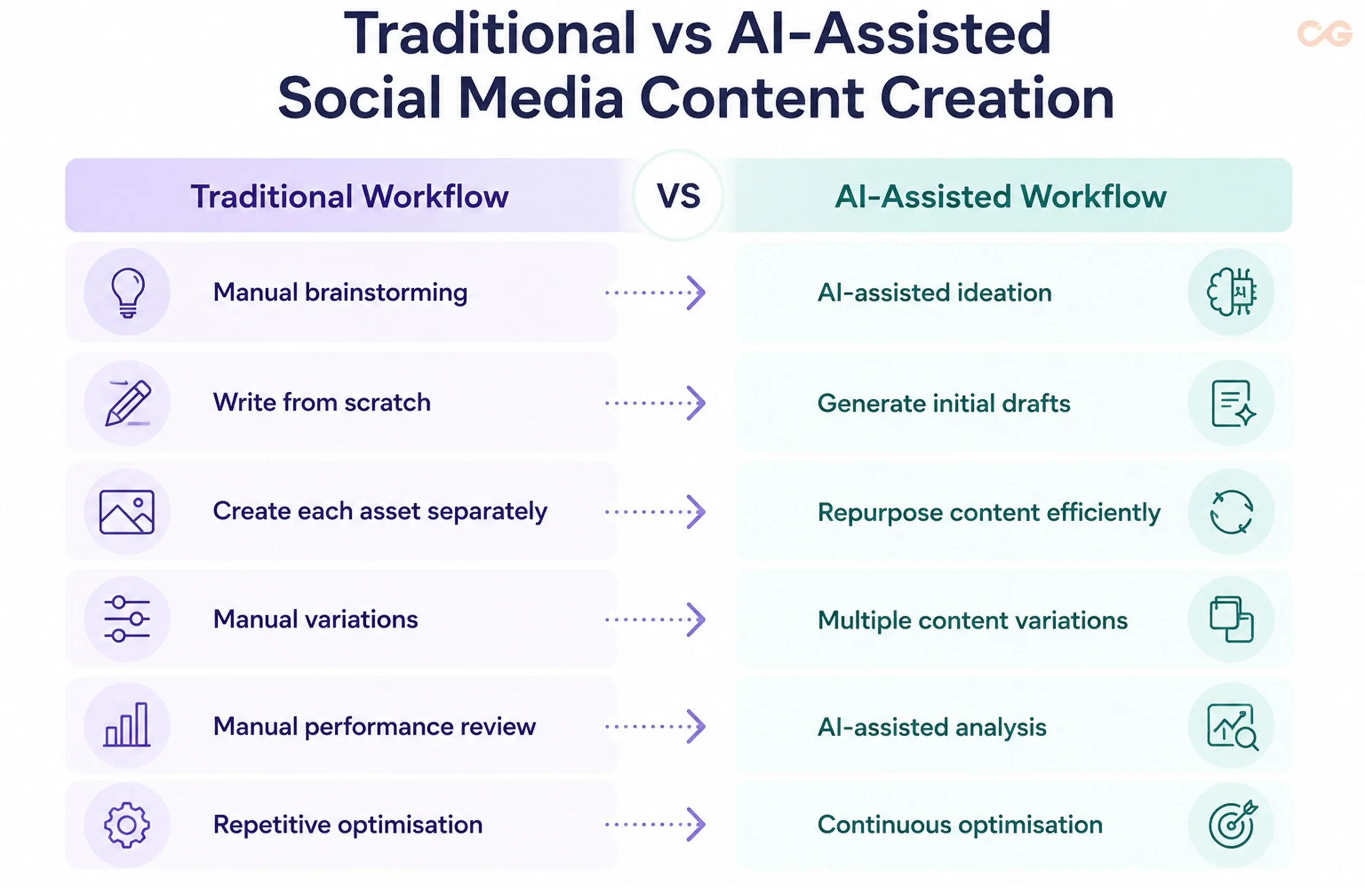
AI-generated content is changing how brands approach social media in 2026. What once required separate steps for brainstorming, writing, designing, editing, and adapting content can now be supported by AI tools within a much shorter workflow. Marketers can generate ideas, create different versions of a post, repurpose existing content, and adapt it for different platforms without starting from scratch each time.
However, the real shift is not simply about producing more content. It is about making the entire content process faster, more personalised, and more responsive to what audiences actually engage with.
Takeaway

Ready to create your next social media post with AI? Try these tools to speed up ideation, writing, design, video creation, and content scheduling without committing to a paid plan immediately.
a. Automated Content Creation
The most visible impact of AI on social media is the way content itself is created. Generative AI can help marketers brainstorm post ideas, write captions and ad copy, develop video scripts, and create or assist with visual content.
For example, a marketer can use AI to turn a long-form blog about social media marketing into an Instagram carousel, a LinkedIn post, and several short captions, adapting the tone and format for each platform while keeping the core message consistent.
This is particularly useful when marketers need to maintain a consistent flow of content across multiple channels.
- AI can generate post ideas, hooks, captions, hashtags, and video scripts.
- Generative AI tools can help create images, videos, and other visual assets more quickly.
- Existing blogs, articles, and long-form content can be repurposed into shorter social posts, carousels, or video scripts.
- Marketers can create multiple versions of the same idea instead of relying on a single piece of content.
The benefit is not that AI takes over creativity. Rather, it takes care of some of the repetitive work, giving marketers more time to focus on ideas, storytelling, brand voice, and creative direction.
b. Personalised Content & Audience Targeting
Once AI makes it easier to create content at scale, the next opportunity is making that content more relevant to different audiences.
AI can analyse audience signals such as interests, engagement patterns, previous interactions, and content preferences to identify what different groups are more likely to respond to. Marketers can then use those insights to create variations of their content rather than showing everyone exactly the same message.
- AI can generate different versions of a post for different audience segments.
- Content can be adapted based on audience interests, behaviour, and preferences.
- Marketers can adjust messaging, tone, format, or creative elements for different groups.
- As audience behaviour changes, AI can help identify new patterns and inform future content.
This moves social media personalisation beyond simply adding a person’s name or targeting a broad demographic. The goal is to make the content itself more relevant to the people seeing it.
And once personalised content is being created, marketers can use performance data to understand which versions are actually working.
c. AI-Powered Content Optimisation
Creating multiple pieces of content is only useful if marketers can understand what resonates with their audience. This is where AI-powered optimisation becomes important.
AI can analyse engagement patterns and content performance to identify which topics, formats, messages, or creative approaches are generating stronger responses. It can also help marketers develop and compare different versions of content before deciding what to publish.
- AI can identify patterns across high- and low-performing posts.
- Marketers can generate variations of headlines, hooks, captions, and creative concepts for testing.
- AI can help identify content themes that are receiving stronger engagement.
- Performance insights can be used to refine future content rather than relying entirely on guesswork.
This creates a more continuous process: create content, measure the response, learn from the results, and improve the next piece.
That optimisation naturally connects with distribution because even strong content needs to reach the audience at the right time and on the right platform.
d. Smart Scheduling & Content Distribution
AI is also making the distribution side of social media more efficient. Instead of treating every platform and audience in exactly the same way, AI-powered tools can help marketers adapt content to the channel where it will be published.
For example, an AI-powered scheduling tool can analyse a brand’s previous engagement data and audience activity to identify when its followers are most likely to be active. It can then help marketers schedule posts around those windows, making it easier to maintain a consistent publishing routine without manually deciding when each post should go live.
AI can also support scheduling by analysing previous engagement patterns and helping marketers identify suitable publishing times and frequencies.
- Content can be adapted to suit the format and audience expectations of each platform.
- AI can help identify suitable posting windows based on historical performance.
- Multiple posts can be prepared and scheduled in advance.
- Repurposing makes it easier to distribute one core idea across several channels without simply duplicating the same post.
This means AI is not only helping marketers create content faster; it is helping them get more value from each content idea after it has been created.
e. Influencer Marketing & Trend Prediction
The final part of this content cycle is knowing what people are interested in right now and who can help brands communicate with those audiences.
AI can analyse social conversations, emerging topics, creator content, and audience engagement patterns to help marketers identify potential trends and relevant influencers. In influencer marketing, AI-driven analysis can look beyond follower counts and help brands evaluate factors such as audience relevance, engagement, and content fit.
- AI can help identify emerging topics and conversations across social platforms.
- Marketers can use creator data to find influencers whose audiences align with their target market.
- AI can analyse engagement and content relevance to support influencer selection.
- Trend insights can help brands develop content around topics while they are still gaining attention.
But this does not mean brands should automatically jump on every trend AI identifies. A trending topic still needs to make sense for the brand and its audience. Human judgement remains important for deciding which trends are worth joining and how to approach them authentically. This matters even more in 2026, as research continues to show that audiences place strong value on authenticity and can become sceptical of overly synthetic content.
The Bigger Shift
The impact of AI-generated content on social media goes beyond simply helping marketers write captions or create images. It is changing the entire content workflow — from finding an idea and creating the first draft to personalising it, optimising its performance, adapting it for different platforms, and responding to emerging trends.
The biggest advantage is speed and scale. Marketers can test more ideas, create more variations, and respond to audience behaviour faster than they could through a completely manual process.
But more content does not automatically mean better content. AI still needs human direction to maintain originality, brand voice, accuracy, relevance, and authenticity. Even AI tools themselves recommend reviewing generated content because it can contain inaccuracies or outdated information.
Advantages of AI-Generated Content on Social Media
AI-generated content is changing more than the way social media posts are produced. It is also helping marketers work more efficiently, scale their content efforts, create more relevant audience experiences, and make better-informed decisions. These benefits make AI increasingly useful for businesses looking to strengthen their social media presence without adding the same level of time and resources to content production.
1. Faster Content Production
One of the most immediate benefits of AI-generated content is the time it can save. Instead of spending hours on repetitive tasks, marketers can use AI to speed up parts of the content workflow and spend more time on creative thinking, storytelling, and campaign strategy.
In fact, 93% of marketers use AI to generate content faster, according to Statista. AI can help marketers quickly develop content ideas, create initial drafts, adapt existing content, and produce different variations for testing. This is particularly useful when brands need to maintain a consistent presence across several social media platforms.
The result is a more efficient workflow where marketers spend less time on routine production and more time improving the quality and direction of their content.
2. Greater Content Scalability
Saving time also makes it easier for businesses to scale their content efforts. AI allows marketers to take one content idea and adapt it into different formats, messages, and platform-specific versions, helping them get more value from the work they have already done.
Ahrefs found that companies using AI published 42% more content each month than those that did not. While this research covers content marketing more broadly rather than social media specifically, it shows how AI can increase the volume of content businesses are able to produce.
For social media, this scalability means a single long-form piece of content can be adapted into social posts, carousel copy, short-form video scripts, or campaign variations. This makes it easier for brands to maintain an active presence across multiple platforms without creating every piece of content from scratch.
For small and growing businesses in particular, this can make it easier to maintain a regular content strategy even with limited marketing resources.
3. More Relevant Audience Experiences
Producing more content is only useful when that content is relevant to the people seeing it. AI can help marketers use audience insights to create content that better reflects different interests, behaviours, and preferences.
Instead of relying on the same message for everyone, brands can develop different versions of their content for different audience groups. This can make social media communication feel more relevant and increase the likelihood of meaningful engagement.
AI-powered analysis can also help marketers identify changing audience interests and adjust their content accordingly. This allows brands to respond to what their audiences are actually interested in rather than relying entirely on assumptions.
4. Lower Content Production Costs
AI-generated content can also help businesses make better use of their content budgets. Producing social media content traditionally may involve separate resources for writing, design, video creation, editing, and content adaptation. AI can assist with several of these tasks, reducing the time and resources required for routine production.
Businesses can use AI to create initial drafts of captions, scripts, visuals, and other creative assets, while human teams review and refine the final output.
This can be particularly useful for small and medium-sized businesses that need to maintain a consistent social media presence without significantly increasing their content production costs.
However, cost savings should not come from simply removing human involvement. The strongest results come from using AI to handle repetitive work while skilled marketers and creatives remain responsible for strategy, originality, brand voice, and quality control.
Takeaway
Ready to create your next social media post with AI? Try these tools to speed up ideation, writing, design, video creation, and content scheduling without committing to a paid plan immediately.
5. Better Data-Backed Decisions
AI-generated content also gives marketers more opportunities to learn from how audiences respond to their content. By analysing performance patterns, AI-powered tools can help identify which topics, formats, messages, and creative approaches are generating stronger results.
This allows marketers to move beyond simply tracking likes and shares and look at broader signals such as engagement patterns, audience sentiment, and conversions.
AI can also support ongoing testing by helping marketers compare different versions of content and identify opportunities for improvement. Rather than creating content, publishing it, and moving on, marketers can use performance insights to continuously refine their approach.
The Bottom Line
The biggest advantage of AI-generated content is not simply that it helps brands produce more social media posts. It gives marketers the ability to work faster, scale content more easily, create more relevant audience experiences, manage resources efficiently, and make decisions based on performance data.
When AI handles repetitive and data-heavy tasks while humans remain responsible for creativity and strategic judgement, businesses can build a social media content process that is both more efficient and more effective.
Challenges & Ethical Considerations
While AI-generated content offers several advantages for social media marketing, it also raises concerns around authenticity, misinformation, bias, and the role of human creativity. The key is to use AI responsibly while keeping human judgement involved in the content process.
1. Concerns Regarding Authenticity in AI-Generated Content
Social media marketing depends heavily on genuine experiences and emotional connections. As more brands use AI-generated content, maintaining that sense of authenticity can become challenging.
- Over-reliance on AI can make content feel generic or less personal, potentially weakening audience trust.
- As social platforms become increasingly filled with AI-generated content, users may find it harder to distinguish human-created content from synthetic content.
- AI-generated content also raises questions around intellectual property, ownership, and accountability.
How brands can address it:
- Use AI to support content creation while adding original ideas, experiences, and brand-specific insights.
- Have human marketers review and refine AI-generated content to ensure it reflects the brand’s voice and values.
- Be transparent about AI involvement when disclosure is appropriate or necessary.
2. Risks of Misinformation and AI Bias
AI can produce highly realistic text, images, audio, and videos, but realistic content is not always accurate. Without proper oversight, AI-generated content can contribute to misinformation, manipulation, and biased representation.
- AI-generated deepfakes can portray people as saying or doing things that never happened.
- Misleading content can spread quickly across social platforms, creating confusion and harmful narratives.
- AI systems can reflect biases or outdated information present in their training data, potentially reinforcing stereotypes or misrepresenting facts.
How brands can address it:
- Fact-check statistics, claims, quotes, and other important information before publishing AI-generated content.
- Verify AI-generated images and videos, especially when they feature real people, events, or organisations.
- Establish a human review process for content that could affect audience trust or brand reputation.
AI should therefore be treated as a content-generation tool rather than an unquestioned source of truth.
3. The Need for Human Creativity Alongside AI
Despite the growing capabilities of AI, human creativity remains essential in social media marketing. AI can generate content quickly, but human understanding is still needed to bring empathy, cultural nuances, emotional depth, and context into that content.
- Use AI for brainstorming, drafting, repurposing, and other repetitive tasks, while keeping humans involved in creative direction.
- Review AI-generated content for accuracy, originality, tone, cultural relevance, and brand fit.
- Establish clear guidelines for the responsible use of generative tools across the marketing team.
- Add human experiences, opinions, and storytelling to ensure AI-assisted content feels relevant rather than generic.
Ultimately, the future of AI in social media marketing will depend on finding the right balance between automation and human creativity. AI can make content creation faster and more scalable, but human judgement helps ensure that the final content remains authentic, accurate, relevant, and trustworthy.
That optimisation naturally connects with distribution because even strong content needs to reach the audience at the right time and on the right platform.
Future of AI in Social Media Marketing
AI-generated content is likely to become more integrated into social media workflows as AI tools become better at understanding context, generating different content formats, and adapting content to changing audience behaviour. The next stage will not simply be about producing more posts. It will be about creating more adaptive, platform-specific, and context-aware content with greater speed and precision.
Emerging Trends in AI-Generated Social Content
Several developments are likely to shape how brands create and distribute social media content in the coming years:
- Multimodal content creation will make it easier to generate text, images, video, and audio from a single creative brief. This can help marketers turn one campaign idea into multiple content formats more efficiently.
- Real-time content adaptation will allow AI systems to adjust messaging and creative elements based on audience responses, current events, and changing conversations.
- AI-assisted creative experimentation will make it easier to generate and test multiple hooks, captions, visuals, and content concepts to identify what resonates with specific audiences.
- Platform-specific content generation will become more sophisticated, allowing AI to adapt the same core idea to the format, tone, and audience expectations of different social platforms.
- Social search and conversational discovery will become increasingly important as users rely on social platforms and AI-powered interfaces to discover information, products, and brands. This will encourage marketers to create content that answers natural-language questions and matches user intent.
These developments point towards a shift from simply creating content at scale to creating content that can adapt at scale.
How Brands Can Prepare
Brands do not need to adopt every new AI tool as soon as it appears. Instead, they should focus on building a flexible content process that can incorporate useful AI capabilities as they mature.
- Integrate AI into existing workflows for ideation, content adaptation, creative testing, and performance analysis rather than treating it as a separate activity.
- Experiment with different AI-generated formats and measure audience response to understand where AI actually improves content performance.
- Build platform-specific strategies instead of publishing identical AI-generated content across every social channel.
- Keep teams updated through regular experimentation and training as AI capabilities and social platforms continue to evolve.
- Measure content quality as well as quantity, looking at engagement, relevance, audience response, and conversions rather than simply counting how much content AI can produce.
The future of AI-generated content in social media will ultimately be about smarter content workflows rather than simply higher content volume. Brands that combine AI’s ability to generate and analyse content at scale with strong strategy and audience understanding will be better positioned to adapt as social media continues to evolve.
Takeaway
Ready to create your next social media post with AI? Try these tools to speed up ideation, writing, design, video creation, and content scheduling without committing to a paid plan immediately.
Conclusion
AI-generated content is becoming an increasingly important part of social media marketing in 2026, changing the expectations around how quickly brands can respond, experiment, and communicate with their audiences. The real impact of this shift, however, will depend on how thoughtfully businesses incorporate AI into their content strategies.
For marketers, the opportunity lies in using AI to expand creative possibilities without allowing automation to define the brand’s identity. Strong social media content still needs a clear point of view, a genuine understanding of its audience, and a reason for people to care.
As the technology continues to advance, successful brands will be those that adapt without losing their individuality. AI may change how social media content comes to life, but the ability to make that content meaningful will continue to depend on the people behind it.