
LinkedIn Algorithm Secrets: How to Boost Your Reach Organically
Table of Contents
- Introduction
- Decoding the LinkedIn Algorithm: How Content Gets Prioritised in 2026
- Proven Methods to Boost Your Organic Reach on LinkedIn
- Key Mistakes That Can Harm Your LinkedIn Organic Reach in 2026
- Conclusion
Introduction
Why Is LinkedIn a Powerful Platform for Professionals in India?
LinkedIn has become one of the leading professional networking platforms in India, with around 189 million registered users as of March 2026, according to NapoleonCat. Its growing user base makes LinkedIn an important platform for Indian professionals, entrepreneurs, and brands looking to build thought leadership, expand their professional network, and create new career and business opportunities through valuable LinkedIn content.
How Does Understanding the LinkedIn Algorithm Maximise Your Organic Reach?
Understanding the LinkedIn algorithm can help you make more informed decisions about your content and engagement strategy. Rather than relying on guesswork, knowing how LinkedIn distributes content allows you to create a more focused approach to building visibility and reaching the right professional audience.
This guide breaks down how the LinkedIn algorithm works in 2026 and provides practical strategies you can use to improve your organic reach, strengthen audience engagement, and build a more consistent presence on the platform.
Decoding the LinkedIn Algorithm: How Content Gets Prioritised in 2026
Understanding how the LinkedIn algorithm evaluates and distributes content is essential for improving organic reach and engagement. In 2026, content visibility depends on factors such as content quality, relevance, audience engagement, and user behaviour. Understanding these signals can help professionals create content that is more likely to reach the right audience and generate meaningful interactions.
How Does the LinkedIn Algorithm Rank Content?
LinkedIn has become one of the leading professional networking platforms in India, with around 189 million registered users as of March 2026, according to NapoleonCat. Its growing user base makes LinkedIn an important platform for Indian professionals, entrepreneurs, and brands looking to build thought leadership, expand their professional network, and create new career and business opportunities through valuable LinkedIn content.
Step 1: Content Quality — Is the Post Relevant and Valuable?
The first stage involves evaluating the quality and suitability of a post. Content can generally be viewed as falling into three broad categories:
- Spam: Content that violates LinkedIn’s policies or uses tactics such as excessive tagging, engagement bait, or irrelevant promotional activity may be restricted from wider distribution.
- Low quality: Posts that provide limited value, lack clarity, or are excessively promotional may receive less distribution.
- High quality: Original, useful, relevant, and professionally focused content is more likely to be considered for broader distribution.
This initial evaluation helps LinkedIn determine whether a post is suitable for further distribution and engagement.
Step 2: Initial Engagement — How Does the Audience Respond?
After the initial evaluation, LinkedIn can assess how people respond to the post. Signals may include likes, comments, shares, and the time users spend viewing or engaging with the content.
Meaningful interactions are particularly valuable because they indicate that the content is relevant enough to encourage further discussion. Instead of focusing solely on the number of reactions, creators should aim to generate genuine conversations and provide information that holds the audience’s attention.
For example, Medium reports that LinkedIn may give greater importance to posts receiving comments of more than 15 words than to those receiving shorter comments.
Posts that generate strong early engagement may have greater opportunities for wider distribution as LinkedIn continues evaluating their relevance to other users.
Step 3: Network Relevance — Who Is Most Likely to Find the Content Useful?
LinkedIn also considers the relationship between the content, creator, and potential audience. Factors that can influence relevance include:
- Connection strength: Content may be more relevant to people who regularly interact with the creator or are closely connected to them.
- Professional relevance: Posts related to a user’s industry, role, interests, or professional activity may be more relevant to that audience.
- Previous interactions: Past engagement between users can help LinkedIn identify audiences that are more likely to find new content useful.
This helps the platform distribute content beyond the creator’s immediate network while maintaining relevance for the people who see it.
Step 4: Continued Distribution — Can the Content Remain Relevant?
Content distribution does not necessarily end immediately after publication. LinkedIn Posts that continue to attract meaningful engagement or remain relevant to ongoing conversations may continue receiving visibility over time.
This gives useful LinkedIn content a longer lifespan and creates additional opportunities to reach people who did not see the post when it was originally published.
Additional Factors That Influence Content Visibility
Beyond these stages, the format and nature of content can also influence how effectively it performs on LinkedIn.
- Prioritise native content: Text posts, videos, documents, carousels, and other content published directly on LinkedIn can help keep users on the platform and encourage deeper interaction. Rather than relying heavily on external links, focus on providing the core value within the LinkedIn post itself.
- Build topical expertise: Consistently sharing original insights, practical advice, and expertise within a specific professional niche can help strengthen your credibility and establish thought leadership over time.
The key takeaway is that understanding the algorithm is not about trying to manipulate individual ranking signals. It is about consistently creating relevant, useful content and encouraging genuine interactions that provide value to your professional audience.
Takeaway

Use this checklist to turn your LinkedIn profile into a platform for genuine professional connections and steady organic growth.
Proven Methods to Boost Your Organic Reach on LinkedIn
Grasping how LinkedIn’s algorithm assesses content is just the beginning. The real challenge is to use that understanding on a regular basis to produce content that captures interest, fosters genuine engagement, and connects with the appropriate professional audience. Here, you’ll find nine strategies that turn key algorithm signals into actionable steps, helping you enhance your LinkedIn organic reach in 2026.
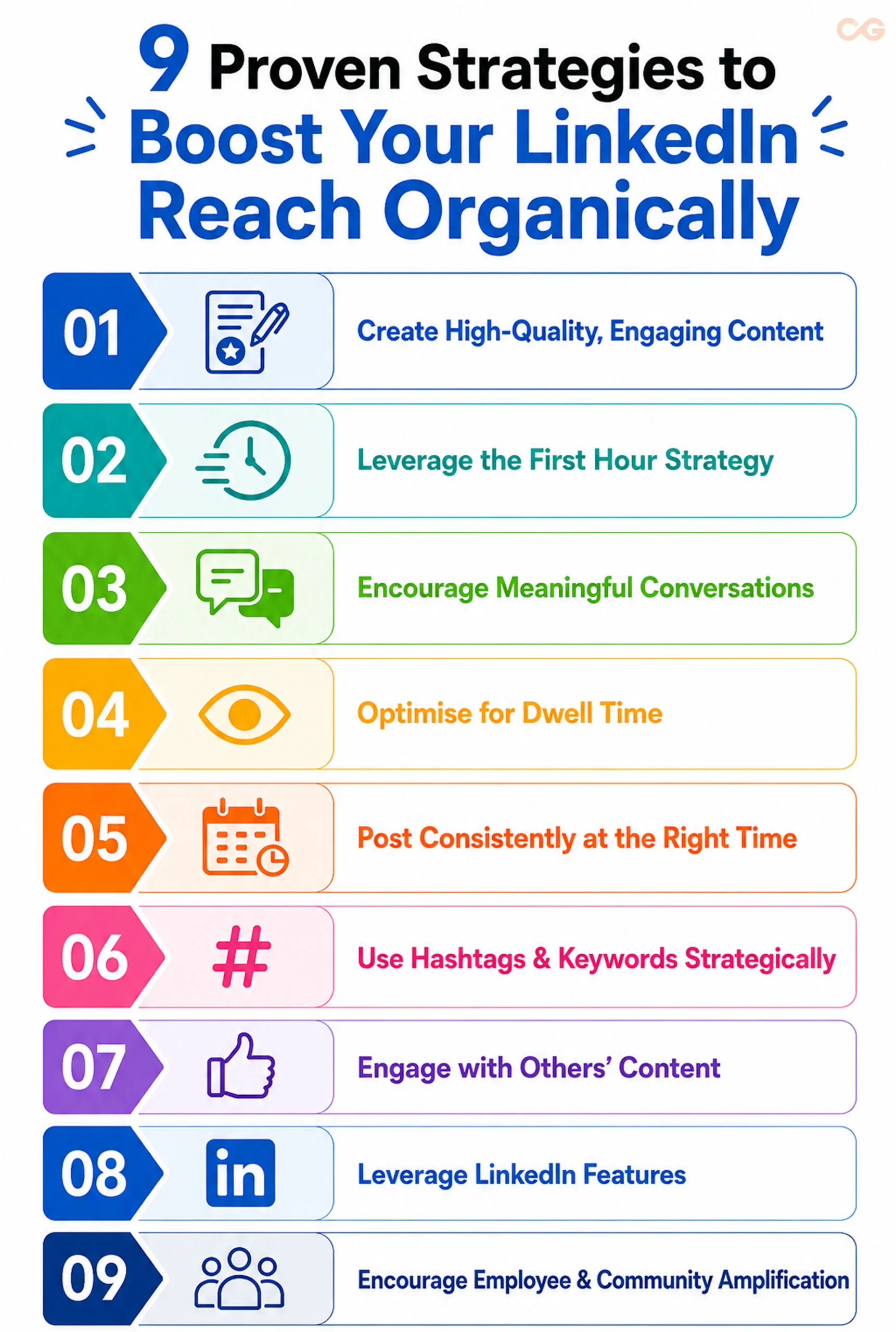
1. Create High-Quality, Engaging Content
Your content needs to provide a clear reason for people to stop scrolling and engage. Share original insights, practical advice, industry observations, data, or professional experiences that are relevant to your target audience.
Use storytelling where appropriate and choose formats that make the information easy to understand. Posts with images attract up to 94% more views, as stated by SearchEngineJournal.
Instead of creating posts simply to maintain a publishing schedule, focus on content that educates, solves a problem, starts a discussion, or offers a useful perspective.
The goal is to build credibility while giving your audience a reason to read, respond, or share your content.
2. The Magic of First-Hour Strategy
The first 60 minutes immediately after posting are crucial, as stated in Win on LinkedIn. During this initial hour, engagement such as likes, comments, and shares can signal to the LinkedIn algorithm that your content is insightful and engaging. Rapid interactions with your posts can help achieve wider distribution.
To make the most of this first-hour opportunity:
- Meet the audience peak time: Post when your target audience is most active, mostly during the morning and early evening in India.
- Spark interaction: Encourage your network to engage by asking a relevant question or tagging a few relevant friends.
- Encourage genuine comments: Ask for meaningful comments rather than simply likes to increase dwell time and the quality of the conversation.
3. Encourage Meaningful Conversations
Don’t treat LinkedIn posts as one-way announcements. Encourage your audience to share their experiences, opinions, or perspectives.
Ask relevant open-ended questions and respond to comments with thoughtful answers rather than generic replies such as “Great post!” or “Thanks.”
A genuine conversation can extend the life of a post, strengthen professional relationships, and create a more active community around your content.
4. Maximise Early Engagement
The period immediately after publishing is an opportunity to monitor how your audience responds to your post. Be available to respond to relevant comments, answer questions, and continue conversations while the post is receiving attention.
Rather than trying to generate artificial engagement, focus on reaching the right audience and encouraging genuine responses. You can also publish when your target audience is most likely to be active, based on your own LinkedIn Analytics and previous post performance.
5. Post Consistently at the Right Time
Consistency helps you maintain visibility and gives you more opportunities to understand what resonates with your audience. However, posting more frequently does not automatically mean better results.
Establish a realistic publishing schedule that you can maintain without compromising content quality. Review your LinkedIn Analytics to identify when your audience is most active, then test different posting times and refine your schedule based on actual performance.
LinkedIn data shows that 23.6% of LinkedIn users open the app daily, mostly during commute or lunch hours, making these periods an ideal time to post.
6. Use Hashtags and Keywords Strategically
Use relevant keywords naturally in your posts and profile so that your content clearly communicates its subject and professional context.
Hashtags can also help categorise content and make it easier for users to discover relevant topics. Instead of adding a long list of broad hashtags, prioritise a small number of specific hashtags that closely match the subject of your post.
For example, a post about B2B digital marketing could use relevant terms such as B2B marketing, digital marketing, and targeted hashtags such as #B2BMarketing or #DigitalMarketing.
7. Engage With Others’ Content
Organic growth is not limited to publishing your own posts. Regularly engage with relevant connections, industry experts, potential clients, and other professionals in your niche.
Leave thoughtful comments that add a new perspective, answer a question, or build on the original discussion. Consistent participation helps you build relationships and increases your visibility within relevant professional communities.
8. Leverage LinkedIn’s Native Features
Experiment with LinkedIn’s available content formats, such as text posts, videos, documents, carousels, polls, and newsletters, to understand which formats work best for your audience.
Choose the format based on the purpose of the content rather than using every feature simply for variety. For example, a document or carousel can be useful for presenting a step-by-step framework, while a video may work better for demonstrations, opinions, or personal insights.
Testing different formats can help you identify which approaches generate the strongest engagement from your specific audience.
9. Encourage Employee and Community Amplification
For businesses, employee advocacy can extend the reach of valuable company content beyond the organisation’s immediate audience.
Encourage employees to share relevant company posts with their own perspectives rather than simply copying and reposting the same message. You can also participate in relevant professional communities and discussions where your audience is already active.
The focus should remain on providing useful information and building genuine professional relationships rather than relying on coordinated or artificial engagement.
Turning These Strategies Into Consistent Organic Growth
These strategies work best as part of a broader LinkedIn content strategy, rather than as isolated tactics. Create valuable content, make it easy to consume, participate in meaningful conversations, and use your performance data to understand what resonates with your audience.
By consistently testing, measuring, and refining your approach, you can build stronger LinkedIn visibility, meaningful professional connections, and sustainable organic reach in 2026.
Key Mistakes That Can Harm Your LinkedIn Organic Reach in 2026
Understanding effective strategies for LinkedIn is crucial, but recognizing what can hinder your content is equally important. Certain habits can diminish LinkedIn visibility and engagement. Here are three pitfalls to avoid for boosting your organic reach on LinkedIn.
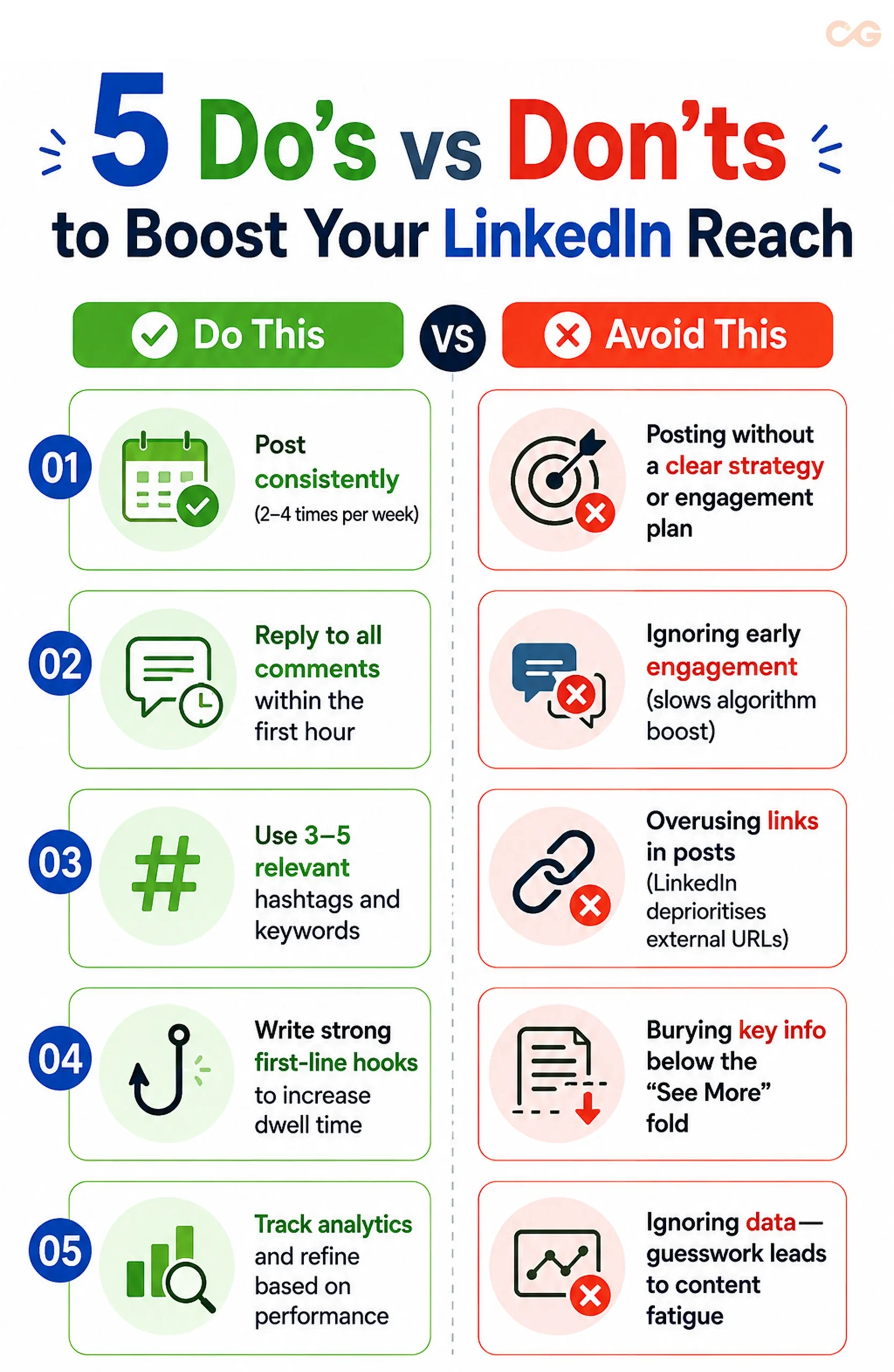
1. Overusing External Links
It’s easy to want to share a link every time you post on LinkedIn. However, if your main goal is to direct users to another site, you risk losing their interest in your LinkedIn content.
Focus on providing valuable insights directly in your post. If an external resource is beneficial, include the link as supplementary information rather than the main attraction.
Recommended action for LinkedIn algorithm in 2026: Create valuable, self-sufficient content for LinkedIn and use external links sparingly to enhance the post’s value.
2. Posting Without a Defined Content and Engagement Strategy
Regular posting doesn’t guarantee improved reach. If you publish content without clear goals or understanding your target audience, you risk producing inconsistent material that fails to resonate.
Implementing a straightforward strategy can enhance focus:
- Select Relevant Topics: Share insights and information aligned with your expertise and your audience’s interests.
- Establish a Realistic Posting Schedule: Post consistently, prioritizing quality over quantity.
- Engage in Conversations: Respond to comments and interact with relevant posts to foster engagement beyond your own content.
A clear strategy aids in determining which topics and formats merit further exploration.
3. Overlooking LinkedIn Analytics
Neglecting the performance of your posts means operating on guesswork. LinkedIn Analytics reveals which content captures attention and drives meaningful interaction.
Monitor these key metrics:
- Engagement: Likes, comments, and shares indicate audience response.
- Impressions and Reach: These metrics illustrate how widely your posts are viewed.
- Audience Demographics: Understanding who engages with your content informs future strategies.
- Post Performance: Analyzing different posts can highlight successful topics, formats, and approaches.
Leverage these insights to refine future content, avoiding repetitive tactics that yield poor results.
Avoiding Mistakes for Sustainable Growth
Achieving organic reach on LinkedIn relies on consistent sharing of valuable content, engaging in genuine discussions, and learning from outcomes.
Steer clear of unnecessary external links. Ensure each post serves a clear purpose, and conduct regular reviews of your analytics. Adopting these straightforward habits can strengthen your LinkedIn visibility, enhance engagement, and foster professional connections over time.
Takeaway
Use this checklist to turn your LinkedIn profile into a platform for genuine professional connections and steady organic growth.
Conclusion
How Can You Maximise Your LinkedIn Organic Reach in 2026?
Understanding the LinkedIn algorithm can help you make smarter decisions about what you post, when you post, and how you engage with your audience. With more than 1.2 billion members globally, (according to SproutSocial), LinkedIn remains the best platform for professional networking and building strong thought leadership. However, there is no single tactic that guarantees consistent reach.
Focus on creating useful, relevant content, starting genuine conversations, and making your posts easy to read and engage with. Maintain a consistent posting routine, experiment with LinkedIn’s native formats, and use LinkedIn Analytics to understand what resonates with your audience.
Most importantly, treat organic growth as an ongoing process. Test different topics and formats, learn from your results, and keep refining your LinkedIn content strategy. Over time, this consistent approach can help you build stronger visibility, meaningful professional connections, and lasting thought leadership on LinkedIn.
Ready to put these strategies into practice? Start with one or two changes today, measure the results, and build from there.