
How AI-Driven Marketing Is Transforming Digital Marketing in 2026
Table of Contents
- Introduction
- Rise of AI in Marketing
- Hyper-Personalisation and Customer Experience
- AI-Powered Content Creation and Optimisation
- AI-Powered Advertising and Campaign Optimisation
- AI-Powered Marketing Analytics and Decision-Making
- Ethical Considerations and Challenges
- Future Trends in AI Marketing
- Conclusion
Introduction
AI Marketing Revolutionises Personalisation and Automation in 2026
In 2026, AI-driven marketing is transforming how brands understand, engage, and connect with consumers. AI has moved beyond simple automation to become a strategic capability that enables hyper-personalisation at scale, helping marketers create relevant customer experiences while streamlining complex workflows.
By combining AI marketing frameworks such as predictive analytics, generative AI for content creation, and AI marketing automation tools, businesses can analyse data, identify customer needs, and make faster, more informed decisions. These capabilities allow marketers to deliver timely, relevant content and optimise campaigns based on changing customer behaviour.
Why Embracing AI Marketing Transformation Is Critical for Staying Competitive
The rapidly growing Indian AI market is projected to triple to $17 billion by 2027, according to Boston Consulting Group, highlighting the increasing importance of AI across business functions. As consumer expectations for personalised and seamless experiences continue to rise, businesses need to adapt how they create content, engage audiences, and respond to changing market behaviour.
AI enables marketing teams to adjust campaigns more efficiently, identify emerging trends, and use AI marketing analytics to turn customer data into actionable insights. However, its value extends beyond automation alone. Organisations that combine AI capabilities with human creativity and strategic judgement can build more relevant customer experiences, respond faster to market changes, and strengthen their competitive position in 2026.
Rise of AI in Marketing
The Increasing Demand for AI in Modern Marketing
In 2026, AI-driven marketing has moved beyond being an emerging trend and has become an important part of digital strategy. Businesses are using AI to understand customers better, automate routine tasks, improve campaigns, and make faster marketing decisions. Valued at $47.32 billion in 2025, the AI marketing industry is projected to grow at a CAGR of 36.6% through 2028, according to SEO.com. This growth reflects how quickly businesses are adopting AI to keep pace with changing customer expectations and manage marketing activities more efficiently.
AI is making an impact across several areas of marketing:
- Greater efficiency: AI takes care of repetitive tasks, giving marketers more time to focus on strategy, creativity, and customer relationships.
- Personalisation at scale: AI can analyse customer behaviour and preferences to help brands deliver more relevant content and experiences to larger audiences.
- Smarter decision-making: By processing large amounts of data, AI helps marketers spot patterns, understand campaign performance, and make timely adjustments.
These capabilities are powered by a range of AI technologies, each playing a different role in the way modern marketing is planned and delivered.
Technologies Shaping AI-Driven Marketing
AI-driven marketing relies on several technologies that help businesses understand their audiences, create content, optimise campaigns, and improve customer interactions. While each technology serves a different purpose, they work together to make marketing more data-driven and responsive.
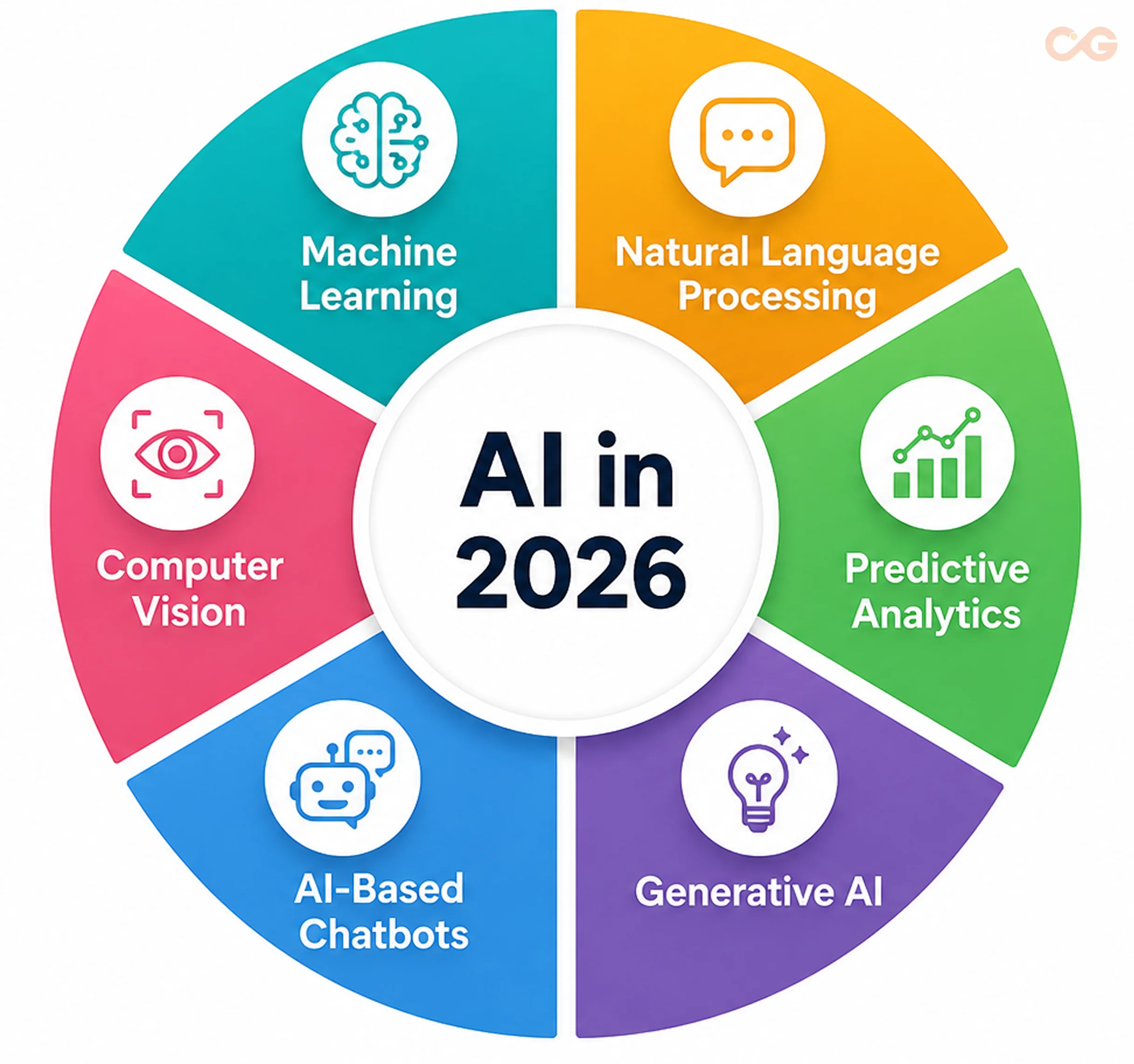
Machine Learning (ML)
Machine learning helps marketers make sense of large amounts of data by identifying patterns and predicting customer behaviour. These insights can be used to improve audience targeting, adjust campaigns, and make better use of marketing budgets.
Natural Language Processing (NLP)
Natural Language Processing helps AI understand human language across sources such as social media posts, customer reviews, search queries, and conversations. Marketers can use NLP to understand customer sentiment, identify intent, and create messaging that better reflects what their audiences are looking for.
Predictive Analytics
Predictive analytics uses past and real-time data to estimate what customers are likely to do next. Marketers can use these insights to forecast demand, identify audience segments, predict campaign outcomes, and make more informed targeting decisions.
Generative AI
Generative AI is changing how marketing teams create content. It can help produce emails, advertisements, social media posts, and visual assets at scale. Marketers can also use it to generate ideas and test different creative variations before deciding what works best.
AI-Based Chatbots
AI-based chatbots help businesses respond to customer questions, provide recommendations, qualify leads, and offer support. Because they can handle multiple conversations at the same time, they allow businesses to provide quicker assistance without relying entirely on manual responses.
Computer Vision
Computer vision allows AI to understand and analyse visual information. In marketing, it can be used for applications such as visual search, product recognition, image analysis, and improving image-based campaigns.
Together, these technologies are giving marketers new ways to understand audiences, create relevant content, optimise campaigns, and improve customer interactions. Their impact becomes clearer when we look at how they are being applied across different areas of marketing.
Takeaway

Build a smarter marketing stack without overspending. Download the complete toolkit for practical free and freemium tools across essential marketing functions.
Hyper-Personalisation and Customer Experience
Unlocking Hyper-Personalisation with AI-Based Customer Insights
AI-driven marketing is making hyper-personalisation more achievable by helping brands understand individual customers at scale. Instead of relying only on broad audience segments, marketers can analyse customer interactions, preferences, browsing behaviour, purchase history, and engagement patterns to deliver more relevant experiences in real time.
AI can turn these insights into personalised recommendations, content, offers, and customer journeys that are more closely aligned with individual needs.
Key ways AI is driving hyper-personalisation include:
Personalised recommendations: Companies such as Amazon and Spotify use customer behaviour, including browsing, purchasing, and listening activity, to recommend products or content that are more relevant to individual users.
Dynamic content delivery: AI can adapt website, email, and app content based on a customer’s interests, previous interactions, and stage in the buying journey.
Personalised offers and promotions: AI can analyse customer and purchase data to identify suitable offers, discounts, or product suggestions for different individuals, helping brands make promotions more relevant.
Brands are already applying these capabilities in practice. For example, Unilever‘s BeautyHub PRO uses AI-powered recommendations to personalise the beauty shopping experience. According to the reported results, the platform contributed to a 39% higher shopping basket value and a 43% increase in purchase completion rates.
Predictive Analytics for Customer Behaviour
While personalisation focuses on making current interactions more relevant, predictive analytics helps marketers anticipate what customers may do next. By analysing historical and real-time data, machine learning models can identify behavioural patterns and estimate outcomes such as purchase intent, demand, or churn risk.
Predictive analytics can enhance the customer experience through:
- Demand forecasting: AI can identify potential changes in customer demand, helping businesses plan inventory, promotions, and campaigns more effectively.
- Churn prediction: AI can identify customers showing signs of disengagement, allowing marketers to introduce relevant retention campaigns before they leave.
- Next-best-action recommendations: AI can analyse recent customer interactions to suggest relevant products, content, offers, or support at the appropriate stage of the customer journey.
Netflix and Amazon are familiar examples of businesses using data-driven recommendation systems to surface relevant content and products based on individual behaviour.
Conversational AI for Customer Engagement
Personalisation is not limited to what customers see on a website or in an email. AI is also changing how customers interact directly with brands. AI-powered chatbots and virtual assistants can provide immediate responses, answer common questions, recommend products, share order updates, and support customers throughout the buying journey.
AI chatbots and virtual assistants can help businesses with:
- Faster responses: Chatbots can answer common customer questions instantly, reducing waiting times.
- Scalable engagement: AI can handle multiple conversations simultaneously, allowing businesses to support more customers without relying entirely on human agents.
- Personalised assistance: By using relevant customer and interaction data, AI can provide recommendations, updates, and support based on the individual’s needs.
According to Zendesk, 56% of customers believe chatbots will have natural, human-like conversations by 2026, highlighting the growing expectation for more conversational and intuitive customer interactions.
AI-Powered Content Creation and Optimisation
How AI Is Transforming Content Creation
In 2026, AI-enabled tools such as ChatGPT, Jasper, and Copy.ai are changing how marketers plan, create, and optimise content. Rather than replacing the entire creative process, these tools help teams move faster by supporting tasks such as brainstorming ideas, creating first drafts, adapting content for different channels, and generating visual concepts.
From blog posts and email campaigns to social media captions and advertising copy, generative AI allows marketers to produce and repurpose content at greater scale. The key value is not simply faster production; it also gives marketing teams more time to focus on strategy, creative direction, and refining content for their audiences.
According to MARTECH, 85% of marketers use AI for content creation, while 20% use generative AI daily. This growing adoption shows how quickly AI is becoming part of everyday content workflows.
What AI Brings to Content Workflows
Faster ideation and drafting: AI can help marketers brainstorm topics, create outlines, and develop initial drafts for blogs, emails, advertisements, and social media content.
Content adaptation: Existing content can be repurposed into different formats, such as turning a long-form article into social posts, email copy, or shorter promotional content.
Multilingual content: AI tools can help marketers adapt content for different languages and markets, making it easier to support international campaigns.
Visual content creation: Tools such as Canva and Midjourney can assist marketers in developing graphics, images, and creative concepts for digital campaigns.
Generative AI is also gaining traction among Indian consumers. Salesforce reports that 73% of Indians have experimented with generative AI, highlighting the growing familiarity with the technology and its potential role in everyday digital experiences.
Enhancing SEO with AI
AI is also changing how marketers approach SEO and content optimisation. Instead of relying solely on manual research and periodic audits, marketers can use AI-powered tools to identify topics, analyse search results, evaluate content, and spot opportunities for improvement.
Key AI-powered SEO capabilities include:
Smarter keyword and topic research: AI can analyse search trends, related topics, and audience interests to help marketers identify relevant content opportunities.
Content optimisation: AI-powered platforms can assess factors such as topic coverage, readability, structure, and keyword usage and provide recommendations for improving existing content.
Performance monitoring: AI can help track content performance and identify changes that may require further optimisation.
Tools such as Surfer SEO and OTTO SEO can support content and technical optimisation, while Originality AI can help with AI-content detection and plagiarism checks. These tools should complement, rather than replace, editorial judgement and SEO strategy.
AI-Powered Search and Voice Search
AI is changing how people search for information, products, and services. Voice assistants such as Alexa, Siri, and Google Assistant use AI and natural language processing to understand conversational queries and identify user intent. For marketers, this makes it important to create content that reflects how people naturally ask questions rather than relying only on short keywords.
Brands can adapt by using conversational and long-tail keywords, answering common questions clearly, optimising for featured snippets, and keeping local business information up to date. These practices can help improve visibility as search becomes more conversational and increasingly influenced by AI.
AI in Social Media Marketing
The role of AI extends beyond creating individual pieces of content. Social media teams can also use AI to plan, test, publish, and analyse content across multiple platforms.
According to ColorWhistle, 28% of marketers relied on AI to write social media copy and 26% used it to create marketing images in 2025.
AI can support social media marketing through:
Smarter publishing: AI can analyse engagement patterns to help marketers identify suitable times to publish content.
Content testing: Marketers can create and compare different versions of posts, captions, headlines, and creative assets to identify what resonates with their audience.
Trend and sentiment monitoring: AI can analyse conversations and audience reactions to help brands identify emerging trends, understand sentiment, and respond more quickly.
Rather than fully automating social media, AI is increasingly becoming a support system for content planning, production, testing, and analysis. This allows marketers to spend less time on repetitive tasks while keeping human oversight over brand voice, storytelling, and creative decisions.
AI-Powered Advertising and Campaign Optimisation
AI is changing how brands plan, run, and optimise digital advertising campaigns. Instead of relying entirely on manual targeting and bidding, marketers can use AI to analyse campaign and audience data, identify promising opportunities, and make adjustments faster. This helps businesses reach relevant audiences, use their budgets more effectively, and respond to changes in campaign performance.
AI-Powered Programmatic Advertising and Real-Time Bidding
AI plays an important role in programmatic advertising by helping marketers decide where, when, and how much to spend on digital ad placements. In real-time bidding (RTB), AI systems can evaluate available ad impressions in milliseconds and use audience and contextual signals to determine which opportunities are most valuable.
This allows marketers to manage advertising across channels such as display, video, connected TV, and audio while responding quickly to changes in audience behaviour and campaign results.
Key advantages include:
- More precise targeting: AI can analyse behavioural and contextual signals to help brands reach audiences that are more likely to engage or convert.
- Automated bidding: Instead of manually adjusting individual bids, AI-powered systems can change bids based on factors such as audience signals, competition, and conversion likelihood.
- Better budget management: AI can identify stronger-performing placements and help marketers direct spending towards opportunities that are more likely to deliver results.
- Cross-channel optimisation: AI can help marketers monitor and optimise campaigns across multiple advertising channels from a more connected view.
Rather than replacing marketers, these systems reduce the amount of manual work involved in campaign management and allow teams to focus more on strategy and performance.
AI-Powered Creative Testing and Optimisation
AI is changing not only where ads appear but also what audiences see. Generative AI can help marketers create different versions of headlines, ad copy, images, and other creative elements for different audiences and campaign goals.
AI can also make A/B testing and multivariate testing faster by helping marketers compare multiple creative variations and identify which ones perform better.
AI-powered creative optimisation can help marketers:
- Create more variations: Marketers can develop different versions of an ad without having to create every variation manually.
- Adapt messaging: Creative elements can be tailored to different audience interests, behaviours, or campaign objectives.
- Identify stronger performers: Campaign data can show which headlines, images, formats, or messages generate better engagement and conversions.
- Speed up testing: AI can help teams test and learn from different creative combinations more quickly.
The goal isn’t simply to produce more ads. AI helps marketers test ideas, understand what works, and improve creative decisions based on actual campaign performance.
AI in PPC and Social Media Advertising
AI is also changing how marketers manage PPC campaigns and social media advertising. Advertising platforms use machine learning to help automate bidding, identify relevant audiences, allocate budgets, and optimise campaigns based on performance data.
For PPC campaigns, AI-powered bidding systems can consider signals such as device, location, time of day, audience characteristics, and previous interactions when estimating the likelihood of a conversion. Social media platforms similarly use machine learning to identify users who are more likely to respond to an advertisement and adjust campaign delivery accordingly.
What this means for campaigns:
- Smarter budget allocation: Automated systems can adjust spending based on campaign performance and conversion signals.
- More relevant targeting: AI can identify patterns in user behaviour and help campaigns reach people who are more likely to take action.
- Faster optimisation: Campaigns can respond to changes in performance without marketers having to manually adjust every setting.
- More efficient testing: Marketers can compare audiences, creatives, placements, and bidding approaches to understand what delivers the best results.
AI is therefore making PPC and social advertising more responsive and data-driven. Marketers still set the goals, guide the strategy, and review performance, while AI takes care of much of the repetitive optimisation work.
Takeaway
Build a smarter marketing stack without overspending. Download the complete toolkit for practical free and freemium tools across essential marketing functions.
AI-Powered Marketing Analytics and Decision-Making
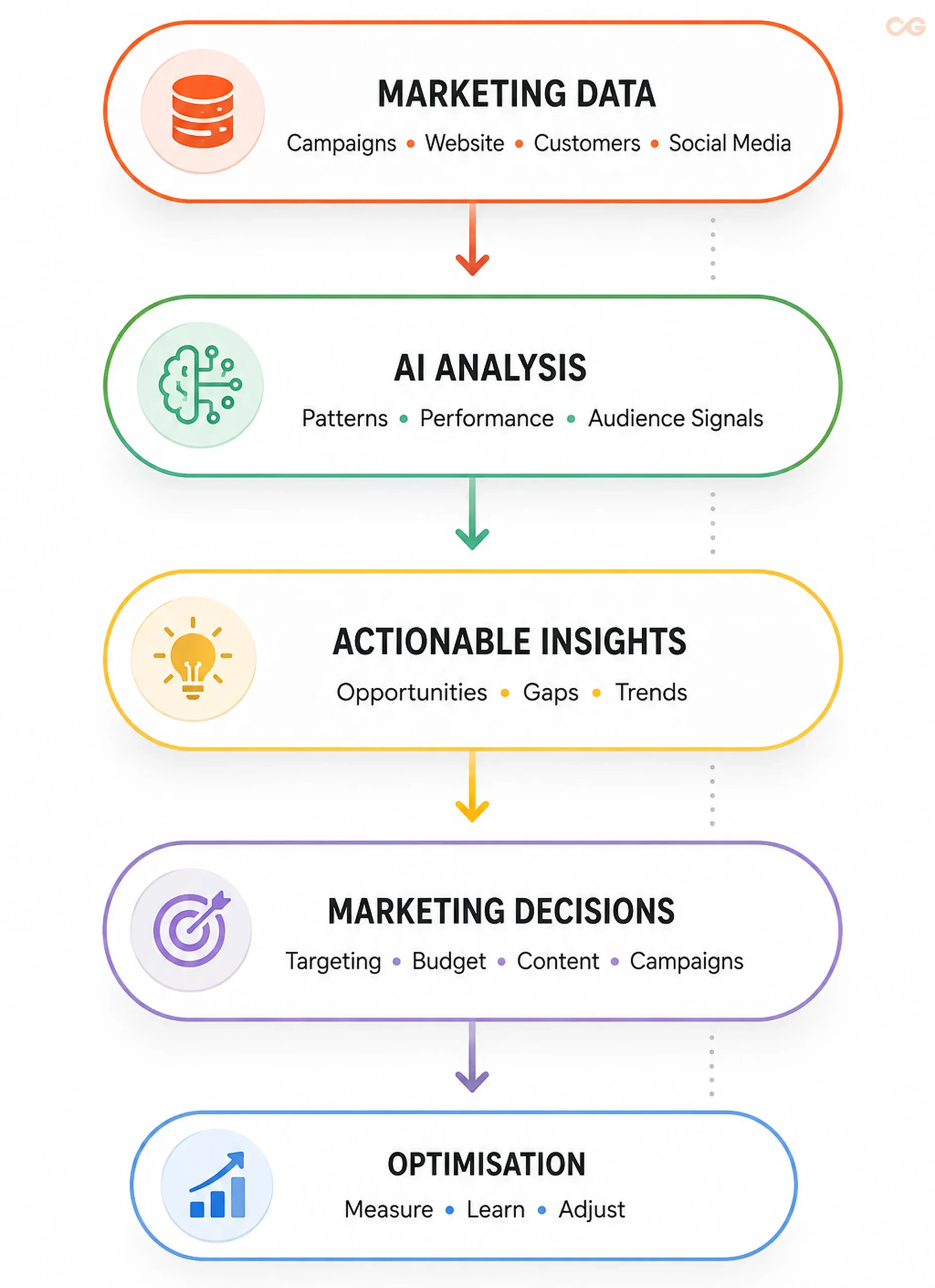
Turning Marketing Data into Actionable Insights
Modern marketing generates data across websites, advertising campaigns, social media, customer interactions, and sales channels. AI-powered marketing analytics helps marketers make sense of this information by identifying patterns, highlighting performance changes, and turning complex data into actionable insights.
Instead of manually reviewing large volumes of reports, marketers can use AI to:
- Identify performance patterns: Detect changes in engagement, conversions, traffic, and campaign performance.
- Automate reporting: Generate reports and highlight important metrics or unusual changes that require attention.
- Improve campaign optimisation: Use real-time insights to adjust targeting, messaging, budgets, and campaign elements.
- Uncover opportunities: Identify audience segments, content gaps, and areas of underperformance that may otherwise be difficult to spot.
AI-powered dashboards can also turn complex marketing metrics into clear visualisations, helping teams understand what is working and where improvements are needed. This allows marketers to move beyond simply collecting data and use it to make faster, more informed decisions.
AI for Competitor Analysis and Trend Identification
AI can extend marketing analysis beyond a company’s own performance. By analysing competitor activity, search behaviour, social conversations, and customer sentiment, AI can help marketers identify changes in the market and spot emerging opportunities.
AI can support competitor and trend analysis by:
- Monitoring competitors: Track changes in competitor content, messaging, offers, and market positioning.
- Identifying emerging trends: Analyse search patterns and online conversations to identify growing interests and changing customer needs.
- Understanding audience sentiment: Analyse customer feedback and social discussions to understand how audiences respond to brands, products, and industry developments.
- Finding market opportunities: Identify content gaps, underserved audiences, and changing preferences that can inform future campaigns.
By combining internal performance data with broader market signals, marketers can develop a clearer picture of what is happening, why it is happening, and where new opportunities may exist. This makes AI-powered analytics useful not only for measuring marketing performance but also for guiding future strategy.
Ethical Considerations and Challenges
As AI becomes more involved in targeting, personalisation, content creation, and decision-making, marketers also need to consider how these systems are used. AI-driven marketing can improve efficiency and customer experiences, but it also raises questions around bias, privacy, transparency, and the role of human judgement.
Navigating AI Bias in Modern Marketing
AI systems learn from the data they are given. If that data contains existing biases or does not adequately represent certain groups, those patterns can influence AI-driven marketing decisions. This can affect areas such as audience targeting, personalised offers, content recommendations, and advertising delivery.
For example, an AI system could unintentionally favour certain audience groups while excluding others because of patterns in historical data. This makes fairness and transparency important considerations when using AI in marketing.
To reduce these risks, businesses should:
- Audit AI systems regularly to identify potentially biased outcomes.
- Use representative and relevant datasets that reflect the audiences being served.
- Monitor marketing outcomes across different audience groups rather than assuming the system is fair.
- Maintain human oversight for important decisions where automated recommendations could have significant consequences.
Responsible AI is therefore not only about improving model performance. It is also about ensuring that marketing decisions remain fair, transparent, and accountable.
Protecting Customer Data and Building Trust
Personalisation often depends on customer data, making privacy and data security essential parts of AI-driven marketing. Customers want relevant experiences, but they also expect businesses to be transparent about how their information is collected, used, and stored.
Data protection regulations such as the GDPR and CCPA, along with other regional privacy laws, require businesses to handle personal information responsibly and respect consumer rights.
Marketers can strengthen customer trust by:
- Being transparent about data collection and usage
- Obtaining appropriate consent where required
- Limiting data collection to legitimate business purposes
- Protecting customer information through appropriate security measures
- Reviewing AI systems and data practices regularly to maintain compliance
The challenge is finding the right balance between personalisation and privacy. Customers may appreciate relevant recommendations and experiences, but they are less likely to trust brands that use their data without sufficient transparency or control.
Keeping Human Creativity at the Centre of AI Marketing
AI can help marketers generate content, analyse data, create advertising variations, and automate repetitive tasks. However, efficiency does not replace human creativity, judgement, and emotional understanding.
AI can identify patterns and generate ideas, but marketers still need to decide whether a message feels authentic, fits the brand, and connects with the audience. Human insight is particularly important when developing brand stories, understanding cultural context, handling sensitive topics, and making creative decisions that go beyond existing data patterns.
The most effective approach is therefore not AI versus human creativity, but AI working alongside human expertise. AI can handle data-heavy and repetitive tasks, while marketers provide the strategy, creativity, empathy, and judgement needed to turn those capabilities into meaningful customer experiences.
Future Trends in AI Marketing
AI is moving from a tool that supports individual marketing tasks to a technology that can influence how marketing decisions, customer journeys, and campaigns are managed as a whole. As AI capabilities continue to advance, marketers can expect more autonomous workflows, real-time personalisation, connected customer experiences, and smarter decision-making.
Some of the key developments shaping the future of AI-driven marketing include:
- Agentic AI for marketing workflows: AI agents are expected to take on more complex, multi-step tasks, from analysing campaign performance and coordinating customer journeys to generating content and recommending actions. Gartner predicts that 60% of brands will use agentic AI for streamlined one-to-one interactions by 2028.
- Real-time personalisation: AI will increasingly adapt content, recommendations, offers, and customer experiences based on real-time behaviour and context rather than relying only on historical customer data.
- Connected cross-channel marketing: AI will help marketers connect data and interactions across websites, email, social media, advertising, CRM platforms, and other touchpoints, creating more consistent customer journeys.
- Continuous campaign optimisation: Instead of relying on periodic campaign reviews, AI can continuously analyse performance signals and help marketers adjust targeting, messaging, creative assets, and budgets as conditions change.
- AI-led strategic decision-making: AI is gradually moving beyond productivity and automation towards supporting higher-level marketing decisions. Gartner notes that marketing AI needs to move “upstream into decision support,” helping teams make decisions based on business value, performance signals, and changing market conditions.
- More authentic AI-assisted marketing: As AI-generated content becomes increasingly common, brands will place greater emphasis on authenticity, original perspectives, and genuine human creativity. Gartner identifies authenticity-driven content ecosystems as an important part of the future marketing landscape.
- AI-powered immersive experiences: AI can also support emerging experiences across virtual, augmented, and mixed-reality environments by enabling personalised virtual interactions, intelligent assistants, and interactive product experiences. This remains a developing opportunity rather than a core mainstream marketing trend today.
Together, these developments point to a significant shift in AI-driven marketing. The future is not simply about automating more tasks; it is about creating marketing systems that can learn from customer and market signals, make better decisions, and adapt experiences in real time. Human creativity, strategy, and judgement will remain essential in guiding these systems and ensuring that technology continues to serve meaningful customer and business goals.
Takeaway
Build a smarter marketing stack without overspending. Download the complete toolkit for practical free and freemium tools across essential marketing functions.
Conclusion
AI is no longer simply a tool for automating marketing tasks. It is becoming a strategic capability that helps businesses understand customers, personalise experiences, create content, optimise campaigns, and make faster, data-informed decisions.
As AI adoption continues to grow, successful AI marketing strategies will depend on more than investing in new tools. Businesses will need to combine AI marketing automation, AI-powered analytics, generative AI, and human creativity to build marketing operations that are both efficient and customer-focused.
The competitive advantage will come from using AI thoughtfully—not simply using more of it. Organisations that invest in the right technologies, develop their teams’ ability to work alongside AI, and maintain appropriate human oversight can respond more effectively to changing customer expectations and market conditions.
Ultimately, the future of AI in digital marketing is about creating a better balance between technology and human expertise. Businesses that make AI part of their marketing strategy while keeping creativity, judgement, and customer trust at the centre will be better positioned to grow in the evolving digital landscape.