
AI in PPC Advertising: How to Maximise ROI with Smart Bidding
Table of Contents
- Introduction
- Understanding Smart Bidding in PPC
- The Role of AI in Smart Bidding
- Benefits of Smart Bidding for PPC Campaigns
- Setting Up Smart Bidding for Maximum ROI
- Common Mistakes to Avoid in Smart Bidding
- Case Studies: How Travel Brands Use Smart Bidding to Maximise ROI
- Predictions for the Future of Automated Bidding
- Conclusion
Introduction
Artificial intelligence (AI) is reshaping digital advertising by helping marketers analyse data, understand user behaviour, and optimise campaigns faster and more accurately. From audience targeting to real-time campaign optimisation, AI helps advertisers make better-informed decisions and respond quickly as user behaviour changes. In India, this shift is already evident, with 59% of IT professionals reporting active AI deployment in their organisations, according to IndiaAI.
One of the most practical applications of AI in PPC campaigns is Smart Bidding. Unlike manual bidding, where advertisers need to monitor and adjust bids regularly, Smart Bidding uses AI and machine learning to assess signals such as user intent, device, location, and time of day before adjusting bids at the auction level. This helps advertisers direct their budget towards opportunities that are more likely to convert while reducing the time spent on manual bid management.
However, automation alone does not guarantee better results. Smart Bidding works best when it is supported by accurate conversion tracking, the right bidding strategy, realistic targets, and consistent human oversight. This guide explains how AI-powered Smart Bidding works, the benefits it can bring to PPC campaigns, how to implement it to improve ROI, common mistakes to avoid, and real-world examples of brands using it to improve advertising performance.
Understanding Smart Bidding in PPC
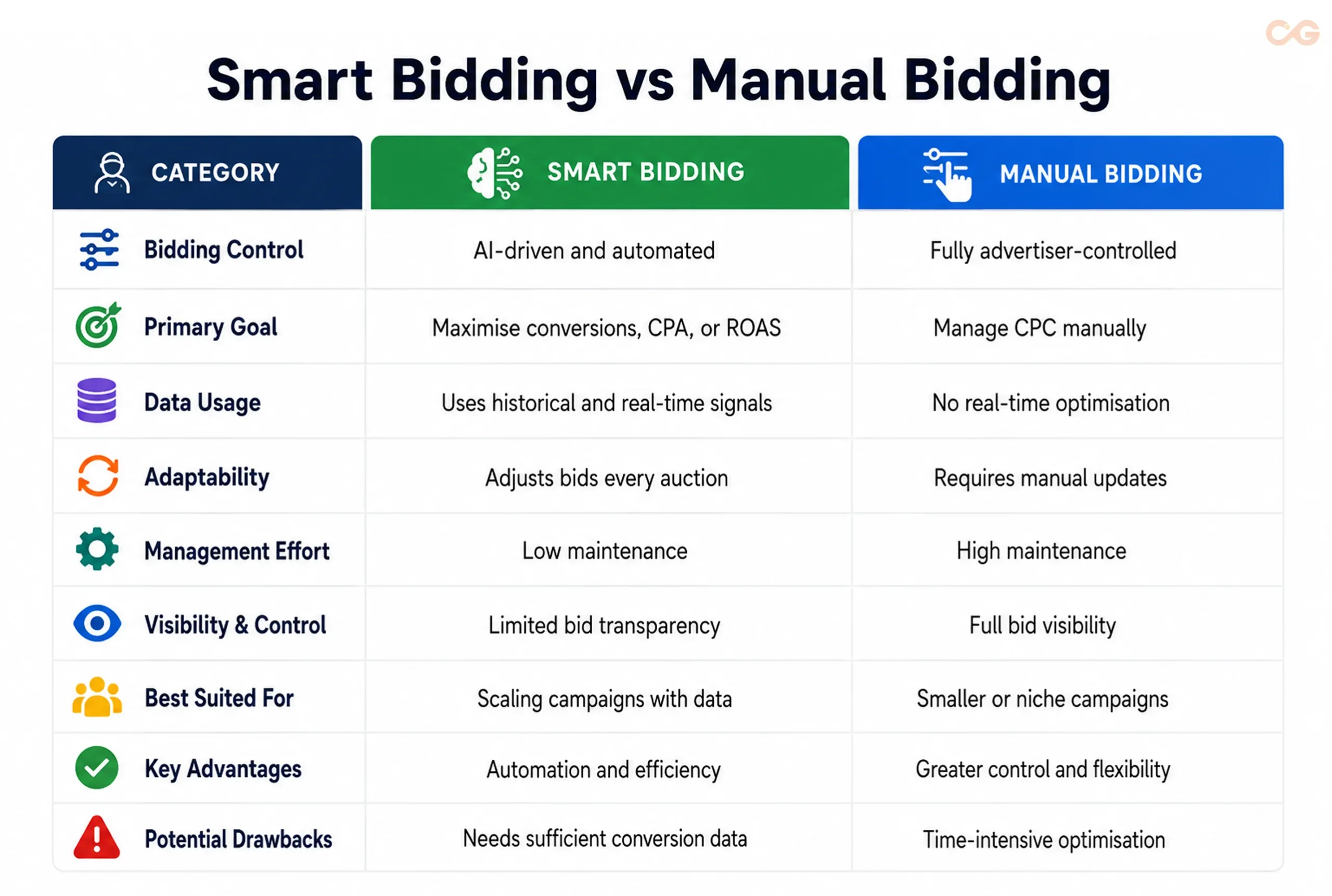
Smart Bidding uses AI and machine learning to automate bid decisions based on signals that indicate the likelihood and value of a conversion. To understand its role in PPC, it is useful to first compare it with manual bidding.
How Smart Bidding Differs from Manual Bidding
Smart Bidding and manual bidding differ mainly in how bid decisions are made. With manual bidding, advertisers set bids for keywords or ad groups based on campaign data, research, and their own judgement. This provides greater control over individual bids, but it also requires regular monitoring and adjustments, which can become time-consuming as PPC campaigns grow.
Smart Bidding, on the other hand, uses AI and machine learning to evaluate multiple signals and adjust bids for individual auctions. These signals can include factors such as user intent, device, location, and time of day. By making these adjustments automatically, Smart Bidding reduces the need for constant manual intervention and allows advertisers to focus more on campaign strategy and performance.
The key difference, therefore, is control versus automated optimisation. Manual bidding gives advertisers greater control over individual bid decisions, while Smart Bidding uses real-time signals and machine learning to make those decisions at scale. For advertisers looking to scale PPC campaigns efficiently, Smart Bidding can help manage bidding more effectively while supporting goals such as increasing conversions or improving ROI.
Google Ads Bidding Strategies: Where Smart Bidding Fits
Google Ads offers several bidding strategies, but they are designed for different campaign goals. Understanding how they differ helps advertisers choose an approach that matches their objectives.
Smart Bidding Strategies
Target CPA: Designed to generate conversions at a target cost per acquisition. The system adjusts bids based on the likelihood of a conversion while working towards the advertiser’s target CPA.
Target ROAS: Designed for campaigns focused on conversion value. It adjusts bids to help achieve a specified return on ad spend, making it particularly useful when conversions have different monetary values.
Maximise Conversions: Automatically adjusts bids to generate as many conversions as possible within the available budget. It is suitable for advertisers whose primary goal is increasing conversion volume.
Maximise Conversion Value: Focuses on generating the greatest total conversion value within the budget rather than simply maximising the number of conversions. This can be useful for businesses where some conversions are worth more than others.
Other Automated Bidding Options
Maximise Clicks: Automatically sets bids to generate as many clicks as possible within the budget. It is more suitable for campaigns focused on increasing website traffic rather than directly optimising for conversions.
Enhanced CPC: Adjusts manual bids based on the likelihood of a conversion, providing some automation while retaining elements of advertiser control.
Choosing the right bidding strategy ultimately depends on the campaign’s primary objective. Conversion-focused campaigns may benefit from Smart Bidding strategies such as Target CPA or Maximise Conversions, while campaigns prioritising traffic may be better suited to Maximise Clicks.
Takeaway

Not sure which Smart Bidding strategy fits your campaign? Download our Smart Bidding Strategy Worksheet to assess your campaign, choose the right approach, and track its performance.
The Role of AI in Smart Bidding
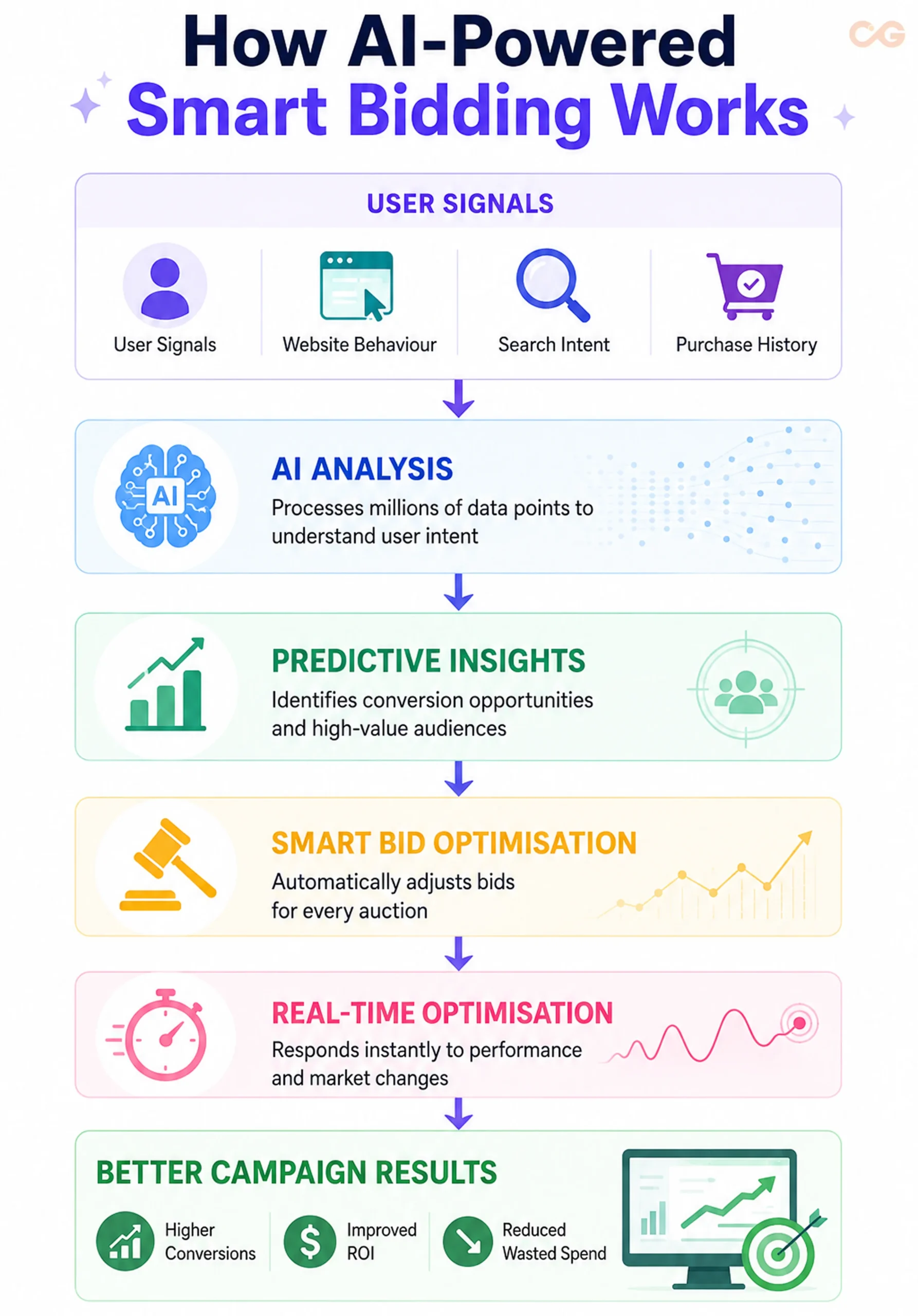
AI is central to how Smart Bidding evaluates auction-level signals and makes bidding decisions. By combining machine learning with real-time data, it helps advertisers respond to changing conditions and optimise bids at scale.
1. Data and User Behaviour Analysis with AI
AI in digital advertising can process a wide range of contextual and behavioural data, including website interactions, purchase history, device, location, and time of day. By identifying patterns across these inputs, machine learning models can estimate user intent and the likelihood of a conversion.
For example, ContextSDK reports that AI can analyse more than 200 mobile signals to identify the optimal times for engaging users, illustrating the breadth of data that AI systems can process.
For PPC campaigns, this gives Smart Bidding a broader view of each auction rather than relying only on predefined keyword or audience settings. These insights help the system distinguish between opportunities that are more or less likely to deliver the desired outcome.
2. Real-Time Adjustments and Automated Decision-Making
Once the likelihood of a conversion or its potential value has been estimated, Smart Bidding can act on that information during individual ad auctions. Instead of applying the same bid broadly, it determines an appropriate bid for each opportunity based on the available signals and campaign objective.
For example, Smart Bidding can:
- Prioritise high-potential auctions based on predicted conversion likelihood or value.
- Respond to changing conditions as auction dynamics and user behaviour shift.
- Align bidding decisions with campaign goals, such as increasing conversions or achieving a target return on ad spend.
This automation allows PPC campaigns to respond to changing opportunities without requiring advertisers to manually adjust every bid. Advertisers can therefore spend more time evaluating overall campaign performance and strategy rather than managing individual bids.
3. AI-Powered Bid Optimisation and Performance Forecasting
Beyond making individual auction decisions, AI helps with bid optimisation by using machine learning and predictive analytics to identify patterns that can indicate future performance. These models can estimate which combinations of users, search contexts, and auction conditions are more likely to generate valuable outcomes.
This predictive capability can help advertisers allocate their budget more efficiently and reduce spending on opportunities that are less likely to contribute to campaign goals. Google reports that campaigns using Smart Bidding Exploration saw an average 19% increase in conversions and an 18% increase in unique search-query categories generating conversions. These results illustrate how AI-powered bidding can help uncover additional conversion opportunities while optimising towards campaign objectives.
Predictive models can also help identify changing patterns in consumer behaviour and demand. By combining these forecasts with real-time auction data, advertisers can make more informed decisions about where their PPC budget is most likely to deliver value.
Benefits of Smart Bidding for PPC Campaigns
Smart Bidding can make PPC campaigns more efficient by automating bid decisions and helping advertisers work towards specific conversion or revenue goals. Its benefits extend beyond bid management, giving marketers more time to focus on campaign strategy, performance, and growth.
1. Real-Time Auction-Level Optimisation
Smart Bidding uses AI and Machine Learning to evaluate auction-level signals and determine an appropriate bid for each opportunity. Instead of relying on fixed bids, it can respond to changes in factors such as device, location, time of day, and user behaviour.
This allows advertisers to direct their budget towards opportunities that are more likely to support their campaign objectives while reducing spend on less valuable opportunities.
2. More Conversions and Better ROI
Smart Bidding can help advertisers optimise campaigns towards specific outcomes, such as increasing conversions, achieving a target cost per acquisition, or reaching a target return on ad spend.
By prioritising opportunities based on predicted conversion likelihood or value, it can help businesses use their advertising budget more efficiently and improve the potential return from their PPC campaigns.
3. Saves Time and Simplifies Campaign Management
Smart Bidding automates many of the repetitive tasks involved in bid management. Instead of manually reviewing and adjusting individual bids, advertisers can allow the system to make auction-level decisions based on campaign goals and available data.
This reduces the time spent on routine bid adjustments and allows marketers to focus more on strategy, creative optimisation, audience insights, and overall campaign performance.
4. Adapts to Changing Conditions
User behaviour, competition, and auction conditions can change throughout a campaign. Smart Bidding can respond to these changes by adjusting bids according to the signals available at each auction.
It also supports different bidding goals, including Target CPA, Target ROAS, Maximise Conversions, and Maximise Conversion Value, allowing advertisers to select an approach that matches their campaign objectives.
5. Enables Data-Driven Decision-Making
Smart Bidding uses large volumes of contextual and performance data to inform bidding decisions. Instead of relying solely on manual assumptions or historical bid adjustments, advertisers can use machine-learning-based optimisation to respond to patterns across individual auctions.
This data-driven approach can reduce guesswork and help advertisers make more informed decisions about how their PPC budget is allocated.
6. Improves Performance Visibility
Smart Bidding provides advertisers with performance data that can be used to evaluate whether their bidding strategy is supporting campaign objectives. By reviewing metrics such as conversions, conversion value, CPA, and ROAS, marketers can identify areas that require attention and make informed adjustments to their overall strategy.
This gives advertisers greater visibility into campaign performance while allowing them to maintain human oversight over automated bidding.
Setting Up Smart Bidding for Maximum ROI
Getting the most from Smart Bidding requires more than selecting an automated bidding strategy. Advertisers need to provide reliable conversion data, choose a strategy that matches their goals, allow sufficient time for the system to learn, and monitor performance regularly. The following steps can help you build a stronger foundation for AI-powered bidding.
1. Choose the Right Bidding Strategy
Start by selecting a strategy that aligns with your primary campaign objective:
For example, Smart Bidding can:
- Target CPA: Suitable when the goal is to generate conversions around a specific cost per acquisition.
- Target ROAS: Useful when the focus is on achieving a specific return from advertising spend, particularly when conversions have different values.
- Maximise Conversions: Designed to generate as many conversions as possible within the available budget.
- Maximise Conversion Value: Focuses on generating the greatest total conversion value within the available budget.
The right strategy depends on whether your priority is conversion volume, acquisition cost, or conversion value.
Avoid unnecessary campaign segmentation: Smart Bidding evaluates each auction individually, so excessive segmentation can limit the amount of data available to the system. Where appropriate, broader keyword coverage can give the algorithm more opportunities to learn and optimise.
2. Set Up Accurate Conversion Tracking
Smart Bidding relies heavily on the conversion data it receives, so tracking should reflect actions that genuinely matter to the business. Depending on the campaign, this could include purchases, qualified leads, sign-ups, or other valuable customer actions.
Assign meaningful conversion values where appropriate so the system can distinguish between higher- and lower-value outcomes.
The quality of your inputs affects the quality of your optimisation. Inaccurate, duplicated, or irrelevant conversion data can lead Smart Bidding towards the wrong outcomes.
3. Give Smart Bidding Enough Data and Time to Learn
Smart Bidding uses historical and current performance data to identify patterns and make predictions. Before evaluating a strategy, give the system enough time and conversion data to learn from campaign activity.
Avoid making frequent changes to bids, targets, budgets, or campaign structure during this period. Constant adjustments can make it harder to determine whether the strategy is actually improving performance.
Instead, allow the campaign to gather sufficient data before making significant changes.
Takeaway
Not sure which Smart Bidding strategy fits your campaign? Download our Smart Bidding Strategy Worksheet to assess your campaign, choose the right approach, and track its performance.
4. Test and Compare Bidding Strategies
When you have enough data to evaluate performance, use Google Ads Experiments where appropriate to compare different bidding approaches in a controlled environment.
For example, you could test two strategies against the same campaign objective and compare metrics such as:
- Conversion volume: The total number of conversions generated by your campaign.
- Conversion rate: The percentage of users who complete a desired action.
- Cost per acquisition (CPA): The average amount spent to acquire one conversion.
- Return on ad spend (ROAS): Revenue generated for every unit of advertising spend.
- Conversion value: The total monetary value generated from completed conversions.
Use the results to determine which strategy better supports your business objective, rather than choosing a strategy based solely on short-term performance.
5. Monitor Performance and Refine the Strategy
Automation does not mean leaving campaigns unattended. Regularly review performance to identify issues such as inaccurate conversion tracking, inefficient spending, unexpected changes in conversion volume, or targets that no longer reflect business priorities.
Make adjustments based on meaningful performance trends rather than reacting to short-term fluctuations. This allows advertisers to maintain human oversight while giving Smart Bidding enough stability to optimise effectively.
Additional Best Practices
- Set realistic targets: Aggressive CPA or ROAS targets can restrict campaign opportunities and limit performance.
- Maintain sufficient budget: A strategy needs enough budget to participate in relevant auctions and generate meaningful data.
- Avoid frequent changes: Give Smart Bidding time to learn before making major adjustments.
- Review conversion quality: More conversions do not necessarily mean better business results; focus on whether those conversions have genuine value.
- Monitor performance regularly: Use campaign data to identify problems and determine when strategic changes are necessary.
Following these steps can help advertisers create the right conditions for AI-powered Smart Bidding to work effectively. Accurate conversion data, an appropriate bidding strategy, realistic targets, and ongoing oversight can help PPC campaigns use their budgets more efficiently and work towards stronger ROI.
Common Mistakes to Avoid in Smart Bidding
Smart Bidding can automate bid management, but it still requires the right inputs, realistic goals, and human oversight. Avoiding the following mistakes can help advertisers get more consistent results from their PPC campaigns.
1. Treating Smart Bidding as Fully Autonomous
Smart Bidding automates auction-level bid decisions, but it does not replace strategic decision-making. Advertisers still need to define campaign goals, set appropriate targets, review performance, and make adjustments when business priorities change.
Automation should therefore support campaign management rather than operate without human oversight.
2. Ignoring Market Trends and Seasonality
Changes in competition, consumer demand, and seasonal behaviour can affect campaign performance. Relying solely on historical performance without considering these factors can lead to unrealistic expectations or inefficient budget allocation.
Monitor significant changes in the market and adjust budgets, targets, or campaign settings when necessary.
3. Feeding Smart Bidding Inaccurate Conversion Data
Smart Bidding relies on conversion data to make optimisation decisions. Incorrect tracking, missing conversions, duplicate actions, or irrelevant conversion events can therefore lead the system in the wrong direction.
Review your Google Ads conversion tracking regularly to ensure that the actions being measured genuinely reflect business outcomes.
4. Overlooking Tracking and Platform Integrations
Conversion tracking should work consistently across Google Ads, Google Analytics, and CRM integrations where applicable. Gaps between these systems can affect the quality and completeness of the data used for campaign optimisation.
Check that conversion events, values, attribution settings, and integrations are configured correctly before relying heavily on automated bidding.
5. Setting Overly Aggressive Target CPA or Target ROAS
Unrealistic targets can restrict campaign performance. A Target CPA that is set too low may limit the system’s ability to find sufficient conversion opportunities, while an excessively high Target ROAS can make it difficult for the system to identify enough opportunities that meet the required return.
Set targets based on actual campaign performance and adjust them gradually rather than expecting the system to achieve unrealistic goals immediately.
6. Making Changes Without Sufficient Data
Smart Bidding provides advertisers with performance data that can be used to evaluate whether their bidding strategy is supporting campaign objectives. By reviewing metrics such as conversions, conversion value, CPA, and ROAS, marketers can identify areas that require attention and make informed adjustments to their overall strategy.
This gives advertisers greater visibility into campaign performance while allowing them to maintain human oversight over automated bidding.
Case Studies: How Travel Brands Use Smart Bidding to Maximise ROI
Real-world examples show how different Smart Bidding strategies can support different PPC objectives. The following travel brands demonstrate how value- and conversion-focused bidding can improve campaign efficiency and business outcomes.
1. Goibibo: Increasing Hotel Bookings with Target CPA
Objective:
Goibibo, an Indian online travel booking platform, wanted to increase hotel bookings while improving acquisition efficiency across its non-brand campaigns.
Challenges:
The company needed a bidding approach that could respond to changing search behaviour and auction conditions while supporting its goal of increasing bookings without unnecessarily increasing acquisition costs.
Strategy:
Goibibo used Google Ads Target CPA (tCPA) Smart Bidding to automate bid optimisation for its hotel campaigns. The strategy used machine learning to adjust bids based on signals associated with conversion likelihood, helping the campaign identify opportunities to generate hotel bookings more efficiently.
Takeaway:
The campaign delivered 25% more hotel transactions and a 22% reduction in cost per conversion with Target CPA, according to Moloco.
Key takeaway:
Goibibo’s example shows how Target CPA Smart Bidding can help travel advertisers increase conversion volume while maintaining greater control over acquisition efficiency.
2. Traveloka: Increasing Booking Value with Target ROAS
Objective:
Traveloka, a major travel platform, wanted to improve the value generated from its search campaigns rather than focusing only on increasing booking volume.
Challenges:
The company was already using automated bidding but wanted to determine whether a value-based approach could generate stronger returns while controlling acquisition costs.
Strategy:
Traveloka conducted a four-week experiment in Indonesia comparing its existing Target CPA strategy with Target ROAS. The test combined Target ROAS with Dynamic Search Ads and first-party, non-customer profile data to optimise towards conversion value rather than simply booking volume.
Takeaway:
The Target ROAS strategy delivered an 11% increase in ROAS, a 14% increase in average booking value, and a 5% reduction in cost per booking, according to Think with Google.
Key takeaway:
Traveloka’s results demonstrate how Target ROAS Smart Bidding can help advertisers optimise towards higher-value conversions and improve the efficiency of advertising spend.
Predictions for the Future of Automated Bidding
The next generation of Smart Bidding is likely to become more predictive, context-aware, and closely connected with broader campaign optimisation. Rather than simply reacting to individual auction signals, future systems may use a wider range of information to anticipate changes in user behaviour, demand, and campaign performance.
Potential developments include:
- Greater emphasis on predictive optimisation: Bidding systems may become better at anticipating conversion likelihood and value before market conditions change.
- Deeper use of first-party data: Advertisers may increasingly combine their own customer and conversion data with platform signals to improve bidding accuracy while supporting privacy-conscious advertising.
- Broader contextual understanding: Future systems may consider a wider combination of user intent, content context, market conditions, and behavioural signals when determining bids.
- Closer integration with campaign elements: Automated bidding may become more closely connected with audience targeting, ad creative, and budget allocation rather than operating primarily as a standalone bidding function.
- More autonomous optimisation: AI may handle a greater share of routine campaign adjustments while advertisers focus on business objectives, strategy, and oversight.
As automated bidding becomes more sophisticated, the advertiser’s role is likely to shift further from managing individual bids to defining goals, evaluating performance, and guiding AI-driven optimisation.
Takeaway
Not sure which Smart Bidding strategy fits your campaign? Download our Smart Bidding Strategy Worksheet to assess your campaign, choose the right approach, and track its performance.
Conclusion
Smart Bidding has changed how advertisers manage PPC campaigns by using AI to automate auction-level bid decisions, respond to real-time signals, and optimise towards specific campaign goals. When supported by accurate conversion tracking, realistic targets, and ongoing human oversight, AI-powered Smart Bidding can help advertisers improve efficiency, make better use of their budgets, and work towards stronger ROI.
As digital advertising continues to evolve, AI-driven bidding is becoming an increasingly important part of PPC management. The goal is not to replace human decision-making, but to combine automation and data-driven optimisation with strategic oversight. By choosing the right bidding strategy, monitoring performance, and refining campaigns based on meaningful data, advertisers can make Smart Bidding a more effective part of their overall PPC strategy.
Ready to improve your PPC performance? Explore how AI-powered Smart Bidding can help you optimise campaigns, reduce manual effort, and make your advertising budget work more efficiently.