
Types of Sales Strategies: Examples, Effective Approaches, and a Winning Sales Strategy
Table of Contents
- Introduction: Why Sales Strategies Define Growth in Modern Markets
- What Is a Sales Strategy?
- Exploring Types of Sales Strategy
- Inbound vs Outbound Sales Strategies
- Consultative vs Transactional Sales Strategies
- Product-Led and Account-Based Sales Strategies
- Channel, Inside, and Field Sales Strategies
- Hybrid Sales Strategy: Combining Approaches for Maximum Impact
- Key Elements of Effective Sales Strategies
- Choosing the Right Sales Strategy
- Conclusion: Strategy Over Activity
1. Introduction: Why Sales Strategies Define Growth in Modern Markets
Sales is no longer about simply pushing products; it is about aligning with evolving customer buying behaviour. Today’s buyers are better informed, more independent, and often complete much of their research before engaging with a salesperson.
HubSpot reports that 96 per cent of prospects conduct independent research before contacting sales teams, while 71 per cent prefer learning about products on their own during the early stages of the buying journey. As a result, traditional one-size-fits-all selling approaches are becoming less effective.
To succeed in this environment, businesses need a sales strategy that aligns with their product, target audience, and customer buying behaviour. The right approach helps organisations attract the right customers, improve engagement, and drive predictable revenue growth.
This blog explores the major types of sales strategies with real-world examples, including inbound, outbound, consultative, transactional, product-led, account-based, channel, inside, field, and hybrid sales strategies. It also examines key sales models and provides practical guidance on selecting the right sales strategy to build predictable, scalable, and long-term business growth.
2. What Is a Sales Strategy?
A sales strategy is a structured approach that defines how a business attracts, engages, and converts customers to achieve its sales objectives. It aligns the target audience, value proposition, sales approach, and resources to create a consistent and scalable path to revenue growth.
An effective sales strategy should answer four fundamental questions:
- Who are we selling to?
- What value are we offering?
- How will we reach and engage our target customers?
- How will we convert opportunities into revenue?
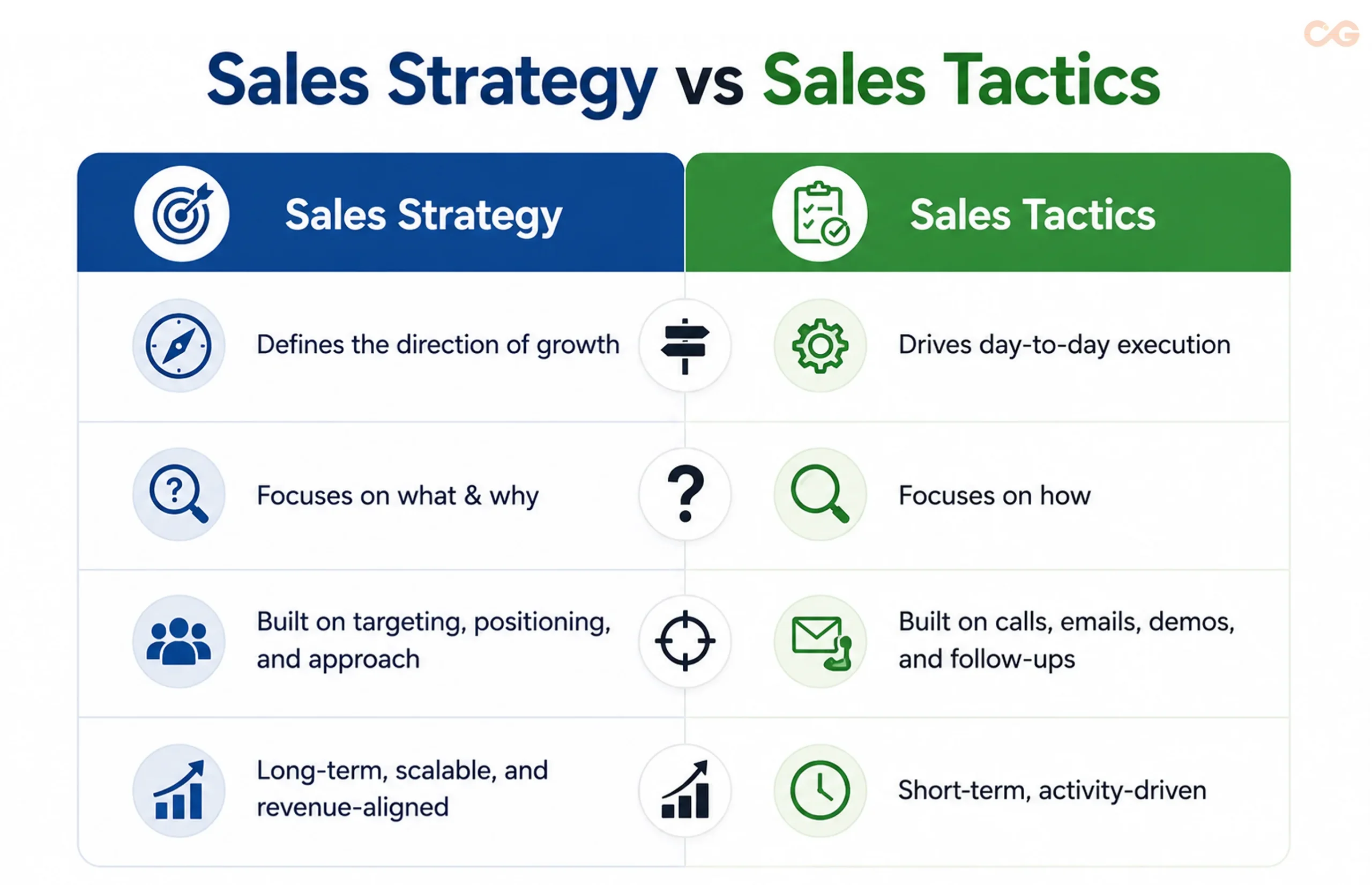
Before exploring the different types of sales strategies, it is important to distinguish between sales strategy and sales tactics.
Sales Strategy
Focuses on the overall direction and long-term approach to achieving sales objectives. It determines who to target, the value to offer, and the most suitable selling approach, providing the foundation for all sales activities.
Sales Tactics
Refers to the specific actions used to execute the strategy, such as prospecting, cold calling, email outreach, product demonstrations, follow-ups, negotiations, and closing deals. These day-to-day activities help move prospects through the sales process and support the overall strategy.
Organisations without a clearly defined sales strategy to increase sales in business often rely on activity-based selling, increasing calls, emails, and outreach without improving results. In contrast, businesses with a structured strategy focus on targeting the right customers, aligning sales efforts with business objectives, and improving conversion rates. This strategic foundation enables predictable revenue growth and prepares organisations to select the most appropriate sales strategy for their market and growth stage.
Takeaway

Have you chosen a sales strategy but aren’t seeing the results you expected? Use this Sales Strategy Implementation Checklist to identify gaps and strengthen your sales execution.
3. Exploring Types of Sales Strategy
Before diving into specific strategies, it’s important to understand that sales strategies can be organised in several ways. These classifications help businesses streamline their sales efforts and choose the right approach based on their goals, products, and market conditions.
- Customer Acquisition Approach: Inbound vs Outbound
This approach focuses on demand generation, choosing between attracting prospects or actively reaching out to them.
- Sales Complexity: Transactional vs. Consultative
This distinction separates high-volume, quick sales from more relationship-oriented, solution-focused selling
- Growth Strategy: Product-Based vs. Account-Based
This decision centres on whether growth relies more on the product experience itself or on proactive sales intervention.
- Execution Model: Inside, Field, or Channel-Based
This defines how sales teams operate — remotely, face-to-face, or through partners and intermediaries.
These categories create distinct levels in the sales process. Combining them provides a comprehensive framework for effective sales strategies across various industries. This approach enables companies to develop organised and scalable sales plans.
4. Inbound vs Outbound Sales Strategies
4.1 Inbound Sales Strategy
An inbound sales strategy focuses on attracting potential customers through valuable content and digital channels rather than direct outreach. Blogs, white papers, webinars, and SEO-driven content help prospects find solutions naturally, making this approach well-suited to today’s research-driven buyers.
Example:
Canva exemplifies an inbound sales strategy by attracting users through its free design platform, templates, tutorials, and educational content. By allowing users to experience the product before purchasing, Canva builds trust and encourages upgrades to its premium plans as their needs grow.
Why inbound works:
- Aligns with modern buyer behaviour.
- Builds trust before sales conversations.
- Generates high-quality leads.
However, inbound strategies require consistent investment in quality content and typically take longer to deliver results.
4.2 Outbound Sales Strategy
An outbound sales strategy involves proactively reaching potential customers through cold emails, phone calls, LinkedIn outreach, and other targeted prospecting methods. Unlike inbound, which attracts existing demand, outbound creates demand by initiating conversations with carefully selected prospects. It is particularly effective for entering new markets and selling high-value or complex solutions.
Example:
Oracle uses an outbound sales strategy by proactively reaching out to businesses through dedicated sales representatives. The sales team identifies potential customers, schedules meetings, and demonstrates enterprise solutions tailored to their business needs, helping Oracle generate new opportunities and expand its customer base.
Why inbound works:
- Enables highly targeted outreach to the right prospects.
- Accelerates pipeline development through proactive engagement.
- Works well for high-value and complex sales opportunities.
To be successful, outbound strategies should be personalised, data-driven, and tailored to customer needs.
5. Consultative vs Transactional Sales Strategies
5.1 Transactional Sales Strategy
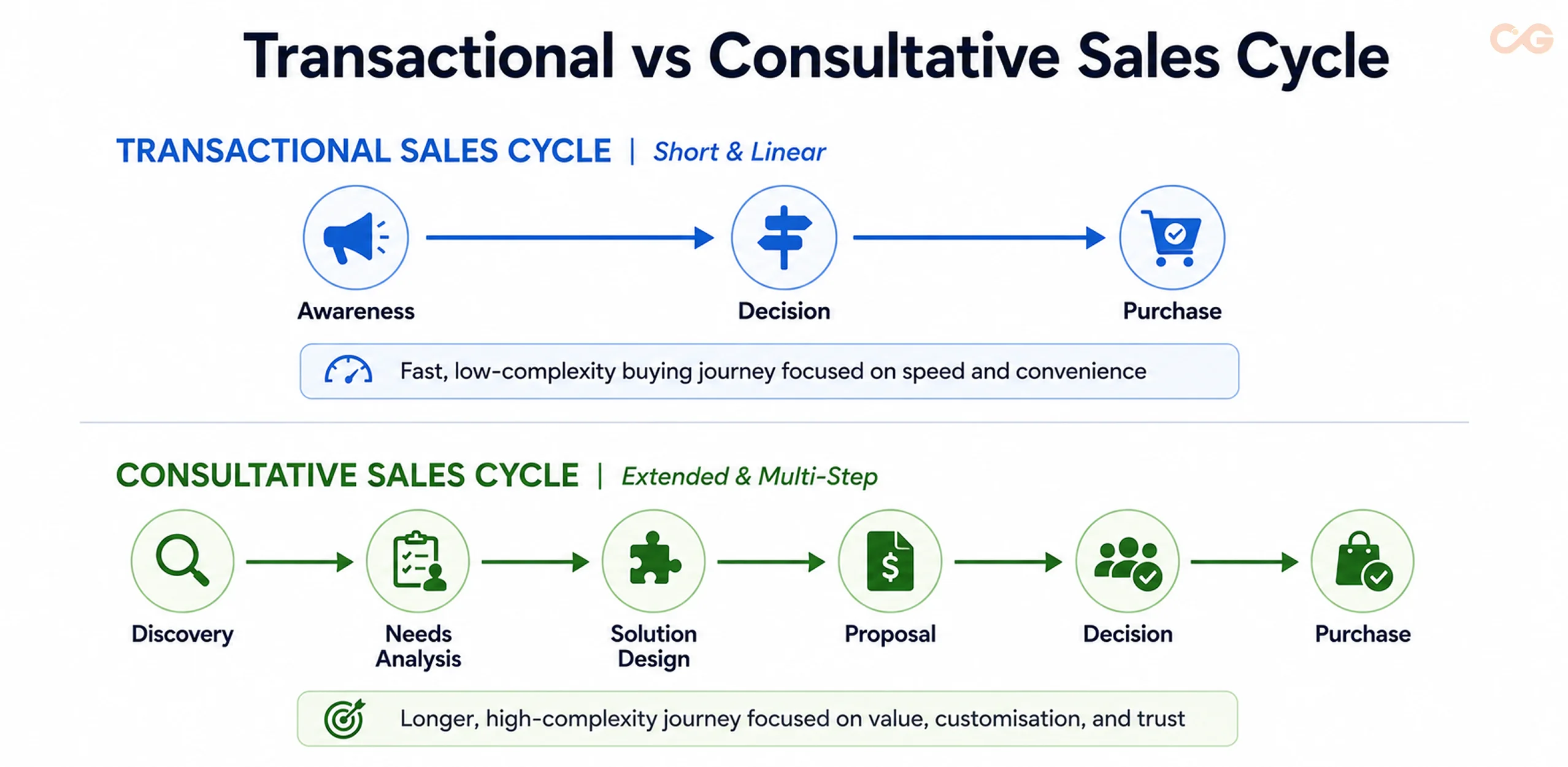
A transactional sales strategy focuses on completing a purchase quickly by minimising the time and effort required to close a sale. It prioritises speed, efficiency, and high sales volume over building long-term customer relationships. This approach is best suited to creating fast conversions with minimal friction in the buying process.
This model is most effective when:
- Products are standardised and require little customisation.
- Prices are competitive and easy to compare.
- Customer decisions are straightforward and involve low complexity.
Example
Amazon is a classic example of a transactional sales strategy. Its streamlined purchasing experience enables customers to browse, compare, and purchase products quickly through a self-service platform designed for speed, convenience, and high-volume sales.
Strengths:
- Highly scalable, allowing businesses to handle large transaction volumes efficiently.
- Short sales cycles, reducing the time between customer interest and purchase.
Limitations:
- Limited opportunity to build deep customer relationships compared with consultative or high-touch sales models.
- Customer loyalty is often driven by convenience, pricing, and ecosystem benefits rather than personal engagement.
- Less suitable for complex or highly customised purchasing decisions, where customers require greater guidance.
5.2 Consultative Sales Strategy
A consultative sales strategy focuses on understanding customer challenges and recommending tailored solutions. It is particularly effective in complex B2B sales, where building trust and addressing specific business needs are essential to the buying process.
Example
IBM is a strong example of consultative selling. When offering enterprise technology and consulting solutions, the company takes time to understand each client’s business challenges and objectives before recommending customised solutions. This customer-centric approach helps IBM build long-term relationships and deliver greater value.
According to BSPK, 82 per cent of salespeople believe that relationship building is the most important aspect of successful selling.
Strengths:
- Increases deal value by delivering tailored solutions that address customer needs.
- Builds stronger customer relationships through trust, collaboration, and long-term engagement.
Limitations:
- Sales cycles are longer because of detailed discovery, discussions, and decision-making.
- Requires highly skilled sales professionals with strong communication, negotiation, and problem-solving abilities.
6. Product-Led and Account-Based Sales Strategies
6.1 Product-Led Growth Strategy
In a product-led growth strategy, the product drives user acquisition, activation, and conversion. This approach is highly effective in SaaS, fintech, and digital environments where user experience directly influences growth.
Example:
Slack is a leading example of a product-led growth strategy. Its freemium model allows teams to adopt and experience the platform without sales intervention. As organisations recognise its value and collaboration benefits, many upgrade to paid plans, driving growth through product adoption rather than traditional sales efforts.
Benefits of a Product-Led Approach:
- Reduces friction in the buying process by minimising reliance on initial sales interactions.
- Encourages organic adoption through self-service onboarding and trial periods.
- Supports scalable growth by emphasising product usage over sales efforts.
This strategy is essential for modern sales, particularly in SaaS companies with wide user bases and streamlined onboarding processes.
6.2 Account-Based Sales Strategy (ABS)
An Account-Based Sales (ABS) strategy focuses on high-value accounts and tailored engagement methods. This approach suits enterprise and B2B sales where deals are sizable and complex.
Example:
Microsoft is a strong example of Account-Based Selling (ABS). For large enterprise clients, the company identifies high-value accounts and develops personalised sales strategies for each organisation. Rather than offering a standard solution, Microsoft works closely with key decision-makers to understand their business goals, industry challenges, and technology requirements before recommending tailored solutions. This personalised approach helps build long-term relationships and improve customer success.
According to Gartner, B2B buying groups typically include 6 to 10 decision-makers. Personalisation greatly enhances conversion rates and deal outcomes.
Advantages of ABS:
- Improves win rates through targeted interactions.
- Aligns solutions more closely with enterprise stakeholders and goals.
Disadvantages of ABS:
- Requires significant resources for deep research and customisation.
- Necessitates close collaboration among sales, marketing, and solution teams.
ABS is especially valuable in high-value enterprise environments and forms a key component of sales strategies for larger organisations.
Takeaway
Have you chosen a sales strategy but aren’t seeing the results you expected? Use this Sales Strategy Implementation Checklist to identify gaps and strengthen your sales execution.
7. Channel, Inside, and Field Sales Strategies
7.1 Channel Sales Strategy
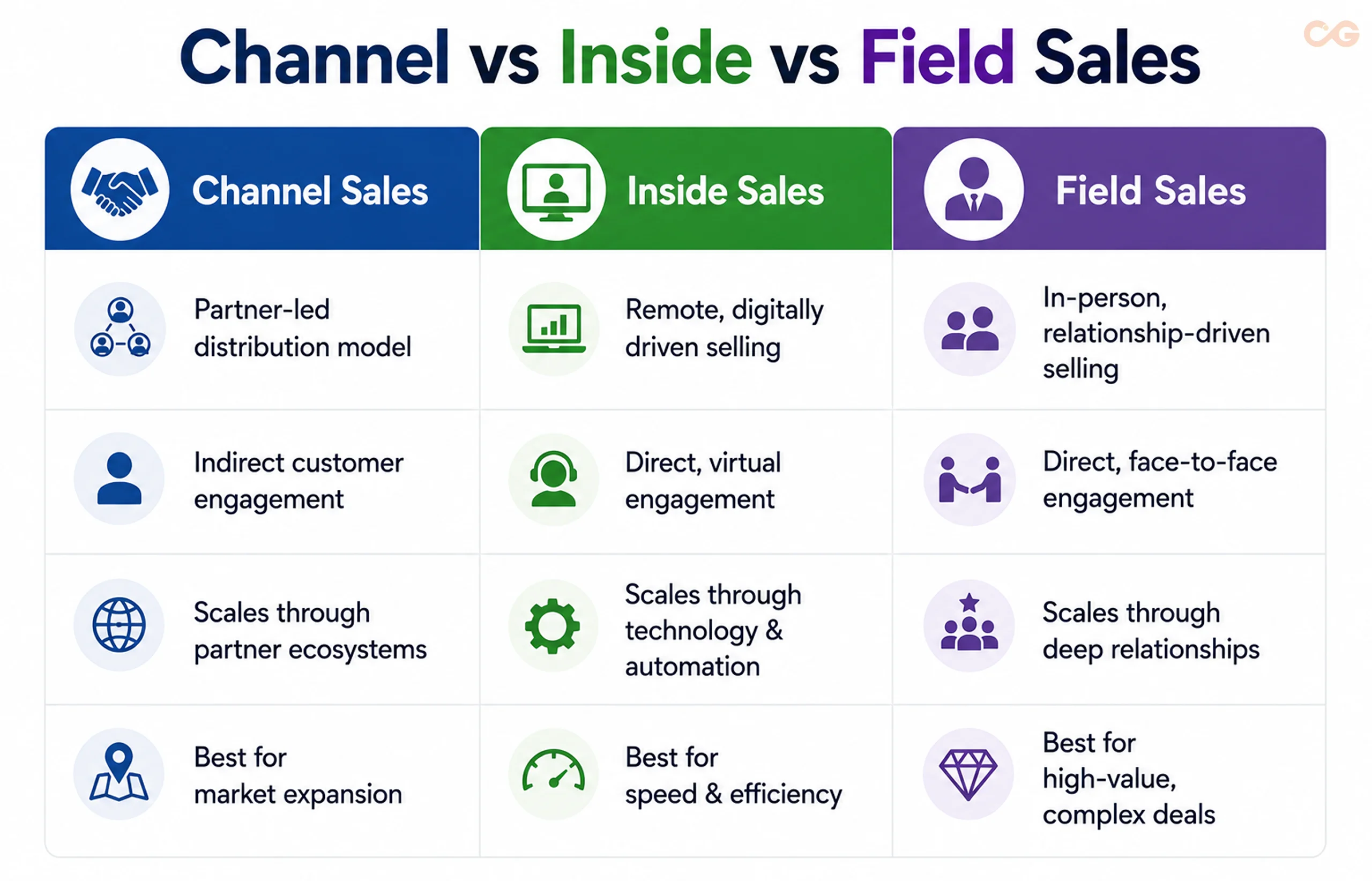
A channel sales strategy involves working with partners, distributors, or resellers to reach customers. It is one of the most scalable sales strategies for expanding into global markets and geographically dispersed regions.
Example:
Apple has built a strong network of partners, distributors, and resellers to extend its market reach beyond direct sales. This approach enables the company to maintain local product availability and after-sales support without relying solely on its in-house sales teams.
Channel sales is widely used in industries where scaling through direct sales alone is inefficient or cost-prohibitive. It enables businesses to expand more quickly by leveraging established partner networks.
7.2 Inside Sales Strategy
An inside sales strategy relies on remote communication channels such as phone calls, emails, CRM-driven outreach, and video conferencing. It plays a key role in modern B2B and SaaS sales environments, where speed, efficiency, and scalability are essential.
Example:
Zoom is a strong example of an inside sales strategy. Its sales teams engage prospective customers through video meetings, phone calls, emails, and online product demonstrations rather than in-person visits. This remote sales approach enables Zoom to efficiently connect with businesses, build customer relationships, and close deals across different regions.
According to Salesforce, sales representatives spend only about two hours each day actively selling, making efficiency and digital tools essential for improving performance. Inside sales is widely adopted because it lowers the cost of customer acquisition, enables faster outreach, and provides valuable pipeline insights through CRM systems.
7.3 Field Sales Strategy
A field sales strategy focuses on face-to-face interactions, on-site customer visits, and relationship-driven selling. Although it is a more traditional approach, it remains highly effective for high-value prospects, enterprise sales, and industries where trust and personal engagement are critical.
Field sales is commonly used in industries such as manufacturing, real estate, healthcare, and enterprise IT, where in-person meetings are often necessary to build trust and negotiate complex agreements.
Field sales is most effective when:
- Deals are high value and relationship building is essential.
- Products or solutions require in-person demonstrations or customisation.
- Long-term contracts depend on stakeholder alignment and detailed negotiations.
Although digital sales channels continue to grow, field sales remains an important part of many hybrid sales strategies and is often combined with inside sales to deliver a more effective customer experience.
8. Hybrid Sales Strategy: Combining Approaches for Maximum Impact
A hybrid sales strategy combines two or more sales approaches to engage different customer segments more effectively. Instead of relying on a single method, businesses use a mix of strategies to match customer needs, improve engagement, and create a more scalable sales process.
No single sales approach works for every customer. Some buyers prefer to explore products on their own, while others need personalised guidance before making a decision. A hybrid approach allows businesses to adapt to these different buying preferences by using the right sales strategy at the right stage of the customer journey.
Case Study: Adobe’s Hybrid Sales Strategy
Adobe is a strong example of how a hybrid sales strategy works in practice. Rather than relying on one sales model, the company combines multiple approaches to serve different customer segments and buying journeys.
- Product-led growth attracts users through free trials and self-service experiences, allowing them to explore the product before making a purchase.
- Inside sales engages interested prospects, nurtures leads, and converts mid-market opportunities through structured remote interactions.
- Account-based sales focuses on high-value enterprise customers by delivering personalised engagement and tailored solutions.
By combining these approaches, Adobe creates a more seamless buying experience while balancing scalability with personalisation.
Why hybrid strategy works:
- Matches different sales approaches to different customer segments.
- Combines the efficiency of digital sales with personalised customer engagement.
- Creates a flexible sales process that supports sustainable business growth.
According to HubSpot, hybrid sales teams are 28 per cent more likely to outperform their peers, highlighting the value of combining complementary sales strategies to improve performance and drive long-term growth.
9. Key Elements of Effective Sales Strategies
Understanding sales strategies is just the first step. What truly counts is how we implement these strategies to achieve results. Whether we aim to boost conversions or drive sales, several crucial factors can enhance effectiveness.
9.1 Focus on Customers
Focus on prioritising customer-centric approaches. Customised communication, targeted outreach, and context-aware interactions significantly improve response rates, especially in outbound sales and account-based selling.
9.2 Leverage Data
Successful teams harness data to improve performance. Analysing high-intent prospects and fine-tuning messaging leads to better outcomes for both inbound and outbound efforts.
9.3 Align Sales and Marketing
Alignment between sales and marketing teams ensures that leads generated through inbound strategies are properly nurtured and converted, creating a seamless buyer experience.
9.4 Embrace Technology and Automation
Modern sales hinge on CRM systems and automation tools. These technologies streamline processes across various models, including inside sales frameworks and channel-driven strategies.
9.5 Commit to Continuous Improvement
We must focus on ongoing improvement to achieve lasting success. Regular performance reviews, effective feedback loops, and investment in consultative selling training help us refine our strategies and maintain a competitive edge.
10. Choosing the Right Sales Strategy
To achieve sustainable and scalable growth, selecting the right sales strategy is crucial. Companies should not rely on a single method. Instead, tailor the sales approach to the product, target audience, sales cycle, and prevailing market conditions. The most effective strategy is the one that aligns best with the business and its customers.
Product Complexity
Simple Offerings: For products that require little customisation, use transactional and product-led sales strategies. Customers can make quick purchases with minimal assistance.
Complex Offerings: For products or services needing personalised guidance, apply consultative and account-based sales strategies. These approaches facilitate detailed discussions and solution-based selling.
Target Audience
Mass audience: Inbound-oriented models (good examples of an inbound sales strategy) are useful to capture and turn high-volume demand effectively.
Premium Customers: Outbound and account-based sales strategies focus on personalised engagement, making them ideal for high-value customers and enterprise accounts.
Sales Cycle
Short cycles: Transactional sales strategies are the best because speed and efficiency lead to conversions.
Long cycles: Relationship-building and consultative selling techniques are necessary to advance deals.
Market Conditions
New or Emerging Markets: Implement outbound sales strategies to raise awareness, create demand, and build relationships with potential customers.
Mature Markets: Use inbound and product-led sales strategies since buyers are already informed about available solutions and are actively researching their options.
Successful organisations leverage multiple sales approaches. They integrate complementary strategies to build a flexible, scalable sales model that meets the diverse needs of customer segments, adapts to varying buying behaviours, and aligns with specific business goals.
Takeaway
Have you chosen a sales strategy but aren’t seeing the results you expected? Use this Sales Strategy Implementation Checklist to identify gaps and strengthen your sales execution.
11. Conclusion: Strategy Over Activity
Choosing the right sales strategy is a key driver of sustainable business growth. By aligning sales efforts with customer buying behaviour, product complexity, and market conditions, businesses can build stronger customer relationships, improve conversions, and achieve more predictable and scalable results.
The most successful organisations recognise that no single sales approach works in every situation. Instead, they combine strategies such as inbound, outbound, consultative, product-led, account-based, channel, inside, and field sales to meet the needs of different customers and business goals. As markets continue to evolve, businesses that regularly evaluate and refine their sales strategy will be better positioned to drive long-term growth and build a lasting competitive advantage.