Proven Sales Frameworks Every Business Should Know
Table of Contents
- Introduction
- What Are Sales Frameworks?
- Core Sales Frameworks
- Sales Frameworks by Industry and Use Case
- How to Select the Appropriate Sales Framework
- Implementation and Execution Strategy
- Common Mistakes to Avoid
- Conclusion
1. Introduction
In today’s highly competitive and fast-paced business environment, companies can no longer rely on intuition and ad-hoc selling to drive revenue growth. Sales teams are expected to deliver predictable performance, repeatable processes, and measurable outcomes, making structured sales processes more important than ever. According to Gartner, 67 per cent of the buyer journey is completed online before a potential customer speaks with a salesperson, highlighting the need for sales teams to engage buyers strategically at the right stage of their journey.
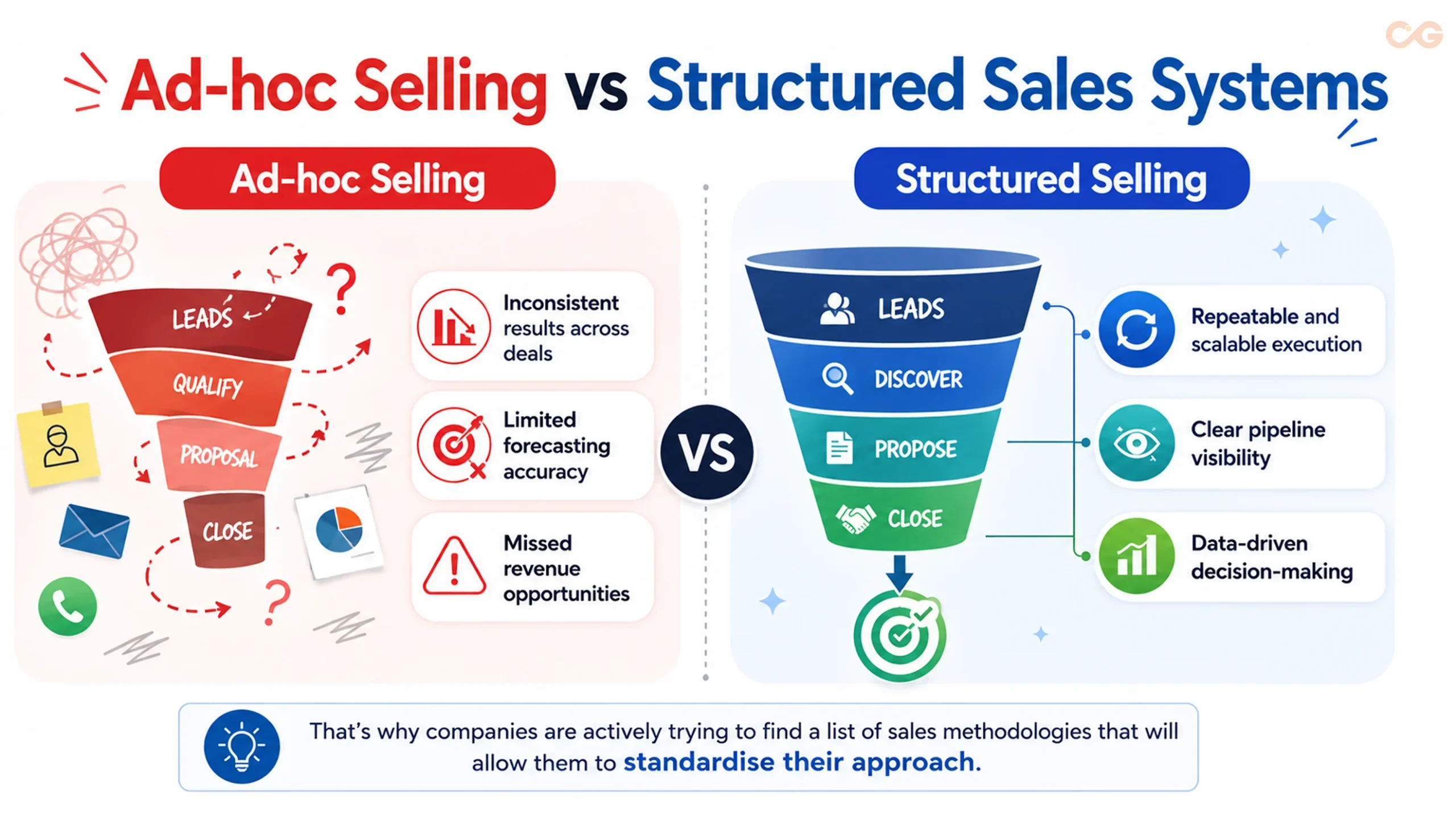
Sales frameworks provide a structured approach to selling, enabling organisations to move from inconsistent results to repeatable success. Whether a startup is building its first sales team or an established enterprise is optimising a global sales operation, implementing the right sales frameworks can significantly improve productivity, consistency, and overall sales performance.
Modern buyers are better informed, sales cycles have become more complex, and market competition continues to intensify. In this environment, sales strategic planning—supported by proven frameworks, practical steps, and real-world examples—helps organisations align teams, standardise sales activities, and make more informed decisions.
Ultimately, proven sales frameworks are not just about closing more deals; they help organisations build a sustainable revenue engine that can scale, adapt, and deliver long-term business growth.
2. What Are Sales Frameworks?
2.1 Definition
Sales frameworks are structured methods that guide sales teams in engaging potential customers, assessing opportunities, and successfully closing sales. They create a consistent approach to managing every stage of the sales process, from the first contact to the final deal. Research from Harvard Business Review shows that companies with a clearly defined sales process see revenue growth that is 18% higher than those without one.
2.2 Purpose and Business Impact
Sales frameworks offer much more than structure; they provide clarity, consistency, and control over the sales process. When implemented correctly, they enable organisations to:
- Boost conversion rates by standardising how teams interact with customers.
- Improve the quality of leads through effective qualification.
- Enhance accuracy in sales forecasts by using structured data.
- Foster scalability across teams, regions, and markets.
By establishing a uniform approach to selling, sales frameworks serve as the backbone of efficient sales operations. They help organisations implement effective sales methodologies consistently across the board.
2.3 Sales Framework vs Sales Process
Sales frameworks and sales processes are distinct yet complementary concepts.
Sales Process: This refers to the specific stages that sales teams follow, including lead generation, qualification, proposal, negotiation, and closing.
Sales Framework: This encompasses the strategies or methodologies utilised within each stage to enhance sales activities and facilitate better decision-making.
For instance, a sales team can implement the BANT framework during the qualification stage to evaluate lead quality. Similarly, they might apply SPIN Selling during the discovery phase to identify customer needs more effectively.
When combined, a clearly outlined sales process and an appropriate sales framework establish a structured, scalable sales system. This approach fosters consistency and promotes sustainable business growth.
Takeaway

Use this Sales Framework Audit Template during your next sales review to identify performance gaps, improve execution, and make more data-driven sales decisions.
3. Core Sales Frameworks
Sales frameworks such as AIDA, BANT, MEDDIC, SPIN Selling, and Solution Selling provide structured approaches to engaging prospects, qualifying opportunities, and guiding them through the sales journey. Organisations that successfully combine these frameworks with effective sales enablement achieve stronger sales outcomes. According to icumulus, 84 per cent of salespeople achieve their quotas when sales enablement is rated as excellent, compared with 58 per cent where enablement is less effective.
The following are some of the most widely used sales frameworks and their key strengths, ideal use cases, and limitations.
3.1 AIDA (Attention, Interest, Desire, Action)
AIDA is a classic sales and marketing framework that guides prospects through the stages of awareness, interest, desire, and ultimately, action. It is particularly effective in marketing-driven environments such as retail and digital campaigns, where customer journeys tend to follow a relatively linear path.
However, the framework may oversimplify complex B2B buying journeys that involve multiple stakeholders and longer decision-making cycles.
3.2 BANT (Budget, Authority, Need, Timeline)
BANT sales methodology is a lead qualification framework that evaluates a prospect’s budget, decision-making authority, business need, and purchase timeline.
It helps sales teams prioritise high-intent prospects while reducing time spent on poorly qualified opportunities. However, its effectiveness may be limited in modern buying environments where budgets and decision-makers are not clearly defined during the early stages of the sales process.
3.3 MEDDIC / MEDDPICC
MEDDPICC (Metrics, Economic Buyer, Decision Criteria, Decision Process, Paper Process, Identify Pain, Champion, Competition)
MEDDIC (and its extended version, MEDDPICC) is a structured framework designed for managing complex enterprise sales by focusing on metrics, decision criteria, and stakeholder mapping.
It improves pipeline visibility and increases win rates by ensuring that critical deal components are addressed throughout the sales cycle. However, the framework requires disciplined execution and may be too detailed for smaller teams or shorter sales cycles.
3.4 SPIN Selling (Situation, Problem, Implication, Need-Payoff)
SPIN Selling is a consultative sales framework that uses structured questioning to identify customer needs and uncover the business impact of existing challenges.
It is particularly effective during the discovery stage, helping sales professionals build stronger business cases. However, the approach can be time-intensive and may not be suitable for high-volume, transactional sales environments.
3.5 Challenger Sale Model
The Challenger Sale model focuses on teaching customers new perspectives, tailoring solutions to their needs, and confidently leading the sales conversation.
It performs well in competitive markets where differentiated insights create value. However, it requires highly skilled sales professionals and may be less suitable for inexperienced or early-career sales teams.
3.6 Solution Selling
Solution Selling focuses on understanding customer challenges and positioning products or services as tailored solutions.
It is well suited to industries where customisation and value-based selling are essential. However, without thorough discovery and clear differentiation, the approach can become too generic.
3.7 Sandler Selling System
The Sandler Selling System emphasises building trust and establishing balanced buyer-seller relationships through open and honest communication.
It is particularly effective in long-term, relationship-driven sales. However, placing excessive emphasis on relationship-building without maintaining sales momentum can slow the sales cycle.
3.8 GAP Selling
GAP Selling identifies the gap between a customer’s current situation and their desired future state, focusing on measurable business outcomes.
It is especially effective in modern B2B sales environments where business impact and return on investment are key decision factors. However, successful implementation requires strong business acumen and analytical skills from sales teams.
3.9 SNAP Selling
SNAP Selling simplifies the buying process by prioritising simplicity, relevance, alignment, and speed.
It works well in environments where buyers have limited attention and need to make decisions quickly. However, it may not provide sufficient depth for complex, high-value sales involving lengthy evaluation processes.
3.10 Consultative Selling
Consultative Selling positions the salesperson as a trusted advisor who identifies customer challenges and recommends tailored solutions.
It is widely applicable across industries, particularly in high-value and advisory sales. However, its success depends heavily on the salesperson’s ability to ask insightful questions and establish credibility.
3.11 Inbound Sales Framework
The Inbound Sales Framework aligns the sales process with the buyer’s journey by attracting, engaging, and guiding prospects through personalised interactions.
It is highly effective in digital-first environments where customers conduct independent research before engaging with sales teams. However, its success depends on strong alignment between sales and marketing, supported by a well-developed content strategy.
How to Choose the Right Sales Framework
People Also Ask
1. Are traditional sales frameworks like AIDA still relevant in a digital-focused sales environment?
Absolutely. Traditional frameworks like AIDA still hold value, but they require modification for today’s complex buying journeys. Modern sales approaches blend AIDA with personalisation, multi-channel engagement, and data insights. This combination helps guide prospects through various digital interactions rather than relying solely on a linear sales process.
2. How have modern buyer journeys impacted the effectiveness of traditional sales frameworks?
Buyer journeys today are more non-linear, self-directed, and influenced by research. Consequently, sales frameworks need to be flexible, customer-oriented, and driven by insights. This shift allows companies to engage knowledgeable buyers across diverse digital platforms and effectively support them throughout their buying process.
4. Sales Frameworks by Industry and Use Case
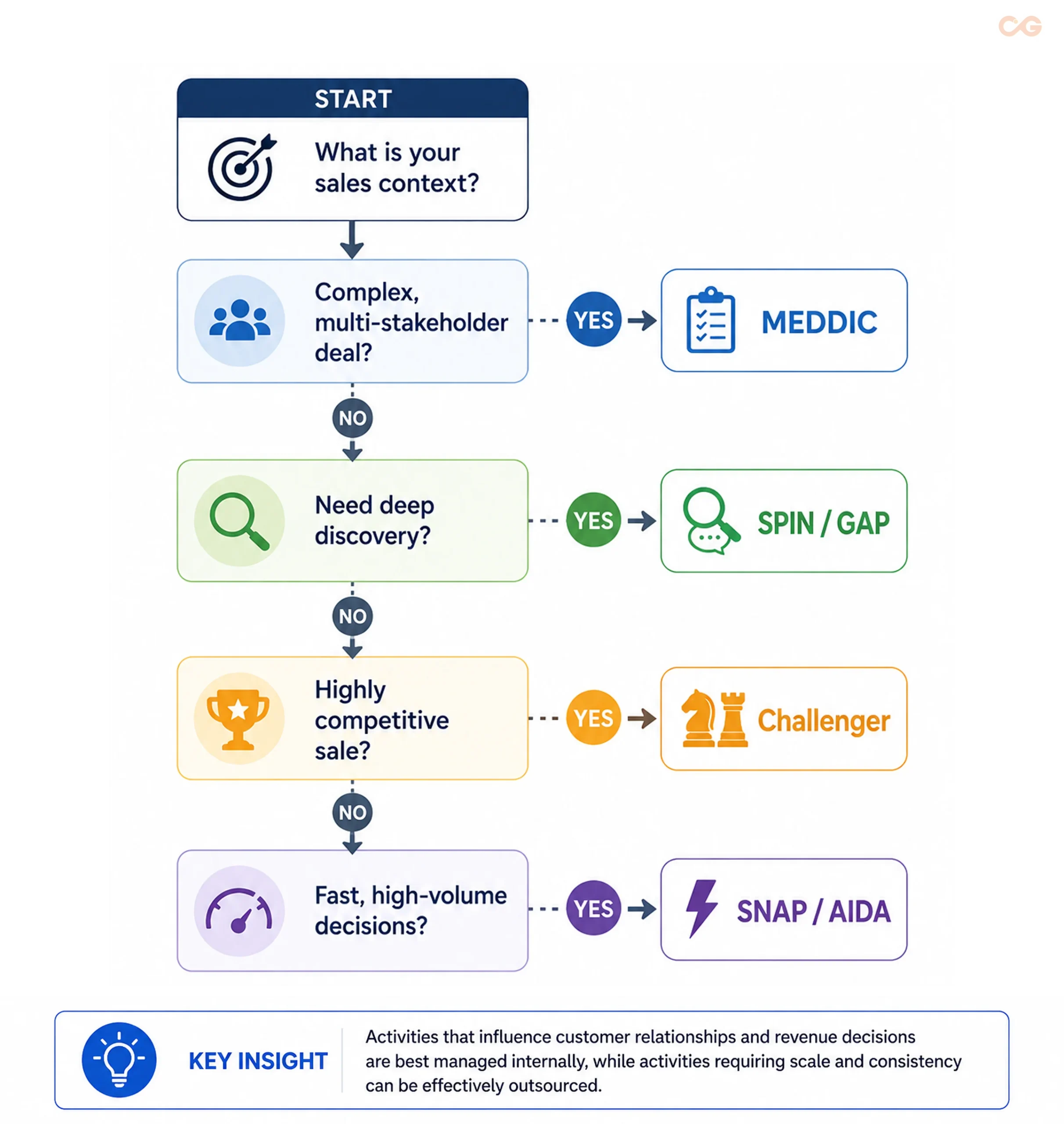
Choosing the right sales framework is a key part of an effective sales strategy, as it depends on the business model, sales cycle, customer behaviour, and buying complexity. While sales processes provide a structured sequence of activities, sales frameworks determine how sales teams engage prospects and move opportunities through the pipeline. Aligning the right framework with the overall sales strategy and sales environment helps organisations improve consistency, customer engagement, and long-term revenue growth.
4.1 B2B Sales (Enterprise, SaaS, Healthcare, Manufacturing)
Characteristics: Long sales cycles, multiple stakeholders, and high-value deals.
Recommended Frameworks:
- MEDDIC / MEDDPICC: Complex deal qualification and stakeholder management.
- SPIN Selling: Deep discovery and needs analysis.
- Challenger Sale: Insight-led selling and value creation.
- Inbound Sales: Buyer-aligned engagement for SaaS and digital B2B businesses.
- GAP Selling: Identifying business challenges and measurable outcomes.
- Consultative Selling: Relationship-driven enterprise sales.
Why These Work
B2B sales often involve complex buying processes, multiple decision-makers, and longer sales cycles. These frameworks support structured qualification, deeper customer discovery, and value-based selling, enabling sales teams to manage complex opportunities more effectively.
Primary Use Cases
- Enterprise SaaS sales
- Healthcare solutions
- Manufacturing and industrial sales
Example:
HubSpot built its growth strategy around the inbound sales methodology by attracting, educating, and engaging prospects with content aligned to the buyer’s journey. Rather than relying primarily on outbound prospecting, the company adopted a buyer-centric approach that encouraged customers to engage after consuming valuable educational content.
4.2 B2G Sales (Government and Public Sector)
Characteristics: Formal procurement processes, strict compliance requirements, and extended sales cycles.
Recommended Frameworks:
- MEDDPICC: Stakeholder mapping and approval management.
- Solution Selling: Requirement-based solution positioning.
- Consultative Selling: Managing complex government stakeholder relationships.
Why These Work
Government sales require strict compliance with procurement procedures, detailed documentation, and structured decision-making. These frameworks help organisations align their solutions with formal requirements while effectively managing multiple stakeholders.
Primary Use Cases
- Government tenders
- Public sector contracts
4.3 B2C Sales (Retail, Banking, Insurance, Real Estate)
Characteristics: High transaction volumes, shorter sales cycles, and emotionally influenced purchasing decisions.
Recommended Frameworks:
- AIDA: Guiding customers through the buying journey.
- BANT (adapted): Rapid lead qualification.
- Sandler Selling: Trust-building and objection handling.
- Consultative Selling: High-value advisory sales.
Why These Work
These frameworks balance emotional engagement with structured qualification, helping businesses improve conversion rates while supporting consultative interactions for more complex purchasing decisions.
Primary Use Cases
- Retail sales
- Banking and financial services
- Insurance advisory
- Real estate sales
4.4 D2C Sales (E-commerce and Digital-First Brands)
Characteristics: Data-driven marketing, digital customer journeys, and rapid purchasing decisions.
Recommended Frameworks:
- AIDA: Customer journey optimisation.
- Inbound Sales: Content-driven customer acquisition.
- Solution Selling: Addressing customer pain points with tailored messaging.
Why These Work
D2C businesses rely on personalised digital experiences, content marketing, and streamlined buying journeys. These frameworks help brands engage customers effectively while improving conversion across digital channels.
Primary Use Cases
- E-commerce businesses
- Subscription-based services
- Digital-first consumer brands
Warby Parker transformed the eyewear industry through its direct-to-consumer model, gaining greater control over pricing, distribution, and customer experience. Its home try-on programme and omnichannel strategy simplified the buying process while building customer trust.
Business Impact:
The company achieved strong early traction, exceeded its initial sales expectations, and evolved into a leading D2C brand with a successful online and offline presence.
Framework Lens:
Warby Parker’s strategy reflects the principles of AIDA through customer journey optimisation and SNAP Selling by simplifying purchase decisions, demonstrating how multiple sales frameworks can complement a modern D2C strategy.
4.5 Cross-Industry Frameworks (Universal Use Cases)
Some sales frameworks are effective across multiple industries because they address common sales challenges regardless of business model.
Applicable Frameworks
- BANT: Structured lead qualification and opportunity prioritisation.
- Solution Selling: Matching products or services to customer needs.
- Sandler Selling: Building trust through transparent, relationship-driven selling.
- Consultative Selling: Delivering personalised, customer-focused recommendations.
- SNAP Selling: Simplifying decision-making for time-constrained buyers.
Why These Work
These frameworks focus on universal sales principles such as qualification, trust-building, problem-solving, and customer engagement. Their flexibility makes them suitable for organisations operating across different industries and sales models.
People Also Ask
Which sales frameworks are best suited for Product-Led Growth (PLG) companies?
Frameworks such as AIDA, Inbound Sales, and Solution Selling are particularly effective for Product-Led Growth (PLG) businesses because they support self-service customer journeys, product adoption, and value-driven engagement through content, onboarding, and in-product experiences.
Takeaway
Use this Sales Framework Audit Template during your next sales review to identify performance gaps, improve execution, and make more data-driven sales decisions.
5. How to Select the Appropriate Sales Framework
Selecting the right sales framework is a key part of strategic sales planning. The most effective framework is one that aligns with your business objectives, sales environment, and customer buying behaviour. Rather than relying on a single approach, organisations should evaluate their sales requirements and choose a framework that supports consistent engagement, effective qualification, and successful deal conversion.
When selecting a sales framework, consider the following factors:
- Business Model (B2B, B2C, D2C, B2G)
Different business models require different sales approaches. Complex B2B and B2G environments often benefit from structured qualification frameworks, while B2C and D2C businesses typically require frameworks that support faster, customer-focused conversions.
- Sales Cycle Length
Longer sales cycles require frameworks that emphasise discovery, relationship-building, and structured qualification. Shorter sales cycles benefit from approaches that prioritise speed, simplicity, and efficient decision-making.
- Deal Complexity
Sales involving multiple stakeholders and lengthy approval processes require frameworks that support stakeholder mapping, value-based selling, and structured decision-making.
- Deal Size
Enterprise and high-value opportunities often require detailed qualification and consultative selling techniques, whereas transactional sales benefit from simpler, efficiency-focused frameworks.
- Sales Team Maturity
Experienced sales teams can effectively implement more advanced frameworks, while newer teams often achieve better results with simpler, easier-to-adopt methodologies.
In practice, many organisations adopt a hybrid sales approach by combining multiple frameworks throughout the sales process. For example, BANT can be used to qualify leads, SPIN Selling to uncover customer needs during discovery, and MEDDIC to manage complex enterprise opportunities.
People Also Ask
How do you design a hybrid sales framework for multi-product organisations?
A hybrid sales framework combines different methodologies across various stages of the sales process. Organisations should align qualification, discovery, proposal, and closing frameworks with individual products, deal complexity, customer segments, and stages of the buyer’s journey to create a more flexible and effective sales strategy.
6. Implementation and Execution Strategy
To effectively utilise sales frameworks, companies must focus on proper implementation and execution. Even the best frameworks fail to deliver results without proper alignment, tools, and processes. This section outlines how to put these frameworks into action using sales enablement, CRM integration, and performance tracking.
6.1 Sales Enablement and Training
Successful implementation starts with organised onboarding and continuous coaching. Research from LXA shows that effective enablement leads to 84% of sales representatives meeting their quotas. Teams need to understand the frameworks conceptually and apply them through role-plays, simulations, and real-life situations.
6.2 CRM and Technology Integration
Organisations must integrate frameworks directly into CRM systems, including specific fields, workflows, and pipeline steps. For example, applying BANT criteria to lead qualification ensures consistency across teams. This integration aids in tracking progress, generating reports, and making evidence-based decisions.
6.3 Process Standardisation
Companies should create detailed sales playbooks that outline how to apply each framework at different levels. Standardisation ensures that sales, marketing, and customer success teams work together effectively, reducing friction and increasing efficiency.
6.4 Performance Measurement and Metrics
To evaluate the effectiveness of any sales framework, organisations should track performance metrics that measure both sales efficiency and business outcomes. Monitoring these indicators helps identify strengths, uncover process gaps, and continuously improve sales performance.
Key performance metrics include:
- Conversion Rate: Measures the percentage of prospects that successfully move from one stage of the sales process to the next, indicating how effectively the chosen framework supports customer progression.
- Lead Qualification Rate: Evaluates the quality of qualified leads and how efficiently sales teams identify high-potential opportunities.
- Win Rate: Measures the percentage of qualified opportunities that convert into closed deals, helping assess the overall effectiveness of the sales framework.
- Sales Cycle Length: Tracks the average time required to close a deal, providing insight into process efficiency and buyer engagement.
- Pipeline Velocity: Measures how quickly opportunities progress through the sales pipeline, helping identify bottlenecks and areas for improvement.
- Forecast Accuracy: Evaluates how accurately sales teams predict future revenue based on pipeline performance.
- Average Deal Size: Measures the average value of closed deals, indicating whether the framework supports higher-value opportunities.
- Revenue Contribution: Assesses the direct impact of sales activities on overall business growth.
- Customer Acquisition Cost (CAC): Measures the cost of acquiring a new customer relative to the revenue generated.
By regularly monitoring these performance indicators, organisations can determine whether their chosen sales framework is delivering the desired results. These insights support data-driven decision-making, continuous optimisation, and long-term sales improvement.
6.5 Continuous Optimisation
Top-performing sales organisations view frameworks as adaptable systems rather than rigid processes.
Regular reviews, A/B testing of strategies, and feedback loops will drive long-term improvement. Continuous enhancement will keep strategies relevant and effective in response to market shifts.
People Also Ask
1. How can sales frameworks integrate with revenue operations (RevOps)?
Integrate sales structures within RevOps by connecting them with CRM systems, data workflows, and reporting mechanisms. This integration ensures unified processes, visibility, and performance tracking across the revenue lifecycle.
2. What steps ensure cross-functional alignment among sales, marketing, and customer success?
Achieve alignment through standardised processes, shared KPIs, clear communication workflows, coordinated handoffs, consistent messaging, and a unified customer experience among sales, marketing, and customer success teams.
7. Common Mistakes to Avoid
Many organisations fail to reach their sales goals due to poor execution and lack of alignment, even when using popular sales methodologies. Choosing the right model is not enough; success hinges on effective implementation and adaptation.
Here are common mistakes to avoid:
1. Overcomplicating Frameworks: Introducing many complex structures at once can create confusion and slow down progress. Focus on simplicity and clarity for consistent adoption.
2. Neglecting Training and Adoption: Sales teams may understand the theories behind frameworks, but without proper training and support, they struggle to apply them in real sales situations.
3. Applying One Framework Universally: No single framework works for every scenario. Using the same strategy across different deal types, industries, or customer segments often proves ineffective.
4. Ignoring Performance Metrics: Monitoring essential metrics — such as conversion rates, pipeline velocity, and win rates — is crucial for assessing impact and enhancing performance.
5. Failing to Adapt to Changing Buyer Behaviour: Today’s consumers are better informed and more independent. Sticking to outdated methods can reduce engagement and conversions.
By avoiding these pitfalls, organisations can create sales structures that are flexible, targeted, and aligned with business performance. This approach fosters a more productive and effective sales operation.
Takeaway
Use this Sales Framework Audit Template during your next sales review to identify performance gaps, improve execution, and make more data-driven sales decisions.
8. Conclusion
In today’s increasingly competitive and complex sales landscape, adopting a structured sales framework is no longer optional—it is essential for building a consistent and scalable sales organisation. The right sales framework helps sales teams engage prospects more effectively, improve decision-making, and create a more predictable path to revenue growth.
However, no single sales framework is universally effective. The best results come from selecting a framework that aligns with your business model, customer journey, sales cycle, and team capabilities, and then implementing it consistently across the organisation.
Ultimately, sales frameworks are not just tools for closing more deals—they provide the foundation for a disciplined, data-driven sales strategy that supports continuous improvement and long-term business growth. Organisations that regularly evaluate, refine, and adapt their sales approach are better positioned to meet evolving customer expectations and achieve sustainable success.