
Creating a Winning Sales Plan and Processes for Your Business
Table of Contents
- Introduction: Scalable Sales Foundation
- Define Business Goals and Revenue Targets
- Identify Your Target Market and Ideal Customer Profile (ICP)
- Craft Your Value Proposition and Core Messaging
- Design a Structured Sales Process
- Create an Effective and Scalable Sales Team and Lead Generation System
- Establish Metrics, Tools, and Execution Systems
- Optimise, Scale, and Pursue Continuous Improvement
- Conclusion
1. Introduction: Scalable Sales Foundation
Sales growth is often viewed as the result of increased effort, such as making more calls, expanding outreach, or hiring larger sales teams. While these activities are important, sustainable and predictable growth depends on well-designed systems rather than effort alone. Without a clear sales strategy plan and a structured sales process, businesses often face inconsistent performance, limited forecasting visibility, and difficulties in scaling.
An organised sales strategy provides a clear framework for planning, executing, measuring, and continuously improving sales activities. It shifts the focus from effort-driven selling to a system-driven approach, enabling organisations to achieve consistent and repeatable success instead of relying solely on individual performance.
1.1 What is the Sales Process?
To build a scalable system, it is important to first understand what a sales process is. A sales process is a structured series of sales process steps that guide a prospect from initial awareness to the final purchase decision.
Instead of leaving outcomes to personal interpretation, there should be a clear-cut process that makes sure that all opportunities are dealt with in a consistent and purposeful manner. Every single phase, be it prospecting, qualification, or closing, possesses its set of actions, goals, and criteria of progress.
This structured approach helps sales teams:
- Maintain consistency in approaching and nurturing leads.
- Ensure no critical stage of the buyer journey is overlooked.
- Develop a common understanding of how opportunities move through the sales pipeline.
Over time, this consistency forms the foundation of a scalable sales process, allowing successful outcomes to be replicated across teams, markets, and customer segments.
1.2 Why Structure Drives Revenue Growth
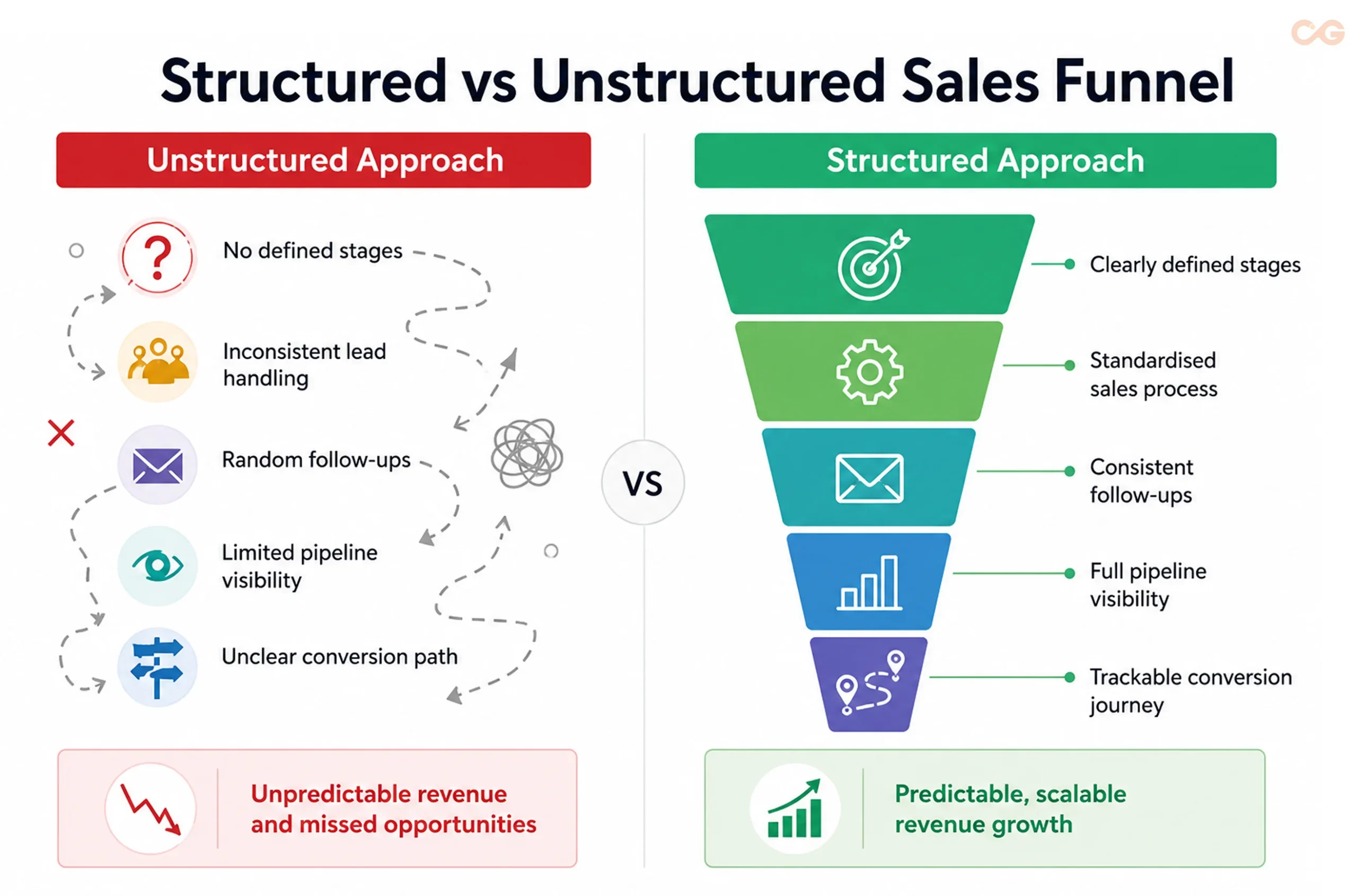
A structured sales strategy is essential for achieving consistent business outcomes. Organisations that adopt a clearly defined sales process often experience stronger revenue growth, greater consistency, and improved sales performance than those without a formal structure. According to CSO Insights, companies with formal sales processes achieve 28% higher revenue growth.
This is because a structured sales strategy framework provides greater operational clarity and enables:
- Consistent execution across teams
A common methodology ensures every prospect receives a consistent, high-quality sales experience.
- Improved visibility into pipeline performance
Clearly defined stages make it easier to track deal progress, identify trends, and improve forecasting.
- Stronger conversion performance across stages
Streamlined processes help identify what drives conversions, making it easier to move prospects from lead to customer.
Ultimately, structure transforms sales into a measurable and optimisable system that supports long-term business growth.
1.3 The Risk of an Unstructured Approach
Without a well-defined sales process, sales activities often vary across individuals and teams. While this may offer flexibility, it can make it difficult to achieve consistent results and scale effectively.
Some common challenges include:
- Inconsistent lead qualification
Without aligned qualification criteria, teams may spend valuable time pursuing low-fit opportunities, reducing efficiency and conversion rates.
- Messaging and communication variability
Inconsistent positioning and sales pitches create an uneven customer experience and weaken the overall value proposition.
- Long and unpredictable sales cycles
Poorly defined sales process steps often delay deal progression because follow-ups and next actions are unclear.
- Poor visibility into performance drivers
Without standardised processes, it becomes difficult to identify what is working, measure performance accurately, or optimise results.
In this environment, sales performance depends more on individual selling styles than on a reliable system. By implementing a structured sales strategy plan, businesses can improve consistency, strengthen performance, and create a more predictable path to long-term growth.
2. Define Business Goals and Revenue Targets
A successful sales plan begins with a clear understanding of what the business aims to achieve and how sales contribute to those objectives. Without well-defined goals, sales efforts often become fragmented, making it difficult to measure performance or scale growth effectively.
Effective goal setting provides direction while aligning teams around shared priorities. It ensures every sales activity supports measurable business outcomes and contributes to long-term growth.
2.1 Align Sales with Business Objectives
Sales should be viewed as an extension of the overall business strategy, not as a separate function. Whether the objective is to expand market share, enter new markets, or improve customer retention, sales priorities should align with these business goals.
According to McKinsey research, companies that align sales with their overall strategy are 1.5 times more likely to achieve above-average growth. This alignment helps organisations focus their resources, messaging, and sales efforts on the opportunities that create the greatest business impact.
In practice, this means:
- Prioritising high-value customer segments that support long-term growth.
- Aligning sales activities with product expansion or market expansion objectives.
- Setting revenue targets that contribute directly to broader business goals.
When sales and business objectives are aligned, every customer interaction—from prospecting to closing—supports measurable business results rather than individual achievements.
2.2 Establish Specific and Attainable Sales Goals
An effective sales strategy translates business objectives into clear, measurable revenue targets. These goals provide the foundation for planning, execution, and performance evaluation.
A structured goal-setting approach typically includes:
- Annual revenue targets to define the overall direction.
- Quarterly and monthly targets to monitor progress.
- Team-level quotas to improve accountability.
High-performing organisations go beyond broad goals such as “increase sales.” Instead, they define the key drivers of revenue, including:
- Revenue targets for a specific period.
- The number of deals required to achieve those targets.
- Average deal size.
- Conversion rates at each stage of the sales process.
Breaking goals into measurable components turns strategy into action. It enables sales leaders to implement targeted sales strategies to increase sales, allocate resources effectively, and identify performance gaps early.
2.3 Transform Targets into Action Metrics
To ensure consistent execution, leading organisations break revenue goals into operational metrics that can be tracked daily or weekly. These metrics provide real-time visibility into performance and help teams stay focused on their targets.
Common metrics include:
- Pipeline coverage ratio, ensuring there are enough opportunities to achieve revenue goals.
- Deal velocity, measuring how quickly opportunities move through the sales process.
- Activity metrics, such as calls, meetings, and demos, that keep the pipeline active.
High-performing sales teams are significantly more likely to rely on data-driven insights for decision-making. This allows them to identify trends early, take proactive action, and improve performance before opportunities are lost.
Taking into consideration these operational metrics, businesses are able to determine the performance trends early, streamline performance and continue to push towards their revenue targets.
2.4 Case Study: Sales Transformation at Microsoft
Microsoft’s shift to Azure, its cloud computing platform, demonstrates how aligning sales objectives with business strategy can drive scalable growth. As the company moved from traditional software licences to cloud-based subscriptions, it redesigned its sales model to focus on customer adoption, recurring revenue, and long-term customer value.
This transformation involved:
- Redefining sales goals around subscription-based revenue.
- Aligning incentives with customer lifetime value.
- Integrating sales with customer success and product teams.
As a result, Azure became one of Microsoft’s key growth drivers, demonstrating how a well-aligned sales strategy plan can strengthen sales performance and support long-term business growth.
Takeaway

Struggling to identify high-fit, high-intent leads? Use this ICP & Target Market Worksheet to define your ideal customers, prioritise the right opportunities, and build a stronger sales pipeline.
3. Identify Your Target Market and Ideal Customer Profile (ICP)
After establishing clear business goals and revenue targets, the next crucial step is pinpointing the audience that can help achieve those objectives. A successful sales strategy relies on precision rather than sweeping outreach. Instead of attempting to reach every potential lead, effective organisations prioritise customers who are most likely to convert, provide long-term value, and promote sustainable growth.
A well-defined target market, along with a detailed Ideal Customer Profile (ICP), enables businesses to channel their sales efforts for maximum impact. This enhances targeting accuracy, strengthens market positioning, and boosts overall sales performance.
3.1 Develop Your Ideal Customer Profile
An Ideal Customer Profile (ICP) specifies the type of customer that aligns best with your products and business model. These customers are more likely to convert, stay loyal, and contribute significantly over time.
A comprehensive ICP should outline:
- Company and Industry Size: Determine which industries and company sizes benefit most from your solution.
- Budget and Purchasing Power: Assess if potential customers can financially invest without major obstacles.
- Pain Points and Urgency: Identify the specific issues customers face and the urgency for a solution.
- Decision-Making Process: Understand the key players, approval steps, and timelines involved in purchasing decisions.
According to HubSpot, businesses with clearly defined ICPs can see up to a 36% increase in conversion rates, highlighting the importance of targeted segmentation.
A strong ICP also fosters better collaboration between sales and marketing. Marketing can generate more qualified leads, while sales can prioritise opportunities with the highest chances of conversion, resulting in a more cohesive and scalable sales strategy.
3.2 Understand Modern Buyer Behaviour
Defining your ICP is just one part of the process. Engaging the right customers also requires insight into how contemporary buyers approach purchasing decisions.
Modern buyer behaviour, especially in B2B markets, has evolved. Customers now access extensive information before engaging with a sales representative.
- B2B buyers spend only 17% of their buying journey interacting with suppliers.
- Most research and decision-making occurs prior to the initial sales conversation.
As a result, prospects often come to the sales process well-informed about their challenges, available solutions, and potential vendors.
To adapt, sales teams should:
- Offer valuable insights instead of reiterating known information.
- Emphasise differentiation and measurable business value over mere product features.
- Customise discussions based on the buyer’s current stage, intent, and readiness to make a decision.
By integrating these insights into a modern sales strategy, businesses can foster more relevant, timely, and value-driven customer interactions.
3.3 Target High-Value Opportunities
When businesses combine a clearly defined ICP with a strong understanding of buyer behaviour, they can identify and prioritise high-value opportunities more effectively. Rather than treating every lead equally, high-performing organisations focus their efforts on prospects with the greatest potential for conversion and long-term value.
This targeted approach strengthens the sales process by delivering:
Optimal customers would create repeat business, upsells and better long-term relationships.
- Improved conversion rates
Qualified prospects are more likely to progress through each stage of the sales process.
- Greater sales efficiency
Focusing on high-potential accounts reduces wasted effort and improves overall productivity.
- Higher customer lifetime value
The right customers are more likely to generate repeat business, upselling opportunities, and long-term relationships.
By prioritising quality over quantity, businesses can build a more predictable and scalable sales process that supports sustainable growth.
3.4 Case Study: ICP-led Targeting at Zapier
HubSpot highlights Zapier as an example of a company with a clearly defined Ideal Customer Profile (ICP). According to the article, Zapier focused on fast-growing businesses with 50–500 employees that relied on multiple software applications and experienced significant manual work due to disconnected workflows. This clear ICP helped shape its content strategy, messaging, and positioning as a simple no-code automation platform.
4. Craft Your Value Proposition and Core Messaging
After identifying your target market and Ideal Customer Profile (ICP), the next step is to create a value proposition that resonates with these potential customers. A strong value proposition is essential for any successful sales strategy. It clearly links what your business offers to what customers need. This connection enables sales teams to convey relevance, differentiation, and measurable value.
A compelling value proposition not only grabs attention but also fosters trust, accelerates decision-making, and boosts conversion rates throughout the sales funnel
4.1 Develop a Good Value Proposition
A successful sales plan relies on messaging that succinctly communicates customer value. A robust value proposition should answer three key questions:
1. What problem do we solve?
Clearly identify the customer’s main challenge and explain how your solution addresses it.
2. What makes our solution unique?
Point out the features and advantages that set your offering apart from competitors.
3. What results can customers expect?
Emphasise the measurable business outcomes that your solution can deliver.
A strong value proposition ensures that every interaction with customers — whether through marketing or sales — conveys the same core message.
An effective value proposition will make sure that all communication, regardless of whether it is a marketing-focused or a sales-focused interaction, supports the same fundamental narrative.
4.2 Shift from Features to Outcomes
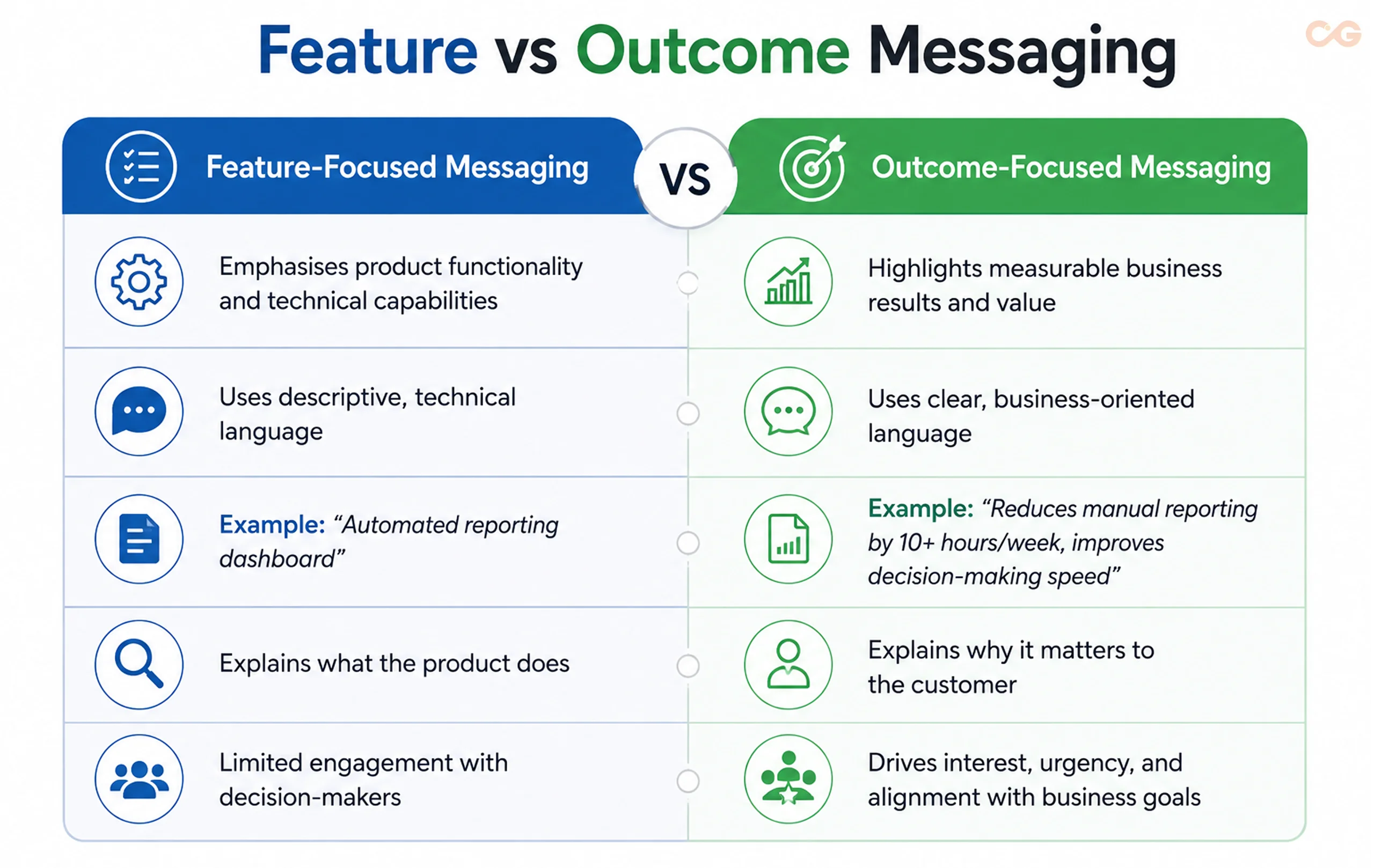
Today’s buyers evaluate solutions based on the business results they deliver rather than the features they offer. As a result, sales teams should focus their messaging on outcomes that matter most to decision-makers.
This includes highlighting:
- Cost reduction
Demonstrate how the solution lowers operational costs and improves efficiency.
- Efficiency improvements
Show how it streamlines processes, saves time, and increases productivity.
- Revenue growth
Explain how the solution supports business growth, improves sales performance, or increases deal value.
This outcome-focused approach strengthens sales strategies to increase sales by aligning messaging with what customers value most—measurable business impact.
4.3 Ensure Messaging Consistency
Consistent messaging across every customer touchpoint builds credibility, strengthens brand trust, and creates a better buying experience. Whether customers interact through marketing or sales, they should receive the same core message and positioning.
Key practices include:
- Aligned communication across channels
Maintain consistent messaging across emails, sales calls, presentations, and marketing materials.
- Standardised sales narratives
Equip sales teams with structured messaging frameworks for consistent customer conversations.
- Reinforced brand positioning
Consistent communication strengthens brand recognition, credibility, and recall throughout the buyer journey.
A standardised messaging approach makes your sales strategy framework more effective while ensuring value is communicated consistently at every stage of the sales process.
5. Design a Structured Sales Process
Once your value proposition and core messaging are clearly defined, the next step is turning that strategy into consistent execution. A structured sales process provides a clear roadmap for sales teams, ensuring every opportunity is managed systematically from the first interaction to the final sale.
By standardising how deals move through the pipeline, businesses improve efficiency, increase predictability, and build a scalable foundation for long-term growth.
5.1 Define the Stages of the Sales Process
An effective sales process outlines the key stages every opportunity follows. While the exact process may vary between organisations, a common sales process includes:
1. Prospecting
Identify potential customers through outbound outreach, inbound leads, referrals, and targeted market research.
2. Qualification
Evaluate leads based on their fit, budget, authority, needs, and readiness to engage.
3. Discovery
Understand the customer’s challenges, goals, and decision-making criteria through structured conversations.
4. Solution Presentation
Present tailored solutions that address customer needs while highlighting value, differentiation, and expected outcomes.
5. Objection Handling
Address concerns, resolve objections, and reinforce value to build trust and confidence.
6. Closing
Finalise terms, secure commitment, and convert qualified opportunities into customers.
7. Post-Sale Engagement
Support onboarding, deliver ongoing value, and strengthen customer relationships to encourage retention and growth.
Clearly defined stages improve deal visibility, help identify bottlenecks, create a more consistent customer experience, and make the overall sales process easier to manage and optimise.
5.2 Define Sales Process Steps Within Each Stage
A successful sales process requires more than defined stages. Each stage should include clear actions and progression criteria to ensure consistency and accountability across the sales team.
This includes:
- Specific activities within each stage
Clearly define the required actions, such as calls, demos, follow-ups, and stakeholder interactions.
- Entry and exit criteria
Establish the conditions that must be met before an opportunity progresses to the next stage.
- Performance and conversion benchmarks
Track measurable metrics to evaluate effectiveness and identify opportunities for improvement.
By documenting these requirements, businesses ensure that sales process steps are not only well defined but also measurable, repeatable, and easier to improve over time.
5.3 Impact of a Structured Process
The benefits of a structured sales process are supported by data. According to TheSalesCollective, 51% of organisations improve forecast accuracy after implementing a structured sales process, leading to better predictability and decision-making.
A structured process helps businesses achieve:
- Greater visibility into pipeline health
Monitor deal progression across every stage of the sales pipeline.
- More accurate forecasting
Use stage conversion data and historical performance to improve revenue predictions.
- Consistent execution across teams
Standardised processes reduce reliance on individual selling styles and improve overall performance.
Together, these benefits strengthen the overall sales strategy plan and support long-term business scalability.
Takeaway
Struggling to identify high-fit, high-intent leads? Use this ICP & Target Market Worksheet to define your ideal customers, prioritise the right opportunities, and build a stronger sales pipeline.
6. Create an Effective and Scalable Sales Team and Lead Generation System
After establishing a structured sales process, focus on developing a proficient sales team and a reliable lead generation system. Your scalable sales strategy hinges on hiring suitable personnel, defining clear job roles, and ensuring a steady influx of qualified leads.
Integrating specialised sales roles with a robust lead generation mechanism will facilitate efficient growth while ensuring consistent performance.
6.1 Organise the Sales Team
Contemporary sales organisations delegate specific roles throughout the sales process to enhance efficiency and improve outcomes.
Sales Development Representatives (SDRs)
SDRs analyse and qualify incoming and outgoing leads, channelling high-quality opportunities to the sales team.
Account Executives (AEs)
AEs handle qualified opportunities, present product demonstrations, and convert prospects into customers.
Account Managers (AMs)
AMs enhance customer relationships, facilitate renewals, and discover opportunities for upselling and cross-selling.
6.2 Develop a Robust Lead Generation System
An effective sales strategy requires a balanced approach of both inbound and outbound lead generation to sustain a healthy sales pipeline.
Inbound channels:
SEO and content
Use valuable content to attract high-value prospects through strong search visibility and organic discovery.
Campaigns and Lead Magnets
Create qualified leads by implementing targeted campaigns, gated content, and effective conversion tools.
Outbound Channels
Cold outreach
Reach potential customers through personalised emails, phone calls, and other direct strategies.
Targeted prospecting
Identify and engage high-value accounts using data-driven insights and clear Ideal Customer Profile (ICP) criteria.
Combining both inbound and outbound strategies will strengthen your sales pipeline, enhance conversion rates, and support sustainable long-term growth.
6.3 Uniting Sales and Marketing
A successful sales strategy relies on the effective collaboration of sales and marketing teams. When both departments pursue shared goals, they enhance lead generation and conversion rates.
Key components for alignment include:
- Shared Goals and KPIs: Both teams should aim for common revenue targets, pipeline contributions, and conversion metrics.
- Consistent Messaging: The sales and marketing teams must deliver the same value proposition at every customer interaction.
- Higher-Quality Leads: Improved teamwork allows marketing to deliver more qualified leads, enabling sales to concentrate on prospects with greater conversion chances.
Aberdeen Group indicates that organisations with well-aligned sales and marketing experience a 20% annual revenue growth, underscoring the importance of this collaboration.
6.4 Business Example: HubSpot’s Inbound Marketing Approach
HubSpot showcases how aligning sales and marketing can build an effective lead generation system. The company centres its strategy on inbound marketing, utilising content, SEO, and automation to attract and convert qualified leads.
This strategy has enabled HubSpot to:
- Maintain a steady flow of high-intent leads.
- Align marketing efforts with sales targets and revenue goals.
- Create a scalable system that consistently attracts and converts demand.
By merging inbound marketing with a structured sales process, HubSpot has established a reliable growth engine that drives ongoing success.
7. Establish Metrics, Tools, and Execution Systems
With a scalable sales team and lead generation engine in place, the next step is measuring performance and standardising execution. An effective sales strategy framework relies on clear metrics, the right technology, and structured execution systems to improve visibility, maintain consistency, and support continuous improvement throughout the sales process.
7.1 Define Key Metrics
Tracking the right KPIs helps businesses measure sales performance, identify gaps, and continuously optimise their sales strategy.
Key metrics include:
- Conversion rates
Measure how effectively leads move through each stage of the sales funnel.
- Pipeline value
Monitor the total potential revenue within the sales pipeline to forecast future growth.
- Sales cycle length
Track the time required to convert leads into customers and identify delays in the sales process.
- Win rates
Measure the percentage of opportunities that successfully convert into closed deals.
According to Salesforce, high-performing sales teams are three times more likely to use advanced sales tools, highlighting the importance of data-driven decision-making.
7.2 Adopt CRM and Sales Tools
Technology plays a vital role in managing and scaling the sales process. CRM systems act as the central platform for tracking customer interactions, managing pipelines, and improving sales visibility.
Key benefits include:
- Centralised data management
Store customer interactions, deal progress, and communication history in a single system.
- Pipeline tracking and forecasting
Monitor deal stages, forecast revenue, and improve forecasting accuracy.
- Automation and higher productivity
Automate routine tasks so sales teams can focus on high-value customer activities.
According to Nucleus Research, CRM systems deliver an average return of $8.71 for every $1 invested, making them an essential component of scalable sales growth.
7.3 Build Execution Systems
Metrics and technology deliver the best results when supported by standardised execution systems. Documented processes help sales teams follow consistent practices, reduce errors, and improve performance across every stage of the sales process.
Essential execution systems include:
- Develop Standard Operating Procedures (SOPs)
Create documented processes that standardise daily sales activities and improve operational consistency.
- Create sales playbooks
Provide clear guidance on messaging, objection handling, sales conversations, and best practices for every stage of the sales process.
- Automate workflows
Use automation to streamline repetitive tasks, improve efficiency, and minimise manual errors.
Together, these systems ensure that sales process steps are executed consistently, making the overall sales process more predictable, repeatable, and scalable.
8. Optimise, Scale, and Pursue Continuous Improvement
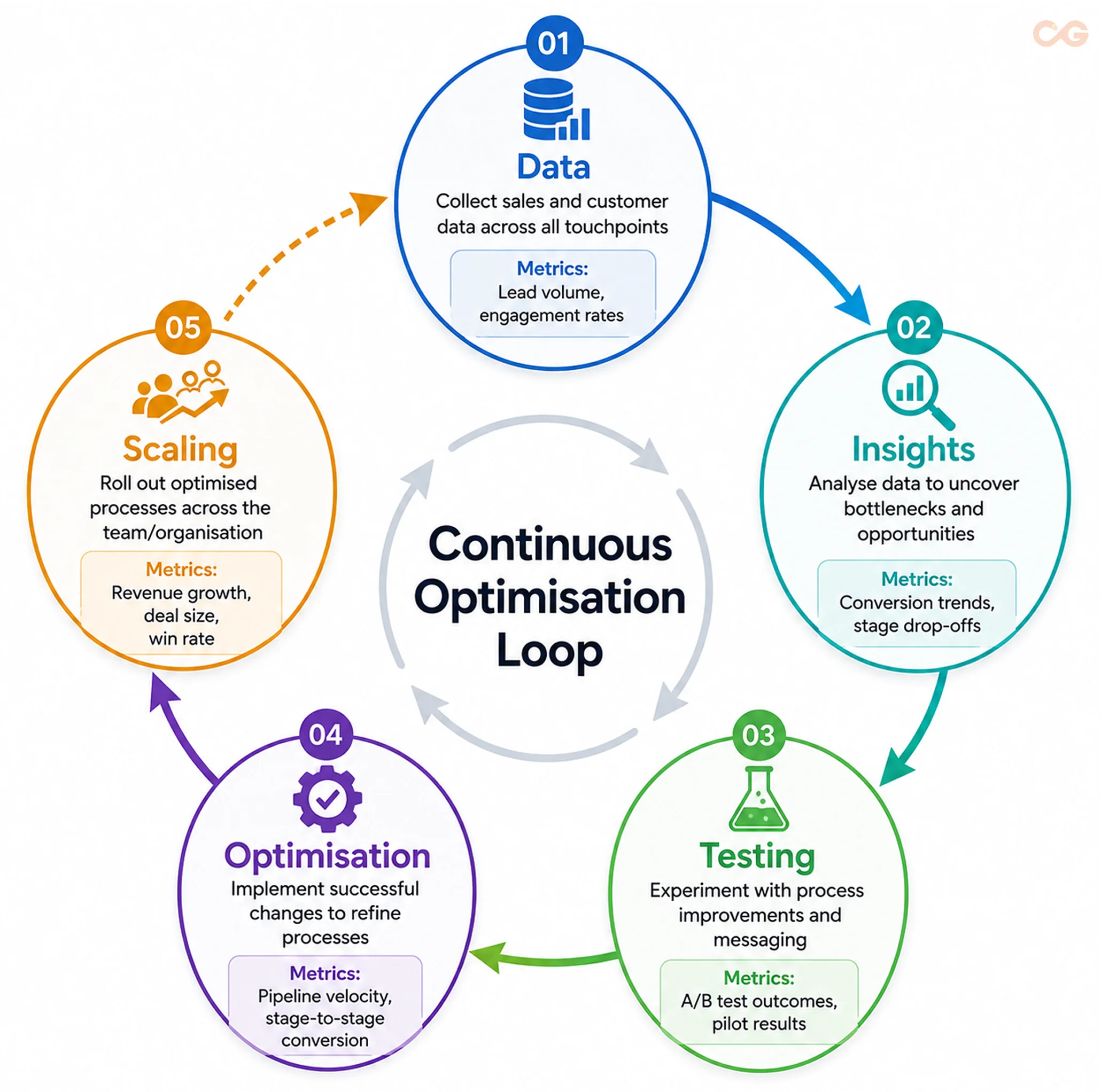
With the right metrics, tools, and execution systems in place, our focus turns to ongoing improvement. A scalable sales strategy remains dynamic; it adapts through analysis, testing, and refinement. Successful organisations consistently assess their sales processes to find improvement opportunities and enhance performance for sustainable growth.
8.1 Identify Bottlenecks
To kick off continuous improvement, pinpoint where prospects slow down or exit the sales funnel.
Evaluate your sales process to uncover:
- Drop-off Points: Identify where leads lose interest or fail to advance.
- Conversion Gaps: Compare projected and actual conversion rates to spot performance issues.
- Stage Inefficiencies: Detect delays or unnecessary steps that prolong the sales cycle.
According to McKinsey, organisations that leverage analytics for performance optimisation experience 20% higher productivity, emphasising the importance of ongoing performance evaluation.
8.2 Test and Enhance
After identifying areas for improvement, regularly test different methods to refine your sales strategy.
Focus on:
- Messaging Strategies: Experiment with value propositions and communication styles to boost customer engagement.
- Channels and Outreach: Assess the effectiveness of inbound and outbound channels to determine optimal lead sources.
- Pricing and Packaging: Modify pricing models and service offerings to align with customer expectations and value perceptions.
This approach to continuous testing solidifies sales strategies, driving growth by replacing assumptions with data-driven decisions.
8.3 Scale What Works
Once successful strategies have been identified, the next step is to standardise and expand them across the organisation.
This includes:
- Standardise successful processes
Document proven sales practices so they can be consistently replicated across teams.
- Expand across teams and markets
Apply successful strategies to new regions, customer segments, or business units to accelerate growth.
- Embed success into sales systems and playbooks
Incorporate effective workflows, tools, training, and best practices into everyday sales operations.
By scaling proven approaches, businesses transform individual successes into a repeatable and scalable sales strategy framework that supports long-term growth.
Takeaway
Struggling to identify high-fit, high-intent leads? Use this ICP & Target Market Worksheet to define your ideal customers, prioritise the right opportunities, and build a stronger sales pipeline.
9. Conclusion
To build a successful sales strategy, companies need to focus on a clear and repeatable framework instead of relying on random tactics. Establishing specific business objectives, identifying a well-defined target market, offering a strong value proposition, and following a structured sales process are essential steps. This approach creates a system that promotes steady revenue growth.
With a capable sales team, an effective lead generation strategy, relevant performance metrics, and efficient execution systems, the framework enhances visibility, boosts conversion rates, and enables precise revenue forecasting.
Achieving sustainable sales growth requires ongoing optimisation rather than one-time fixes. Companies should measure performance regularly, refine their strategies, and expand successful initiatives. This way, they can develop a flexible sales strategy that adapts to market changes while ensuring long-term, measurable results.