How to Choose the Right Sales Consultant for Your Business
Table of Contents
- Reasons Why Small Businesses Need Strategic Sales Support
- What Does a Sales Consultant Actually Do?
- Core Skills to Look For
- A Practical Guide to Evaluating Sales Consultants
- Smart Questions to Ask Potential Sales Consultants
- Common Mistakes Small Businesses Make When Hiring Sales Consultants
- Evaluating Sales Consultant ROI
- Conclusion: Make Confident and Clear Choices
Sales is the foundation of every successful business, yet many small businesses struggle to achieve consistent revenue growth. Even with a great product or service, growth can stall without a structured sales process, reliable forecasting, and a clear strategy for turning leads into paying customers.
This is where a sales consultant can make a real difference. They bring the expertise, proven frameworks, and strategic guidance needed to improve sales performance and build a scalable revenue engine. However, not all sales consultants offer the same level of experience or value. Choosing the right sales consultant can help your business unlock new growth opportunities, improve sales performance, and maximise the value of your investment.
In this blog, you’ll learn how to choose the right sales consultant for your business through practical tips, a structured evaluation framework, and real-world examples, helping you make an informed decision that supports long-term business growth.
Reasons Why Small Businesses Need Strategic Sales Support
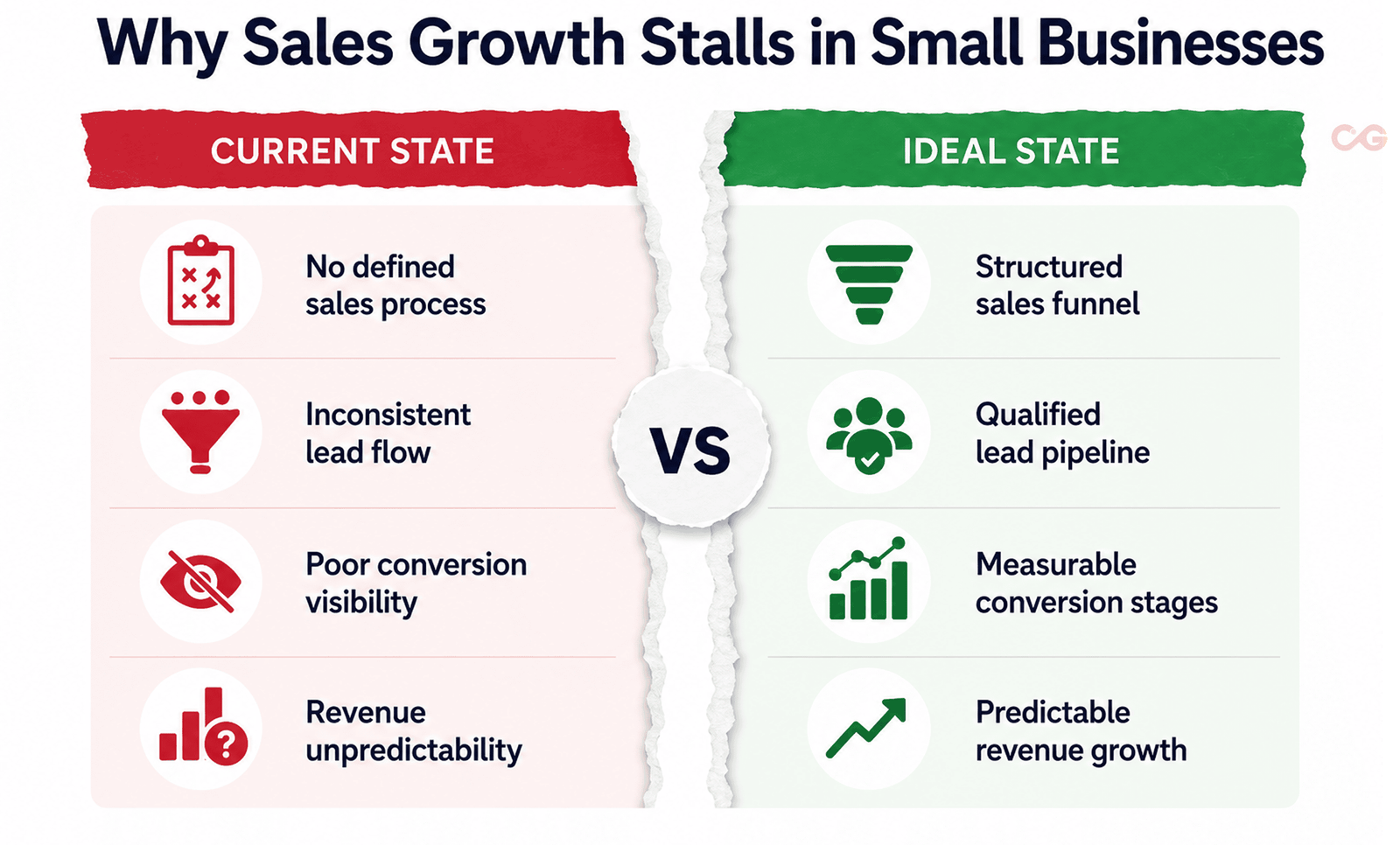
Sales today goes beyond simply closing deals. For many small businesses, it involves managing customer relationships, building trust, and creating a consistent buying experience. As a result, business owners often face challenges such as:
- Customers expecting quick responses, personalised interactions, and tailored solutions.
- Sales activities overlapping with customer service and brand building.
- Teams lacking formal sales training, the right tools, or clear visibility into the sales pipeline.
According to HubSpot, 65% of small businesses identify generating traffic and leads as one of their biggest challenges, while also struggling to convert those leads into paying customers.
This is where a sales consultant adds real value by helping businesses:
- Identify gaps and inefficiencies in the sales process.
- Build structured sales pipelines and lead qualification frameworks.
- Train sales teams in customer engagement, follow-ups, and consultative selling.
- Implement and optimise CRM systems to track performance and measure ROI.
What a Sales Consultant actually does
One of the biggest mistakes businesses make is hiring a sales consultant without fully understanding the value they bring. A sales consultant does much more than offer one-time advice. They work closely with your business to strengthen your sales strategy, improve execution, and build a scalable revenue engine.
Rather than applying a one-size-fits-all approach, an experienced sales consultant takes the time to understand your business goals, sales challenges, and growth opportunities. They typically contribute by:
- Reviewing your sales process: Evaluating every stage of the customer journey—from lead generation to deal closure—to identify inefficiencies and opportunities for improvement.
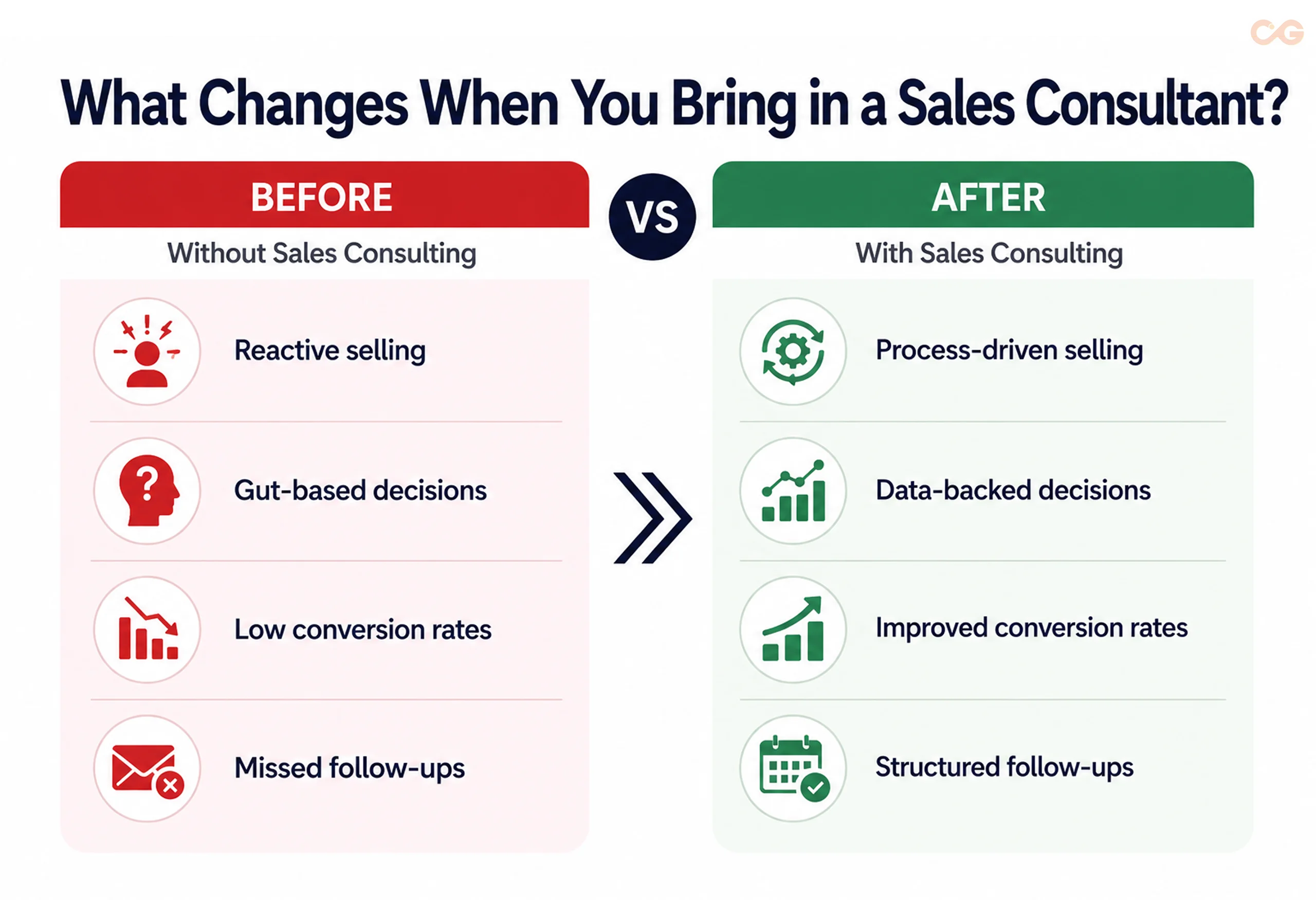
- Identifying sales bottlenecks: Pinpointing issues such as poor lead quality, delayed follow-ups, low conversion rates, or gaps in the sales process that may be limiting revenue.
- Providing data-driven recommendations: Using sales data, customer insights, and proven frameworks to recommend practical improvements instead of relying on assumptions.
- Optimising sales technology: Helping implement or improve CRM systems, sales automation, and reporting tools that increase efficiency and provide better visibility into performance.
- Coaching and enabling sales teams: Developing the skills, confidence, and consistency of sales teams through structured coaching, practical guidance, and performance-focused training.
For small businesses, this combination of strategic expertise and hands-on support can make a significant difference. Instead of offering temporary fixes, a sales consultant helps build repeatable processes, stronger sales capabilities, and a structured foundation for long-term revenue growth.
Takeaway

Want to maximise the value of your sales consulting engagement? Use this practical guide to build a strong partnership and achieve better business outcomes.
People Also Ask
What are the early warning signs that a sales process requires professional guidance?
Common warning signs include inconsistent lead follow-ups, unpredictable revenue, long sales cycles, low conversion rates, and the absence of documented sales processes. If your business is consistently struggling to convert opportunities into revenue despite ongoing efforts, a sales consultant can identify the underlying issues and recommend structured improvements.
Core Skills to Look For
When outsourcing a sales consultant, don’t focus solely on job titles or credentials. While experience and qualifications are important, the real value lies in the skills and expertise they bring to your business. A capable sales consultant should be able to identify growth opportunities, solve sales challenges, and implement strategies that deliver measurable business results. Here are the essential skills to look for in a modern sales consultant:
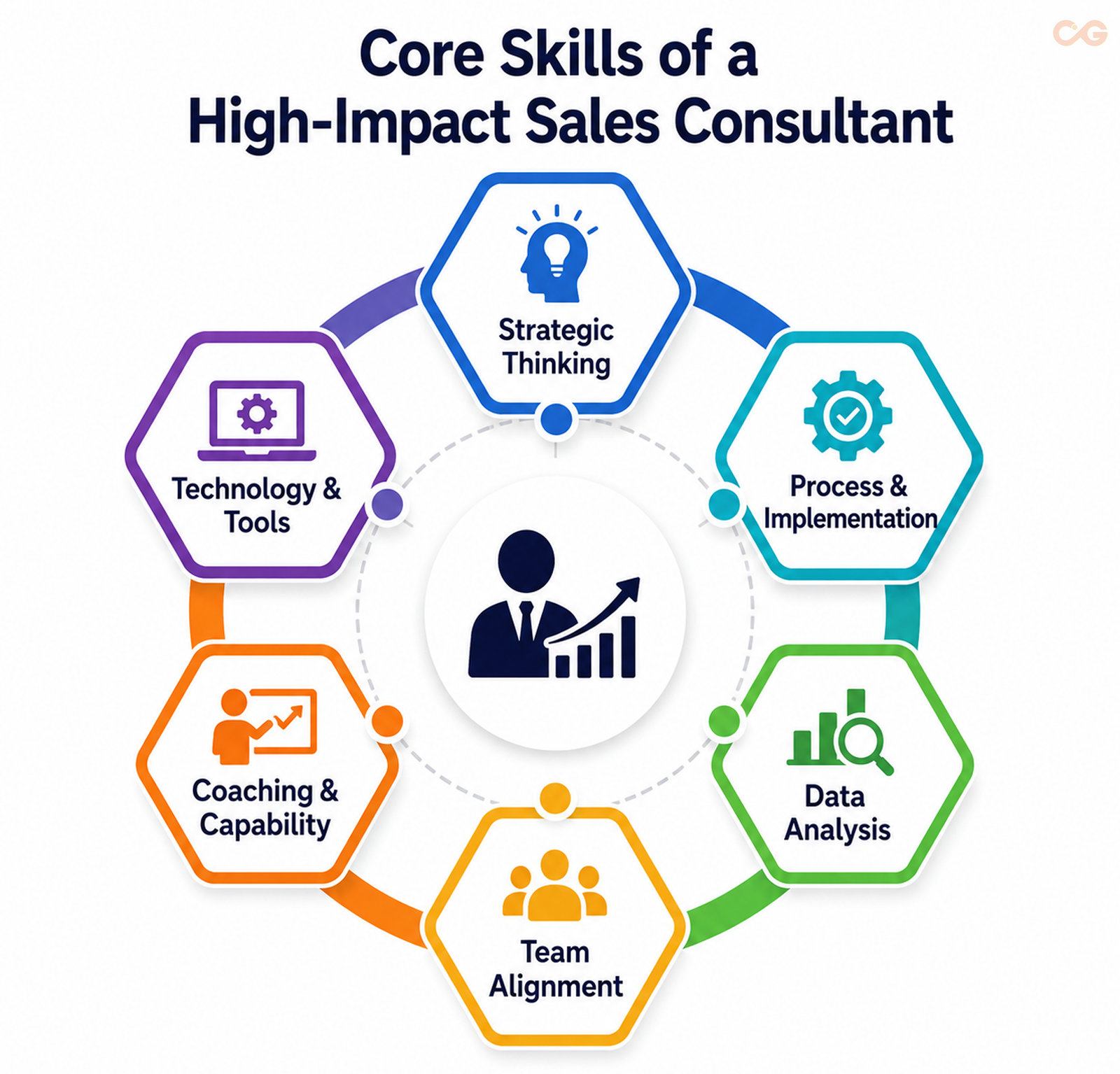
1. Strategic Thinking
An effective sales consultant looks beyond day-to-day sales activities and focuses on the bigger picture. They understand how your sales strategy supports your overall business objectives and help you build a clear roadmap for sustainable growth.
Strong strategic thinkers can:
- Understand your business model, revenue goals, and competitive landscape.
- Set realistic sales objectives based on market conditions and growth opportunities.
- Align sales initiatives with broader business goals to maximise long-term impact.
This strategic approach ensures your sales efforts deliver sustainable growth rather than short-term gains.
2. Process and Implementation Expertise
A great strategy only delivers results when it is implemented effectively. The best sales consultants bring structure, consistency, and repeatability to your sales operations.
They help businesses:
- Design or optimise a structured sales funnel.
- Improve lead qualification and lead-scoring processes.
- Reduce pipeline leakage and increase sales predictability.
According to The Sales Collective, more than half of businesses have lost revenue because they lacked a clearly defined sales process. A structured sales process enables teams to work more efficiently, scale consistently, and generate predictable revenue.
3. Analytical Thinking and Problem-Solving
Successful sales decisions are driven by data, not assumptions. A skilled sales consultant analyses performance metrics to identify what’s working, uncover hidden challenges, and recommend practical improvements.
Key practices include:
- Tracking sales metrics such as conversion rates, average deal value, and sales cycle length.
- Monitoring KPIs to measure progress and identify performance gaps.
- Refining sales strategies based on data-driven insights.
For example, research by Rework found that leads contacted within five minutes are more than 21 times more likely to qualify than those contacted later. Even small improvements in response time can have a significant impact on conversion rates.
4. Team Alignment and Communication
Even the best sales strategy will struggle without effective communication and collaboration. A capable sales consultant ensures that leadership, sales, marketing, and other key teams work towards shared business goals.
They should be able to:
- Present recommendations clearly and explain the reasoning behind them.
- Gain leadership support for new initiatives.
- Foster collaboration between sales, marketing, and operations to ensure consistent execution.
Strong alignment helps businesses implement change more effectively and achieve better results.
5. Coaching and Capability Building
A great sales consultant doesn’t just improve your sales process—they also strengthen your team’s ability to succeed long after the engagement ends.
They support businesses by:
- Delivering sales training and practical role-play sessions.
- Identifying skill gaps and providing targeted coaching.
- Establishing structured performance reviews and continuous feedback.
This is particularly valuable for small businesses, where teams often handle multiple responsibilities. Ongoing coaching helps improve confidence, consistency, and overall sales performance.
Research by CareerTrainer indicates that in organisations where sales coaching is well organised, the sales representatives meet and exceed the quota by 107% against 88% in organisations where sales coaching is non-existent.
6. Technology and Tool Proficiency
Modern sales success depends on using the right technology to improve efficiency and decision-making. An experienced sales consultant helps businesses select, implement, and optimise the tools that best support their sales process.
They can help:
- Evaluate and implement the right CRM solution for your business.
- Automate repetitive administrative tasks.
- Monitor sales performance through dashboards and reporting tools.
Many small businesses begin by managing sales activities through spreadsheets or basic tracking systems. As the business grows, implementing CRM platforms such as HubSpot, Zoho CRM, or Freshsales can provide better pipeline visibility, automate workflows, improve team accountability, and support more scalable sales operations.
People Also Ask
What sales skills should be prioritised when coaching hybrid or multi-role teams?
When coaching hybrid or multi-role teams, focus on core sales skills such as lead qualification, objection handling, negotiation, closing techniques, time management, and effective communication. These skills help team members balance multiple responsibilities while maintaining consistent sales performance and delivering a better customer experience.
Takeaway
Want to maximise the value of your sales consulting engagement? Use this practical guide to build a strong partnership and achieve better business outcomes.
A Practical Guide to Evaluating Sales Consultants
Now that you understand the essential skills to look for, it’s time to evaluate the right sales consultants in a structured way. The following steps will help you choose a consultant whose expertise aligns with your business goals and growth priorities.
Step 1: Clarify Your Business Needs
Start by defining your objectives.
- Do you need support with sales process design, team coaching, technology implementation, or a combination of these?
- Is your primary goal to increase revenue, improve conversion rates, or achieve both?
Having clear priorities will help you identify consultants whose expertise matches your specific business requirements rather than relying solely on general experience or credentials.
Step 2: Focus on Results, Not Just Experience
It is the results they have produced that matter and not the places they have served. Ask for:
- Case studies that demonstrate measurable business impact.
- Examples of businesses similar to yours that they’ve worked with.
- Quantifiable outcomes from previous projects, such as increased conversion rates, shorter sales cycles, or revenue growth.
Prioritising proven results will help you choose a consultant who can deliver measurable improvements for your business.
Step 3: Evaluate Their Methodology
Experienced consultants follow a structured approach instead of offering one-size-fits-all solutions. Look for:
- An initial assessment of your current sales process.
- Data collection and process analysis to identify improvement opportunities.
- A clear action plan with practical recommendations.
- Defined KPIs and milestones to measure progress.
If a consultant cannot clearly explain their methodology, it may indicate a lack of structure or experience.
Step 4: Assess Cultural Compatibility
Sales is a people-driven function, so it’s important to choose a consultant who fits well with your team’s culture and communication style. Consider whether they:
- Listen carefully and understand your business challenges.
- Ask thoughtful and relevant questions.
- Communicate clearly and adapt to the way your business operates.
A strong cultural fit encourages better collaboration and increases the likelihood of successful implementation.
Step 5: Look for Coaching and Knowledge Transfer
The right sales consultant should leave your business stronger than they found it. Look for someone who not only solves current challenges but also equips your team with the skills and knowledge to sustain long-term success.
They should be able to:
- Coach your team through practical training and guidance.
- Share best practices that can be applied consistently.
- Build internal capabilities so your team can continue improving after the engagement ends.
People Also Ask
Can a sales consultant help reduce customer churn while generating new leads?
Yes. A sales consultant can analyse customer behaviour, identify gaps in follow-up and engagement, and optimise your sales process to improve both customer retention and lead generation. By strengthening the sales funnel and refining customer engagement strategies, businesses can reduce churn while attracting and converting more qualified leads.
Smart Questions to Ask the Potential Consultants
When interviewing a sales consultant, avoid asking generic questions like “What is your experience?” Instead, ask questions that reveal their problem-solving approach, methodology, and ability to deliver results for businesses like yours. Consider asking:
- Which sales metrics do you use to measure the success of a consulting engagement?
- How do you identify weaknesses or bottlenecks in a sales process?
- Can you share a success story or case study from a business similar to mine?
- How will you work with my team throughout the engagement?
- Which sales tools or CRM systems would you recommend for a small business like ours, and why?
The right sales consultant should provide clear, practical, and tailored answers rather than generic advice. Their responses should demonstrate a structured approach, industry expertise, and a genuine understanding of your business challenges.
Common Mistakes Small Businesses Make When Hiring Sales Consultants
Even well-intentioned businesses can make costly mistakes when selecting a sales consultant. Recognising these common pitfalls can help you make a more informed decision and maximise the value of your investment.
- Hiring based on reputation instead of relevance: A consultant may have an impressive track record, but their experience should align with your industry, business size, and specific sales challenges.
- Failing to define success before the engagement begins: Without clear goals and measurable KPIs, it becomes difficult to evaluate the consultant’s impact. Establish success metrics from the outset to track progress effectively.
- Expecting immediate results without improving internal processes: Sustainable sales growth takes time and requires consistent implementation. Unrealistic expectations can lead to disappointment and hinder long-term success.
- Overlooking team buy-in and adaptability: Even the best sales strategy will struggle if your team isn’t prepared to adopt new processes. Encourage collaboration, open communication, and employee engagement to ensure successful implementation.
By avoiding these common mistakes, small businesses can build stronger consulting partnerships, improve implementation outcomes, and achieve a better return on their investment.
Evaluating Sales Consultant ROI
Hiring a sales consultant on board is a smart move, and like any investment, it’s crucial to assess how well it’s paying off through measurable results. This approach allows you to gauge the impact of their work and drives data-informed decisions that support ongoing revenue growth by keeping an eye on essential metrics.
Here are some key indicators to look at:
1. Sales Conversion Rates: Track how effectively you’re turning leads into paying customers. Research from Monetizely suggests that sales teams with well-defined performance metrics, such as conversion rates and pipeline health, enjoy win rates that are 18% higher compared to teams lacking formal measurement.
2. Value Pipeline: Assess the growth of your sales pipeline’s potential revenue attributed to the consultant’s input.
3. Sales Cycle Length: Analyse how quickly deals are being finalised. Industry benchmarks indicate that the average B2B sales cycle lasts between 60 to 120 days. Monitoring cycle times and pipeline velocity can significantly improve revenue forecasting and predictability.
4. Revenue Growth Over Time: Examine the overall impact of these enhancements on your business performance.
To quantitatively assess ROI, compare these metrics against the consultant’s recommendations and your business objectives. This approach not only helps validate the tangible benefits of the consulting engagement but also presents opportunities for ongoing improvements in optimisation and sustainable growth.
Takeaway
Want to maximise the value of your sales consulting engagement? Use this practical guide to build a strong partnership and achieve better business outcomes.
Conclusion: Select with Confidence and Clarity
Hiring the best sales consultants involves more than just impressive qualifications or extensive experience. It’s about choosing a strategic partner who understands your business, shares your goals, and helps you create a sales process that drives consistent and measurable growth.
When assessing potential consultants, concentrate on:
- Results you can measure: Seek consultants with a track record of delivering outcomes that solve business challenges and foster growth.
- Strategies backed by data: Prioritise consultants who rely on insights and analysis, using proven practices rather than just industry trends.
- Empower your team: A good consultant will enhance your team’s skills, ensuring they can maintain improvements long after the partnership ends.
- Implement scalable solutions: Focus on consultants who set up processes and tools that boost efficiency, support effective decision-making, and facilitate long-term growth.
With the right choice, a sales consultant becomes a valuable partner in developing a reliable, high-performing sales engine. By making a well-informed selection, your company can enhance its sales capabilities, improve overall performance, and establish a strong foundation for sustainable growth.