How Sales Consulting Drives Revenue Growth Across Industries
Table of Contents
- Introduction
- Identifying Revenue Gaps in the Sales Funnel
- Enhancing Demand Generation and Conversion
- Streamlining Sales Operations and Team Performance
- Facilitating Data and Technology-Driven Growth
- Driving Revenue with Industry-Specific Strategies
- Conclusion
Introduction
In today’s competitive market, achieving revenue growth requires more than just effort. It demands precision, predictability, and an optimised sales strategy. Customer journeys and buying cycles are becoming more complex and data-driven. As a result, many businesses choose to outsource sales consulting services to establish scalable and sustainable revenue streams.
Sales consulting has evolved into a strategic growth role. It aids organisations in aligning their sales strategies, processes, and revenue operations to attain measurable outcomes. By utilising structured frameworks, analytics, and proven methods, businesses can enhance sales performance and improve conversion rates.
Organisations typically seek sales consulting when they experience:
- Declining or inconsistent revenue growth.
- Underperforming sales funnels.
- Low lead-to-customer conversion rates.
- Insufficient visibility in their sales pipeline and forecasting.
- Challenges in scaling across different markets or industries.
Research from Harvard Business Review indicates that companies with a clear sales process optimisation strategy can achieve up to an 18% increase in revenue growth. Additionally, organisations that invest in process-driven sales teams often see a 25-30% rise in their sales winning rates, according to HEIMDALL’s findings.
Sales consulting is focused not just on improving sales, but on establishing a reliable and scalable revenue growth mechanism.
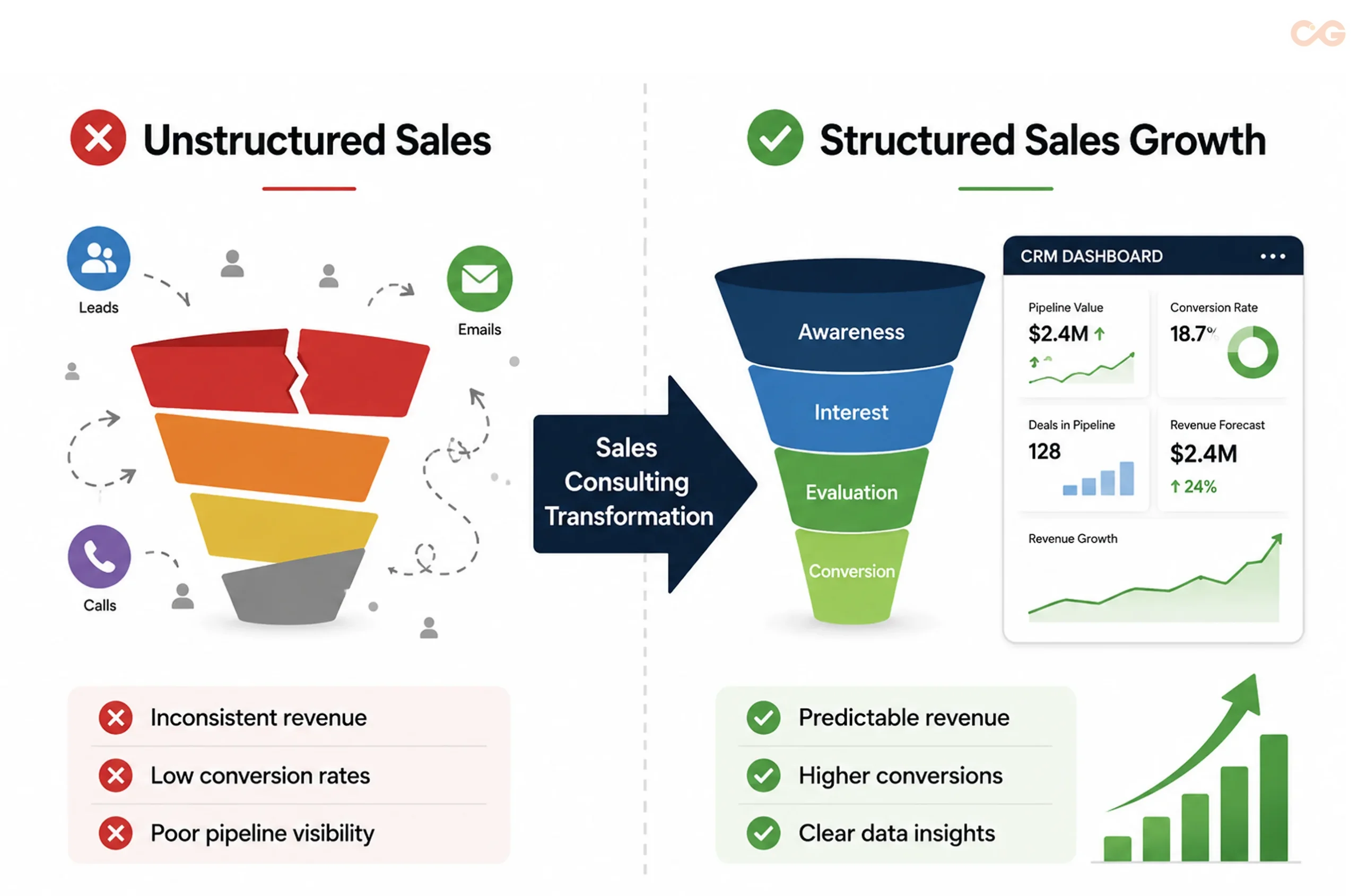
Before vs After – Sales Transformation
Identifying Revenue Gaps in the Sales Funnel
To achieve sustainable revenue growth, businesses must pinpoint where they are losing income. Sales consulting focuses on optimising the sales funnel by identifying inefficiencies, bottlenecks, and hidden revenue leaks.
The first step involves a comprehensive sales performance assessment. Sales consultants examine key metrics like conversion rates, pipeline velocity, deal size, and win-loss ratios. Often, the problems do not originate at the top of the funnel; they commonly occur in the middle or lower stages.
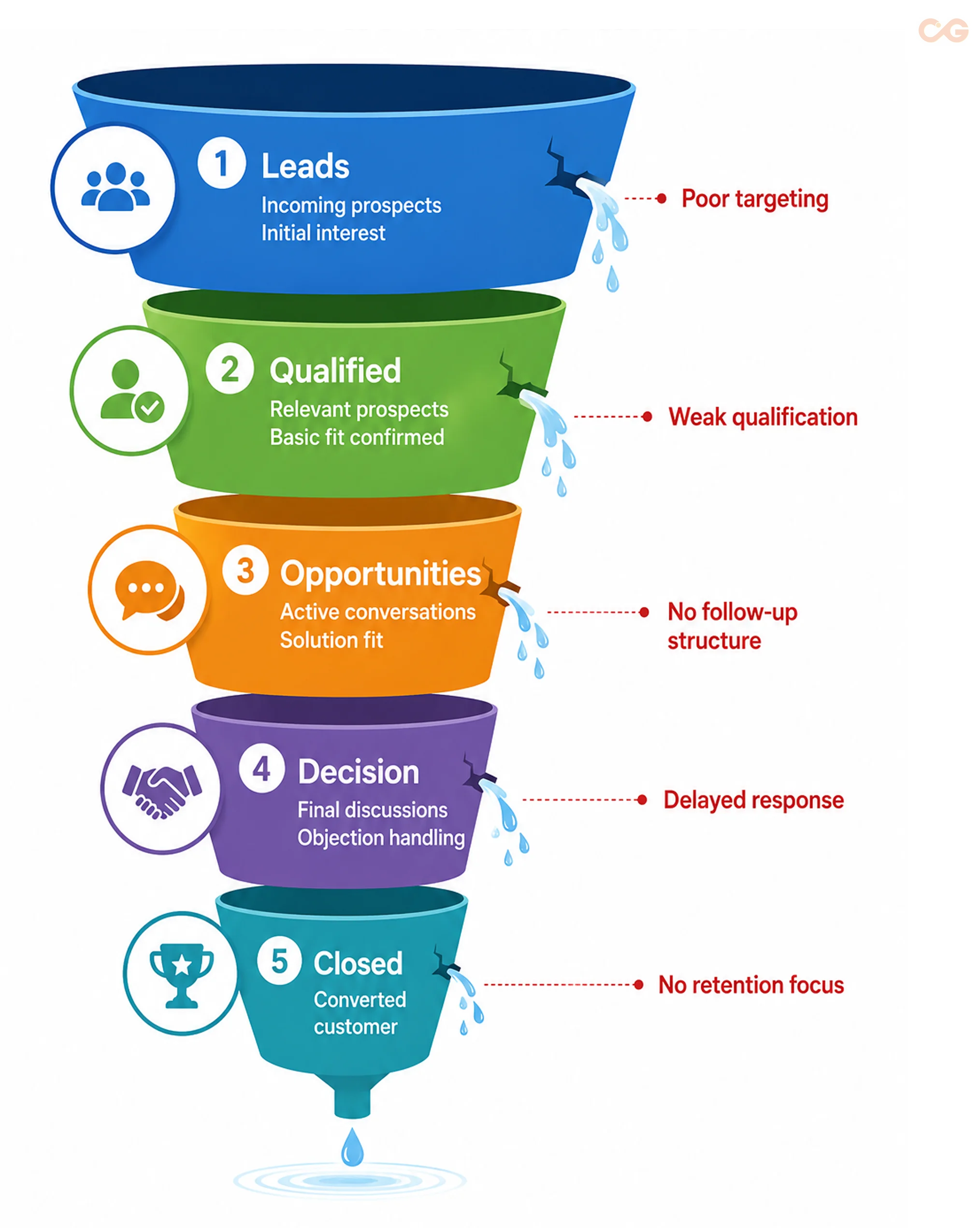
A major challenge businesses face is revenue leakage during various funnel stages. While many leads enter the pipeline, they often fail to convert due to several critical factors:
- Poorly qualified leads allow low-intent prospects to enter the sales process.
- Inconsistent or delayed follow-ups reduce engagement and lower conversion rates.
- Generic sales engagement tactics do not resonate with prospects, making advancement in the funnel difficult.
Research from TrueFutureMedia indicates that 79% of marketing leads fail to convert into sales due to inadequate nurturing and qualification. This highlights the need for better funnel management and stronger alignment between marketing and sales teams.
Another essential but often overlooked issue is revenue attribution. Most organisations lack clarity on which marketing channels or campaigns truly drive revenue. This ambiguity leads to inefficiencies in optimising marketing spending and planning sales strategies.
Takeaway

Is your business losing revenue without you realising it? Use this framework to identify hidden revenue leaks before they impact your growth.
Without accurate attribution, several key problems arise:
- High-performing channels may not receive the budget they deserve due to a lack of understanding of their revenue impact.
- Underperforming channels continue to receive funding simply because their contributions are unclear.
- Strategic decisions often rely on assumptions, resulting in misallocated resources and missed growth opportunities.
To drive revenue growth effectively, implement a robust revenue growth mechanism that addresses these issues within revenue operations.
How Sales Consulting Resolves Revenue Attribution in SMBs
Sales consulting helps businesses build a structured multi-touch marketing attribution model that connects every customer interaction to revenue performance.
At the centre of this approach is integrated CRM tracking, which acts as the single source of truth. Around this system, consultants introduce complementary tools and processes that make every customer touchpoint measurable and actionable.
- Organised UTM Models to Map Campaign Performance
Consultants create a standardised tagging system using parameters such as source, medium, and campaign across all marketing links. This allows businesses to trace every click back to its original source, whether it comes from advertisements, email campaigns, or social media. As a result, they can clearly identify which campaigns are driving conversions and revenue.
- First-Party Analytics to Identify High-Impact Funnel Touchpoints
Consultants use website and funnel analytics tools, such as Google Analytics, to identify where prospects leave the funnel, which pages perform best, and which customer journeys contribute the most to revenue. These insights help businesses make informed decisions to optimise their sales funnel.
- Call Tracking Systems to Measure Offline Conversions
Different marketing campaigns are assigned unique phone numbers or call-tracking tools, enabling businesses to connect inbound calls and offline enquiries with specific marketing activities. This provides a clearer picture of how offline interactions contribute to revenue.
- Marketing Automation Software to Track Lead Journeys and Engagement
SMBs often use platforms such as HubSpot CRM, Zoho CRM, or Mailchimp to automate email campaigns, capture leads, and monitor customer behaviour. These platforms track activities such as email opens, link clicks, and website visits, helping businesses understand how prospects move through the sales funnel and where engagement is strongest.
- Standardised Sales Feedback Loops to Validate Attribution Data
Sales teams are encouraged to consistently record lead-source information during customer conversations, for example, by asking, “How did you hear about us?” This qualitative insight complements CRM data and helps validate the accuracy of attribution.
Together, these systems create a unified revenue attribution framework that does not rely on a single source of data. Instead, businesses gain a more complete, accurate, and consistent understanding of how customers interact with their brand before making a purchase.
Ultimately, effective sales funnel diagnostics provide the analytical foundation needed to improve conversion performance, optimise channel investments, and drive sustainable revenue growth.
People Also Ask
What can you do to increase sales funnel conversion rates?
To increase sales funnel conversion rates, businesses should optimise every stage of the funnel, improve lead qualification, implement structured follow-up processes, and use CRM data to identify where prospects drop off so those bottlenecks can be addressed effectively.
Where Sales Opportunities Leak in Your Funnel
Enhancing Demand Generation and Conversion
Once revenue gaps have been identified and attribution insights are in place, sales consulting shifts its focus to execution by strengthening demand generation and improving conversion efficiency across the sales funnel.
Improving lead quality begins with defining a clear Ideal Customer Profile (ICP) and using data-driven targeting strategies. Rather than focusing on lead volume alone, high-performing organisations prioritise high-intent prospects based on behavioural signals, demographics, and engagement patterns.
Companies that adopt advanced segmentation and targeting strategies can achieve higher conversion rates, demonstrating the importance of precision in demand generation. However, improving conversions requires a structured approach across every stage of the sales funnel:
- Top of the Funnel: Effective positioning and messaging capture attention and increase engagement.
- Middle of the Funnel: Personalised lead nurturing builds interest and strengthens relationships with prospects.
- Bottom of the Funnel: Well-crafted sales pitches and effective objection handling improve conversion rates and drive more successful deal closures.
According to AOV UP, companies that invest in lead nurturing generate 50% more sales-ready leads while reducing costs by 33%, making lead nurturing an essential driver of sustainable revenue growth.
Another key contributor to revenue growth is strong alignment between sales and marketing teams, which is often achieved through a Revenue Operations (RevOps) framework. When these teams operate in silos, businesses frequently face challenges such as low-quality leads, missed opportunities, and inconsistent messaging throughout the customer journey.
- Increased sales conversion rates.
- Greater efficiency in customer acquisition.
- Improved overall sales performance.
This is where strategy meets execution, enabling organisations to create a more efficient and scalable revenue generation process.
People Also Ask
What is the difference between lead generation and demand generation?
What is the difference between lead generation and demand generation?
Takeaway
Is your business losing revenue without you realising it? Use this framework to identify hidden revenue leaks before they impact your growth.
Streamlining Sales Operations and Team Performance
Generating high-quality demand is only one part of the revenue growth in sales. To achieve consistent results, businesses also need an efficient sales process and a high-performing sales team that can convert opportunities into customers. This is where sales consulting helps streamline sales operations, strengthen team performance, and build scalable systems that support long-term growth.
One of the primary areas of focus is reducing the length of the sales cycle. Inefficient workflows, delayed follow-ups, and unclear processes can slow down deal closures and affect overall revenue. By simplifying sales workflows and automating routine tasks, businesses can improve sales velocity, maintain a healthy pipeline, and close deals more quickly. According to Hatrio Sales, organisations that automate their sales processes typically reduce their sales cycle by 28%.
Another important focus is building scalable sales systems. Many businesses rely heavily on individual performance rather than standardised processes, making it difficult to achieve consistent growth. Sales consultants help establish structured systems that improve efficiency and support long-term scalability, including:
- Standardised sales playbooks to ensure a consistent and structured sales approach.
- Clearly defined sales stages to improve pipeline visibility and track progress more effectively.
- Repeatable customer engagement processes that create predictable and scalable interactions throughout the sales journey.
Together, these systems promote consistency, improve collaboration, and make it easier to scale sales operations across teams and markets.
Once these systems are in place, the next priority is ensuring that sales teams consistently follow them and continue to improve over time. This is where performance management plays a critical role.
Effective sales team performance management includes:
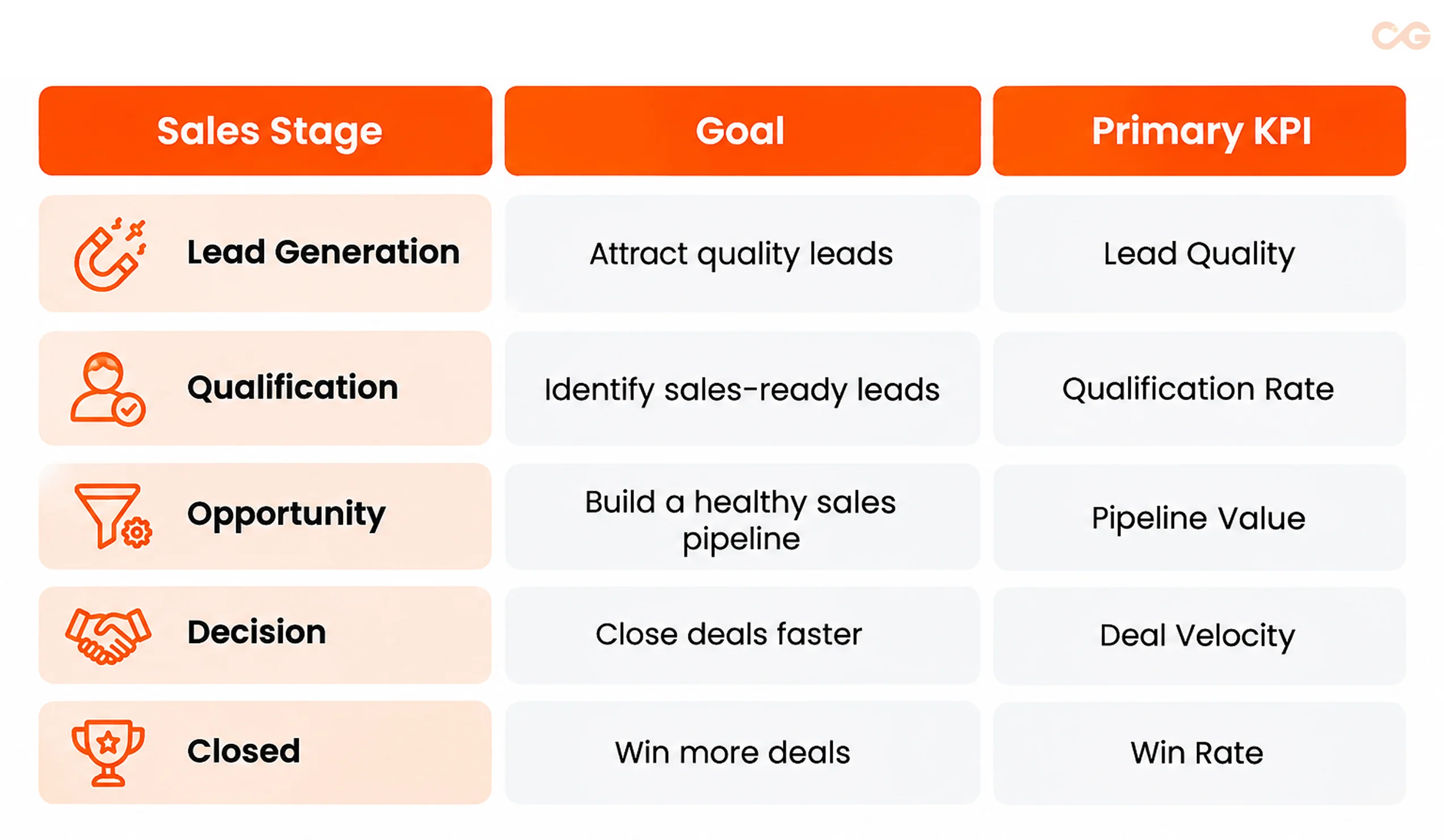
- Establishing clear KPIs, such as conversion rates and quota attainment.
- Providing structured coaching and training to strengthen sales effectiveness.
- Implementing accountability systems to monitor performance and encourage continuous improvement.
According to Darren Flanagan’s research published on LinkedIn, organisations that invest in structured sales coaching can achieve up to a 20% improvement in sales performance, highlighting the importance of ongoing coaching and performance development in driving sustainable revenue growth.
Sales Stages with Key KPIs
Facilitating Data and Technology-Driven Growth
Once efficient sales processes and high-performing teams are in place, the next step is using data and technology to scale those efforts. Sales consulting helps businesses implement CRM systems, sales analytics, and automation tools effectively, enabling better decision-making, improved visibility, and sustainable revenue growth.
CRM systems provide valuable pipeline visibility and customer insights, but their effectiveness depends on how well they are implemented and adopted. Many organisations struggle with incomplete data or low user adoption, making it difficult to generate reliable insights and make informed decisions.
Sales consultants improve CRM effectiveness by:
- Enhancing data accuracy to generate reliable insights and support better decision-making.
- Customising CRM workflows to align with specific sales processes and business requirements.
- Enabling real-time reporting to improve pipeline visibility and monitor sales performance more effectively.
Once a strong CRM foundation is in place, businesses can use sales analytics and predictive forecasting to turn data into actionable insights. Organisations that move beyond basic reporting and embrace advanced analytics gain a significant competitive advantage.
Predictive analytics helps organisations:
- Forecast revenue more accurately using historical data, market trends, and real-time sales performance.
- Identify high-value opportunities through predictive intelligence, behavioural signals, and customer engagement patterns.
- Detect potential risks early in the sales pipeline, helping prevent deal delays or losses.
The final component of the technology ecosystem is automation. By reducing manual tasks and improving response times, automation allows sales teams to focus on high-value selling activities. Automated email sequences, lead scoring, and follow-up workflows improve productivity while creating a more efficient and scalable sales process.
According to Nucleus Research, organisations that use sales automation tools report an average productivity increase of 14.5%, making automation a key driver of scalable revenue growth.
Driving Revenue with Industry-Specific Strategies
Sales consulting principles stay consistent, but approaches to boost revenue vary by industry. Each sector has distinct customer behaviours, buying patterns, and market conditions. Sales consulting enables businesses to create tailored sales strategies that meet these differences and optimise revenue potential.
SaaS: Focus on Recurring Revenue and Customer Lifetime Value
SaaS companies thrive on recurring revenue and customer retention. Unlike traditional models, success comes from not just gaining new customers but also enhancing revenue from existing ones.
Sales consulting emphasises:
- Implementing product-led growth strategies to attract users and accelerate product adoption.
- Optimising onboarding processes to lower customer churn and enhance retention.
- Using upselling and cross-selling tactics to increase customer lifetime value.
As per the research of Averi, top SaaS firms maintain a net revenue retention of over 110% thanks to effective retention and account expansion strategies. Consultants work to align sales, customer success, and product teams, creating a cohesive revenue engine.
Retail: Enhancing Customer Experience and Omnichannel Sales
In retail, providing a smooth customer experience across various channels is crucial for sales. As customers engage with brands online and offline, maintaining consistency and integration boosts engagement and conversions.
Sales consulting assists businesses by:
- Merging online and offline channels to ensure a consistent customer experience.
- Leveraging customer data for personalised promotions and targeted engagement.
- Improving omnichannel experiences to enhance conversion rates at every touchpoint.
An effective omnichannel strategy deepens customer engagement, drives repeat purchases, and increases conversion rates, playing a vital role in retail growth.
Manufacturing: Managing Complex Sales Cycles and Relationships
Manufacturing companies often face extended sales cycles and high-value transactions that depend on relationship management. Achieving sustainable growth requires building trust, showcasing technical expertise, and nurturing strong customer relationships.
Sales consulting concentrates on:
- Employing account-based selling strategies to pinpoint and convert high-value customers.
- Strengthening technical sales knowledge to improve customer communication.
- Optimising relationships with distributors and channel partners to expand market reach and boost efficiency.
These approaches enhance conversion rates, improve customer relationships, and elevate overall sales effectiveness in complex manufacturing environments.
Expanding Revenue Beyond Industry-Specific Strategies
While tailored strategies tackle unique challenges, sales consulting also identifies broader avenues for long-term revenue growth. By examining market trends and performance metrics, consultants reveal scalable opportunities for sustainable expansion.
This includes guiding businesses into high-potential markets, identifying underserved customer segments, and fine-tuning pricing strategies to enhance profitability without diminishing demand.
Sales consulting also promotes revenue diversification through cross-selling, upselling, and service innovation. By refining pricing strategies and identifying new revenue opportunities, businesses can improve profitability while supporting sustainable long-term growth.
Takeaway
Is your business losing revenue without you realising it? Use this framework to identify hidden revenue leaks before they impact your growth.
Conclusion: The Mobile-First Future of India
Sales consulting has become a key driver of revenue growth by helping businesses move from reactive selling to a more strategic and structured sales approach. By optimising sales funnels, streamlining processes, and leveraging performance analytics, it transforms sales into a predictable and scalable growth engine.
Its greatest value lies in identifying hidden inefficiencies, improving conversion rates at every stage of the sales funnel, and providing actionable insights that support data-driven decision-making. It also helps businesses build repeatable systems and well-defined workflows, enabling long-term scalability and stronger overall sales performance.
Rather than offering a short-term solution, sales consulting is a long-term investment in business growth. It strengthens sales and marketing alignment, improves operational efficiency, and equips organisations to achieve sustainable, measurable revenue growth in an increasingly competitive business environment.