
10 Non-Negotiable Sales Rules Every Revenue Team Must Follow
Table of Contents
- Introduction
- The Importance of Sales Rules
- The 10 Non-Negotiable Sales Rules
- Common Mistakes Revenue Teams Make
- How to Implement These Rules
- Conclusion
1. Introduction
Modern sales have shifted from a seller-led process to a buyer-driven journey. Today, buyers research solutions, compare providers, evaluate alternatives, and form opinions before they ever engage with a sales team.
This shift creates both an opportunity and a challenge for revenue teams. Sales teams must engage buyers at the right time, with relevant information and consistent follow-up, rather than relying on a single interaction to drive a purchase decision. As buying journeys become more complex, consistent execution becomes essential.
So, what are sales rules?
Sales rules are data-informed operational benchmarks that guide how revenue teams prioritise leads, manage pipelines, engage buyers, and move opportunities toward closure. Unlike theoretical sales frameworks, these rules are grounded in observed sales patterns, conversion behaviour, and execution practices.
When applied consistently, sales rules help teams improve execution, strengthen pipeline predictability, prioritise high-value opportunities, and create a more scalable approach to revenue growth. The following 10 sales rules provide a practical framework for turning these principles into repeatable sales actions.
2. The Importance of Sales Rules
Defining sales rules is only the first step. Their real value comes from creating a consistent way to execute sales activities across teams, stages, and buyer touchpoints. Without clear standards, performance can vary significantly based on individual selling styles, follow-up habits, and decision-making.
Sales rules turn proven sales practices into repeatable actions across the sales funnel from responding to leads and qualifying opportunities to managing the pipeline and closing deals. Rather than serving as generic guidelines, they provide practical standards that teams can apply and measure throughout the sales process.
When consistently applied, sales rules can help revenue teams to:
- Improve pipeline visibility and forecast accuracy
- Increase conversion rates across key funnel stages
- Maintain a healthier and more consistent pipeline
- Strengthen coordination between marketing, SDRs, and sales
- Prioritise opportunities based on measurable sales signals
More importantly, sales rules create a shared operating system for the sales team. This reduces dependence on individual selling styles and makes performance more consistent across representatives, opportunities, and accounts.
Over time, this consistency helps organisations scale more effectively. Instead of simply generating more opportunities, teams can focus on improving the quality, progression, and predictability of those opportunities. The result is a healthier pipeline, more efficient deal cycles, and more dependable revenue performance.
With the role of sales rules established, the next section looks at the 10 non-negotiable rules revenue teams can apply across the sales process.
3. The 10 Non-Negotiable Sales Rules
The following rules are based on recurring patterns in B2B sales execution. Together, they provide practical standards for improving lead response, pipeline management, buyer engagement, and deal progression.
3.1 The 5-Minute Rule (Speed to Lead)
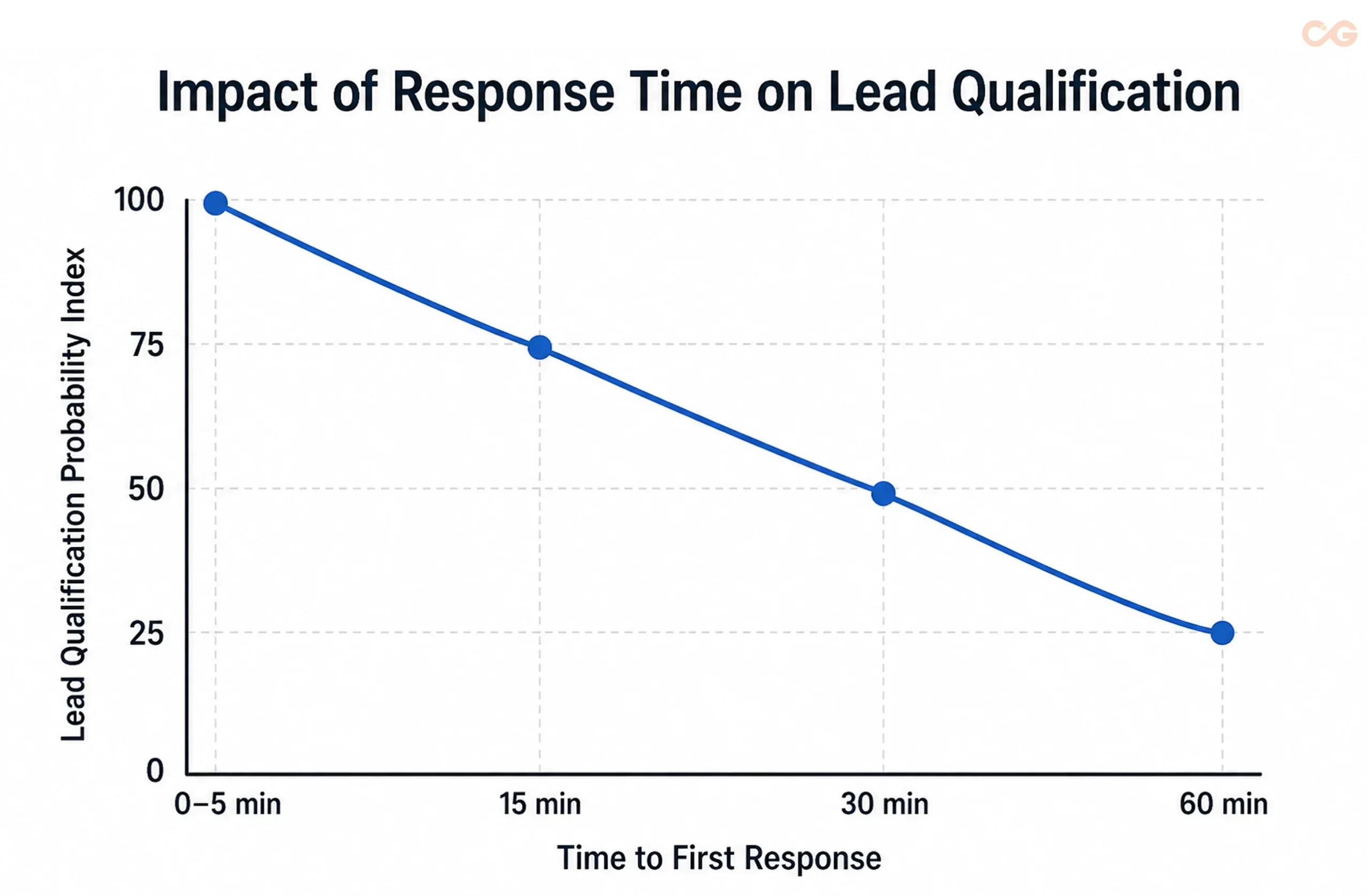
The 5-minute rule recommends responding to an inbound lead within five minutes of their enquiry, when interest and buying intent are typically at their highest.
Research cited by Ken Krogue reports that leads contacted within five minutes are 21 times more likely to be qualified than those contacted after 30 minutes.
The reason is simple: an inbound enquiry signals active interest. The longer a team waits, the greater the chance that the buyer will continue researching alternatives or engage with a competitor. A fast response helps sales teams enter the conversation while the need is still fresh.
High-performing teams make this rule operational through automated lead routing, response-time SLAs, real-time alerts, and SDR prioritisation. The goal is not simply to respond quickly, but to make the first response timely, relevant, and useful.
People Also Ask
Is a 5-minute response realistic for all businesses?
Not always through manual effort. However, businesses can use automation, lead-routing workflows, alerts, and SDR prioritisation to reduce response times and achieve near-instant first contact.
3.2 The 3x Pipeline Coverage Rule
The 3x pipeline coverage rule helps sales teams make sure they have enough potential revenue in the pipeline to reach their targets. Since not every opportunity turns into a closed deal, teams need a healthy pipeline to account for deals that are lost or delayed.
3x Pipeline Coverage Formula
Pipeline Coverage = Total Pipeline Value / Revenue Target
According to LandBase, average B2B win rates commonly fall between 21% and 29%. In other words, most opportunities in the pipeline will not become closed revenue. A 3x coverage target gives sales teams a buffer to absorb these expected losses.
Example:
Suppose a sales team has:
- Revenue target: ₹1 crore
- Average win rate: 25%
- Required pipeline: ₹3–4 crore
Maintaining 3x–4x coverage gives the team enough room to deal with differences in deal quality, conversion rates, and sales cycle length.
Good vs. Poor Pipeline Coverage
- Good coverage (3–4x): A wider pool of opportunities reduces dependence on a few large deals and makes revenue forecasts more reliable.
- Poor coverage (<2x): With fewer opportunities available, losing even a few deals can create a significant gap against the revenue target.
So, pipeline coverage is not just about having a large number of opportunities. It helps sales teams understand whether the pipeline is strong enough to support future revenue.
Teams should review pipeline coverage regularly and adjust lead generation, qualification, and opportunity progression when coverage starts to fall.
Practical takeaway: Pipeline coverage answers a simple question: Do we have enough qualified opportunities to realistically reach our revenue target?
Takeaway

Turn your sales rules into consistent execution with this practical checklist.
3.3 The 80/20 Rule (Pareto Principle)
The 80/20 rule, also known as the Pareto Principle, is based on a simple idea: a relatively small number of inputs can often generate a large share of the results. In sales, this means some customers, deals, and activities will naturally contribute more value than others.
In sales, the 80/20 pattern can show up in areas such as:
- A small group of customers generating a significant share of total revenue
- A smaller number of high-intent opportunities producing most conversions
- A few sales activities or channels consistently delivering better results
The practical lesson is simple: not every opportunity deserves the same amount of attention. A pipeline may contain hundreds of leads, but their value, buying intent, conversion potential, and strategic importance can vary widely.
Sales teams can use factors such as deal value, conversion probability, buying intent, customer potential, and strategic fit to identify which opportunities deserve more attention.
This helps teams move beyond simply doing more sales activities. Instead, they can spend more time on the accounts, deals, and channels that are most likely to generate meaningful results.
Practical takeaway: The 80/20 rule does not mean that the ratio will always be exactly 80:20. It means finding where the greatest value is coming from and focusing resources there.
3.4 The Rule of 7 (Buyer Exposure)
The Rule of 7 is based on the idea that buyers often need several interactions with a brand before they feel familiar and confident enough to take action. In today’s B2B buying journey, these interactions can happen across different channels and at different stages of the decision-making process.
Buyer exposure can include:
- Reading blogs, guides, or other educational content
- Watching videos or engaging with social media content
- Visiting the company website
- Speaking with sales representatives
- Reading reviews, case studies, or recommendations from peers
These interactions build on one another. A buyer might first discover a company through a blog, visit its website later, engage with its social content, and eventually speak with a salesperson. Each interaction can make the brand more familiar and reduce uncertainty around the buying decision.
However, repeated exposure does not mean sending the same message again and again. Each touchpoint should provide something useful, whether that is new information, evidence, guidance, or a clearer understanding of the buyer’s problem.
For revenue teams, this means treating buyer engagement as a connected journey rather than a series of unrelated interactions. Marketing content, social media, website experiences, and sales conversations should work together to build trust and move the buyer closer to a decision.
Practical takeaway: Multiple touchpoints work best when each interaction adds value and strengthens the buyer’s understanding and confidence in the brand.
3.5 The 6–8 Touchpoint Rule
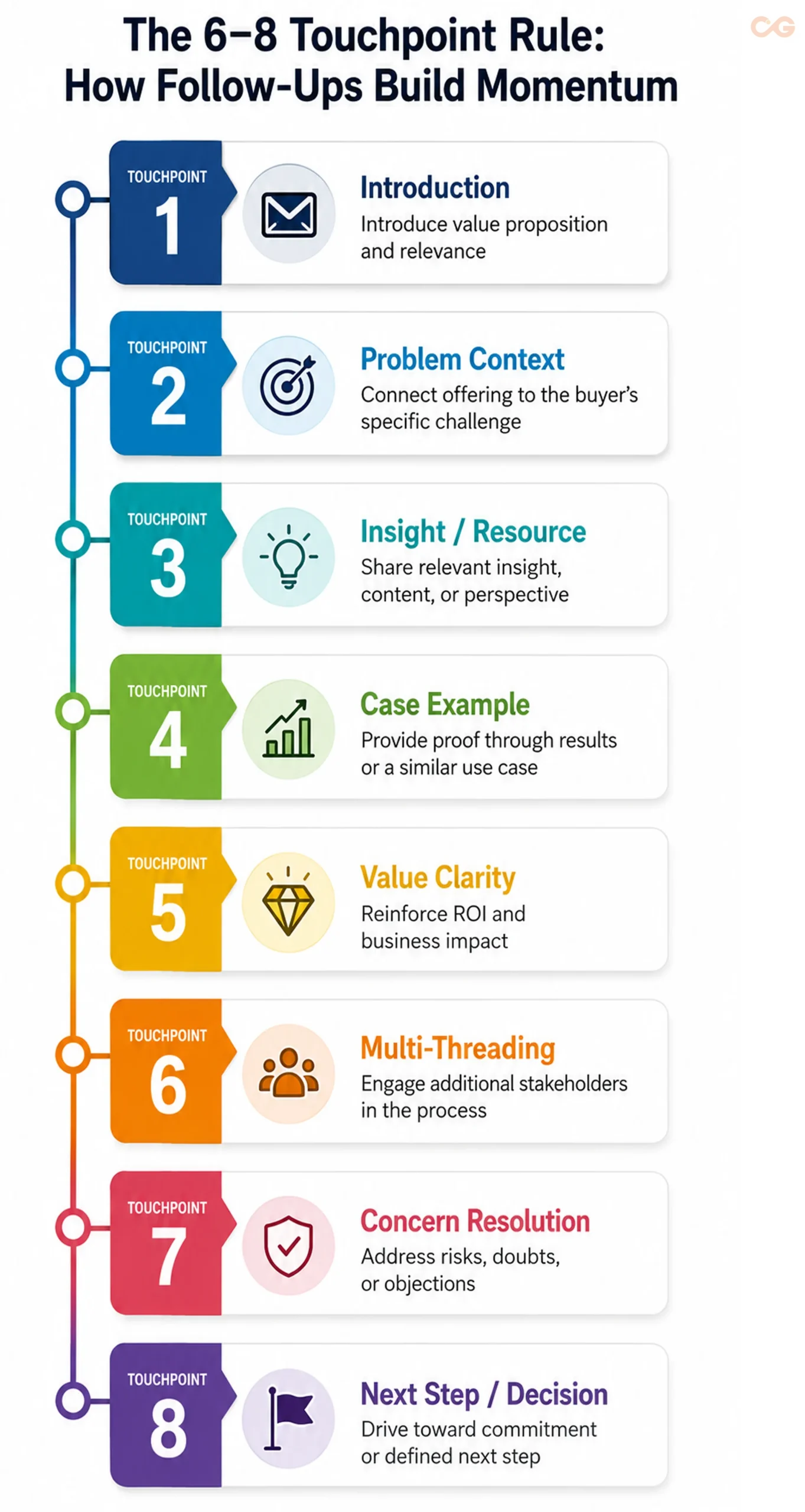
The 6–8 touchpoint rule highlights the importance of consistent follow-up in moving sales opportunities forward. Buyers rarely make a decision after a single interaction. Multiple, relevant conversations help build trust, address questions, and maintain momentum throughout the sales cycle.
Martal Group reports that 80% of deals require at least five follow-ups after the initial contact, highlighting the importance of continued engagement rather than relying on a single outreach attempt.
Effective follow-ups should be:
- Progressive: Each interaction adds new information, value, or insight instead of repeating the same message.
- Contextual: The follow-up reflects the buyer’s needs, sales stage, and previous interactions.
- Action-oriented: Each conversation gives the buyer a clear and relevant next step.
Consistent, value-driven follow-up helps sales teams maintain momentum and move opportunities closer to a decision.
Insight: Effective follow-up is not about contacting buyers more often. It is about making every interaction relevant enough to move the conversation forward.
People Also Ask
How can follow-ups stay effective without becoming intrusive?
Keep them timely, relevant, and purposeful. Each follow-up should add new value, address a specific need, or provide a clear next step rather than simply repeating the previous message.
3.6 The No Decision = Lost Deal Rule
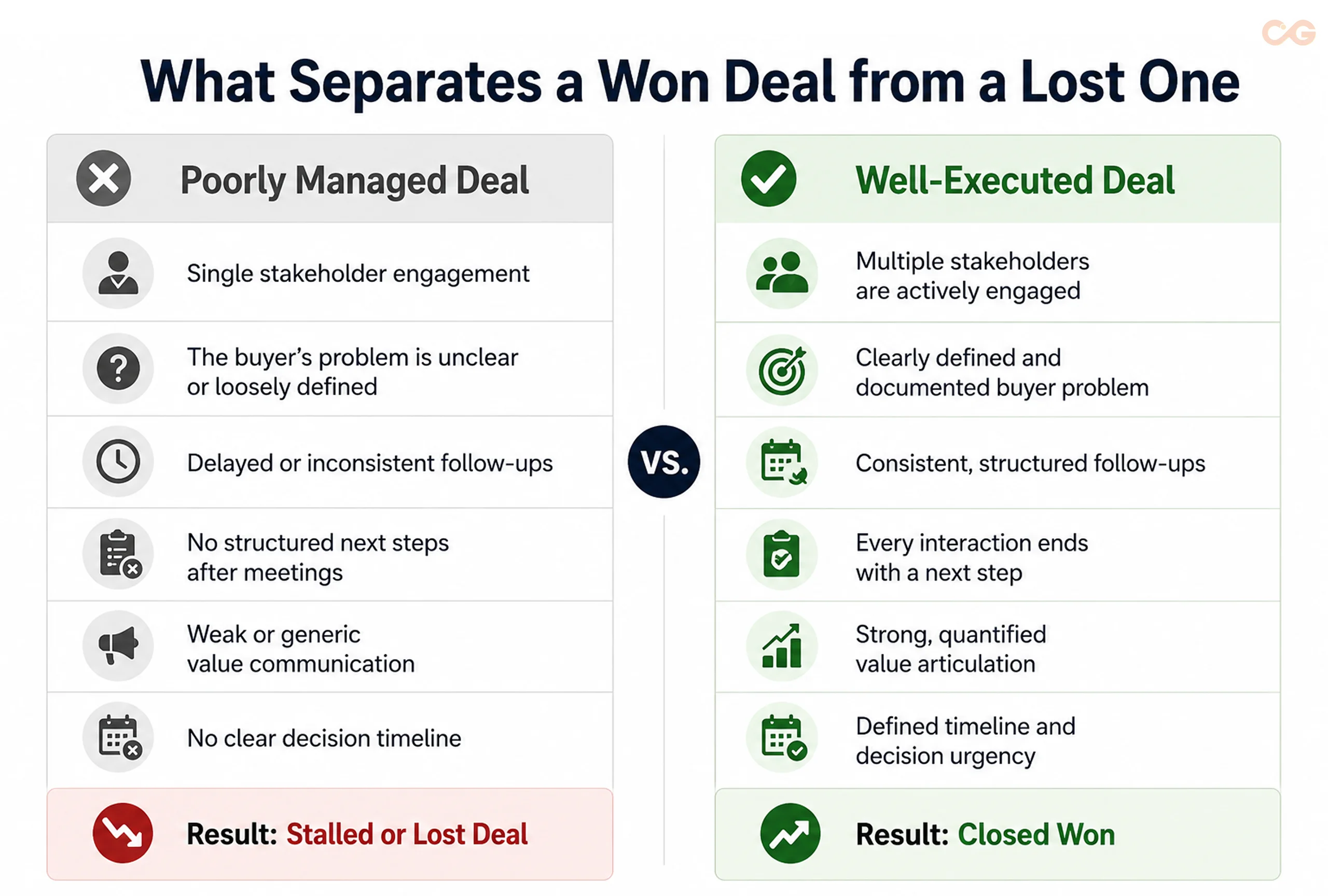
The “No Decision = Lost Deal” rule highlights an important reality in B2B sales: a deal can be lost even when the buyer does not choose a competitor. When stakeholders cannot agree, define priorities, or build enough confidence to move forward, an opportunity can simply stall.
This makes decision momentum critical. Without clear progress, even promising opportunities can lose urgency and remain stuck in the pipeline.
Why deals stall
- Internal misalignment: Stakeholders have different priorities or expectations.
- Unclear decision criteria: The buying group has not agreed on what defines the right solution.
- Risk aversion: Uncertainty makes stakeholders more comfortable delaying a decision.
How effective teams respond
- Create decision clarity: Help buyers define priorities, requirements, and success criteria.
- Build alignment: Engage relevant stakeholders early and address their concerns.
- Maintain momentum: End each meaningful interaction with a clear next step.
Insight: Sales momentum comes from helping buyers move toward a decision, not simply from creating more activity.
Teams should review pipeline coverage regularly and adjust lead generation, qualification, and opportunity progression when coverage starts to fall.
Practical takeaway: Pipeline coverage answers a simple question: Do we have enough qualified opportunities to realistically reach our revenue target?
3.7 Multi-Stakeholder Buying Rule
The multi-stakeholder buying rule recognises that B2B purchasing decisions are rarely made by one person. Different stakeholders often evaluate the same solution based on their own priorities, responsibilities, and concerns.
Adobe notes that B2B buying groups can include 6 to 10 decision-makers on average, making stakeholder alignment an important part of the sales process.
What makes multi-stakeholder deals complex?
- Different priorities: Finance may focus on cost, IT on integration, and users on usability.
- Longer alignment cycles: More stakeholders often mean more discussions and approvals.
- Decision friction: Different perspectives can make it harder to reach a shared decision.
How effective teams manage it
- Map stakeholders early: Identify decision-makers, influencers, users, and potential blockers.
- Tailor communication: Connect the solution to each stakeholder’s priorities and concerns.
- Build consensus: Bring stakeholders together around shared business outcomes rather than individual preferences.
Example: In a SaaS purchase, the IT team may focus on integration, finance on cost, and end users on usability. Addressing each concern helps the buying group build a stronger case for moving forward.
Teams should review pipeline coverage regularly and adjust lead generation, qualification, and opportunity progression when coverage starts to fall.
Insight: Winning a B2B deal often requires aligning the entire buying group, not just the initial point of contact.
Takeaway
Turn your sales rules into consistent execution with this practical checklist.
3.8 First Response Advantage Rule
The first response advantage rule highlights the value of making the first meaningful interaction with a buyer. An early, relevant response can shape how buyers understand their problem, evaluate available solutions, and view your company.
While the 5-minute rule focuses on responding quickly, this rule focuses on what that first response achieves. A fast response is valuable, but it becomes more effective when it also provides useful information or direction.
What does early involvement help with?
- Problem framing: Helps buyers clarify their needs and challenges.
- Evaluation: Introduces useful criteria for comparing potential solutions.
- Positioning: Gives your solution an early place in the buyer’s consideration.
How teams can use this advantage
- Respond with relevance: Connect the first response to the buyer’s specific enquiry.
- Add immediate value: Offer useful information, insight, or direction rather than a generic reply.
- Guide the conversation: Help the buyer understand the problem and identify the next step.
Insight: The goal of the first response is not simply to be first. It is to make the first interaction useful enough to influence the conversation that follows.
3.9 The Pipeline Velocity Rule
The pipeline velocity rule measures how quickly opportunities move through the sales pipeline and contribute to revenue. It shows that sales performance depends not only on the number of opportunities but also on how efficiently those opportunities progress toward closed deals.
Sales Pipeline Velocity Formula
Pipeline Velocity = (Number of Deals × Average Deal Size × Win Rate) / Sales Cycle Length
The formula combines four factors that directly influence revenue flow: the number of opportunities, their average value, the likelihood of winning them, and the time required to close them.
What drives pipeline velocity?
- Win rate: A higher conversion rate generates more revenue from the existing pipeline.
- Deal size: Larger average deals increase the revenue generated from each opportunity.
- Sales cycle length: Shorter sales cycles allow revenue to be realised faster.
Why does pipeline velocity matter?
Generating more leads is only one part of sales growth. Teams can also increase revenue by improving conversion rates, increasing deal value, or reducing the time it takes to close opportunities.
Insight: Improving pipeline efficiency can help sales teams generate revenue faster without relying solely on increasing lead volume.
People Also Ask
What is a good pipeline velocity?
There is no universal benchmark because pipeline velocity varies by industry, deal size, win rate, and sales cycle. The more useful measure is whether your team’s velocity is improving consistently over time.
3.10 The Value Perception Rule
The value perception rule highlights an important principle in B2B sales: buyers do not evaluate price in isolation. They consider whether the expected value and business impact justify the investment.
Key factors that influence value perception
- Return on investment: The financial return the solution can generate compared with its cost.
- Risk reduction: How effectively the solution reduces business risks, uncertainty, or potential losses.
- Business impact: How the solution can improve revenue, efficiency, productivity, or overall performance.
When buyers can clearly understand the business value of a solution, price becomes easier to evaluate in context.
Why this matters in sales
- Clear value reduces price sensitivity: Buyers can better understand what they are paying for.
- Unclear value encourages price comparisons: When the benefits are not clear, price often becomes the easiest comparison point.
- Strong value positioning reduces discount pressure: Demonstrating measurable outcomes gives sales teams a stronger basis for defending the price.
Insight: In competitive B2B markets, clearly communicating the value and business outcomes of a solution can be just as important as presenting its price.
4. Common Mistakes Revenue Teams Make
Having clear sales rules is only useful when teams apply them consistently. In practice, revenue teams can lose momentum through small execution gaps that accumulate across the sales funnel. These issues may not reflect a weak sales strategy, but they can still affect pipeline quality, conversion rates, and revenue predictability.
Common execution mistakes include:
- Delayed lead response: Slow responses can cause teams to miss the period when buyer interest is strongest. Even qualified leads can lose momentum when there is a long gap between enquiry and first contact.
- What to do: Set clear response-time expectations, use automated lead routing, and prioritise high-intent enquiries.
- Inconsistent follow-up: Following up once or twice and then stopping can leave promising opportunities without the engagement needed to move forward.
- What to do: Use a structured follow-up process based on the buyer’s needs, previous interactions, and stage in the sales cycle.
- Poor pipeline quality: A large pipeline may look healthy on paper, but opportunities with low buying intent, poor fit, or limited revenue potential can make forecasts unreliable.
- What to do: Review opportunities regularly based on qualification, deal value, buying intent, and conversion potential.
- Treating every opportunity equally: Giving the same level of attention to every lead or account can spread sales resources too thin. The 80/20 sales rule highlights the importance of focusing on opportunities with greater potential value.
- What to do: Prioritise accounts based on revenue potential, strategic fit, buying intent, and conversion probability.
- Identifying stakeholders too late: B2B deals often involve multiple stakeholders with different priorities. Relying on a single contact can create delays when other decision-makers enter the process later.
- What to do: Map key stakeholders early and tailor communication to their roles, concerns, and decision criteria.
- Managing deals passively: Waiting for buyers to take the next step can cause opportunities to lose urgency and eventually stall.
- What to do: End important interactions with a clear next step, confirm timelines, and actively help buyers move toward a decision.
Why These Mistakes Matter
Each issue may seem minor on its own, but repeated execution gaps can create significant revenue leakage. Delayed responses can reduce engagement, weak follow-up can slow opportunities, poor qualification can fill the pipeline with low-value deals, and late stakeholder involvement can extend sales cycles.
The solution is not necessarily to increase sales activity. It is to execute the right activities consistently and at the right stage of the buyer journey.
Insight: Revenue performance often improves when teams close execution gaps across the funnel. Consistently applying the right sales rules can turn good opportunities into more predictable outcomes.
5. How to Implement These Rules
The value of the 10 sales rules comes from putting them into everyday sales operations. Rather than treating them as general best practices, revenue teams can build them into their workflows, metrics, and team routines.
What effective teams do to implement them:
- Embed rules into CRM workflows: Set lead response SLAs, follow-up triggers, pipeline coverage thresholds, and stage-based actions.
- Track key sales indicators: Monitor metrics such as pipeline coverage, pipeline velocity, response time, win rate, and sales cycle length.
- Align marketing and sales: Use shared definitions for qualified leads, buyer touchpoints, and conversion stages to create a consistent handoff.
- Build accountability: Use dashboards, regular reviews, and performance discussions to identify gaps and maintain execution discipline.
- Review and refine: Compare results against the rules regularly and adjust processes when buyer behaviour, conversion patterns, or business priorities change.
This turns sales rules into a repeatable operating system rather than a set of guidelines that depend on individual selling styles.
Insight: Sustainable sales performance comes from making the right behaviours repeatable, measurable, and accountable across the team.
Takeaway
Turn your sales rules into consistent execution with this practical checklist.
6. Conclusion
The 10 sales rules provide a practical framework for improving how revenue teams manage leads, opportunities, buyers, and deals throughout the sales process
From responding quickly and maintaining meaningful follow-up to managing pipeline coverage, aligning stakeholders, and communicating value, these rules address the key areas that influence sales execution and revenue performance.
When consistently applied, they can help teams achieve:
- More predictable pipelines: Better visibility into opportunities and improved forecasting.
- More efficient deal cycles: Clearer progression and fewer execution gaps.
- Stronger revenue performance: A repeatable sales process that can scale with the business.
The goal is not to make every salesperson follow the same style. It is to create a consistent sales system that gives teams the structure, visibility, and discipline needed to perform effectively.
Closing Insight: Sustainable revenue growth comes from turning sound sales principles into consistent, measurable execution across the entire sales process.