
Key KPIs that All Small businesses should measure: All the details an Indian entrepreneur needs to know
Operating a small business in the competitive business environment in India is like sailing a ship in the sea with unknown waters. You are making myriad decisions every day, but what do you do to know whether you are heading in the right direction? The solution is to monitor the appropriate KPIs for small businesses.
Most Indian business leaders fall into the trap of vanity metrics—impressive-looking numbers that fail to drive meaningful business growth. In the meantime, the metrics that actually matter are frequently ignored. This is a complete guide that can assist you in realising what kind of business metrics to track, and how to apply them successfully in the Indian market situation.

Introduction to KPIs
The Building Block of Data-Based Decision Making
People Also Ask: What are KPIs and their importance to small businesses?
Key Performance Indicators (KPIs) are measurable metrics in which the performance of your business is reflected in terms of how well it attains its main goals. Imagine them as the vital signs to your business, just as a doctor checks your heart rate and blood pressure to determine how healthy you are, KPIs allow you to determine the performance of your business.
In the case of small businesses in India, where a rupee matters, measuring the appropriate KPIs is not only good but a survival strategy. According to a CB Insights study, points out that 35% of startups are a failure because of a lack of need in the market, which might be discovered very early by the right tracking of customer perception and market performance indicators.
How do metrics differ from KPIs?
Although the terminology and the terms are used interchangeably, there is one important difference. Any data that you quantify is considered a metric; it can be the number of visitors to your site, your followers on social media, or your email open rates. Instead, KPIs are the actual measures that are directly connected to your strategic business objectives. All KPIs are metrics, though not all metrics are KPIs.
To illustrate, in case you operate a boutique clothing business in Mumbai, one of the metrics is the number of Instagram followers. However, the conversion rate of Instagram to real sales is a KPI since it directly influences your revenue target.
From Goals to Metrics: Understanding the KPI Hierarchy
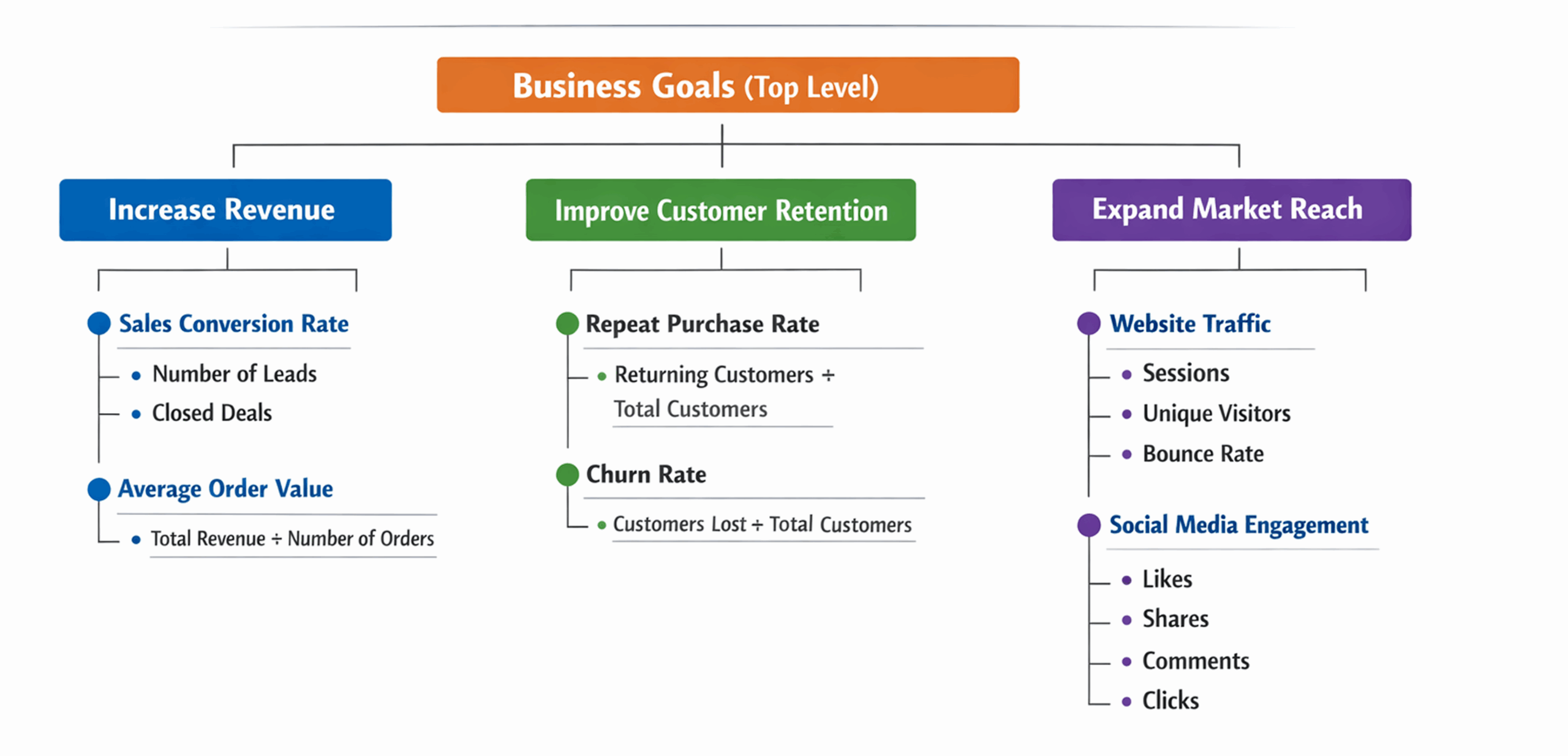
Financial Key Performance Indicators: The Lifeline of Your Business
Revenue Growth Rate
The rate of increase in revenue is, perhaps, the simplest sign of the health of the business. It demonstrates that your business is growing, flat, or shrinking.
Formula: [(Current Period Revenue – Previous Period Revenue) / Previous Period Revenue] × 100
In the case of small businesses in India, it is essential to monitor monthly revenue growth because of the seasonal character of various businesses. An example would be that retailers would be busy when Diwali or wedding seasons are on, or B2B service providers may have sluggish quarters in the summer.
Indian Case Study
Chumbak, the eccentric lifestyle brand based in Bangalore, carefully tracked its revenue growth rate on the various products and channels. This assisted them to realise that the online sales were increasing at a rate of 8 per cent annually, and they decided to invest much in their e-commerce site, which ultimately became their major source of revenue, according to the research of Canvas.
Gross Profit Margin
This measure shows how much money you are left with after considering the direct costs of producing your goods or services.
Formula: [(Revenue – Cost of Goods Sold) / Revenue] × 100
With the price-sensitive market in India, it is a fine balancing act to ensure a healthy profit margin and be competitive at the same time. Industry average gross profit margin can differ widely- software services may have 75-85% margins, and retail may run on 30-45%, as per the research of Gross Margin.
People Also Ask: What can I do to increase my profit margin as a small business?
Small businesses in India can enhance their profitability by negotiating long-term supplier rates, optimising inventory, embracing technology to curb inefficiencies, employing value-based pricing, as well as experimenting with direct-to-consumer channels to reduce the middlemen to improve cost effectiveness.
Cash Flow
Cash flow is the flow of money which goes in and out of your business. Poor management of cash flows can result in the failure of even profitable businesses- and this is a problem that Indian SMEs face in terms of late payments.
Formula: Cash Flow = Operating Cash Flow + Investing Cash Flow + Financing Cash Flow
The issue with working capital among small businesses in India is critical, and cash flow monitoring is therefore a must. The Rule of 40 is widely employed by many successful businesspeople in India; they keep a minimum of 40 days of operating expenses in liquid cash.
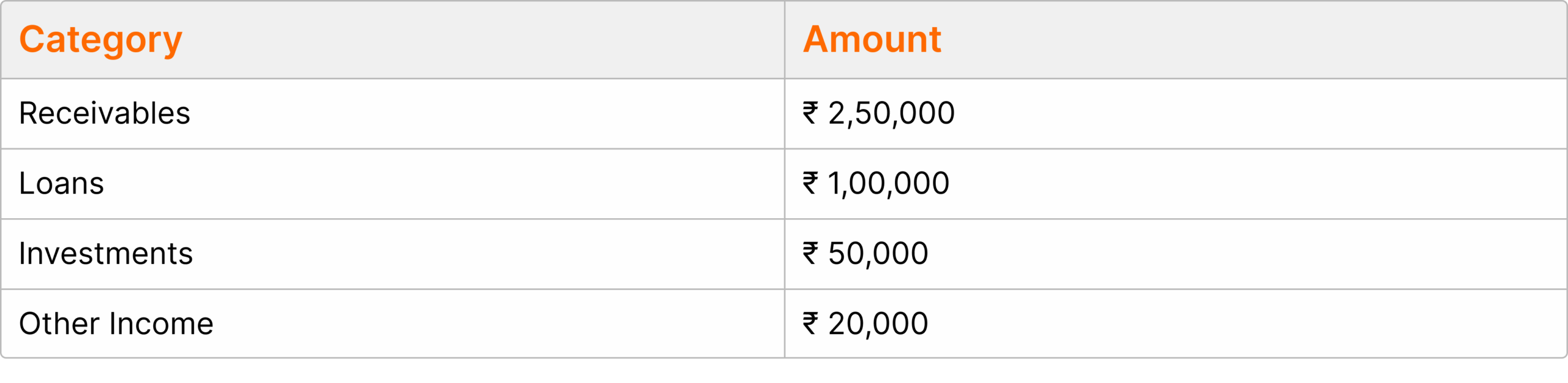
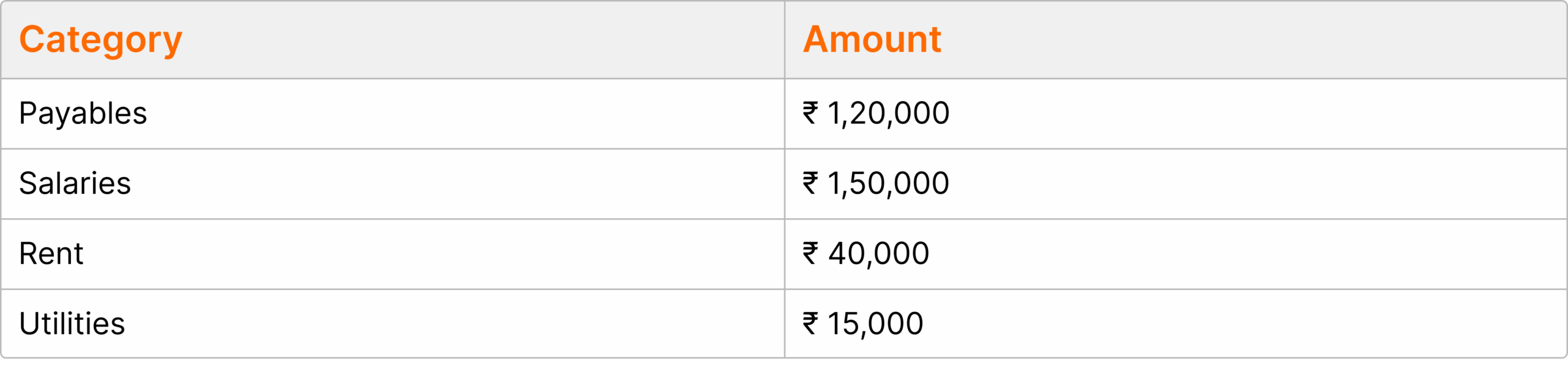
Business Cash Flow Overview
Inflows (Cash Coming In)
Outflows (Cash Going Out)
Net Cash Flow
Calculation: Total Inflows – Total Outflows
Example: ₹4,20,000 – ₹3,25,000 = ₹95,000 net cash
Customer Acquisition Cost (CAC)
CAC gives you an estimate of the amount of money you are spending to get each new customer, both the costs of digital marketing measurement and the sales costs.
Blog: Digital Marketing: A Transformation Guide to Traditional Indian Businesses
Section: Digital marketing strategies for traditional Indian businesses
Formula: Total Sales and Marketing Costs/Number of New Customers Acquired
In the case of Indian small businesses, CAC differs radically across channels. The industry data show that the average CAC of basic plans for:
Social media marketing: ₹8,000-₹15,000 per month
Google Ads: ₹10,000-₹30,000 per month
Organic content marketing: ₹2,000-₹4,000 per piece, according to Digital Sky 360.
People Also Ask: How much do small businesses in India spend on acquiring customers?
The general principle is that your CAC must not exceed one-third of your Customer Lifetime Value (CLV). In the case of a subscription-based business, the goal is to recover CAC in the span of 12 months. In the case of e-commerce, it is best to recover CAC during the initial purchase due to the presence of a competitive market.
Customer Lifetime Value (CLV)
CLV is used to determine the amount of revenue you are likely to get out of an individual customer during the time they are established with your company.
Formula: (Average Purchase Value × Purchase Frequency × Customer Lifespan)
Indian businesses tend to underestimate CLV and pay more attention to acquisition as opposed to retention. Nevertheless, researches indicate that an increment in customer retention by even 5 per cent can result in higher profits of 25-95 per cent, according to the research of ClickPost.
Indian Case Study
FirstCry, the largest online retailer of baby products in India, increases the customer lifetime value with early hospital collaboration, one-on-one communication with WebEngage, loyalty programs, and its parenting content platform. Its omnichannel offer and its own labels, such as BabyHug, retain customers, enhance trust, and trigger repeat buying during the parenting process.
Measuring Online Success: Digital Marketing KPIs
In the fast-digitalising Indian economy, the knowledge of digital marketing KPIs is not a compromise. Your online presence has a direct influence on your bottom line because it has more than 900 million internet users.
Traffic and Engagement Website Measures
Critical website indicators are:
Unique Visitors
Unique Visitors are the number of individual persons visiting your site. In the case of the Indian business, the source of traffic can be tracked to determine whether your audience is a result of organic search, social media or paid campaigns.
Bounce Rate
This is the rate of visitors who exit after visiting just a single page. The list of the most visited websites and their bounce rates in the month of August 2025, according to the study of Semrush:

32.51%

50.03%

35.98%

56.97%
Average Session Duration
The duration the visitors spend on your site. Indian users spend on average 4 minutes and 56 seconds on healthcare websites, with an average of more time spent on mobile devices, according to Spectrum Infinite.
People Also Ask: What is the cost-effective way of measuring website performance?
Google Analytics is the best marketing analytics for the small business category- and it is free.
Indian businesses are advised to keep an eye on traffic, city and state, mobile and desktop, Hindi and regional language page performance, and page load speed that will make India and its diverse, mobile-first, and multilingual internet audience more accessible and engaging.
Google Analytics Dashboard for Indian Small Businesses
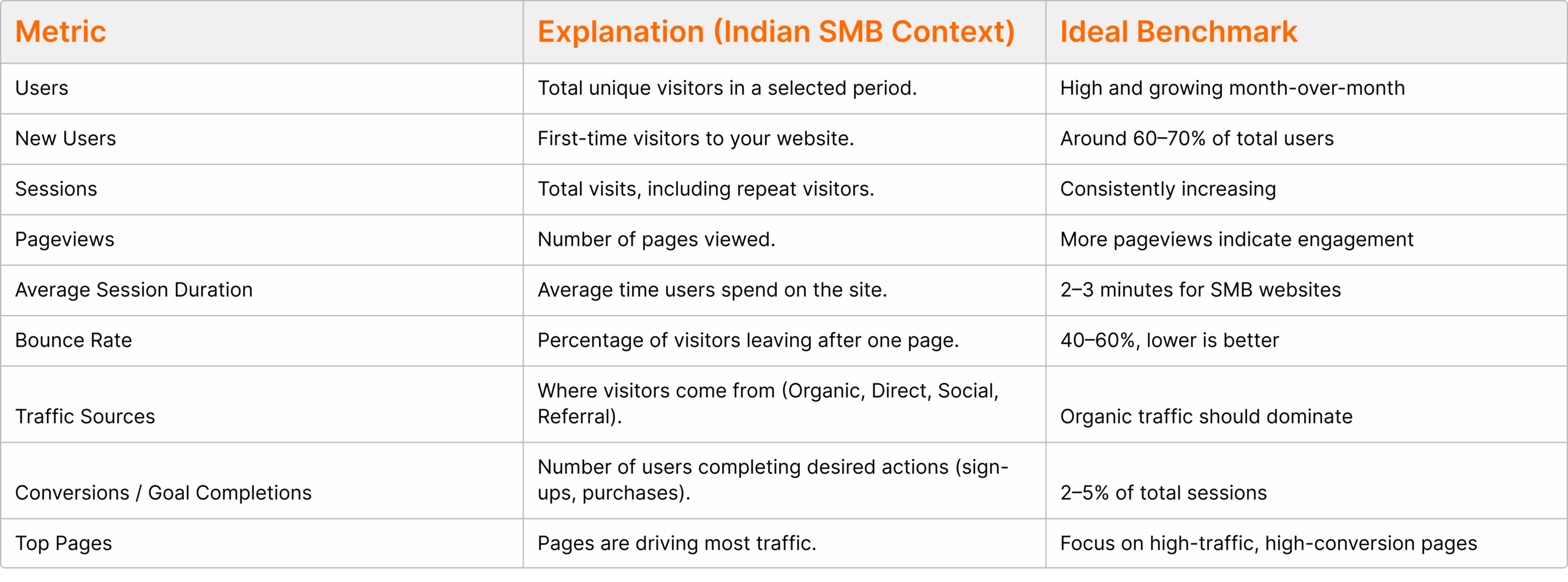
Conversion Rate
Your conversion rate quantifies your ability to convert visitors into customers- the ultimate aim of any digital marketing KPI for small business strategy.
Formula: (Number of Conversions/Total Visitors) × 100
People Also Ask: What is a good conversion rate to use in small businesses?
In most cases, a score above 3% is regarded as a good performance, but the results in different fields differ depending on the audience behaviour and the kind of industry.
Industry-Average Conversion Rates, as per CleverTap:
Speciality e-commerce: 7.6%
Software-focused websites: 4.1%
Fashion and accessories: 1.57%
Food and beverages: 1.36%
Email Marketing Metrics
Email is also very effective in India, especially with the B2B and educational products. Measure the following measurements of digital marketing:
Open Rate
The average open rate of the Indian industry is 9.05%. Pro tip: Adding Hindi subject lines to the appropriate audiences will increase open rates.
Click-Through Rate (CTR)
The average CTR among Indian audiences is 0.84%. Emails that are sent at lunch (12:30-2:00 PM) and evening commute (6-8 PM) times tend to be better.
Unsubscribe Rate
The average unsubscribe rate is 0.13%. An increase in rates means that your content is not connecting, or you are oversending mail.
Social Media KPIs
In India, social media has a special place, as platforms such as WhatsApp, Instagram, and Facebook generate substantial business.
Engagement Rate
This indicator is a measure of likes, comments and shares of total followers (usually between 2-5 per cent, as per Hootsuite).
Reach and Impressions
This is vital as far as brand awareness in the crowded Indian online market is concerned.
Social Commerce Conversion
Instagram Shopping and Facebook Marketplace are both on the rise, and document sales made directly on social sites.
Measurement of operational KPIs: Streamlining your Business Processes
Inventory Turnover Ratio
Your conversion rate quantifies your ability to convert visitors into customers- the ultimate aim of any digital marketing KPI for small business strategy.
Formula: The cost of Goods Sold/Average Inventory Value
With the high storage costs and the high value of working capital in the markets, inventory turnover is of critical importance to optimise. The turnover rate is generally low in different industries depending on several forces such as product demand, seasonal and shelf life. There is a natural, slower turnover of durable or high-value items as compared to fast-moving items that need to be replenished frequently.
It is through monitoring this ratio that businesses can maintain healthy stock levels, minimise storage costs and enhance the cash flow, which eventually facilitates smooth operations and enhances their profitability.
People Also Ask: What are the most significant KPIs to monitor when the Indian retail businesses are involved?
To maximise profitability and customer experience, Indian retailers must monitor key performance metrics other than inventory turnover, such as sales per square foot, conversion of foot traffic, average transaction value, returns rate and frequency of stock-out.
Productivity Measures of the employees
The productivity of your team is the one that influences profitability. In the case of service businesses, track revenue per employee. In the case of manufacturing, monitor units per hour or per shift.
Indian Context
As the labour laws across different states differ and the gig economy is beginning to grow, many Indian companies are currently monitoring the productivity of full-time employees and the performance of contractors individually. Revenue contribution per employee is one of the metrics that have been used as a primary measure of business efficiency and labour utilisation in all fields.
Order Fulfilment Time
Speed of delivery is an issue in the era of Amazon Prime. Monitor the time between order placement and delivery.
Rapid delivery is a significant competitive advantage in India. In metro cities, most businesses are now able to deliver across a 24-48 hours delivery period, in tier-2 cities across 48-72 hours, and in tier-3 cities across 3-5 days, which has increased customer satisfaction and competitiveness.
Customer-Focused KPIs: Creating Loyalty in a Competitive Market
Customer Retention Rate
Acquiring a new customer is more expensive than retaining an old one would be a major concern to Indian Companies whose margins are already slim.
Formula: [(Customers at the End of the Period-New Customers)/Customers at the Start of the Period) x 100].
People Also Ask: What can small businesses do to enhance customer retention in India?
In India, successful customer retention is based on tiered rewards through loyalty programs, personalised communication, and effective after-purchase services. Festive brands that give exclusive offers and create working communities within applications such as WhatsApp or Facebook promote greater involvement and devotion.
Net Promoter Score (NPS)
NPS also determines the level of customer satisfaction and the chances of them referring your business.
Formula: Percentage of Promoters (score 9-10) – Percentage of Detractors (score 0-6).
• Promoters (9-10): Customers who like your brand and will refer their friends to it.
• Passives (7) -8): Content, but not passionate customers – do not have a direct impact on the NPS.
• Detractors (0–6): Unsatisfied customers who can turn away others to use your brand.
Customer Satisfaction Score (CSAT)
CSAT is a measure of satisfaction regarding particular interactions or transactions.
Formula: (Number of Satisfied Customers/ Number of Responses) x 100
Industry-Specific KPIs
Industry-Specific KPIs
E-commerce and Retail
Cart Abandonment Rate: It amounts to about 70.22% and the main causes are unexpected shipping prices, complicated checkout, and credit card failures, according to the research of Baymard Institute.
Formula: (Carts created-purchases completed)/carts created x 100
Minimising abandonment in India
In order to mitigate cart abandonment in India, companies must provide cash on delivery, show all prices upfront, support UPI and wallets, allow guest checkout and send abandoned cart notifications via SMS or WhatsApp.
Return Rate
Percentage of orders returned. Having high returns means there were problems with product description or quality issues. The average e-commerce return rate stands at 16.9% because of a number of reasons, according to Channelwill.
Service-Based Businesses
Billable Utilisation rate
In the case of consultancies, agencies, and professional services, this is a measure of the percentage of work hours billed to customers.
Formula: (Billable Hours /Total Available Hours) x 100
The Indian service companies are supposed to be working on maximum billable utilisation because lower rates may reflect the pricing issues or project management inefficiency.
Project Completion Rate
This is the rate of projects that are completed within the budget and within the time limits, but the main focus is on ensuring that the expectations and the deadlines of the clients are met.
SaaS and Subscription Businesses
Monthly Recurring Revenue (MRR)
This is the constant and foreseeable revenue that a business acquires on a monthly basis out of the subscription-based services and helps to predict the growth and handle cash flow efficiently.
Churn Rate
Determines the percentage of customers who cancel their subscriptions in a time frame, which proves the difficulty in retention and outlines the aspects of how to increase customer satisfaction and loyalty.
What are the problems that Indian SaaS companies have in ensuring decreased churn?
Indian Market Challenges
Indian SaaS companies are especially prone to such obstacles as sensitivity to prices, preference for yearly plans because of anticipated discounts, the existence of free or cheaper options, and a low penetration rate by credit cards, which hinders the global pricing strategies.
Healthcare and Wellness
Healthcare and Wellness
Patient Retention Rate
The number of patients returning after some period of time is the measure of loyalty and quality of clinic service.
Average Revenue Per Patient
Monitors the amount of revenue per patient, informing price policies and possible upselling prospects.
Appointment No-Show Rate
Percentage of appointments scheduled that patients miss, meaning inefficient scheduling and possibly loss of revenues. No-show rates are 5-30% in the healthcare industry, as per Curogram. Minimise it with SMS notifications 24 hours prior to appointments and WhatsApp confirmation.
Healthcare and Wellness
Table Turnover rate
This is a metric that evaluates the efficiency of the restaurant in serving its tables, which determines operational efficiency and table turnover speed.
Table Turnover Rate
Total Guests Served (or Parties)/ Number of Tables.
Table Turnover Target: Restaurants are encouraged to have higher turnover of tables at lunch and dinner times since this will help them to have the maximum seating capacity and revenue potential.
Online Order Monitoring
Monitor the revenue of delivery platforms and dine-in in order to control commissions and optimise business operations and direct promotional campaigns.
Establishing Your KPI Tracking System: Real-World Application
Selecting the appropriate tools for Indian Small Businesses
Indian SMEs do face budget constraints. The following is a hierarchical response to the question of how business performance metrics can be measured:
Free Tier (₹0/month):
- Google Analytics: Monitors the traffic of the website, the activity of the users, and the performance of the online business and allows businesses to comprehend the interaction with the customers and to develop an optimal online strategy.
- Google Search Console: This tool is used to track SEO performance, indexing status and search performance to give actionable advice on how to improve the performance of organic search results.
- Facebook/Instagram Insights: Provides social media metrics, active engagement, outreach, and follower growth to assess the performance of the content and the behaviour of the audience.
- Google Sheets: Allows creating KPI dashboards manually, and simple data analysis, which will allow small businesses or team-based businesses to create customised reporting and visualisation.
- Zoho Analytics Free Plan: Offers entry-level business intelligence, such as basic dashboards and reports, which can be used to monitor important measurements with little data and users.
Budget Tier (₹500-₹2,000/month):
- Zoho Analytics: This is an all-inclusive dashboard with powerful reporting options, and it is priced in INR, which suits Indian businesses.
- Databox: This allows the use of multi-source KPI dashboards, which combine data from more than 130 platforms to track overall performance.
- Google Data Studio: Open-source visualisation platform that designs interactive and customizable reports and dashboards.
- Razorpay Dashboard: Payments and transaction analytics specifically created to meet the needs of Indian businesses, it allows one to track financial and revenue-related metrics.
Growth Tier (₹2,000-₹10,000/month):
- Zoho One: Entire business solution including CRM, analytics, marketing and operational components of end-to-end management.
- HubSpot: Offers marketing, sales, and service metrics at cost-effective startup-friendly prices and with scalable features.
- CleverTap: Provides sophisticated mobile analytics, engagement measurement, and user behaviour data to Indian companies.
- Freshworks: * Provides customer engagement tracking at reasonable prices, designed to suit Indian companies to provide customer support and retention.
People Also Ask: What are the free tools Indian small businesses can use to monitor KPIs?
In addition to Google Analytics, free tools, such as GST portal statistics, UPI dashboards, WhatsApp Business statistics, Instagram Shopping statistics, and YouTube analytics, can deliver insights and allow businesses to track sales, payments, customer feedback, social commerce data, and video marketing results.
Developing a good KPI Dashboard
1. Find Your Best KPIs:
Select 5-7 key metrics that directly influence your business goals. It is best to avoid the monitoring of everything as excessive KPIs may water down understanding and drive less value to action.
2. Choose Dashboard Format:
Daily Operational Dashboard: Track sales, web traffic, and customer requests to make prompt decisions.
Weekly Performance Dashboard: To determine the short-term performance, monitor conversion rate, marketing ROI, and cash position.
Monthly Strategic Dashboard: Determine revenue growth, profit margins and customer acquisition costs to plan in the long term.
3. Prepare Data Collection:
Coordinate all the systems required, e.g. accounting software, CRM, marketing tools, so that data will automatically flow into your dashboard to provide accurate and timely reporting.
4. Define Targets:
Provide industry standards and past performance when coming up with realistic but ambitious goals to make sure that your KPIs motivate improvement.
5. Schedule Reviews:
Perform daily quick check, weekly team and monthly deep reviews to keep track of the trends, changing strategies, as well as keeping the pace with the business goals.
Customer-Focused KPIs: Creating Loyalty in a Competitive Market
Customer Retention Rate
Industry Averages:
To compare the performance, refer to research reports published by organisations such as NASSCOM (tech), CII (manufacturing), and RAI (retail).
Your Historical Data:
Examine your own annual and monthly trends in order to see how the organisation is growing and what needs to be improved.
Competitor Analysis:
Mystery shop or research the competitors with available information to understand their strategies and their performance indicators.
Then establish goals based on the SMART model:
- Specific: Have specific, measurable objectives, like maximising the web conversion, instead of general objectives like maximising sales.
- Measurable: The success can be measured through the use of quantifiable indicators.
- Achievable: Have goals that are realistic based on the resources, team capacity, and market conditions.
- Relevant: Focus on the larger business goals to keep the goals on track.
- Time-bound: Set a specific deadline or time frame to motivate responsibility and prompt outcomes.
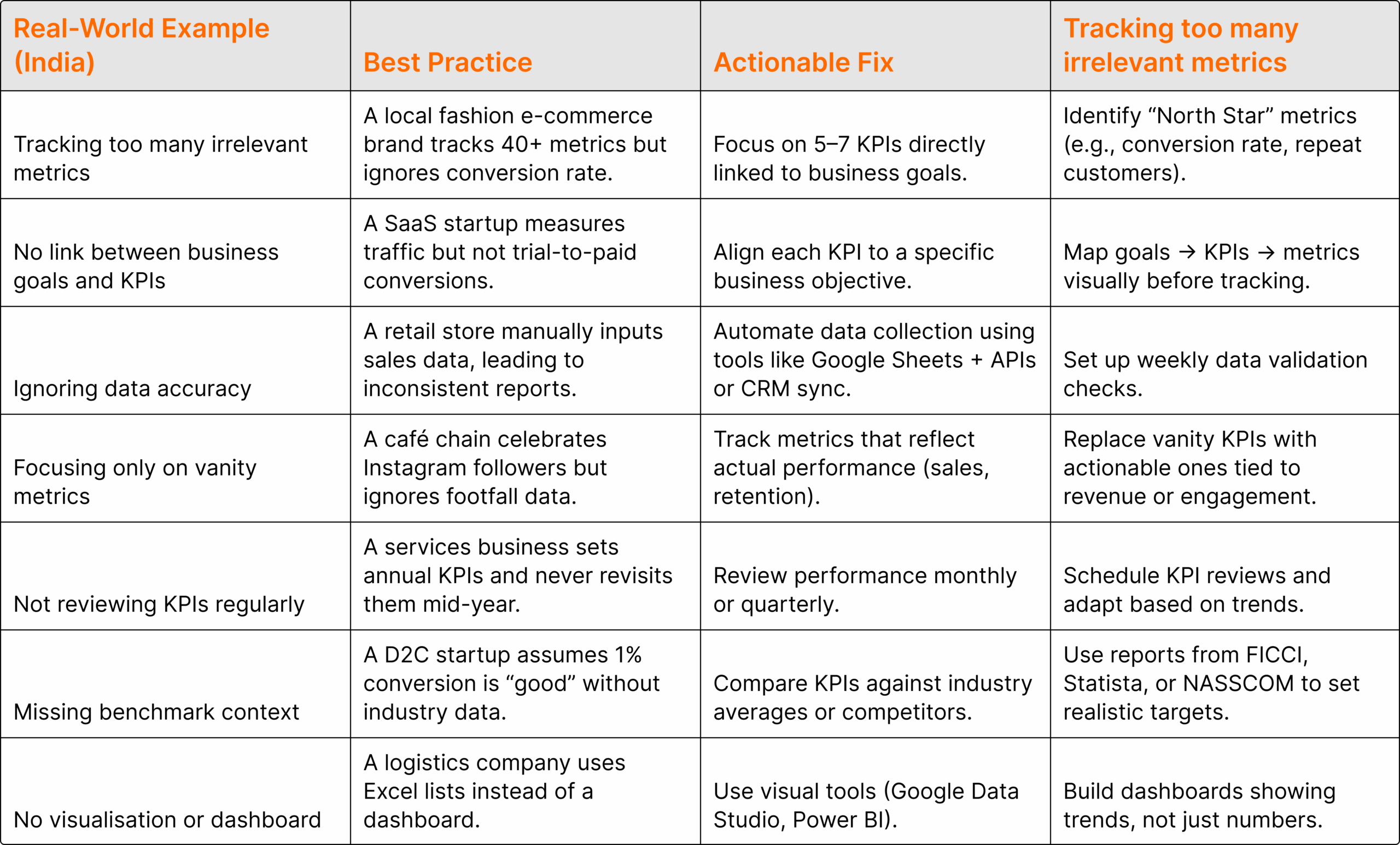
The 5 KPIs errors to avoid in Indian Small Businesses
Vanity Metrics Trap
Most businesses are following interesting-looking figures which do not contribute to business performance. The number of social media followers, page views, and email list sizes are stereotypical examples; they are good for presentations but not bill paying.
Instead, concentrate on the following: monitor social media activity and sales conversions, conversion rates versus traffic and email click-through and purchasing behaviour instead of open rates in order to gauge actual performance and performance motivation in all online activities.
Analysis Paralysis
Monitoring excessive KPIs gives rise to confusion and a lack of action. In his 8 Mantras, Harsh Mariwala emphasises focus – he tells entrepreneurs that they should have a few priorities and not be a jack of all trades in order to become sustainable, according to the report of Business Standard.
Ignoring Context
A decrease in revenue can be misleading without the perspective. Performance should always be measured against the same period last year to determine seasonality, the earlier period to determine trends and the industry benchmarks to determine the real performance of the business. Numbers are transformed into understanding through context.
Not Acting on Insights
Data is useless unless it is acted upon. In case a KPI is off track, there must be a protocol:
1. Determine the root cause:
With the help of data and understanding, determine the underlying cause of performance problems.
2. Brainstorm solutions:
Work with teams to come up with realistic, creative and outcome-focused ideas on how things can be improved.
3. Take action:
Introduce the chosen strategies in a systematic manner and with clear duties, schedules and specific success indicators.
4. Track performance:
Measure the performance constantly, compare it to the targets, and adjust the performance strategies to ensure long-term business development.
The Building Block of Data-Based Decision Making
The aspirational culture of Indian business demands that entrepreneurs have high targets that demotivate teams when the targets are not achieved. It is best to have stretch objectives that are challenging and not discouraging.
The Indian Market ROI Calculation Methods
People Also Ask: How do I compute marketing ROI in India?
The basic formula remains:
Marketing ROI = (Revenue gained due to Marketing – Marketing Cost)/Marketing Cost) × 100.
But the Indian markets demand some modifications:
Attribution Problems: Indian customers usually surf the internet to find some information on the products, but make their purchases offline, making it difficult to measure their performance.
Addressing Attribution Problems:
- Monitor offline purchases with special promo codes or coupons that are associated with online campaigns.
- Combine CRM and POS systems to have a comprehensive picture of customer behaviour.
Blog: The Role of a Sales Consultant in Modern Organisations: Responsibilities, Functions, and Strategic Value,
Section: CRM Implementation and Sales Tool Integration
- Gather in-store feedback to determine how customers learned of the product on the internet.
- Compare trends of online interactions with the offline purchase in order to optimise marketing techniques.
Delayed Conversion Indian B2B sales cycles have a normal duration of 3-6 months.
Apply multi-touch attribution models, which receive several attributions.
Channel-Specific ROI in India
Google Ads:
The average ROI that Google Ads brings in India is 2:1 to 4:1, which refers to 176 earned on 88 as the initial investment, as per Enhencer. Tier-1 cities have better performance, and Hindi keywords tend to be cheaper but efficient.
Facebook/Instagram Ads:
Facebook advertisements provide an average ROAS of 3.8:1, whereas Instagram provides 4.2:1, according to the research of SocialPulseStats. The two are both effective in B2C marketing, and 88 per cent of marketers indicate that video content is more engaging and profitable, as per the research of VisualBest.
Content Marketing:
The long-term ROI of content marketing is 5:1 to 13:1, according to HumansWithAI. The outcomes are realised 6-12 months later in terms of the growth of the brand and organic presence of SEO-optimised English and Hindi content.
WhatsApp Marketing:
The ROI of WhatsApp marketing in India is between 200 per cent and 800 per cent, as per Bird. It has high open rates of 90%+ that qualify it as a repeat purchase, customer retention and establishment of direct and personal communication with buyers, according to the research of Insider.
Takeaway
Get it today: Get the checklist and make it easy to track KPIs to grow the business in measurable ways.
Conclusion: Data to Action
Measuring KPI for small business is not about submerging in the numbers to measure success, but rather about achieving clarity. The business metrics to track should make your way clear, rather than clouding.
Do not forget the following principles:
- Keep It Simple: initiate with 5-7 key KPIs to help prevent being overwhelmed and keep a clear focus on what is actually important.
- Be Consistent: Monitor these KPIs on a regular basis; regular monitoring is more important than having a perfect set of data.
- Take Action: Act not only to report with KPI insights but rather to use the insight to improve business outcomes.
- Be Adaptable: Change KPIs with the time as business objectives, strategies or market environments change.
- Accessible: Disclose KPI findings to your team to promote transparency, cross-functional collaboration, and accountability.
Digital marketing KPIs and marketing analytics for small businesses are no longer a luxury for Indian small businesses; it is a survival tactic in the fast-changing market. It is the businesses that integrate the intuition of the entrepreneur with data-driven decision-making that will be successful in the next decade of Indian growth.
Start today. Select your five important KPIs for small business in India to achieve success. Set up basic tracking. Review weekly. Adjust quarterly. In half a year, you will know what your competitor does not know- and that is your competitive edge.
Guesswork does not do your business a favour. Endow it with the virtue of clarity by systematic KPI tracking.
Frequently Asked Questions
What are the 5 KPIs that are most important to a small business?
Small businesses have the most key KPIs, namely
Revenue Growth rate
Gross Profit Margin
Customer Acquisition Cost
Cash flow
Customer Retention rate
These indicators give you an overall picture of your financial status, the effectiveness of your marketing, and the retention of customers.
What should be my frequency of checking my business KPIs?
Consider operational KPIs on a day-to-weekly basis, marketing on a weekly or bi-weekly basis, and strategic financial on a monthly basis. Deep dives that are done quarterly assist in determining the trends that should be considered on a long-term basis and in making strategic decisions.
Is it possible to monitor KPIs without costly software?
Absolutely. Begin with Google Analytics (free), Google Sheets to generate dashboards and what your accounting software already offers as its built-in reporting. These free tools have been used by many Indian businesses to track KPIs for years before they upgrade the tools to paid versions.
What is the difference between leading and lagging indicators?
Leading indicators are indicators of future performance (such as traffic to the site predicting future sales), whereas lagging indicators are indicators of previous performance (such as the revenue made last month). Strike a balance between the two to have total business intelligence.
What makes me know whether my KPIs are good or bad?
Compare your KPIs to three standards: your prior performance (are you getting better?), industry standards (how do you fare against your competitors?), and your goals (are you achieving objectives?). The importance is in context rather than absolute numbers.